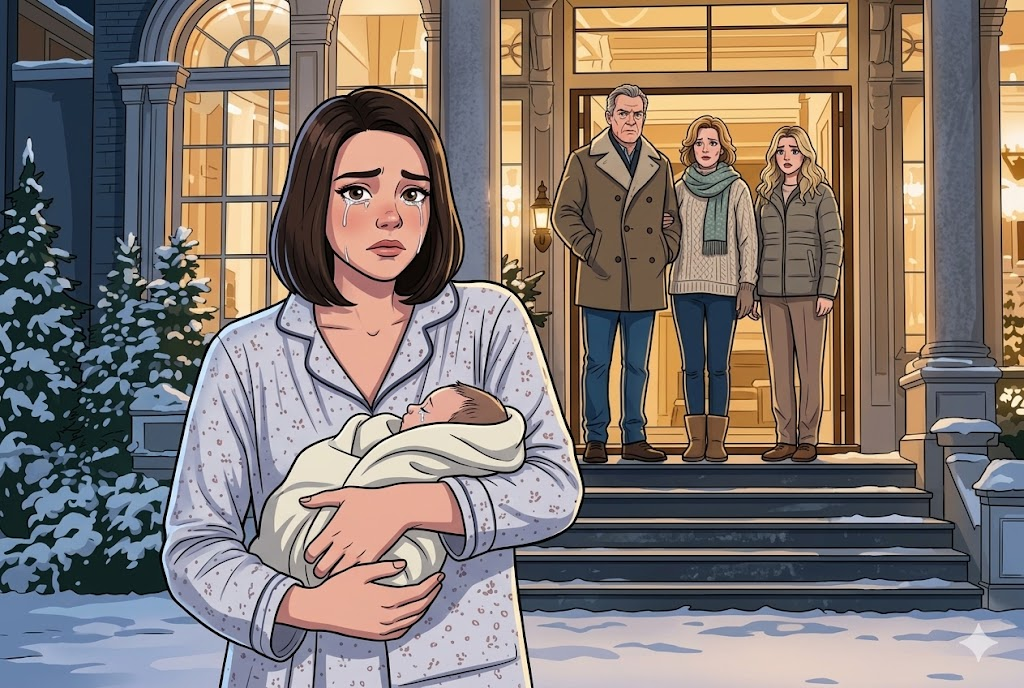
The perfect secretary who used to smile at me in Bruno’s office looked like she had run through three nightmares before reaching my door.
“Mariana,” she whispered.
My hand stayed on the door.
“What are you doing here?”
She looked over her shoulder toward the street.
Then back at me.
“Please. I know you hate me. You have every right. But I need to come in.”
I laughed once.
Not because anything was funny.
Because the situation was so absurd my body did not know what else to do.
“You came to my house with a baby after sleeping with my husband, and you want me to invite you in?”
Her face crumpled.
“I didn’t come because of Bruno.”
My blood went colder.
I looked at the baby again.
“Whose child is that?”
Carolina’s mouth trembled.
Before she could answer, the baby stirred and made a soft little sound.
Not crying.
Just breathing.
That sound went through me like a needle.
Because I had once imagined that sound in this house.
For years.
A baby in the kitchen.
A baby asleep against Bruno’s chest.
A baby whose tiny socks I would wash and fold and lose under the sofa.
But after three failed treatments, one miscarriage, and a doctor who said my body needed “rest from disappointment,” Bruno had stopped wanting to talk about children.
He said we should enjoy our marriage.
He said maybe motherhood was not for everyone.
He said it gently.
With forehead kisses.
Now there was a baby on my doorstep, and the woman holding her looked terrified of the man who had once comforted me through my own empty crib.
“Come in,” I said.
The words surprised both of us.
Carolina stepped inside carefully, as if the floor might accuse her.
I closed the door and locked it.
Twice.
Just like Bruno always did.
The house was too quiet.
The broken glass still glittered on the table.
Bruno’s phone lay on the floor with her message still glowing.
I already did what you asked me to do. Now tell your wife the truth.
I pointed at it.
“What truth?”
Carolina stared at the phone.
Her face twisted with pain.
“He didn’t tell you.”
“No. Bruno has been busy lying about strategy meetings.”
She flinched.
“I know what this looks like.”
“Do you?”
“Yes.”
“Good. Then start talking before I decide to throw both you and your yellow blanket out.”
The baby made another little sound.
I hated myself immediately for saying it.
Carolina held the child closer.
“Her name is Lucía.”
The name landed softly.
Too softly for the room it entered.
I crossed my arms.
“Is she Bruno’s?”
Carolina looked at me.
For one strange second, she looked almost sorry for me.
Then she said, “No.”
I blinked.
“No?”
“No.”
My eyes moved to the baby.
Then back to her.
“Then why are you here?”
Carolina swallowed.
“Because Bruno told me to bring her.”
The room tilted.
“What?”
“He said today was the day. He said you already knew something was wrong. He said after he told you the truth, I should bring the baby here.”
I stared at her.
My mouth was dry.
“What truth?”
Carolina lowered her voice.
“Mariana… Lucía is not mine.”
The words did not make sense.
I looked at the baby.
Then at Carolina’s empty hands except for the blanket.
“What do you mean, she’s not yours?”
“I carried her. I gave birth to her. But she’s not genetically mine.”
A ringing sound began in my ears.
Far away.
High and thin.
I sat down slowly on the edge of the sofa.
“Say that again.”
Carolina’s tears spilled over.
“She’s yours.”
My body went completely still.
The air left the room.
The baby made a small sigh in her sleep.
I looked at her.
At the curve of her cheek.
The dark hair at her forehead.
The shape of her tiny mouth.
My heart gave one violent, impossible beat.
“No,” I whispered.
Carolina stepped closer.
“I’m sorry.”
“No.”
“Mariana—”
“No.”
The word came out sharper this time.
The baby startled.
Carolina immediately rocked her.
“Shh, mi vida, shh…”
I stood too fast.
“Don’t call her that.”
Carolina froze.
I had not known where the words came from until they were already in the room.
My hands were shaking.
“What are you saying? What are you accusing him of?”
Carolina reached into the diaper bag hanging from her shoulder.
Slowly, carefully, she pulled out a folder.
Not a small folder.
A thick one.
Medical papers.
Lab reports.
Consent forms.
Clinic invoices.
Photos.
And on the first page, printed clearly beneath a fertility clinic letterhead, was my full name.
Mariana Alejandra Torres.
My knees weakened.
I grabbed the back of the chair.
Carolina placed the folder on the coffee table beside Bruno’s phone.
“I didn’t know at first,” she said quickly. “I swear I didn’t know. Bruno told me you and he had embryos stored from your treatments. He said you were too emotionally fragile after the miscarriage to carry another pregnancy. He said you had agreed to a surrogate, but you couldn’t be involved until after the birth because it would break you.”
My fingers went numb.
Embryos.
My treatments.
The miscarriage.
Bruno had sat beside me through every injection, every scan, every blood test, every bill.
He had held my hand when the doctor said there were embryos we could preserve.
He had told me he would take care of everything.
I had been too grief-stricken to read every document.
Too tired.
Too trusting.
Carolina kept speaking, her voice shaking.
“He told me it was a private arrangement. That you didn’t want your family to know. That you had signed. That after the baby was born, he would explain everything gently and bring her home.”
I looked at the folder.
I could not touch it.
If I touched it, it would become real.
“How old is she?” I asked.
“Six weeks.”
Six weeks.
For six weeks, somewhere in this city, a baby who might be mine had existed while I was washing Bruno’s shirts and wondering why he no longer touched me with tenderness.
I turned toward the staircase.
The guest bathroom door was open.
The window still stood ajar.
“Where is Bruno?”
Carolina’s lips parted.
“What?”
“He was here when I left. Sick. In the bathroom. When I came back, the front door was open, his phone was on the floor, and he was gone. Where is he?”
Carolina’s face changed.
“I don’t know.”
“You don’t know?”
“He was supposed to call me. He said he would tell you everything first. Then I got his message to come.”
I picked up Bruno’s phone.
It was unlocked.
Of course it was.
Maybe he had dropped it before leaving.
Maybe someone else had.
The message from Carolina was not the last one.
There was another thread open beneath it.
A number saved only as M.
The last message had been sent at 1:03 p.m.
You failed to control the secretary. We are taking over now.
My blood went cold.
I showed Carolina.
She went pale.
“Who is M?”
“I don’t know.”
“Don’t lie to me.”
“I’m not.”
The baby began to fuss.
Carolina rocked her with practiced tenderness.
That tenderness hurt more than the papers.
Because it was real.
Whatever she had done, whatever she had believed, she had held that baby through six weeks of midnight hunger and morning sunlight.
Then I noticed the pharmacy bag again in my mind.
The one upstairs.
With my name written on it.
I grabbed the folder and ran upstairs.
Carolina followed me with the baby.
The guest bathroom smelled awful.
Humiliatingly awful.
But beneath that was another smell.
Sharp.
Chemical.
On the sink was the white pharmacy bag.
My name was written on it in black marker.
Inside were three things.
A box of postpartum medication.
A hospital bracelet.
And a small plastic bottle labeled with my name.
Not current.
Old.
From the fertility clinic.
A medication used during the embryo retrieval process.
My hand shook as I picked up the bracelet.
It did not have my name on it.
It had Lucía’s.
Baby Girl Torres-Rivas.
Torres.
My last name.
Rivas.
Bruno’s.
A sound came out of me.
Not a cry.
Not a scream.
Something deeper.
Something a body makes when the truth is too large for language.
Carolina stood in the doorway.
“I asked him why the baby’s hospital band had your name,” she whispered. “He said it was legal paperwork. He said you were the intended mother. I believed him until last week.”
“What happened last week?”
Carolina looked down.
“I found messages.”
“From M?”
She nodded.
“They wanted Bruno to transfer legal custody. Not to you. To someone else.”
My head snapped up.
“What?”
Carolina’s voice trembled.
“They said the baby was worth more than he understood.”
The bathroom seemed to close around me.
I gripped the sink.
Worth.
They used that word about a baby.
My baby.
Maybe my baby.
“What else?”
Carolina swallowed.
“Bruno told them no. He said he only agreed to the surrogacy lie because he thought he could manage everything after the birth. He said he wanted to bring the baby here and force you to forgive him.”
I let out a broken laugh.
“That sounds like Bruno.”
“He said once you saw her, you would accept anything.”
My stomach turned.
Accept the betrayal.
Accept Carolina.
Accept the lie.
Accept that my own child had been grown in another woman’s body without me knowing.
Because love would make me easy to control.
I looked at Lucía.
Her eyes were open now.
Dark.
Unfocused.
Searching.
The world narrowed to those tiny eyes.
Then the doorbell rang again.
We all froze.
Once.
Twice.
Three times.
Carolina backed away from the hallway.
“Don’t open it.”
I looked at the security camera through my phone.
Two men stood outside.
Not police.
Not neighbors.
Dark suits.
Blank faces.
One looked directly into the camera and smiled.
My skin crawled.
Then my phone rang.
Unknown number.
I answered without speaking.
A man’s voice came through.
“Mrs. Torres, we need to collect the child.”
Carolina made a choking sound.
I held up a hand to silence her.
“Who is this?”
“A representative of the legal party responsible for the arrangement.”
“The arrangement?”
“The child was not supposed to be delivered to you yet.”
My eyes moved to the baby.
Lucía blinked slowly, innocent of the fact that men outside my door were discussing her like a package.
I lowered my voice.
“If you think I’m handing a baby to strangers, you’re insane.”
The man sighed.
“Your husband created complications. We are here to resolve them.”
“Where is Bruno?”
A pause.
Too long.
“Unavailable.”
Carolina began crying silently.
I walked into the bedroom and opened the drawer where Bruno used to keep an old pistol he insisted was for protection.
Empty.
Of course.
I came back into the hallway and said into the phone, “Leave my property.”
“This can be done politely.”
“No.”
“Mrs. Torres—”
“I said leave.”
Then I hung up and called the police.
My voice did not shake when I gave the address.
It shook afterward.
Carolina stood in the upstairs hallway with Lucía against her chest.
“What do we do?”
I looked at her.
“I don’t trust you.”
“I know.”
“But I trust them less.”
She nodded, tears streaming.
“Tell me where to go.”
We went into the master bedroom and locked the door.
Then I dragged the dresser in front of it while Carolina sat on the bed, whispering to Lucía.
From downstairs came a loud knock.
Then another.
The men did not shout.
That frightened me more.
They were patient.
Patient men are worse than angry ones.
My phone buzzed.
My cousin.
I answered instantly.
“Mariana? I was just about to call. I found something in those bank statements.”
“Lucía,” I said.
“What?”
“The baby. Carolina is here. She says the baby is genetically mine. There are men outside trying to take her. Bruno is gone.”
Silence.
Then my cousin’s voice changed completely.
“Lock yourself somewhere. Police?”
“Called.”
“I’m coming with two officers I know. Do not open the door. Do not let Carolina leave with the child. And Mariana?”
“Yes?”
“If that baby is connected to your embryos, this is not just infidelity. This is reproductive fraud, medical fraud, possibly trafficking.”
Trafficking.
The word landed like ice water.
I looked at Lucía.
She was beginning to cry softly now.
Hungry.
Scared.
Alive.
“Come fast,” I whispered.
Downstairs, glass shattered.
Carolina screamed.
I dropped the phone.
The men had broken a window.
The house alarm screamed to life.
Lucía began wailing.
I grabbed the heavy lamp from the bedside table.
Carolina stood, holding the baby with one arm and clutching a blanket with the other.
“Bathroom,” I said.
We locked ourselves inside the master bathroom.
I wedged a chair under the handle.
Footsteps moved through the house.
Slow.
Methodical.
One man called out, almost politely.
“Mrs. Torres, this is unnecessary.”
My hands tightened around the lamp.
Carolina sank onto the floor, holding Lucía to her chest.
“I’m sorry,” she whispered over and over. “I’m so sorry.”
I wanted to hate her.
I did hate her.
But hatred was a luxury for people not hiding in a bathroom with a stolen baby and strangers downstairs.
“Later,” I said.
“What?”
“You can be sorry later. Right now, keep her quiet.”
Carolina nodded and began feeding Lucía with a bottle from the diaper bag.
The baby’s cries softened.
The footsteps came upstairs.
One step.
Then another.
The house that had once held my marriage now held the sound of men coming for a child.
A voice outside the bedroom door.
“She’s in here.”
The door handle rattled.
The dresser held.
For now.
Then came the sound of wood cracking.
I lifted the lamp.
Carolina closed her eyes.
Then, suddenly, sirens.
Not far away.
Close.
The footsteps stopped.
A man cursed.
The bedroom door crashed open.
I heard shouting downstairs.
“Police! Hands where I can see them!”
More footsteps.
A struggle.
A heavy thud.
Carolina sobbed with relief.
I did not move until my cousin’s voice called from the bedroom.
“Mariana! It’s me!”
Only then did I remove the chair.
When I opened the bathroom door, my cousin stood there in a navy suit, hair wild, face pale with fury.
Behind her were two uniformed officers.
Downstairs, the two men were being handcuffed in my living room.
The broken glass on the floor glittered like teeth.
My cousin looked at Carolina.
Then at the baby.
Then at me.
“Is this her?”
I could not speak.
Carolina nodded.
The officer nearest us softened his voice.
“Ma’am, we need everyone downstairs, but the baby is safe.”
Safe.
Again, that word felt too fragile to touch.
We spent the next seven hours in statements.
Police.
Child protection.
Medical questions.
Names.
Dates.
Clinic records.
Bruno’s messages.
Carolina’s documents.
The pharmacy bag.
The hospital bracelet.
The men outside.
Their IDs were fake.
Their car was rented.
One had a burner phone with Bruno’s number in it.
Bruno himself remained missing.
By midnight, Lucía was asleep in a portable crib a female officer had brought from social services.
Carolina sat at the kitchen table, wrapped in a blanket, giving her statement.
I sat across from her.
Not beside her.
Across.
There were things I still could not forgive.
Maybe would never forgive.
But I listened.
She told the full story.
Bruno had approached her at work with kindness at first.
Then favors.
Then compliments.
Then the affair.
He told her his marriage was empty.
He told her I was cold.
He told her he wanted a child desperately but I had “given up.”
Then came the proposal.
Carry an embryo.
Help him “save his family.”
He would pay her.
He would take care of her.
He would explain everything later.
Carolina had debts.
A sick father.
A younger brother in school.
Bruno knew all of that.
“He chose me because I was desperate,” she whispered.
My jaw tightened.
That did not absolve her.
But it explained the shape of the trap.
“Did you sign papers?”
“Yes.”
“With whose lawyer?”
“Bruno’s.”
Of course.
“Did you ever meet anyone from the clinic alone?”
“No. Bruno came to every appointment.”
My cousin, listening from the counter, cursed under her breath.
“What made you realize something was wrong?” she asked.
Carolina looked at Lucía sleeping in the crib.
“When she was born, they took her away for almost an hour. Bruno argued with someone in the hallway. I heard him say, ‘She is Mariana’s, and I decide when she knows.’ Then another man said, ‘That was not the agreement.’”
My blood turned cold.
Carolina continued.
“I demanded the baby back. Bruno told me I was emotional. But the nurse gave her to me because I was the one who delivered her. After that, Bruno kept delaying. He said he needed the right time to bring her here.”
She looked at me.
“Last night, I found messages about transferring the baby to a private adoption contact. I told Bruno I would go to the police. He panicked. He said he would tell you today.”
I thought of the coffee.
The laxative.
His scream in the garage.
Some absurd part of me almost laughed.
I had thought I was ruining his romantic morning.
Instead, I had disrupted whatever plan had already been moving beneath our house.
“Why did he run?” I whispered.
My cousin looked at Bruno’s phone.
“Maybe the men arrived before you did. Maybe he escaped through the bathroom window.”
“And left his phone?”
“Panic makes people stupid.”
I thought of Bruno doubled over, sweating, furious.
For once, his body had betrayed him at the exact moment his lies collapsed.
The next morning, the DNA process began.
Emergency petition.
Court order.
Child protection involvement.
Medical review.
The fertility clinic denied everything at first.
Then my cousin arrived with police and document preservation orders.
Their attitude changed.
By afternoon, we had enough to prove that embryo records had been altered.
By evening, a nurse from the clinic called my cousin privately.
“I knew something was wrong,” the nurse said. “But Dr. Larios told us the wife had signed everything.”
The wife.
Me.
I had signed nothing.
At least nothing knowingly.
But in the file, there were consent forms with my name.
My signature.
Not mine.
My initials.
Not mine.
A copy of my passport.
A scanned ID from Bruno’s files.
All used to build a lie around my body.
My grief.
My embryos.
My child.
Lucía remained in temporary protective custody, but because Carolina had brought her to me and cooperated fully, she was allowed supervised contact.
So was I.
The first time a social worker placed Lucía in my arms, I almost collapsed.
She smelled like milk and baby shampoo.
Her head fit beneath my chin.
Her tiny hand opened against my blouse.
I looked down at her and saw, or imagined I saw, my mother’s mouth.
My own brow.
Bruno’s dark hair.
I wanted to love her immediately.
I did love her immediately.
But love arrived tangled with horror.
There is no clean way to become a mother through a crime.
Carolina sat across the room, crying quietly.
I did not comfort her.
Not then.
Lucía blinked up at me.
Her dark eyes unfocused but calm.
“Hello,” I whispered.
My voice broke.
“I think I’m your mother.”
The DNA results came five days later.
I opened them in my cousin’s office.
Carolina was there.
So was the social worker.
The report confirmed it.
Lucía was my biological daughter.
Bruno was her biological father.
Carolina was not genetically related.
The room blurred.
My cousin put a hand on my shoulder.
Carolina covered her face and sobbed.
I read the words again.
Probability of maternity: 99.999%.
My daughter.
My stolen daughter.
My hidden daughter.
My six-week-old baby who had almost been taken by strangers because the man I married believed women, wombs, babies, and truth were all things he could arrange around his convenience.
Bruno was arrested two days later at a cheap motel outside Puebla.
He had shaved his beard.
Dyed his hair badly.
Used cash.
He looked ridiculous in the police photo.
Smaller than I remembered.
Maybe he had always been small, and I had lent him height by loving him.
When he called from holding, I almost did not answer.
My cousin said I did not have to.
But I wanted to hear his voice without believing it.
“Mariana,” he said.
He sounded exhausted.
“Where is Lucía?” I asked.
Silence.
Then softly, “So Carolina told you.”
“She told me enough.”
“I was going to explain.”
I laughed.
That laugh came from somewhere ugly and necessary.
“When? After selling her? After bringing her here? After letting me thank you for making me a mother?”
“I was not selling her.”
“No?”
“No. It got complicated.”
“Babies are not business deals, Bruno.”
He inhaled shakily.
“I made mistakes.”
“You created a child behind my back using embryos I thought were safely stored. You deceived a desperate woman into carrying her. You forged my consent. You hid my daughter for six weeks. Then men came to my house to collect her.”
His voice lowered.
“I never meant for them to go to the house.”
That was not a denial.
My blood chilled.
“Who are they?”
No answer.
“Who is M?”
Still nothing.
“Bruno.”
His voice cracked.
“I owed money.”
The floor seemed to tilt.
“What?”
“Investments went bad. Loans. Men you don’t just ignore.”
I closed my eyes.
The expensive dinners.
The missing savings.
The strange withdrawals.
The hotel rooms.
The perfume.
All of it had looked like an affair.
But beneath the affair was debt.
And beneath the debt was my daughter.
“They found out about the embryos,” he whispered. “They knew a private adoption network. They said people would pay.”
I pressed the phone so hard against my ear it hurt.
“You were going to sell our child?”
“No!” he cried. “I was trying to fix it. I was going to bring her to you. Once you saw her, you would help me. You would pay anything.”
There it was.
The real confession.
Not love.
Not regret.
Calculation.
He thought my motherhood would become his ransom note.
I hung up.
The trial became news.
Of course it did.
A stolen embryo.
A secretary surrogate.
A missing husband.
Men breaking into a house in Del Valle.
A baby almost sold through a private network.
Reporters camped outside.
Neighbors stared.
Women online argued about Carolina.
Some called her a victim.
Some called her a homewrecker.
Both things could be true in different proportions.
That was the part people hated.
They wanted clean roles.
Villain.
Victim.
Mother.
Mistress.
But real life is more uncomfortable.
Carolina had betrayed me.
She had also been exploited.
She had carried my daughter safely.
She had brought Lucía to my door instead of handing her to the men.
I did not know what forgiveness would look like.
But I knew the truth required all its pieces.
In court, Bruno tried to say I had agreed to everything and later “forgot” because of emotional distress.
That lasted until my cousin played the messages.
Until the clinic nurse testified.
Until Carolina testified.
Until the financial records showed debts, payments, forged consents, and contact with illegal brokers.
Until Bruno’s own call from jail was entered.
“You would pay anything.”
The prosecutor repeated that line three times.
Each time, Bruno looked smaller.
Carolina testified for two days.
She cried through most of it.
At one point, Bruno’s lawyer tried to paint her as a jealous mistress who had invented the baby scheme after being rejected.
Carolina looked at him and said, “I loved a man who lied to me. That made me foolish. It did not make those documents fake.”
I looked at her then.
Really looked.
For the first time without only hatred.
She was twenty-six.
Tired.
Ashamed.
Still lactating for a baby she no longer had in her arms every night.
A woman who had made terrible choices and then, when the final choice came, had chosen to bring Lucía to me.
That mattered.
Not enough to erase.
Enough to remember.
Bruno was convicted on multiple charges.
Fraud.
Forgery.
Reproductive coercion.
Child trafficking conspiracy.
Assault-related charges tied to the men who broke into my house.
The clinic doctor lost his license and faced separate proceedings.
The private adoption network cracked open wider than anyone expected.
Several babies were found.
Several women came forward.
Several families learned truths that broke and remade them.
Lucía, without knowing it, had pulled a thread that unraveled an entire hidden industry.
She was nine months old when the custody order became final.
I became her legal mother.
Sole guardian.
No contact with Bruno.
Carolina requested one thing through the court.
Not custody.
Not rights.
A letter.
One letter placed in Lucía’s file for when she was old enough.
I read it first.
It began:
Dear Lucía, I carried you before I understood the truth. When I learned enough to be afraid, I chose the door that led to your mother. I am sorry for every choice that made your beginning painful. I hope one day you know that even inside a lie, you were loved by more than one woman.
I cried for an hour after reading it.
Then I approved it.
Carolina moved away from Mexico City.
She sent updates through my cousin for a while.
Her father recovered.
Her brother graduated.
She never contacted me directly.
I appreciated that.
Bruno sent letters from prison.
I did not read them.
My cousin kept them in a file.
Evidence, if needed.
Trash, emotionally.
Lucía grew.
She laughed before she crawled.
She hated peas.
She loved music.
She had a stubborn little frown that looked unfortunately like Bruno, but I learned not to fear it.
Children are not their fathers’ crimes.
One day, when she was two, she found the black coffee cup in the back of a cabinet.
Best husband.
I had forgotten to throw it away.
She banged it against the floor until the handle broke.
I laughed so hard I cried.
Then I threw it away.
For a long time, I blamed myself.
For not reading every fertility form.
For trusting Bruno.
For turning my suspicion into a laxative joke instead of going to the police sooner.
For not knowing my daughter existed.
Therapy helped.
So did motherhood.
Babies are very rude to guilt.
They need bottles, diapers, songs, clean blankets, vaccines, sleep routines, and someone willing to look ridiculous making airplane noises with mashed banana.
Guilt can wait its turn.
Years passed.
Lucía learned to walk in the living room where men had once broken glass.
I replaced the window.
I replaced the table.
I replaced the locks.
I replaced my last name.
Back to Torres.
Mine.
My mother’s.
One evening, when Lucía was four, she asked why there were only pictures of her as a baby after she was already big enough to smile.
I sat very still.
The question had come earlier than I expected.
Children find locked doors by accident.
I touched her hair.
“Because when you were very tiny, Mommy didn’t know where you were yet.”
She frowned.
“Was I lost?”
I swallowed.
“A little.”
“Did you find me?”
I looked at her.
At those dark eyes.
At the child who had been hidden from me, carried by another woman, nearly taken by strangers, and delivered to my door wrapped in yellow.
“Yes,” I said. “You came home.”
She seemed satisfied.
For now.
One day, she will know more.
Not everything at once.
Not before her heart can hold it.
But she will know.
I will tell her that she was not born from shame.
She was born through a crime, yes.
Through lies, yes.
Through betrayal, yes.
But she herself was never the betrayal.
She was the truth everyone tried to move around.
The living proof.
The heartbeat that refused to remain hidden.
I will tell her that a young woman named Carolina made terrible mistakes but carried her safely and chose not to hand her to danger.
I will tell her that her father broke laws, vows, and bodies of trust, and that he faced consequences.
I will tell her that motherhood did not begin for me in a hospital room.
It began at my own front door, when a woman I hated stood there pale and shaking with a baby in a yellow blanket.
It began in terror.
It became love.
Sometimes I still think about that morning.
The perfume.
The coffee.
The little bottle in my hand.
Bruno swallowing without gratitude.
His scream from the garage.
The absurd satisfaction I felt when he ran to the bathroom.
I thought I had made him swallow his shame.
I had no idea shame was only the smallest thing in that house.
Behind it were forged papers.
Stolen embryos.
Debt.
A baby hidden in another woman’s arms.
Men waiting outside doors.
A life I had dreamed of, born in secret while I was mourning it.
I once believed betrayal was the worst thing a husband could do.
I was wrong.
Betrayal can break a marriage.
But stealing a woman’s chance to know her own child?
That breaks the world.
And yet, somehow, from that broken world came Lucía.
My daughter.
My miracle with dark hair and a laugh like bells.
The child who taught me that truth can arrive wrapped in the arms of someone who hurt you.
That love can begin with terror.
That motherhood is not always clean, but it can still be sacred.
And that sometimes, the doorbell you dread most is the one that brings your life back.
Bruno left that morning perfumed for his lover.
He thought he was going to choose between two women.
He thought he was the secret-keeper.
The father.
The man in control.
But by nightfall, his phone was on the floor, his lies were in a folder, police were in my living room, and the baby he tried to use as leverage was asleep in my arms.
Just two days after our wedding, I refused to bring dinner to my sister-in-law while she sat glued to the television. My husband exploded, screamed at me, and slapped me across the face. Without thinking twice, I shoved the food away, and that single moment changed everything.
Two days after my wedding, I learned that a marriage could transform before the flowers from the reception tables had even begun to wilt.
My name is Emily Harper, and I married Daniel Whitmore on a bright Saturday afternoon in Portland, Oregon. He was thirty-two, polished, charming, the kind of man who remembered servers’ names and opened car doors when people were watching. His younger sister, Vanessa, was twenty-seven and had been living with him “temporarily” for nearly a year.
Before the wedding, Daniel told me Vanessa was fragile. “She’s been through a lot,” he said. “Just be patient with her.”
On Monday evening, I came home from work with sore feet, still wearing the blouse I had worn to orientation at my new job. Daniel had texted me a grocery list during lunch, then called twice to remind me that Vanessa liked her mashed potatoes “extra buttery.” When I opened the front door, the television was blaring some reality show. Vanessa was curled up on the couch beneath a blanket, scrolling through her phone while laughing at the screen.
The kitchen sink was full. Empty soda cans covered the coffee table. Daniel stood near the counter with his arms folded, as if he had been waiting for a servant.
“You’re late,” he said.
“It’s 6:20,” I replied carefully. “Traffic was bad.”
Vanessa did not look away from the TV. “I’m starving.”
I cooked anyway. Chicken, potatoes, green beans. I plated everything and set two dishes on the dining table. Daniel sat down. Vanessa stayed on the couch, her eyes fixed on the screen.
“Dinner’s ready,” I said.
“Bring it here,” Vanessa said, waving one hand without turning around.
I stared at her. “You can eat at the table.”
The room went quiet except for the laughter coming from the television.
Daniel’s chair scraped back. “What did you just say?”
“I said she can eat at the table,” I answered. “I’m not serving dinner to someone glued to the TV like I’m hired help.”
Vanessa finally looked over, her face twisting. “Wow. Two days in and she already thinks she owns the place.”
Daniel crossed the room so quickly that I stepped back on instinct.
“Apologize,” he snapped.
“No.”
His hand struck my face before I even understood he had moved. A sharp burst of pain exploded across my cheek. My ear rang. For one second, everything froze—the blue and white flashes from the television, Vanessa’s mouth slightly open, Daniel breathing hard in front of me.
Then something inside me snapped cleanly in two.
Without hesitation, I shoved the food away with force. Plates crashed onto the floor. Chicken slid across the tile. The bowl of green beans shattered near Daniel’s shoes.
I looked him directly in the eyes and said, “You just made the biggest mistake of your life.”
PART 2
Daniel stared at the broken dishes as though they offended him more than the slap had offended me.
For years afterward, I would remember that moment in fragments: the sting burning across my cheek, the smell of butter and garlic, Vanessa clutching the blanket against her chest, Daniel’s face shifting from rage to shock when he realized I was not crying.
He expected tears. He expected begging. He expected me to lower my eyes and apologize for embarrassing him in his own house.
Instead, I reached for my phone.
Daniel lunged toward me. “What are you doing?”
I stepped back and lifted the phone high. “Calling the police.”
Vanessa jumped up. “Are you insane? It was one slap.”
“One slap two days after the wedding,” I said, my voice shaking but clear. “That’s not a mistake. That’s a preview.”
Daniel’s expression changed again. The anger faded just enough for calculation to show. He softened his voice, using the same tone he had used with my parents at the rehearsal dinner.
“Emily,” he said, “don’t be dramatic. I lost my temper. You threw food everywhere.”
“You hit me first.”
“You humiliated my sister.”
“I asked her to sit at a table.”
Vanessa scoffed. “You came into our family acting like a queen.”
That sentence told me everything.
Our family. Not my home. Not our marriage. Their family, where I was supposed to earn my place by serving them.
Daniel took another step toward me. “Put the phone down.”
I dialed 911.
His eyes widened.
When the operator answered, I gave the address before Daniel could speak. I said my husband had slapped me across the face, that I did not feel safe, and that I wanted officers sent to the house. Daniel started talking over me, insisting I was emotional, newly married, stressed from wedding planning. Vanessa shouted that I had destroyed the kitchen.
The operator told me to move away from them if I could.
I grabbed my purse from the chair.
Daniel blocked the hallway.
“Move,” I said.
“You are not leaving this house like this.”
I looked at him, truly looked at him. This was the man who had danced with me two nights earlier beneath string lights, whispering that he would protect me forever. Now he stood between me and the front door, his jaw tight, his hand still red from hitting me.
“I am leaving,” I said. “And you will not touch me again.”
For one second, I thought he might.
Then headlights swept across the living room window.
Vanessa whispered, “You actually called them.”
“Yes,” I said. “I actually did.”
The police knocked hard. Daniel stepped aside with a curse under his breath. I opened the door before he could put on another version of himself.
Two officers entered. One spoke with me in the hallway while the other stayed with Daniel and Vanessa. I told the truth. I did not decorate it. I did not exaggerate. I said he yelled, slapped me, and tried to stop me from leaving. My cheek was already swelling.
Daniel told them I had “gone crazy” and thrown dinner.
The older officer looked at the broken plates, then at my face.
“Do you have somewhere safe to go tonight?” she asked.
I nodded. “My friend Rachel lives twenty minutes away.”
I packed a bag while the officer stood at the bedroom door. Daniel watched from the living room, silent now, his mask cracked but not completely gone.
As I zipped my suitcase, my wedding dress hung from the closet door inside its garment bag, white and useless.
I left my ring on the kitchen counter beside the pieces of shattered plate.
PART 3
Rachel Morgan opened her apartment door before I had even knocked twice.
She was thirty-one, a nurse, and the kind of woman who could read damage in a single glance. Her eyes went straight to my cheek. She did not gasp. She did not ask what I had done to cause it. She simply stepped aside and said, “Come in.”
That was the first kindness that made me cry.
I sat at her small kitchen table while she wrapped an ice pack in a towel. The apartment smelled like coffee and lavender detergent. Outside, Portland rain tapped softly against the windows, ordinary and calm, as though my life had not split open in the last hour.
Rachel placed the ice pack against my cheek.
“Did the police take a report?” she asked.
“Yes.”
“Good.”
Her voice was steady, but her hands trembled when she turned away to fill the kettle.
I stared down at my left hand. The pale mark where my ring had been looked strange, almost indecent. Two days married. Forty-eight hours. People still had not finished liking our wedding photos online, and I was sitting in my best friend’s apartment with a swollen face and a police report number in my purse.
My phone started buzzing at 9:14 p.m.
Daniel.
Then Daniel again.
Then Vanessa.
Then Daniel’s mother, Patricia.
Rachel looked at the screen. “Do not answer.”
“I know.”
But knowing and resisting were not the same thing.
The messages came in waves.
Daniel: You embarrassed me in front of my sister.
Daniel: I said I was sorry.
He had not said he was sorry.
Daniel: We need to talk like adults.
Vanessa: You are seriously ruining his life over one slap?
Patricia: Emily, marriage requires forgiveness. Call me.
Then Daniel sent a photo from our wedding. The two of us smiling beneath the arch, his hand around my waist, my face turned toward him like I had found safety.
Below it, he wrote: Don’t destroy this because you’re angry.
I turned the phone face down.
Rachel sat across from me. “Tomorrow, we go to the courthouse.”
I looked up. “For what?”
“A protective order, if you want one. And then a lawyer.”
The word lawyer sounded enormous. Bigger than divorce. Bigger than police. It sounded like a door closing.
“I don’t even know if an annulment is possible,” I said.
“Then we find out.”
I slept badly on Rachel’s couch. Every time a car passed outside, my body tightened. I replayed the moment over and over: Daniel’s hand, the sound, Vanessa’s face, the food hitting the floor. By morning, my cheek had darkened into a bruise no makeup could fully cover.
At 8:30 a.m., Rachel drove me to the courthouse.
I expected the building to feel dramatic, but it did not. It was gray, crowded, fluorescent, full of people holding folders and trying not to cry. A clerk gave me paperwork. I wrote Daniel’s name, my name, the address, the incident. My hand cramped from gripping the pen too tightly.
When I reached the section asking whether there had been threats or attempts to prevent me from leaving, I stopped.
Rachel touched my shoulder. “Write it.”
So I did.
By that afternoon, I had a temporary protective order. It was not a magic shield. It was paper. But it was paper that said the law had heard me.
The lawyer’s office was downtown, on the sixth floor of a building with narrow windows and quiet carpet. Her name was Marjorie Klein. She was in her fifties, sharp-eyed, calm, and direct.
She listened without interrupting. Then she asked for dates.
“Wedding was Saturday, June 14,” I said. “He hit me Monday, June 16.”
Her eyebrows lifted slightly, but her face stayed professional.
“Do you have witnesses?”
“His sister saw it.”
“Will she admit it?”
“No.”
“Any photos?”
Rachel had taken pictures of my cheek that morning in natural light. I handed them over. Marjorie studied them, then nodded once.
“Police report?”
I gave her the report number.
“Good,” she said. “Here is what we are going to do. We will file for divorce immediately. Annulment may be difficult depending on the grounds, but divorce is straightforward. You need distance, documentation, and no private contact.”
“No private contact,” I repeated.
“None. He will try different approaches. Anger, apology, guilt, romance, panic. Do not respond. Everything goes through counsel.”
She was right.
Daniel tried anger first.
He sent messages from new numbers after I blocked his. He said I had made him look like a criminal. He said his boss’s wife knew someone at the police department and rumors might spread. He said I was selfish, unstable, ungrateful.
Then he tried apology.
He emailed me a long message titled “My Heart.” He wrote that stress had overwhelmed him, that Vanessa had been difficult since childhood, that he felt trapped between his wife and his sister. He said he loved me more than anyone and that he hated himself for hurting me.
He did not say, “I chose to hit you.”
He said, “Things got out of control.”
Then he tried romance.
Flowers arrived at Rachel’s apartment even though I had never given him the address. That scared me more than the angry messages. The card said: Come home, Mrs. Whitmore.
Rachel threw the flowers into the dumpster behind her building.
I filed a police update.
Then came guilt.
Patricia called my mother, crying. My mother, Linda, had always liked Daniel. She liked polished men with firm handshakes and stable jobs. At first, she asked me whether I was sure I wanted to “end a marriage over one incident.”
I sent her the photo of my cheek.
She called back five minutes later, and her voice sounded different.
“I’m sorry,” she said.
Those two words loosened something inside me.
My father, George, drove from Salem the next day. He was sixty-one, a retired mechanic, quiet and broad-shouldered. When he saw me, he hugged me so carefully I almost broke down again.
“I should have seen something,” he said.
“So should I,” I whispered.
He pulled back. “No. He hid it. That’s on him.”
The next month moved with strange speed. I returned to Daniel’s house once, escorted by police, to collect the rest of my belongings. Calling it Daniel’s house felt correct now. I had lived there for only two nights as his wife. My clothes were still in moving boxes. My favorite coffee mug sat in the cabinet, clean and untouched. The bed was made.
Vanessa was there.
She leaned against the hallway wall with her arms crossed while I packed.
“You’re enjoying this, aren’t you?” she said.
I ignored her.
She followed me into the bedroom. “Daniel is barely sleeping.”
I folded sweaters into a suitcase.
“He cries,” she said. “He actually cries because of you.”
I looked at her then. She wore sweatpants and one of Daniel’s old college hoodies. Her hair was pulled into a messy bun, and her eyes were sharp with resentment.
“Vanessa,” I said, “your brother hit me.”
Her mouth tightened. “You provoked him.”
“No. I disobeyed the system you two built.”
For the first time, she did not have an immediate answer.
I closed the suitcase.
“You wanted me to become what you were used to,” I continued. “Someone who cooked, cleaned, served, stayed quiet, and took the blame when Daniel lost control. I was in that house for two days, and he already showed me the rules. I’m lucky he showed me early.”
Her face flushed. “You think you’re better than us.”
“No,” I said. “I think I’m leaving.”
The officer in the hallway stepped forward slightly, and Vanessa moved back.
I walked out with my suitcases and did not look at the wedding photo still sitting on the mantel.
Daniel contested the divorce at first. He claimed we could reconcile. He claimed I had abandoned the marital home. He claimed I was exaggerating for attention. But documentation has a weight charm cannot easily lift. The police report existed. The photographs existed. The protective order existed. The messages existed, especially the ones where he admitted he “lost control.”
Marjorie told me to stay patient.
“He wants a private emotional battlefield,” she said. “We are keeping this in writing, in court, and on record.”
Daniel hated that.
At the first hearing, I saw him across the room in a navy suit, looking thinner but still handsome. His hair was neatly combed. His mother sat behind him. Vanessa was not there.
He looked at me once, long and wounded, as if I had betrayed him by surviving his version of marriage.
My hands trembled beneath the table.
Marjorie leaned toward me. “Breathe.”
The judge reviewed the temporary order and the evidence. Daniel’s attorney tried to frame the incident as a newlywed argument that had escalated on both sides. Marjorie did not raise her voice. She simply laid out the sequence.
Dinner disagreement.
Screaming.
Physical strike.
Attempt to block departure.
Police call.
Visible injury.
Repeated unwanted contact.
Flowers sent to an undisclosed address.
The judge extended the protective order.
Daniel’s face hardened.
That was the moment I stopped seeing two Daniels—the charming one and the violent one. There was only one man. The charm had not exactly been fake. It had been a tool. The rage was another tool. He used whichever one worked.
After the hearing, Patricia approached me in the hallway.
Rachel stepped between us, but Patricia raised both hands.
“I just want to say something,” she said.
Marjorie’s voice cut in. “Mrs. Whitmore, be careful.”
Patricia’s lips trembled. She looked older than she had at the wedding, her makeup settled into tired lines.
“I told him to apologize,” she said to me. “I told him he couldn’t do that.”
I said nothing.
Then she added, almost bitterly, “But you didn’t have to call the police.”
There it was.
Not remorse. Not accountability. Reputation management.
I walked away.
The divorce was finalized seven months later.
By then, I had moved into a small one-bedroom apartment near my office. The place had old floors, thin walls, and a view of a brick building, but it was mine. I bought a round dining table just big enough for two chairs. The first night it was delivered, Rachel came over with Thai food and a bottle of sparkling cider.
We ate at the table.
No television. No orders. No one waiting to be served.
Just two women laughing too loudly in a half-furnished apartment while rain slid down the windows.
A week after the divorce, Daniel sent one final email through his attorney. It was brief.
I hope someday you understand what you destroyed.
I read it once, then forwarded it to Marjorie. I did not answer.
Because I did understand.
I had destroyed the future where I learned to flinch at footsteps. I had destroyed the marriage where dinner plates mattered more than my face. I had destroyed the illusion that a wedding ring could turn control into love.
And I had done it two days after the wedding, before a mortgage, before children, before years of excuses could wrap around me like chains.
Months later, I ran into Vanessa at a grocery store.
She was standing in the frozen food aisle, thinner than before, her face bare of makeup. For a moment, we both froze. She looked toward the exit as if considering escape, then back at me.
“Emily,” she said.
“Vanessa.”
There was no screaming. No audience. Only the hum of freezer lights.
She swallowed. “Daniel moved to Seattle.”
“I heard.”
“He and Mom don’t talk much now.”
I said nothing.
Vanessa gripped the handle of her basket. “He started yelling at me after you left. More than before.”
The words hung there, heavy and late.
“I’m sorry,” I said.
She gave a small, humorless laugh. “You were right about the system.”
I looked at her then, truly looked. She was not innocent in what had happened to me. She had mocked me, excused him, protected him. But she had also lived inside that house longer than I had. Maybe she had learned to survive by becoming useful to the person who frightened her.
That did not erase what she did.
It only made the picture clearer.
“Take care of yourself,” I said.
She nodded, her eyes shining, and walked away.
I never saw her again.
On what would have been my first wedding anniversary, I did not sit at home grieving. I took my parents and Rachel to a restaurant overlooking the Willamette River. My father wore the same suit he had worn to my wedding, but this time he smiled without strain. My mother ordered dessert first because, as she said, “We are celebrating backward.”
Rachel raised her glass.
“To Emily,” she said. “For leaving before the story got worse.”
I looked around the table. At my father’s weathered hands. My mother’s careful smile. Rachel’s fierce eyes. The city lights trembling on the water outside.
Then I touched my cheek.
There was no bruise anymore. No mark anyone could see. But I remembered the slap, not as the moment I became broken, but as the moment the truth became impossible to ignore.
Daniel had wanted obedience.
Vanessa had wanted service.
Patricia had wanted silence.
I chose the door.
And when people later asked why my marriage ended after only two days, I stopped shrinking from the answer.
I said, “Because on the second day, he hit me. And on the second day, I left.”
That was the whole story.
Not a scandal. Not a failure. Not a tragedy dressed in white.
My husband said it in the car like he had been waiting years to hear himself sound that powerful.
Jason Bennett had one hand on the steering wheel and the other tugging loose the knot of his tie, the same deep blue tie I had bought him two Christmases earlier because he said every man in sales needed one tie that made him look “decisive.” He was still flushed from the promotion dinner, still smelling like steakhouse smoke, expensive cologne, bourbon, and victory. The glow from the dashboard cut across his jaw, making him look sharper than he was, like a man in an advertisement for ambition.
We were driving north through Atlanta, past the blurred white and red lights of the freeway, while our four-year-old daughter Ellie slept in the back seat with her head tilted against the car seat and one small hand curled around the stuffed rabbit she refused to go anywhere without. The city rolled by in gold signs and glass towers and late-night brake lights. Somewhere behind us, at the steakhouse where Jason’s new regional sales director title had been toasted over ribeyes and old-fashioneds, people were still telling him he deserved it.
He believed them so completely that by the time we pulled onto I-75, he had already started rewriting our life.
“The freeloading ends today,” he said again, as if the first time had tasted so good he wanted another bite.
I turned my head slowly from the passenger window. “Excuse me?”
Jason laughed under his breath, not because anything was funny, but because he had recently developed the habit of laughing before saying things he knew were cruel. It gave him a kind of preloaded defense. If I reacted, he could say I was too sensitive. If I stayed quiet, he could claim he was joking. If I cried, he could tell me I was proving his point.
“You heard me, Nora,” he said. “From now on, we’re doing separate bank accounts.”
“No more shared money,” he continued. “No more automatic access. No more me funding everything while you coast.”
The freeway lights slid over his face. Bright. Dark. Bright. Dark.
We had been married six years.
I was thirty-three years old, a registered nurse at Piedmont Atlanta Hospital, the kind of nurse who worked twelve-hour shifts that were almost never only twelve hours. I had held pressure on wounds while families prayed in hallways. I had helped frightened old men remember how to breathe after surgery. I had cleaned vomit off shoes that were not mine and blood off floors I would never mention at dinner. I had learned to eat granola bars standing up and drink coffee gone cold because someone’s mother needed one more blanket, one more explanation, one more human being to look her in the eye and say, “I’m here.”
Then I came home and became the other kind of invisible.
The woman who knew when Ellie’s preschool forms were due. The woman who noticed the milk was low, the laundry was souring in the washer, the dog needed flea medication, the mortgage autopay had cleared, the dishwasher was making a grinding noise, the pediatrician had left a voicemail, Jason’s dry cleaning had to be picked up before his quarterly meeting. I packed lunches. I bought birthday gifts for nieces whose mothers barely thanked me. I folded laundry at midnight. I wrote grocery lists in the notes app on my phone between patient rooms.
Jason called that “being good at home stuff.”
I called it my second unpaid job.
Now he sat beside me, newly promoted and drunk on applause, telling me that he was tired of carrying me.
“I’m not funding everything anymore,” he said. “I’ve been thinking about this for a while.”
That was the first honest thing he had said all night.
He had been thinking about it. I had felt it building for months, like pressure behind a locked door. The promotion had not created the cruelty. It had merely given it permission to speak.
Jason’s company had been dangling the regional sales director position in front of him since January. By March, he began using phrases that sounded borrowed from podcasts hosted by men who talked too loudly into microphones. Financial discipline. High-value habits. Dead weight. Lifestyle leakage. Accountability. He used these words at the kitchen island while I packed Ellie’s lunch. He used them while sitting in the recliner watching golf with one hand down a bag of chips. He used them while I stood at the stove after coming home from a shift where one of my patients had died before his daughter could make it from Chattanooga.
At first, I thought he was stressed.
Then I realized he was rehearsing.
He wanted to become the kind of man who could say something ugly and call it leadership.
The promotion dinner had been held at a dark-paneled steakhouse in Buckhead where the hostess had cheekbones like glass and the menus did not list prices on the specials. Jason’s boss, Mitchell Grant, raised a glass and talked about drive, grit, numbers, leadership presence. The other men at the table nodded at Jason as if he had pulled himself out of a burning building instead of beating two other sales managers for a role with a bigger territory and a cleaner title. Their wives smiled politely. One asked me whether nursing was “emotionally rewarding,” the way people ask when they mean underpaid but useful.
Jason told the table that my job kept me busy, but “the real stress” had been on him these past few years.
I had smiled.
I had learned over time that marriage can train your face into obedience before your heart realizes what is happening.
Now, in the car, he was finally saying the rest.
“We’ll split things fairly,” he said. “I’ll handle my stuff. You handle yours. No more assuming my money is just household money.”
My mouth went dry.
In the back seat, Ellie shifted and sighed in her sleep.
I looked at her first. Not at Jason. Her little cheeks were pink from sleeping in the restaurant booth while adults clapped too loudly. A strand of hair stuck to her forehead. Her rabbit’s ear was pressed under her chin. She had no idea her father had chosen the drive home from his promotion dinner to declare her mother a burden.
Jason wanted a fight.
I could feel it as clearly as I could feel the seat belt across my chest. It was in the sideways glance he gave me, the small smile waiting for panic, the lifted edge of his mouth when he imagined me scrambling. He expected tears, outrage, pleading. He expected me to say, “But Jason, how will we manage?” He expected me to remind him that we were a team so he could tell me teams still needed standards. He expected to be the calm one. The reasonable one. The man setting boundaries with a wife who had gotten too comfortable.
I gave him nothing.
“Okay,” I said.
Jason blinked. “Okay?”
“Separate accounts,” I repeated calmly. “We can do that.”
His smile spread slowly, like he had won something. “Good. Finally.”
He leaned back into the driver’s seat, satisfied.
I turned toward the window again and watched Atlanta streak past.
Jason thought separate accounts meant freedom.
He did not understand the math of our life.
That was the part that would undo him.
At home, he pulled into the driveway of our brick two-story house in Marietta with the same exaggerated control he used when he wanted me to notice he was displeased. The neighborhood was dark except for porch lights and the soft blue flicker of televisions behind curtains. Our house looked peaceful from the outside: black shutters, white trim, hydrangeas by the walkway, a little tricycle tipped over near the garage because Ellie had abandoned it there before we left for dinner.
I carried Ellie inside while Jason grabbed nothing.
That was normal. He had always been the kind of father who loved the idea of holding his daughter in photographs but somehow failed to notice when she needed to be lifted from the car, changed out of a dress, given water, tucked in, kissed twice, then once more because the first two “didn’t count.”
I carried her upstairs, took off her shoes, changed her into pajamas with little yellow moons on them, and tucked her into bed. She opened her eyes for half a second.
“Mommy?”
“I’m here, baby.”
“Daddy got a clapping dinner?”
I almost laughed. “Yes. Daddy got a clapping dinner.”
“Did you get claps?”
I smoothed her hair back. “Not tonight.”
She yawned. “I clap for you.”
Then she patted her hands together weakly, eyes already closing.
That tiny, sleepy applause nearly broke me.
I stood beside her bed longer than necessary, listening to her breathing settle. Across the hall, Jason turned on the shower. A few minutes later, I heard him singing under his breath.
By the time I went downstairs, he had already left his shoes in the middle of the bedroom, his belt on the floor, and his dress shirt slung over the chair instead of the hamper. His phone buzzed on the nightstand again and again with congratulations. He emerged from the bathroom in sweatpants, hair damp, face relaxed in the steam of his own importance.
“You okay?” he asked, though the question held no concern. It was bait.
“I’m fine.”
He gave me a look that said he did not believe me and was pleased by that. “This is going to be good for us, Nora.”
“Maybe.”
“It’ll make things clearer.”
“Yes,” I said. “I think it will.”
He heard agreement.
I heard prophecy.
He climbed into bed with his phone, scrolling through LinkedIn comments and texts from coworkers and friends. I watched him type thank-yous with the focused tenderness he had not shown me in months. Within fifteen minutes, he was asleep, one hand still resting near the glowing screen.
I did not sleep.
I went downstairs.
The kitchen was dark except for the light above the stove. It cast a yellow pool over the counters, the sink, the school artwork magneted to the refrigerator, the stack of mail I had sorted after my shift the day before. There were still two coffee mugs in the sink because I had not gotten to them. Jason’s travel mug sat on the counter, stained ring beneath it. Ellie’s backpack hung from a chair.
I opened my laptop at the kitchen table.
The house was quiet except for the hum of the refrigerator and the occasional creak of settling wood. Outside, somewhere down the block, a dog barked twice and stopped.
I logged into our bank account.
The joint account stared back at me in neat columns of numbers that told the truth better than either of us had.
For most of the last three years, my paycheck had been the stable one. Jason’s commission checks came in bursts—fat deposits after good months, thin stretches after slow ones, always explained with phrases like pipeline timing, territory transition, client delays, market softness. During the good months, Jason spent freely because he had “earned it.” During the slow months, the house did not stop needing money.
The mortgage came out whether Jason had closed a deal or not.
So did the power bill.
The water bill.
The internet.
The phones.
The insurance.
Ellie’s daycare.
Groceries.
Prescriptions.
School fees.
Car insurance.
Dental copays.
Birthday parties.
Laundry detergent.
Gas.
Dog food.
The invisible machinery of a family kept running because I kept feeding it.
Jason called that “help.”
I called it carrying.
I clicked through eighteen months of statements. I did not need to do it because I already knew, but knowing in your bones and proving on paper are different kinds of power. I downloaded transactions. I sorted categories. I opened a spreadsheet and began organizing our life the way I had organized medication schedules, shift rotations, discharge instructions, and everything else people assumed women simply remembered.
Mortgage: $2,180.
Electric, water, gas: average $430.
Internet and phones: $210.
Childcare: $1,150.
Groceries: average $900, sometimes more when prices climbed and Ellie decided strawberries were the only acceptable fruit.
Health insurance premiums through my hospital plan: $640.
Car insurance: $190.
School supplies, clothes, medications, copays, birthday gifts, household repairs: average $300 or more.
Total: a little over $6,000 every month before emergencies, holidays, or Jason’s spontaneous purchases disguised as investments in his career.
Then I pulled Jason’s contributions.
Transfers to the joint account: irregular, average $1,200 a month over the last twelve months.
Payments made directly: his truck.
That truck was a black Ford F-150 with leather seats, upgraded wheels, and a payment that made me feel faint the day he signed the paperwork. He had insisted he needed it for “client presence,” though his clients usually met him in conference rooms or on Zoom. He treated the truck like proof he had become someone. He washed it more often than he loaded the dishwasher.
Then there was Melanie.
Jason’s sister Melanie Bennett had been a recurring expense in our marriage, though she did not appear on any budget line. Her requests came through Venmo, Cash App, text messages, and guilt. Rent short. Car note. Just until payday. Emergency groceries. Phone bill. Kid’s field trip. Hair appointment framed as job interview prep. She was thirty-seven years old, worked when she felt like it, dated men with motorcycles and unresolved custody issues, and treated Jason like an ATM with childhood trauma.
In eighteen months, nearly $10,000 had gone from our joint account to Melanie.
I stared at the total for a long time.
$9,840.
Not including cash Jason had handed her.
Not including groceries I had bought when she came over and “shopped” from my pantry.
Not including Christmas gifts for her children that I purchased because Jason promised to handle them and then forgot on December 23rd.
I downloaded the Venmo records. Dates. Notes. Amounts. Some had emojis. A laughing face beside “rent short again.” A prayer hands emoji beside “promise I’ll pay back.” She almost never did.
At 2:13 a.m., I sat back in the kitchen chair and looked at the spreadsheet.
There was a strange calm inside me.
I had expected anger. I had expected grief. Instead, what I felt was clarity so clean it almost felt cold.
Jason had asked for separate accounts.
I would give him separate accounts.
Not revenge. Not theatrics. Not screaming. Just exactly what he claimed he wanted, stripped of the fantasy that my labor and my paycheck would continue cushioning his ego.
The next morning, I woke before six after less than three hours of sleep.
I made coffee. Packed Ellie’s lunch. Fed the dog. Signed a permission slip Jason had left under a pile of mail. Put scrubs in the wash. Wiped down the kitchen counters. Set Ellie’s little sneakers by the door.
Jason came downstairs at seven-thirty, yawning, wearing gym shorts and a T-shirt from a sales conference in Nashville.
“Morning,” he said, opening the refrigerator.
“Morning.”
He scanned the shelves. “We out of that protein yogurt?”
“It’s on the grocery list.”
He closed the door with a sigh meant to be heard. “Okay.”
Normally, I would have apologized, though I had no reason to. That morning, I did not.
He noticed the absence.
His eyes moved to me. “You’re quiet.”
“I’m drinking coffee.”
He smirked. “Still mad?”
“No.”
“Good.” He poured himself coffee and leaned against the counter. “Because I really think last night was a turning point. We’ve got to operate like adults.”
I looked at him over my mug. “Agreed.”
He seemed pleased, though a little disappointed not to find resistance.
Ellie came bouncing into the kitchen in mismatched socks, holding her rabbit by one ear.
“Daddy, clap dinner!”
Jason laughed and scooped her up. “That’s right, peanut. Daddy got promoted.”
“What’s promoted?”
“It means Daddy worked hard and got a bigger job.”
Ellie looked at me. “Mommy works hard.”
Jason hesitated just long enough for me to feel it.
“Mommy works hard too,” he said finally, kissing Ellie’s forehead.
Too.
As if my work were an add-on.
After preschool drop-off, I did not go straight home. I went to a branch of a bank where Jason and I had never held an account together. The woman who helped me had silver-framed glasses and a calm voice. She asked what kind of account I wanted.
“Checking and savings,” I said. “In my name only.”
She clicked through screens, asked for identification, printed forms, explained debit card timing, mobile access, routing numbers. I listened carefully. I had learned that freedom often begins as paperwork.
From the parking lot, I logged into my hospital employee portal and changed my direct deposit.
Then I drove home and moved through the rest of the financial machinery.
Autopays connected to my income were redirected. Mortgage from my new account. Utilities. Internet. Phones. Insurance. Childcare. Health plan deductions stayed where they were, through my paycheck. Grocery subscriptions were moved. I changed passwords Jason had never bothered to learn anyway. I set up a household expense tracker in my own system and created a recurring invoice template for Jason’s share.
I did not cancel anything Ellie depended on.
That mattered.
I was angry, but I was not reckless. I would not let my daughter’s daycare lapse to prove a point. I would not risk the mortgage. I would not turn our home into a battlefield where utilities became weapons. That was not who I was.
I simply stopped allowing Jason to confuse access with contribution.
The joint account remained open.
I left one automatic payment there.
Jason’s truck.
By Friday afternoon, I had printed everything.
A simple folder. Clean tabs. Bank statements. Transaction summaries. Household expenses. Jason’s average contributions. Melanie’s transfers. A proposed monthly split. A list of accounts updated. A final page with my written terms.
No insults.
No dramatic language.
Just numbers.
Numbers are useful because they do not care who feels like the hero.
Sunday was family dinner.
It had been scheduled before the promotion dinner, though scheduled was too generous a word. Melanie had texted Jason earlier in the week: Coming Sunday. Tell Nora to make that chicken. Jason had relayed it like a weather report. I had considered refusing, then decided Sunday might be useful.
Melanie arrived at five-thirty in a cloud of perfume and noise.
She wore tight white jeans, a bright red blouse, large hoop earrings, and bracelets that clattered when she moved. Her hair was freshly highlighted, her nails long and glossy. She carried no dish, no wine, no flowers. She entered our house like someone checking into a hotel where the staff knew her preferences.
“Baby girl!” she shouted, crouching as Ellie ran toward her.
Ellie hugged her because Ellie hugged nearly everyone. Melanie squeezed her dramatically, then stood and kissed Jason on the cheek.
“Mr. Big Promotion,” she said. “Look at you.”
Jason grinned. “Hey, Mel.”
She glanced at me and gave a nod so small it barely counted. “Nora.”
“Melanie.”
Her eyes swept the living room, the rug, the framed preschool art, the folded blanket on the couch, the basket of toys, the shoes by the door. She always scanned my house like she was looking for evidence that I had failed to deserve it.
“Smells good,” she said, walking toward the kitchen.
“You’re welcome,” I replied.
She either did not hear the edge or chose not to.
Dinner was roast chicken with lemon and rosemary, green beans, mashed potatoes, warm bread, and a salad Melanie did not touch. Ellie chattered about making a paper caterpillar at school. Jason seemed relaxed, newly expansive, like a king among subjects. He poured wine for himself and Melanie, then looked at me.
“You want some?”
“No, thank you.”
“Still doing early shift tomorrow?”
“Yes.”
Melanie rolled her eyes. “Hospitals. I don’t know how you do it.”
I smiled. “Most people don’t.”
She missed that too.
For a while, dinner looked ordinary.
That is one of the cruelest things about family conflict. It rarely begins with thunder. It begins with bread being passed, a child asking for more potatoes, someone laughing too loudly. The room seems normal until one sentence opens the floor.
Melanie lifted her wine glass and smirked at me.
“About time he stopped,” she said.
I paused with my fork halfway to my mouth. “Stopped what?”
She tilted her head toward Jason like they shared a private joke. “Stopped funding you.”
Jason did not correct her.
He did not look surprised.
That told me everything I needed to know. He had told her. Of course he had. He had taken our private conversation—if a declaration in a car after a promotion dinner could be called a conversation—and fed it to Melanie as proof of his new authority.
“You’ve had it easy,” Melanie continued, eyes cold and amused.
Ellie looked up from her potatoes.
My daughter’s eyes moved from Melanie to Jason to me. She was too young to understand the words, but children hear tone before they understand meaning. She knew something sharp had entered the room.
I reached over and brushed a crumb from her cheek.
“I do admit it,” I said softly.
Jason’s eyebrows lifted.
Melanie blinked, then smiled wider. “Well. There we go.”
I set my fork down gently.
“You’re right, Melanie.”
Jason leaned back in his chair, surprise turning to satisfaction.
Because he thought I was agreeing with them.
What I was actually doing was giving him one last calm moment before his new reality arrived.
Jason chuckled. “Finally.”
Melanie waved her fork. “See? Even Nora admits it. Jason’s been carrying this whole thing.”
I looked at my husband.
He was smiling.
Not awkwardly. Not apologetically. Not like a man embarrassed by his sister’s cruelty.
Smiling.
That smile did more damage than the words.
Because in marriage, there are moments when betrayal does not come from the person who attacks you. It comes from the person who sits beside you and lets it happen because the attack flatters him.
“Separate accounts are a great idea,” I said.
Melanie laughed. “Good for you, Jason. I told you. Women get comfortable.”
Jason lifted his glass. “To accountability.”
I picked up my water glass and touched it lightly to his.
“To accountability,” I echoed.
Then I stood.
Jason looked amused. “What are you doing?”
“Getting dessert.”
In the kitchen, I took the pie from the counter. Store-bought apple, warmed in the oven because I had worked too many hours that week to make one from scratch for a woman who thought gratitude was a tax. Beneath the pie plate sat the folder.
For a moment, my hand rested on it.
Not shaking.
I thought of all the nights I had sat alone at this same kitchen table paying bills while Jason slept. All the times I had transferred money from my savings because his commission was delayed. All the times I had told myself marriage was not supposed to be scorekeeping. All the times he had spent hundreds on golf weekends while I compared grocery prices and chose the cheaper laundry detergent. All the times Melanie had sent another request, and Jason had said, “She’s family,” as if I were not.
Then I picked up the pie and the folder.
I returned to the dining room.
Ellie clapped. “Pie!”
“Yes, baby. Pie.”
I set the pie in the center of the table. Then I slid the folder toward Jason.
He looked down, still smiling. “What’s that?”
“A breakdown,” I said. “Since we’re doing separate finances.”
Melanie leaned in with delight. “Oh, this should be good.”
Jason opened the folder.
The first page was simple.
Monthly Household Expenses — Previously Paid by Nora.
Mortgage: $2,180.
Electric, water, gas: $430.
Internet and phones: $210.
Childcare: $1,150.
Groceries: $900.
Health insurance: $640.
Car insurance: $190.
Miscellaneous school costs, clothes, medications, copays, household needs: $300.
Total: $6,000 plus.
Jason’s smile faltered slightly.
“Okay,” he said slowly. “And?”
I turned the page for him.
Jason’s Contributions — Average Last 12 Months.
Transfers to joint account: $1,200.
Payments made directly: truck only.
Below that, in clean bullet points:
Nora’s paycheck covered approximately 80 to 90 percent of household costs.
Jason’s commission spikes were spent primarily on personal expenses, leisure, and discretionary purchases.
Melanie Bennett’s Venmo requests paid from joint account: $9,840 in eighteen months.
Melanie’s head snapped up.
“Excuse me?”
Jason’s eyes widened. “That can’t be right.”
“It is,” I said. “Every transfer is printed in the back. Dates. Notes. Amounts.”
Melanie’s face flushed. “Why are you tracking me like some kind of criminal?”
“I tracked our household spending,” I said. “You appeared often.”
Jason flipped through pages too quickly, panic rising in the movement of his hands. “Why did you make this?”
“Because you said freeloading ends today,” I replied. “And I agree.”
His throat worked.
“Nora,” he said, voice lower now. “We’re married. It’s not freeloading if it’s family money.”
I smiled gently.
“You’re the one who wanted separate finances.”
“That’s not what I meant.”
“No,” I said. “It’s what you said.”
Melanie pushed back her chair. “Jason, tell her to stop.”
Jason did not tell me to stop.
He was too busy reading.
I reached into my pocket and placed two cards on the table.
One was the new debit card linked to my personal account.
The other was the joint account card.
“I opened a new account Friday,” I said. “My direct deposit now goes there.”
Jason stared at me. “You did what?”
“I rerouted my paycheck.”
“You can’t just—”
“My paycheck,” I said calmly. “My account.”
He blinked as if the concept offended him.
“I also moved every autopay I’ve been covering to my account and scheduled cancellations from the joint one where necessary. The mortgage, daycare, utilities, insurance, groceries, and phones are protected. I’m not risking Ellie’s stability. But you no longer have automatic access to the income that pays them.”
Melanie stood so fast her chair scraped the floor.
“So you’re trying to control him with money!”
I looked at her. “No. I’m removing your access.”
Her mouth fell open.
Jason’s face had gone pale under the dining room light. “Wait. What about the joint account balance?”
“What about it?”
“My promotion bonus goes there.”
I tilted my head. “Not anymore.”
The room went very still.
Even Ellie stopped moving her fork through the pie crust I had just placed on her plate.
Jason’s eyes narrowed. “What does that mean?”
“It means your bonus is not going into the joint account.”
“How would you know?”
“Because last week, when you asked me to handle your promotion paperwork, you signed the direct deposit update with the new account instructions attached.”
His face changed.
Confusion first.
Then recognition.
Then fear.
Then anger racing to cover fear.
Melanie’s voice rose. “You stole his money!”
“I didn’t steal anything,” I said. “He signed the authorization.”
Jason stood. “I didn’t authorize that.”
I took the final page from the folder and slid it across the table.
His signature sat at the bottom.
Not forged. Not copied. Not manipulated. His handwriting, bold and careless, the way he signed everything when he assumed I had already made sure the details would not inconvenience him.
“You asked me to print your onboarding documents for the promotion,” I said. “You signed without reading because you assumed I was your unpaid assistant.”
Jason stared at the paper like it had betrayed him.
“This is fraud,” he said.
“No,” I replied. “This is paperwork you didn’t respect until it stopped benefiting you.”
“Send it back.”
“After it deposits, we can discuss your required household contribution.”
“My required—Nora, that’s my bonus.”
“And this is our household.”
“I earned that.”
“I earned the income that has been paying the mortgage you sleep under.”
Melanie pointed a shaking finger at me. “You are unbelievable.”
I turned toward her. “Melanie, you have received almost ten thousand dollars from an account funded mostly by my labor. That ends tonight.”
Her face contorted. “After everything I’ve been through—”
“You’ve been through my bank account,” I said.
Ellie’s small voice cut through the room.
“Mommy… are we okay?”
My heart pinched so sharply I almost lost my composure.
I turned to her immediately. “We’re okay, baby.”
“Is Daddy mad?”
Jason looked at Ellie then, and something like shame flickered across his face. Not enough. But something.
“No, peanut,” he said, forcing his voice softer. “Daddy’s not mad.”
He was lying, but at least he was trying not to scare her.
I stood and lifted Ellie from her chair. “Why don’t we wash your hands and get ready for a movie upstairs?”
“But pie.”
“I’ll bring it.”
I carried her to the bathroom, helped her wash sticky fingers, then settled her in our bedroom with her pie on a small plate and a cartoon playing low on the television. She relaxed quickly, because children want to believe adults when adults say things are fine.
I stood in the doorway watching her for a moment.
Then I returned downstairs.
The dining room had become a different room.
Jason stood near the table, one hand on his hip, the other gripping his phone. Melanie paced near the window, whispering curses under her breath. The folder lay open like evidence at a trial.
Jason looked up. “Fix this.”
“No.”
His jaw tightened. “Nora.”
“You wanted separate finances. This is separation.”
“You tricked me.”
“You trusted me to manage paperwork you couldn’t be bothered to read.”
“That’s not the same thing.”
“No,” I said. “It’s the pattern.”
Melanie scoffed. “Oh, here we go. She has a speech.”
I looked at her, and for the first time that night, I let her see my exhaustion.
“No, Melanie. I don’t have a speech. I have six years of receipts.”
That shut her up for almost three seconds.
Jason stepped closer, lowering his voice like intimidation had a history of working here. Maybe it did. Maybe I had mistaken avoiding his moods for peace so many times that he thought my silence belonged to him.
“You think you’re smart, Nora?” he said. “You think you can outplay me?”
I met his eyes.
“I’m not playing. I’m done.”
His phone buzzed on the table.
He glanced down automatically. Then grabbed it.
I watched his face as he read.
His anger faltered.
His voice dropped. “The truck payment declined.”
I nodded. “The joint account is now funded by you. You spent what was left on Friday.”
“That was a golf weekend with clients.”
“And new clubs.”
“They were on sale.”
“They were eight hundred dollars.”
Melanie laughed, but it came out thin. “So what? He’ll transfer money.”
Jason did not answer.
Because the truth had arrived quietly and sat down among us.
His separate account was almost empty.
He had been spending like his promotion was already a bank balance instead of a promise on company letterhead. He had counted money before it arrived. He had assumed my paycheck would continue to soften every foolish choice.
I stood at the end of the table.
“Here’s what happens next,” I said. “You keep your separate account. I keep mine. Every month, you transfer three thousand dollars to cover your share of the household expenses. If you don’t, we meet with a mediator and put the arrangement in writing. If you still refuse, I’ll speak to an attorney and formalize a financial separation agreement.”
Jason’s face twisted. “You’re threatening divorce?”
“No. I’m creating boundaries.”
“Same thing.”
“It is only the same thing if you believe marriage requires me to be financially available for disrespect.”
He looked away.
“And Melanie,” I said, turning to her, “do not send another Venmo request to my husband that relies on money from this household. If he wants to help you from his own discretionary funds after meeting his obligations here, that is between you and him. But my paycheck is no longer your emergency plan.”
She sneered. “You think you’re better than me because you wear scrubs and pay bills?”
“No,” I said. “I think I’m done paying yours.”
She grabbed her purse.
Jason said, “Mel, wait.”
She rounded on him. “Are you kidding me? You’re going to let her talk to me like that?”
He opened his mouth, but nothing came out.
For once, he was standing between two women and could not use one as a shield against the other.
Melanie looked at me. “You’ll regret this.”
I almost smiled.
People say that when they have run out of leverage.
She stormed out, slamming the front door hard enough to rattle the glass.
The house went quiet.
Jason sat down slowly at the dining room table and stared at his phone. The folder remained open in front of him. Numbers. Dates. Proof. The unromantic skeleton of our marriage.
For a while, neither of us spoke.
Then he muttered, “I didn’t mean it.”
I stood across from him. “Mean what?”
“The freeloading comment.”
I waited.
“I was hyped,” he said. “Dinner, promotion, everybody congratulating me. Mitchell was talking about leadership. I just… I got carried away.”
I nodded once. “You meant it enough to say it out loud.”
His eyes lifted, glossy with frustration. “So what, you’re leaving me?”
It would have been easy to answer with drama. To say yes just to watch him panic. To say no just to keep the floor from opening. Instead, I told him the truth.
“I’m giving you a chance to be a partner,” I said. “For the first time. Not a dependent with an ego.”
His face flushed. “That’s unfair.”
“No. What’s unfair is calling me a freeloader while living inside a life my labor built.”
He looked down.
I picked up the folder and closed it.
“I’m going upstairs to put Ellie to bed properly. When I come back down, we can discuss the first transfer.”
“Nora.”
I paused.
His voice was smaller now. “What happened to us?”
I looked at him for a long moment.
“That’s what I’ve been wondering,” I said.
Then I went upstairs.
Ellie had fallen asleep sideways across our bed with pie crust crumbs on her pajama shirt and the cartoon still playing. I turned off the television, brushed crumbs from the blanket, and carried her to her room. She stirred when I tucked her in.
“Mommy?”
“I’m here.”
“Daddy got loud.”
“I know.”
“Are you sad?”
I sat beside her bed and held her little hand. “A little.”
She opened her eyes. “I clap for you again tomorrow.”
My throat tightened.
“Thank you, baby.”
She fell asleep holding my fingers.
I stayed there long after her breathing evened out.
Downstairs, Jason moved around the kitchen. A plate clinked. A chair scraped. The dishwasher opened and closed. That alone told me how badly I had scared him. Jason almost never loaded the dishwasher without being asked.
The next morning, he made coffee.
Badly.
He used too many grounds and spilled some on the counter, but he made it. When I came downstairs in scrubs, he was standing near the machine holding a mug like a peace offering.
“Coffee?” he asked.
I took it. “Thank you.”
He watched me sip.
“It’s strong,” I said.
“Yeah. I, uh, wasn’t sure how much.”
I did not say, You’ve lived here six years.
He looked tired. Not just sleepy. Tired in the way people look when the story they tell about themselves has begun to crack.
There is a difference, and I was no longer interested in confusing them.
For the next three days, Jason behaved like a man trying to reverse a storm by straightening furniture. He took out the trash without announcing it. He packed Ellie’s backpack, incorrectly but earnestly. He asked what time I worked. He texted me a photo of the grocery list and asked whether we needed eggs. He transferred fifteen hundred dollars with a memo line that said household.
He also sulked.
Quietly, but not invisibly.
When he thought I was not looking, his mouth tightened. He checked his accounts often. He whispered on the phone in the garage once, and I knew it was Melanie before he came back inside because his shoulders were up near his ears.
I did not ask.
By Friday, the second fifteen hundred had not arrived.
I waited until six.
Then seven.
At eight-thirty, after Ellie was asleep and Jason was watching television with the remote in one hand and his phone in the other, I stood in the living room doorway.
“The transfer didn’t come.”
He did not look at me. “Cash flow is weird this week.”
“Your paycheck came in.”
“It’s not that simple.”
“It is.”
He muted the television and sighed loudly. “Nora, I had things pending. The truck issue caused fees. I had to cover some work expenses. I can’t just empty my account because you made a spreadsheet.”
“Household expenses are not optional.”
“I said I’ll get it to you.”
“When?”
“Soon.”
That word had carried too much weight in my marriage.
Soon, I’ll fix the garage shelf.
Soon, I’ll call daycare.
Soon, I’ll pay back the joint account.
Soon, I’ll talk to Melanie.
Soon, things will calm down.
Soon is where accountability goes to die.
I nodded. “Okay.”
He looked relieved, which told me he misunderstood.
On Monday morning, after preschool drop-off, I called a family law attorney named Rebecca Harlan whose office was in a brick building near Decatur Square. I had found her through a colleague at the hospital who once told me over vending machine coffee that the best lawyers were the ones who did not sound impressed by drama.
Rebecca did not sound impressed by drama.
She listened while I explained the separate accounts, the household expenses, the missed transfer, and the fact that I was not yet filing for divorce but needed boundaries enforceable enough to matter.
When I finished, she said, “You’re describing a postnuptial financial agreement or a formal separation of financial responsibilities. Whether he signs voluntarily is another question.”
“I expected that.”
“Do you feel unsafe at home?”
The question landed quietly but heavily.
“No,” I said after a moment. “Not physically.”
“Emotionally?”
I looked out the window at people walking past with coffee cups and laptop bags.
“I feel tired.”
“That’s not nothing.”
“I know.”
She explained options. Mediation. Documentation. Temporary agreements. Child-related expenses. Separate accounts. Debt responsibility. Household contributions. Legal limits. Risks. She asked about the direct deposit update, and I told her the truth: he signed the form, but he did not read it. Her silence afterward was long enough to make my stomach tighten.
“That may create conflict,” she said carefully.
“I know.”
“Do not move or redirect any additional funds belonging solely to him without explicit written clarity.”
“I won’t.”
“Good. Going forward, clean lines only.”
Clean lines.
I wrote that down.
By the time I left her office, I had a list of documents to gather, a plan for mediation, and a strange feeling in my chest that was either fear or oxygen.
Jason did not react well.
I told him that evening at the kitchen table after Ellie went to bed. I had printed Rebecca’s mediation referral and a proposed temporary household contribution agreement.
He stared at it.
“You went to a lawyer.”
“Yes.”
“Unbelievable.”
“You missed the transfer.”
“I told you cash flow was weird.”
“And I told you what would happen if you didn’t contribute.”
He pushed the paper away. “This is insane. Married people don’t invoice each other.”
“Married people also don’t call each other freeloaders after years of being subsidized.”
His jaw tightened. “So you’re never letting that go.”
“I’m not letting the pattern continue.”
He stood and paced to the sink, then back. “You know what Melanie said? She said you planned this. She said you’ve been waiting for a chance to humiliate me.”
“Melanie has received nearly ten thousand dollars from us. Her opinion is not neutral.”
“She’s my sister.”
“I’m your wife.”
He stopped.
The sentence hung between us.
For years, I had watched Jason treat those two loyalties as if mine were the flexible one. Melanie could demand. Melanie could cry. Melanie could accuse. Melanie could arrive empty-handed and leave with leftovers and money. I was expected to understand because she was family.
But what was I?
The woman who paid the mortgage?
The woman who made sure his daughter had shoes that fit?
The woman who smiled at promotion dinners while he told people he carried the stress?
Jason rubbed both hands over his face. “I don’t want a mediator.”
“Then make the transfer and sign a household agreement.”
“I don’t want to be treated like a tenant.”
“I didn’t want to be treated like an expense.”
He looked at me then, and for once, he had no immediate answer.
The next few weeks were not dramatic in the way people think marital turning points are dramatic.
There was no screaming in the driveway. No suitcase thrown from a balcony. No public meltdown in front of neighbors. Instead, there were emails from lawyers, bank notifications, tense conversations after Ellie fell asleep, and mornings where we passed each other in the kitchen like coworkers after a failed merger.
Jason paid the overdue amount, but not gracefully.
He made comments.
“Must be nice having everything controlled.”
“Should I ask permission before buying lunch?”
“I guess I’m just the bad guy now.”
Sometimes I answered. Sometimes I did not. I was learning that not every thrown hook deserved my mouth.
At work, I became quieter. My friend and fellow nurse, Denise Carter, noticed by the second week.
Denise was forty-five, divorced, sharp-eyed, and almost impossible to fool. She had the kind of calm that came from raising two sons, surviving one bad marriage, and working trauma long enough to know which complaints mattered.
We were restocking supplies after a brutal morning when she said, “You look like someone who either needs coffee or a shovel.”
I almost laughed. “Coffee.”
“Mm-hmm. Who are we burying?”
“No one yet.”
She stopped and looked at me.
That was all it took.
I told her the shorter version in the break room over microwaved soup neither of us wanted. The promotion dinner. The freeloading comment. The separate accounts. The spreadsheet. Melanie. The missed transfer. The lawyer.
Denise listened without interrupting.
When I finished, she stirred her soup and said, “Men love separate finances until they find out their wives were the infrastructure.”
I stared at her.
Then I laughed so hard I nearly cried.
She handed me a napkin. “I’m serious.”
“I know.”
“Is he mean often?”
I looked down.
Denise’s voice softened. “Nora.”
“He wasn’t always.”
“They never are every minute.”
“He can be good with Ellie.”
“That’s not the same as being good to you.”
I nodded, but the nod hurt.
At home, Jason began trying in uneven bursts.
Some days he seemed genuinely shaken. He would cook spaghetti and leave the kitchen looking like a minor disaster, then clean it without being asked. He would sit with Ellie and practice letters. He would ask how my shift went and actually listen for a minute or two.
Other days, resentment leaked out of him like gas from a cracked line.
He hated sending the monthly transfer.
He hated seeing the numbers.
He hated that his promotion bonus, once deposited, did not become proof of dominance. After legal advice, we documented what portion was his separate income and what portion would be applied toward overdue household contributions, shared debt, and a savings account for Ellie’s care. He called that “bureaucratic.” I called it clean.
Melanie hated everything.
She sent me a Venmo request for $600 two weeks after the dinner with the note: since you like receipts.
I declined it.
Then I blocked her.
She called Jason crying. Then yelling. Then crying again. For a few days, he was unbearable, pacing the house with his phone, saying things like, “She has nobody else,” and “You don’t understand how hard it’s been for her,” and “It’s just money.”
Finally, I said, “Then give her your golf clubs.”
He stared at me.
“What?”
“If it’s just money, sell the new clubs and send her that. Or skip lunches out for two months. Or cancel your sports package. Or use your discretionary account. Help your sister however you want after your obligations here are met.”
“That’s not fair.”
“Why?”
“Because I shouldn’t have to choose.”
I looked at him, and something in my face made him look away.
“You’ve been making me choose for years,” I said. “You just never had to see it.”
That night, he slept on the couch.
Not because I asked him to. Because his pride needed a room of its own.
Mediation happened in a beige office park in Sandy Springs with framed abstract art and a bowl of peppermints on the conference table. The mediator, a gray-haired woman named Linda Shaw, had a voice so neutral it could have cooled soup. Jason arrived in a navy blazer, as if dressing like a responsible man might help him become one.
I brought a binder.
Jason saw it and sighed.
Linda began by asking what we wanted.
Jason said, “I want my wife to stop treating me like I’m financially irresponsible.”
Linda wrote something down.
I said, “I want documented household contributions proportional to expenses, clear separation of discretionary spending, no use of joint funds for extended family without written agreement, and a shared savings plan for our daughter.”
Linda wrote longer.
Jason looked at me. “You sound like a contract.”
“I learned from receipts.”
The first session was ugly in quiet ways.
Jason tried to frame himself as a husband blindsided by a controlling wife. I let him talk. That was something I had learned from nursing too: people often reveal the wound by describing the wrong pain.
He said I “suddenly changed everything.”
I showed the years of uneven contributions.
He said I “made him look bad” in front of Melanie.
I showed Melanie’s transfers.
He said he had been under pressure before the promotion.
I said pressure did not create permission to degrade me.
Linda asked him whether he believed I had been freeloading.
Jason looked at the table.
“No,” he said finally.
It was the first time he had said it plainly.
Linda waited.
Jason swallowed. “No. She wasn’t freeloading.”
I stared at my hands because if I looked at him, I might cry, and I did not want my tears mistaken for surrender.
“Then why use that word?” Linda asked.
Jason rubbed his jaw.
“I don’t know.”
Linda said nothing.
Jason exhaled. “Because I wanted to feel like I was the one in control.”
There it was.
Not complete accountability. Not transformation. But a door opening.
Linda turned to me. “What do you need to hear from him?”
I looked at Jason.
“I need to hear that you understand our life was not being carried by you alone.”
His eyes met mine.
“I understand,” he said.
“No. Not like that.”
His face tightened, but he tried again.
“I understand that your paycheck has been paying most of our household expenses. I understand that you have been managing the bills, Ellie’s care, the house, and your job. I understand that I benefited from that while acting like I was the only one under pressure.”
The room went very quiet.
Linda wrote something down.
I nodded once.
It did not fix everything.
But truth, spoken clearly, has weight.
We left mediation with a temporary agreement.
Jason would transfer a fixed amount monthly based on documented household costs. Both of us would keep separate personal accounts. Shared expenses would be tracked through a household account requiring agreed contributions. No money would go to extended family from shared funds without written consent. Ellie’s expenses would be prioritized. Personal debts remained personal unless jointly agreed. We would revisit in six months.
Jason hated signing it.
But he signed.
When we got home, Ellie ran into the hallway holding a drawing.
“Mommy! Daddy! Look!”
It was a picture of three stick figures under a yellow sun. One had long brown hair. One had short brown hair. One was small with wild yellow scribbles around the head. Above them, she had asked her preschool teacher to write: My family.
Jason looked at it for a long time.
Then he crouched and hugged her.
I stood in the doorway watching, the signed agreement still in my bag.
People think boundaries destroy families.
Sometimes they are the only thing that gives a family any honest chance to survive.
Fall moved into Atlanta slowly that year.
The heat loosened its grip by degrees. Mornings grew cooler. Leaves collected along the curb. Ellie turned five in October and insisted on a butterfly birthday party with purple cupcakes and enough glitter to permanently alter our living room rug. Jason helped hang decorations. He paid for half the party without complaint. When Melanie texted him asking why she had not been invited to “her own niece’s birthday planning,” he showed me the message instead of hiding it.
“What do you want to do?” he asked.
“What do you want to do?” I replied.
He looked uncomfortable. “I want to invite her if she can behave.”
“And if she can’t?”
“Then she leaves.”
“Can you enforce that?”
He hesitated.
There was the work.
Not the words. Not the agreement. The work.
“I think so,” he said.
“That’s not enough.”
He nodded slowly. “Then no. Not this year.”
Melanie did not come.
Ellie barely noticed. She had preschool friends, cupcakes, balloons, and a butterfly crown. Jason looked sad for part of the afternoon, and I let him. His sadness was not mine to solve.
Later, after everyone left and Ellie fell asleep surrounded by new stuffed animals, Jason and I cleaned frosting off the kitchen floor.
“I miss who I thought Melanie was,” he said.
I rinsed a sponge. “Who was that?”
“My little sister who needed me.”
“That may be part of who she is.”
He looked at me. “But not all.”
“No.”
He nodded, eyes tired. “I think I liked being needed. It made me feel successful before I actually was.”
I leaned against the counter.
“That’s probably the most honest thing you’ve said in months.”
He gave a small, humorless laugh. “Therapy.”
“You’re going?”
He nodded.
I had not known.
“Since when?”
“Three weeks.”
“What made you start?”
He looked around the kitchen. The butterfly plates stacked near the sink. The deflated balloons. The crumbs. The ordinary evidence of a child loved well.
“I didn’t like who I sounded like in mediation.”
I absorbed that quietly.
“Good,” I said.
He looked at me, almost smiling. “That’s all?”
“That’s a lot.”
Therapy did not turn Jason into a different man overnight.
Nothing does.
But it gave him fewer places to hide from himself. He began noticing his own defensiveness, sometimes after the fact, sometimes during. He apologized more specifically. He stopped saying “helping” when he meant parenting. He learned Ellie’s pediatrician’s name. He took over scheduling her dentist appointment and only asked me three questions instead of twelve. He started cooking on Thursdays because those were my late shifts. The food was repetitive, but edible.
He still slipped.
Once, in November, after a bad sales week, he snapped, “Must be nice to have a steady paycheck and not worry about performance.”
I looked at him.
He closed his eyes. “I’m sorry. That was ugly.”
“Yes.”
“I’m scared about numbers and I took a shot at you.”
“Yes.”
“I’ll make pasta.”
“That doesn’t fix it.”
“I know. But I’m still making pasta.”
That was new.
Not perfection.
But new.
Thanksgiving came with its own battlefield.
Jason wanted to invite Melanie.
I said no.
He argued, but not like before. No accusations. No “she’s family” as a magic spell. He argued from guilt, which was at least more honest.
“She’ll be alone,” he said.
“She has friends.”
“She’ll tell everyone I kept her away.”
“She probably will.”
“She’ll say you control me.”
“Jason.”
He sighed. “I know.”
“What do you know?”
“That if I invite her before she takes responsibility, I’m asking you to absorb the cost again.”
I said nothing.
He rubbed his forehead. “I hate this.”
“I know.”
“She’s my sister.”
“I know.”
“You’re my wife.”
I looked at him then.
He said it quietly, but it mattered.
“Yes,” I said.
We spent Thanksgiving with Denise and her family instead. Ellie played with Denise’s granddaughter. Jason watched football with Denise’s brother and helped wash dishes afterward without making a heroic announcement. Denise caught my eye from across the kitchen and raised one eyebrow.
Later, when Jason took Ellie to the bathroom, Denise leaned close and said, “He looks housebroken.”
I choked on my tea.
“Denise.”
“What? I’m being generous.”
“He’s trying.”
“Good. Make sure trying has receipts too.”
“I do.”
She smiled. “That’s my girl.”
By Christmas, the household account had become routine.
Jason’s transfers came on time. Mine did too. Shared bills were paid from shared contributions. Personal spending stayed personal. I stopped carrying the invisible panic of wondering whether his choices would collide with the mortgage. I built savings again. Not huge. Not dramatic. But mine.
The first time I bought myself a new winter coat from my personal account without mentally subtracting Melanie’s next emergency, I sat in my car outside the store and cried.
Not because of the coat.
Because of the space around the decision.
Jason noticed the coat when I came home.
“It looks nice,” he said.
“Thank you.”
“How much was it?”
The old me would have answered quickly, defensively, already justifying.
The new me looked at him.
He caught himself. “Sorry. None of my business unless it affects household money.”
“It doesn’t.”
“Then it looks nice.”
That small correction warmed me more than the coat.
In January, Jason’s company held a regional kickoff event downtown. Spouses were invited to the closing dinner. I almost did not go. The memory of the promotion dinner still lived in me like a bruise. But Jason asked differently this time.
“I’d like you there,” he said. “Not for appearance. Because I want you there. But if you don’t want to, I understand.”
I went.
The dinner was at a hotel ballroom with too much beige carpet and surprisingly good salmon. Jason introduced me to colleagues as “my wife, Nora, who’s a nurse at Piedmont and honestly keeps our entire life from falling apart.” He said it lightly, but not jokingly.
I watched the faces around us.
Some laughed.
One woman said, “Same.”
Mitchell Grant, Jason’s boss, clapped him on the shoulder and said, “Smart man, giving credit where it’s due.”
Jason looked at me. Not for praise. For recognition.
I gave him the smallest smile.
During dessert, Mitchell’s wife asked me how I balanced nursing and motherhood.
Normally, that question made me tired. That night, I answered honestly.
“I don’t balance it alone anymore,” I said.
Jason heard.
His hand found mine under the table.
That did not erase the car ride. It did not erase the folder. It did not erase Melanie’s smirk or the truck payment decline or the mediation office. But healing, if it comes, does not come as erasure. It comes as evidence that the wound is no longer being reopened daily.
In February, Melanie appeared at our front door.
It was raining.
I opened the door because Jason was giving Ellie a bath upstairs. Melanie stood on the porch in a black hoodie, mascara smudged under one eye, hair damp at the ends. She looked less polished than usual. Younger somehow. Or maybe just less armored.
“Nora,” she said.
I did not invite her in.
“Melanie.”
She shifted her weight. “Is Jason here?”
“Yes.”
“Can I talk to him?”
“About what?”
Her eyes flashed. “He’s my brother.”
“And this is my house.”
The old Melanie would have exploded. This one looked down.
“I need help,” she said.
“With money?”
Her mouth tightened.
I waited.
“My car got repossessed.”
I felt a flicker of pity. Real pity. Then I remembered nearly ten thousand dollars and the way she had said I had it easy.
“I’m sorry to hear that.”
“I need to get to work.”
“You have a job?”
“Yes.”
“Good.”
She looked past me into the warmth of the house. “Can you just get Jason?”
I stepped back and called upstairs.
Jason came down in jeans and a sweatshirt, Ellie’s bath water still running faintly above us.
When he saw Melanie, his face changed with old reflexive worry. Then he looked at me. Not for permission. For steadiness.
“What’s going on?” he asked.
Melanie told him. The car. The missed payments. The fees. The need for cash immediately or everything would collapse. She cried halfway through. Some of it was real. Some of it was strategy. Often, in families like theirs, even the person crying no longer knows the difference.
Jason listened.
Then he said, “I’m sorry.”
Melanie wiped her cheek. “So can you help?”
“I can help you figure out a bus route. Or I can drive you to work twice this week if it doesn’t conflict with Ellie or my schedule. I can help you make a budget. I can’t give you money.”
She stared at him.
“What?”
“I can’t give you money.”
“You mean Nora won’t let you.”
Jason’s jaw tightened.
There it was. The test.
“No,” he said. “I mean I’m choosing not to.”
Melanie looked as if he had slapped her.
“After everything?”
“I love you,” he said. “But I’m not funding emergencies you create by ignoring bills.”
She turned to me, furious. “You did this.”
I shook my head. “No. I stopped doing it.”
Her face crumpled into something uglier than anger. Hurt, maybe. Betrayal, certainly. But not the kind that belongs entirely to the present. I wondered, not for the first time, what Jason and Melanie had learned in childhood about need, love, and money. I wondered who had taught them that rescue was proof and boundaries were abandonment.
Wondering did not make me open my wallet.
Melanie left without coming inside.
Jason stood in the doorway after she walked away, rain blowing lightly onto the floor.
“You okay?” I asked.
“No.”
I waited.
“But I didn’t give her money.”
“No.”
He looked at me. “That was awful.”
“Yes.”
“Necessary?”
“Yes.”
He closed the door.
From upstairs, Ellie called, “Daddy! Bubbles are escaping!”
Jason wiped his face with both hands, then ran upstairs.
Life, relentless and ordinary, continued.
By spring, I no longer checked the household account every day.
That may not sound romantic, but it felt like peace.
I knew what would be there. I knew the mortgage would clear. I knew daycare was covered. I knew Jason’s truck payment came from his account and his anxiety about it was not mine to manage. I knew Melanie could not reach me through Venmo or guilt. I knew if Jason slipped, I had paper, policy, and a lawyer who spoke in clean lines.
I also knew something more painful: love without respect had nearly emptied me.
That realization did not arrive all at once. It came in small moments. When I noticed my shoulders no longer rose at the sound of Jason’s phone buzzing. When I bought groceries without rehearsing explanations for the total. When I stopped apologizing for being tired after a shift. When Ellie asked Daddy for clean socks because Daddy now knew where the socks were.
One Saturday in April, Jason and I took Ellie to Piedmont Park. The dogwoods were blooming, and the air smelled like grass and food trucks. Ellie ran ahead with a kite shaped like a rainbow fish, shrieking every time it dipped. Jason chased her, laughing, nearly tripping over his own feet. I sat on a blanket watching them, sunlight warm on my arms.
For a moment, we looked like the family in Ellie’s drawing.
That scared me.
Not because it was false, but because it was not entirely false. That is what makes decisions hard. People who hurt you are rarely monsters every hour. Jason could be funny. He could be tender with Ellie. He could make pancakes shaped like lopsided hearts. He could also become cruel when threatened, arrogant when praised, careless when comfortable.
The question was not whether he had good in him.
The question was whether the good could become consistent enough to trust.
He came back breathless and dropped onto the blanket beside me while Ellie tried to relaunch the kite.
“She’s fast,” he said.
“She’s five.”
“She has your stamina.”
“She has your stubbornness.”
He smiled. Then his face grew serious.
“I’ve been thinking,” he said.
Dangerous words, once.
Now I waited.
“I want to apologize again. Not for one comment. For the whole way I saw things.”
I looked at Ellie because it was easier than looking at him.
“I thought money I earned was mine and money you earned was ours,” he said. “I didn’t say it that way, but that’s how I acted. I thought my stress counted more because my paycheck changed month to month. I thought because you were steady, you weren’t under pressure. And I let Melanie disrespect you because it made me feel important to be needed by her.”
The wind tugged the kite sideways. Ellie yelled, “Mommy, look!”
“I’m looking!” I called.
Jason waited until Ellie turned away again.
“I’m sorry,” he said.
Something in me softened, and something else stayed guarded. Both were true.
“Thank you,” I said.
“I know you may not forgive all of it.”
“I don’t know what forgiveness means yet.”
He nodded.
“I do know I don’t want to go back,” I said.
“I don’t either.”
“If things slide, I won’t carry them quietly next time.”
“I know.”
“No, Jason. Listen to me. I won’t absorb disrespect to keep the house peaceful. I won’t let Ellie grow up thinking that’s marriage.”
His eyes moved to our daughter.
“I don’t want that either.”
“Then show her something different.”
He nodded slowly. “I’m trying.”
“I know.”
There it was again.
Trying.
A word I had learned to distrust and then slowly allow back into the room, provided it arrived with action.
In June, our six-month financial agreement review came due.
We sat at the same kitchen table where I had once built the spreadsheet after midnight. The folder was thinner now. Less like ammunition. More like a map.
Jason had met every transfer.
No shared money had gone to Melanie.
Household costs were stable.
We had started an emergency fund for Ellie.
Jason had reduced discretionary spending and sold the golf clubs he bought the weekend before the truck payment declined. He did not tell me immediately. I found out when I saw the deposit.
“Why did you sell them?” I asked.
He shrugged. “They annoyed me.”
“Golf clubs annoyed you?”
“What they represented annoyed me.”
That answer stayed with me.
At the review, we made the agreement permanent.
Not because our marriage was perfect. Because the agreement had made honesty harder to avoid.
After we signed, Jason leaned back and looked around the kitchen.
“I used to hate this table,” he said.
I raised an eyebrow. “The table?”
“Yeah. Every big conversation happens here.”
“It’s from Target.”
“I know. But emotionally, it’s a courtroom.”
I laughed before I could stop myself.
He smiled, and for a second we were simply us. Not fixed. Not innocent. But alive.
That summer, Melanie sent a letter.
Not a text. Not a Venmo request. A letter in a pale blue envelope addressed to both of us. Jason opened it while I was making dinner, then went quiet.
“What is it?” I asked.
He handed it to me.
The handwriting was large and dramatic.
She apologized.
Badly at first. The first paragraph included the words “if you felt” twice, which made me nearly hand it back. But by the second page, something shifted. She admitted she had been angry when Jason stopped giving her money. She admitted she had told herself I was selfish because it was easier than admitting she had been using us. She said losing the car had scared her. She said Jason helping her budget instead of rescuing her made her furious, then embarrassed, then eventually grateful. She had taken extra shifts at work. She was on a payment plan. She was trying.
At the end, she wrote: Nora, I shouldn’t have said you had it easy. I knew you worked hard. I said it because I wanted what you built without respecting what it cost you. I’m sorry.
I read that sentence three times.
Jason watched me carefully.
“What do you think?” he asked.
“I think it’s the first useful thing she’s said to me.”
He laughed softly.
“Do you want to see her?”
“Not yet.”
“Okay.”
He did not argue.
Another receipt of change.
In September, I got a promotion of my own.
Clinical nurse coordinator.
It came with more responsibility, a modest raise, and a schedule that was somehow both better and more complicated. Denise brought cupcakes to the break room. Ellie made me a card with glitter letters that said GOOD JOB MOMMY. Jason booked dinner at a small Italian restaurant in Decatur, not a steakhouse, not a performance venue, just a warm place with good pasta and a patio strung with lights.
At dinner, he raised his glass.
“To Nora,” he said.
I narrowed my eyes slightly, half teasing, half cautious.
He smiled. “For being promoted because she is excellent at what she does, for carrying more than I understood, and for teaching this family that accountability is not an attack.”
Ellie lifted her apple juice. “To Mommy!”
I looked at Jason.
There were tears in my eyes, which annoyed me.
“Thank you,” I said.
He reached across the table, palm up.
I took his hand.
The thing about rebuilding is that it does not give you back the old house. It cannot. The old house had hidden rot behind painted walls. The old house looked good from the street and leaked when it rained. The old house taught you where not to step.
What you build afterward is different.
Maybe smaller.
Maybe less impressive to outsiders.
But if you do it honestly, it can stand.
A year after Jason said “the freeloading ends today,” we drove past the same steakhouse in Buckhead on our way home from Ellie’s kindergarten orientation.
I noticed it before Jason did.
The dark windows. The valet stand. The expensive glow.
My body remembered before my mind fully caught up. My stomach tightened. My hands went cold.
Jason glanced over. Then he saw the restaurant and understood.
He was quiet for several blocks.
Finally, he said, “I hate who I was that night.”
I watched the freeway lights appear ahead.
“I hated him too,” I said.
He nodded. “Fair.”
In the back seat, Ellie kicked her feet and sang a song from school.
Jason took a breath. “Thank you for not letting him stay.”
I turned toward him.
He kept his eyes on the road. His hands were steady on the wheel.
“I mean it,” he said. “I don’t know if I would have changed if you’d just argued with me. I think I would have defended myself forever. The receipts made it impossible.”
I looked out the window.
“The receipts weren’t the hard part,” I said.
“What was?”
“Deciding I deserved to use them.”
He did not answer immediately.
Then he said, “You did.”
The freeway lights moved over us. Bright. Dark. Bright. Dark.
This time, the silence between us did not feel like something waiting to explode.
It felt like room.
Room for truth.
Room for regret.
Room for the woman I had been before marriage taught me to shrink around someone else’s pride, and room for the woman I had become when I stopped.
The freeloading did end that day.
Jason had been right about that, though not in the way he imagined.
What ended was not a lazy wife living off a hardworking husband. That woman had never existed. She was a character Jason created because he needed someone to stand beneath him when his promotion lifted him higher than his character could safely carry.
What ended was my willingness to fund disrespect.
My willingness to let “family” mean everyone but me.
My willingness to convert exhaustion into silence.
My willingness to protect a man from the consequences of his own math.
After that night, everything cost what it actually cost.
The mortgage.
The daycare.
The truck.
Melanie’s emergencies.
Jason’s pride.
My patience.
Our marriage.
Some costs were too high. Some were worth paying. Some had been charged to me without permission for years.
But once I saw the numbers, I could not unsee them.
And once Jason saw them, neither could he.
That is the thing about receipts. People think they are paper. They are not. They are memory with proof. They are truth that does not shake when someone raises his voice. They are the record of what happened after everyone has finished explaining what they meant.
I still have the original folder.
It sits in a file box in my closet, behind tax returns and Ellie’s old preschool artwork. I do not look at it often. I do not need to. Its work is done.
But I keep it.
Not because I plan to use it again, though I would if I had to.
I keep it because it reminds me of the night I sat at my kitchen table while my husband slept upstairs believing he had finally taken control. It reminds me of the hum of the refrigerator, the glow of the laptop, the numbers lining up like witnesses. It reminds me that clarity can arrive quietly. It reminds me that calm is not weakness. It reminds me that a woman can be tired, hurt, underappreciated, and still precise enough to save herself.
Sometimes, when younger nurses at work talk about money, marriage, and feeling guilty for wanting fairness, I hear my own old voice in theirs. I do not tell them what to do. People rarely accept instructions about love until they are ready. But I tell them this:
Know the numbers.
Not because marriage should be a business deal.
Because respect should survive math.
And if someone calls you a burden while standing on everything you built, do not waste your breath trying to convince him you are valuable.
Print the receipts.
Then decide what kind of life you are willing to keep funding.
Part 3 (Continue) He finally looked down.
And I saw it—the exact moment he realized silence could be used against him too.
“That’s… a standard business account,” he said. “It has nothing to do with marital assets.”
My attorney nodded as if she expected that answer.
Then she placed another document on top of it.
“And this transfer,” she said, “from that account to a holding company registered under your initials… also standard?”
Scott’s jaw tightened.
For the first time, he wasn’t looking confident.
He was looking careful.
Like every word suddenly mattered more than it ever had before.
Behind me, I could feel Ben shift in his seat. Ellie wasn’t there—she was with a court-appointed advocate in the hallway—but I knew if she had been in that room, she would’ve been watching Scott the same way I was now.
Waiting.
Not angry.
Just done believing.
Scott finally leaned back. “This is ridiculous. She’s trying to punish me because she’s upset about the divorce.”
My attorney didn’t react.
She just opened another folder.
“Then you won’t mind explaining,” she said, “why these transactions occurred during the same period you declared no separate income beyond your salary.”
The room changed after that.
Not loud.
Not dramatic.
Just a subtle shift, like the air itself had decided to pay attention.
Scott stopped smiling.
And I realized something I hadn’t allowed myself to fully feel yet:
This wasn’t a misunderstanding.
It was structure.
A system.
A pattern he thought would never be seen because he had always been the one speaking first, louder, faster, more confidently.
Until now.
By the third hearing, Scott didn’t look like a man who was winning.
He looked like a man trying to remember the version of reality he had rehearsed.
The court had ordered a financial forensic review.
Scott’s “confident new life” started appearing less online.
Fewer photos.
Shorter captions.
No more expensive drinks on rooftop bars.
In court, his blazer stayed the same, but something about it looked different now—less like success, more like armor that no longer fit.
Then came the report.
The forensic accountant didn’t dramatize it.
He didn’t need to.
He simply stated facts.
Multiple undisclosed accounts.
Business revenue diverted into private holdings.
Assets reclassified under third-party names connected to Scott.
And income that had never been declared during our marriage.
My attorney turned one page at a time, slowly, giving the silence room to grow.
Scott didn’t interrupt this time.
He couldn’t.
When it was over, the judge removed his glasses and looked directly at him.
“Mr. Harris,” he said, “do you dispute any of these findings?”
Scott swallowed.
For the first time since this began, he didn’t have an answer ready.
“I—” he started.
Then stopped.
That was the moment everything he had built on confidence collapsed into something much smaller.
Uncertainty.
Outside the courthouse that day, the sky was gray, heavy with rain that hadn’t started yet.
Scott stood a few feet away from me.
Not close.
Not gone.
Just suspended somewhere in between.
“You planned this,” he said quietly.
It wasn’t a question.
I looked at him for a long moment.
“No,” I said.
And it was true.
“I just stopped ignoring it.”
He flinched like that hurt more than anything else in the courtroom.
Because it meant there had never been a version of events where I was blind.
Only a version where I stayed quiet.
Rain finally started falling as I turned to leave.
Not heavy.
Just steady.
The kind that doesn’t punish.
The kind that washes things clean.
And behind me, I heard him say my name one last time.
But I didn’t turn around.
Six months later, the house was no longer a battleground.
It was just a house again.
Ben’s shoes still sat crooked by the door.
Ellie still talked while I cooked, pretending she didn’t need me to respond immediately—still absolutely needing me to hear every word.
The court’s final ruling didn’t feel like victory.
It felt like balance finally remembering its shape.
Scott’s version of the story didn’t survive outside of people who already wanted to believe it.
That happens more often than people admit.
But truth has a strange way of not needing permission.
One evening, I found Ellie sitting at the kitchen counter, staring at the same spot where that folder had first landed.
“You knew, didn’t you?” she asked softly.
I didn’t ask what she meant.
I just said, “I paid attention.”
She nodded like that explained everything.
And maybe it did.
Later that night, after the house went quiet, I stood in the same kitchen where it all began.
The counter was clean now.
No sticky tea.
No folders.
No countdown feeling in the air.
Just stillness.
And I finally understood something I hadn’t the night he walked in:
He thought signing the papers was the end.
But for me, it was the first time I had ever been allowed to stop performing survival and start building truth.
Outside, the porch light flickered once.
Then steadied.
And for the first time in a long time, the silence didn’t feel like surrender.
It felt like mine.
A year later, the house had learned a different rhythm.
Not the tense kind where footsteps meant arguments were coming.
Not the careful kind where silence meant someone was about to explode.
Just… life.
Slow mornings. Normal noise. No hidden weight behind every sound.
Ben got taller that year. He stopped speaking in short answers and started talking again like the world wasn’t something he had to brace against. Ellie began leaving her bedroom door open more often, like she was testing whether the house would stay safe without needing to check.
And I stopped measuring my days by what I had to prevent.
One afternoon, a letter arrived.
No return address I recognized at first.
But the handwriting gave it away before I even opened it.
Scott.
I sat at the kitchen table for a long time before touching it.
Not because I was afraid.
Because I had learned something important:
Some doors don’t need to be reopened just because they still exist.
Eventually, I opened it.
It wasn’t long.
No excuses stretched across paragraphs.
No rewriting of history.
Just a few lines.
He said he had lost everything—his business, his reputation, the version of himself he thought he was entitled to.
He said he understood now that “everything” had never actually been his alone.
And then, at the bottom:
Tell the kids I didn’t stop caring. I just stopped knowing how to stay without breaking everything.
I folded the letter carefully.
Placed it back in the envelope.
And didn’t answer it.
Because some apologies are not requests for forgiveness.
They are just evidence that understanding arrived too late to change anything.
That night, Ben asked me something while we were washing dishes together.
“Do you miss him?”
It was a simple question.
But not a simple answer.
I thought about the years before the papers. The version of me who stayed quiet too long. The version of him who believed control was the same thing as strength.
“I miss what I hoped things were,” I said finally.
Ben nodded like that made sense.
Ellie, passing behind us, added without looking up from her phone, “That’s basically the same thing as missing nothing.”
It made me laugh.
A real laugh.
Not the kind used to soften tension.
The kind that arrives when something inside finally unclenches.
Winter came again slowly that year.
And with it, something unexpected:
Peace that didn’t feel temporary.
Not happiness as a sudden event.
Just stability.
One evening, I stood outside on the porch watching the streetlights turn on one by one.
The same street.
Same neighborhood.
But it didn’t feel like the place where everything had fallen apart anymore.
It felt like a place where something had been rebuilt.
Not perfectly.
Not dramatically.
Just honestly.
And I realized something I hadn’t understood before:
He didn’t take everything when he left.
He only took the version of life that required me to stay small in it.
The rest—my voice, my clarity, my ability to see things as they are instead of how I was told to see them—had stayed.
It had been there the whole time.
Waiting.
The wind moved through the trees quietly.
No urgency.
No warning.
Just movement forward.
And for the first time since that night in the kitchen, I didn’t look back at what was taken.
The mother let out a broken sob and nearly collapsed into the leaves. The father caught her, but his own hands were shaking now.
The little girl stepped closer to the stone and held out the toy soldier.
“He told me not to be scared,” she said. “He said I had to wait for you.”
The father took the soldier with trembling fingers. It felt heavier than it should.
He turned it over and found a tiny slit in the back.
Inside was a folded scrap of paper, protected from the dirt all these years.
His breath caught as he opened it.
The note was written in a child’s uneven handwriting.
They are not our real parents. But they loved us like real ones. Please find our little sister. Don’t leave her here alone.
The mother cried out and covered her mouth.
The little girl looked down at the wet leaves.
“They said my name is Lily,” she whispered. “They said if I ever saw the lady in the black coat, I should tell her they didn’t feel alone when they died.”
The mother stared at her through tears.
Years ago, the orphanage had told them the boys had no surviving family. They adopted them, loved them, and never knew a younger sister had been hidden away in another building.
The father’s voice broke.
“How do you have this?”
The girl blinked slowly.
“The older one put it in my hand the night of the fire,” she said. “He told me to remember.”
The mother looked at the child’s face again.
Now she saw it.
The same eyes as the boys. The same mouth. The same frightened courage.
She crawled through the wet leaves toward her.
“Oh God,” she whispered. “You’re theirs.”
Lily’s lower lip trembled.
“For a long time,” she said softly, “I thought nobody came because nobody wanted me.”
The mother broke completely.
She pulled the little girl into her arms beside the gravestone and held her like she was holding the boys one last time.
And in the cold cemetery, between the two names carved in stone, the family they had buried in grief suddenly wasn’t gone at all.
My wife tightened her grip on my hand beneath the table just as our future daughter-in-law leaned in and murmured, “You’re just decoration. Nobody needs you here.” Then my son chuckled as if it meant nothing. I rose without a word, guided my wife out, and made a single call from the parking lot. By midnight, the wedding fund, the honeymoon plans, and the deposit for their new home had all vanished—and my son was calling me in a panic.
My name is Richard Bennett, and I discovered at my son’s rehearsal dinner that betrayal doesn’t always come loudly. Sometimes it slips in quietly, like a whisper over a white tablecloth.
The dinner took place at a private vineyard outside Napa. My son, Jason, was about to marry Vanessa Cole, a woman who adored attention, flattery, and luxuries she never paid for herself. My wife, Linda, had spent months helping organize everything. She handled invitations, covered deposits, arranged flowers, and even offered Vanessa my late mother’s pearl bracelet as her “something borrowed.”
That evening, Linda wore a navy dress and kept smiling through every subtle insult Vanessa directed at her.
We were seated at the far end of the table, away from Jason and Vanessa. The menu featured champagne we had funded. The centerpieces were from a florist Linda had found. Even the string quartet was listed under our name.
Jason heard it. He was close enough. He looked at Vanessa, then at his mother.
And he smiled.
Not awkwardly. Not with regret.
He smiled as if Linda’s pain was an inconvenience.
I stood up slowly.
“Linda,” I said, “we’re leaving.”
Jason frowned. “Dad, don’t start.”
Vanessa laughed. “Oh my God, it was a joke.”
Linda’s voice trembled. “Jason, you heard what she said.”
My son looked away. “Mom, everyone’s stressed. Don’t make tonight about you.”
That sentence broke something in me.
I took Linda’s hand and led her out while guests stared. No one stopped us. No one asked if she was okay.
In the parking lot, Linda cried into my shoulder.
I held her and made one call to our attorney, Mark Ellis.
“Activate the protection clause,” I said.
By midnight, the wedding account was frozen. The honeymoon payment was reversed. The house deposit transfer was stopped.
At 12:17 a.m., Jason called me fourteen times.
I answered on the fifteenth.
His voice shook. “Dad… what did you do?”
I glanced at Linda sleeping beside me and replied, “I finally noticed who disappeared first.”
Part 2
Jason showed up at our hotel suite the next morning looking exhausted. His shirt was wrinkled, his hair still damp from rushing through the lobby, and Vanessa followed close behind, wearing oversized sunglasses that covered half her face.
She didn’t look remorseful.
She looked irritated.
“Dad,” Jason said, “the wedding planner says the venue payment didn’t go through.”
I poured myself coffee. “I know.”
Vanessa stepped forward. “Then fix it.”
Linda sat near the window, quiet but composed. She had changed into a cream sweater. Her eyes were red, but her posture remained firm.
I looked at Vanessa. “Good morning to you too.”
“This isn’t funny,” she snapped. “There are two hundred guests coming today.”
“Yes,” I said. “To a wedding your family contributed exactly eight thousand dollars toward.”
Her jaw tightened.
Jason said, “Dad, please. You promised.”
“I promised support to my son and his future wife,” I replied. “Not to finance someone who tells my wife she could disappear without consequence.”
Vanessa threw her hands up. “It was one comment.”
Linda finally spoke. “No. It was the last comment.”
Jason looked at her. “Mom, I’m sorry, but canceling everything is extreme.”
Linda’s expression shifted—not anger, but disappointment.
“Jason,” she said, “you didn’t just stay silent. You smiled.”
He swallowed. “I didn’t know what to do.”
“You knew how to ask us for money,” I said. “You knew how to accept your mother’s help. You knew how to let her spend six months making Vanessa feel welcome.”
Vanessa scoffed. “This is emotional blackmail.”
I opened the folder on the coffee table.
“No,” I said. “This is legal language.”
I slid the contract toward Jason. Before funding the wedding and house deposit, our attorney had drafted a family gift agreement. Jason had signed it. Vanessa had signed it too, though I doubted she read beyond the amount.
“The funds were conditional,” I explained. “Respectful treatment of family. No coercion. No abuse. No misuse of accounts.”
Vanessa removed her sunglasses. “You’re calling me abusive over a joke?”
“I’m calling you cruel because you meant it.”
Jason rubbed his face. “So what now?”
“Now,” I said, “you either pay for your own wedding or postpone it.”
Vanessa turned sharply to him. “Say something!”
Jason looked at her, then at Linda.
For a brief moment, I thought he might make the right choice.
Then he said quietly, “Dad, can’t you just release enough for today?”
Linda closed her eyes.
That was when I realized my son wasn’t afraid of losing his future wife.
He was afraid of facing the bill himself.
My phone rang. It was Mark.
I put it on speaker.
“Richard,” Mark said, “we found something else during the account review. You need to see this before the ceremony.”
Vanessa froze.
Part 3
I watched Vanessa’s face, and for the first time since I met her, the act slipped.
Jason noticed it too.
“What does he mean?” he asked.
Mark’s voice remained steady. “There was a pending wire request from the wedding account to an interior design firm in Beverly Hills. Forty-six thousand dollars. Scheduled for Monday.”
Jason frowned. “Interior design? For what?”
Vanessa opened her mouth, but no words came out.
I looked at her. “For the house we were helping you buy?”
Jason turned to her. “Vanessa?”
She crossed her arms. “It was going to be our home.”
“We hadn’t even closed,” he said.
“I was planning ahead.”
Mark continued, “The request was submitted using Jason’s login credentials, but the IP address traces back to Vanessa’s laptop.”
The room fell silent.
Linda stood slowly. “Jason, did you approve that?”
Jason looked devastated. “No.”
Vanessa’s voice sharpened. “It was for us. Why is everyone acting like I stole something?”
“Because,” I said, “you tried to move money that wasn’t yours.”
She pointed at Linda. “This is her fault. She never liked me.”
Linda looked tired but steady.
“I tried very hard to love you,” she said. “You mistook that for weakness.”
Jason sank into a chair.
Outside the hotel window, preparations for the wedding were probably still underway—flowers being placed, guests getting ready—unaware that everything had already fallen apart.
Jason covered his face. “I can’t marry you today.”
Vanessa stared at him. “You’re choosing them over me?”
He looked at his mother. Then at me.
“No,” he said quietly. “I’m choosing to stop being blind.”
The wedding was postponed that afternoon. Vanessa told everyone it was due to a “family emergency.” In a way, she wasn’t wrong.
The emergency was that our family had nearly welcomed someone who valued love in terms of money and silence.
Jason wasn’t forgiven overnight. Linda made that clear. He came home the following week and apologized—alone. Then he came again. And again. He helped his mother pack away the wedding favors she had paid for. He sat at our kitchen table and admitted he had been too afraid of conflict to defend the woman who had always defended him.
Vanessa moved out within a month. The issue with the attempted wire transfer was resolved quietly, but the engagement ended publicly enough.
Six months later, Jason took Linda out to dinner—just the two of them. No cameras. No speeches. No expensive wine. He brought flowers and said, “I noticed you, Mom. I’m sorry it took losing everything to understand what mattered.”
Linda cried when she told me.
As for me, I don’t regret freezing a single account. Money can be replaced. Dignity cannot.
So tell me honestly: if your child allowed their partner to humiliate your spouse, would you forgive them immediately—or make them earn their way back into the family?
My son’s handprint was still burning on my cheek when I pulled the heavy, cast-iron Dutch ovens from the shadowy depths of the lower cabinets. The kitchen was pitch black, save for the blue halo of the stove clock reading 4:15 AM. By dawn, my kitchen smelled of roasted pecans, violently browned butter, and the silent, heavy weight of an impending judgment.
I moved deliberately. I did not shuffle. I did not limp. Every motion I made—from measuring the King Arthur flour to tempering the eggs—carried the profound, undeniable weight of a final verdict.
For thirty-five years, my late husband Thomas and I had poured our blood, our sweat, and our youth into The Hearthside, an artisanal bakery that had organically grown to become the very heartbeat of our bustling, affluent town. We didn’t just sell bread; we sold memories. We sold the comfort of a Sunday morning, the warmth of a holiday gathering, the taste of home. And at the absolute center of this empire of flour and yeast was The Mother, a sourdough starter Thomas and I had painstakingly cultivated during our first, poverty-stricken year of marriage in a tiny apartment. It was a living, breathing thing. It was the soul of our business, fed daily, nurtured like a child, and it lived in a custom-built, temperature-controlled proofing box in the sacred corner of my home kitchen.
Last night, that sacred space had been violated.
Julian had stood in the center of my living room, his posture unnaturally rigid. His wife, Evelyn, hovered just behind his left shoulder like a sleek, venomous shadow waiting to consume whatever light was left in the room. They were both dressed in aggressively sharp, prohibitively expensive clothes—clothes purchased with a phantom wealth they had not earned, but felt entirely entitled to. They looked at me, sitting in my worn armchair, not as a widowed mother who had given them everything, but as a stubborn obstacle blocking their path to unimaginable riches.
“You’re signing the commercial deed over tonight, Mom, and you’re giving us the combination to the safe containing the master recipe ledger,” Julian had demanded, his voice completely devoid of the warmth I had spent three decades nurturing in him. It was cold, clinical, and reeked of rehearsed corporate hostility.
“No.”
That was all I said. One syllable, soft but entirely unbending. It hung in the air, a tiny pebble stopping a massive, grinding gear.
His face, usually so handsome and so much like his father’s, twisted into something ugly, flushed, and unrecognizable. “Do you have any earthly idea what kind of deal we have on the table right now? A national conglomerate—Apex Hospitality Group—wants to franchise The Hearthside. They want the trademark, they want the real estate, they want the recipes, and they specifically want the starter. We’re talking eight million dollars, Mom! Eight. Million. And you’re hoarding it all like a stubborn, senile old fool!”
Family. The word used to smell like pure vanilla extract, warm cinnamon, and Sunday roasts. Now, rolling off his tongue, it tasted like battery acid and ash.
I had paid for Julian’s tuition at an Ivy League university, writing checks that meant Thomas and I ate soup for a year. I had personally bailed out his three failed, catastrophic tech startups, quietly absorbing the debt so his credit wouldn’t be ruined. When Thomas passed away suddenly of a massive coronary five years ago, I let Julian take the title of “Managing Director” at the bakery. I thought it would give him purpose through his grief, while I continued to do the actual, grueling heavy lifting of running the business in the shadows.
Then, Evelyn arrived. She was a corporate consultant with a shark’s smile and a heart made of ledger paper, whispering grand, parasitic delusions into his ear. The demands escalated. They didn’t want to bake. They didn’t want to wake up at 3:00 AM to proof dough. They wanted to liquidate my husband’s ghost for a payout.
Last night, Julian took a thick stack of legal transfer papers and shoved them violently onto my coffee table, sliding them right over Thomas’s favorite leather coasters, knocking a framed photograph of our family askew.
“Sign the papers, Mom. I’ve already told them it’s a done deal. You’re too old and too out of touch to understand modern business anyway. You’re running the place into the ground with your outdated methods.”
I looked at the sleek corporate logo embossed on the documents. Then, I looked up at the boy I had carried in my body.
“No. The Hearthside is not for sale. Not to Apex, not to anyone.”
The strike came so fast my vision shattered into white sparks before my brain even registered the sting. It wasn’t a closed fist, but a sharp, vicious, open-handed slap that whipped my head violently to the side. The sheer force of it sent my reading glasses flying across the room, clattering against the hardwood.
Evelyn gasped loudly, but the sound was laced not with horror, but with a sick, breathless excitement. She had been waiting for him to break me.
Julian leaned close, his breath smelling heavily of expensive, twenty-year-old scotch and desperate adrenaline. “You’ll learn your place, old woman. You’ll sign it tomorrow, or I will have you declared mentally incompetent and take it anyway.”
I stayed perfectly still. I didn’t cry. I didn’t scream. My cheek throbbed with a fiery heat, but my heart turned instantly to absolute ice.
Not because I was broken. Not because I was defeated.
Because the tiny, motion-activated, high-definition security camera hidden inside the digital clock on the bookshelf—the exact camera Julian himself had insisted on installing three years ago to “keep an eye on the house while you’re alone”—was blinking a steady, recording red.
But the camera was only the beginning of my arsenal. I knew exactly what I had to do next, and it required the ruthless precision of a master baker. If Julian wanted a corporate takeover, he was about to get a devastating masterclass in hostile negotiations. And the opening volley would be served hot.
The brioche dough rose perfectly in the pre-dawn silence, swelling beautifully over the edges of the heavy ceramic bowls, golden, yeasty, and full of promise. Thick-cut, applewood-smoked bacon sizzled and snapped in the skillet, rendering its fat, while the rich, dark, earthy aroma of Ethiopian roast coffee filled the air, cutting through the tension.
I moved to the dining room and began to polish the good silver. These were the heavy, ornate heirloom pieces Thomas had bought me for our twenty-fifth anniversary. I hadn’t taken them out of their velvet-lined mahogany box since his funeral. I rubbed the silver polish in slow, methodical circles until I could see the cold reflection of my own bruised face in the knives.
I set four places at the long dining table.
Four. Not three. Four.
Upstairs, right on schedule, the floorboards of the guest suite creaked. It was exactly eight-fifteen. Julian and Evelyn were awake. A few moments later, I could hear Evelyn’s soft, smug laughter drifting down the wooden staircase—the distinct, grating sound of a woman who fully believed she had finally breached the fortress walls and claimed the kingdom for herself. I heard the shower turn on, water running over the bodies of two people who thought they had gotten away with the ultimate betrayal.
I poured the dark, steaming coffee into Thomas’s old, chipped ceramic mug and placed it carefully at the absolute head of the table. Then, I sat down at the opposite end. I smoothed my apron. I kept my back ramrod straight, my hands neatly folded over my lap. The faint, purplish-red bruise blooming on my left cheekbone was an undeniable, vivid testament to the violence of the night before.
Julian came downstairs first. He wore a designer charcoal cashmere sweater and tailored trousers, his hair casually but expensively styled, radiating the insufferable arrogance of a conquering king surveying his newly acquired lands.
He stopped short at the threshold of the dining room.
His eyes swept over the extravagant, lavish spread—the towering, glazed brioche, the perfectly poached eggs florentine sitting on toasted sourdough medallions, the gleaming silver catching the morning light. A slow, deeply triumphant smirk crawled across his face, altering his features into something unrecognizable to a mother.
“So,” he said, his voice dripping with heavy, unmistakable condescension. “You finally learned your place. I knew you’d see reason once you slept on it. We can get the notary over here by ten.”
He stepped fully into the room, reaching out to pull out a chair.
That was when he finally looked up. That was when he saw the two other people sitting in absolute, terrifying silence at the other end of the long mahogany table, nursing their coffee.
Julian froze. His hand stalled mid-air. The color drained from his face so fast he looked instantly, violently ill. The arrogant smirk shattered into a mask of pure confusion and rising panic.
“Good morning, Julian,” said Judge Margaret Sterling. She did not look up from her china plate, meticulously and calmly spreading fresh, deep-purple blackberry preserves onto a thick slice of rye.
Beside her sat Harrison Cole, my personal attorney and the most feared litigator in the tri-state area. He was wearing a navy, pinstriped suit that looked sharp enough to draw blood, his hands steepled under his chin, his eyes locked onto Julian with predatory stillness.
Julian’s mouth opened, forming words, but no sound came out. His brain was desperately trying to calculate the impossibility of this scene.
Behind him, Evelyn practically skipped into the room, tying the silk belt of her expensive emerald robe.
“Oh, Julian, it smells absolutely amazing! I told you she’d come arou—” Evelyn stopped dead, nearly colliding with Julian’s rigid back. She peered over his shoulder. “Who are they? What is this?”
Judge Sterling finally looked up, setting her silver butter knife down with a soft, deliberate clink. Her gaze pinned Julian to the floorboards like a butterfly on a mounting board. “I believe I am the woman who buys two loaves of crusty rye from your mother every single Tuesday, Julian. I am also the honorable judge who sits on the county circuit court. A court you are very likely to become intimately familiar with in the near future.”
Evelyn blinked, her smugness faltering, replaced by a sudden, jagged nervousness. “I don’t understand. What is this?”
“This,” I said, my voice cutting cleanly through the heavy, suffocating air of the dining room, “is breakfast. Have a seat, Evelyn.”
Julian didn’t move an inch. His eyes darted wildly toward the front door in the hallway, the instinct of a trapped animal realizing the walls were closing in. But the true, paralyzing terror hadn’t even begun to set in yet. Because in their panic, they hadn’t noticed the third shadow standing quietly just inside the kitchen doorway, blocking their only other exit.
“We absolutely do not have time for this theatrical nonsense,” Evelyn snapped, her voice trembling slightly as she tried desperately to recover her bravado. “Julian, tell them to leave immediately. This is a private family matter regarding estate planning. They are trespassing.”
“Actually, Mrs. Hayes,” a new, deep, and utterly commanding voice echoed from the kitchen shadows.
Detective Sarah Jenkins stepped fully into the morning light. She was in plainclothes, a dark blazer over a sensible blouse, but the gold police badge clipped prominently to her belt caught the glare of the chandelier. She was holding a steaming mug of black coffee, watching Julian the way a starved hawk watches a wounded field mouse. “It ceased being a private family matter at exactly 9:14 PM last night.”
Julian swallowed so hard I could hear the click in his throat. His Adam’s apple bobbed erratically. “Mom… Mom, what are you doing?”
“I am protecting my kitchen, Julian,” I replied evenly, my tone devoid of maternal affection. “And I am protecting your father’s legacy.”
Harrison Cole methodically clicked open the golden clasps of his thick, leather-bound briefcase. The sound was like a gunshot in the quiet room. “Mrs. Hayes asked us here this morning to witness the execution of several sweeping legal maneuvers regarding The Hearthside Bakehouse, the entirety of her personal estate, and to formally file a comprehensive criminal complaint.”
“Criminal?” Evelyn’s voice pitched an octave higher, bordering on hysterical. “Against who? This is absurd! She’s the one losing her mind! Julian, tell them! She’s been clinically confused for months. She forgets wholesale orders, she hoards the recipes, she talks to that disgusting jar of dough in the kitchen like it’s a person!”
“I would be very, very careful about what you say next, Mrs. Hayes,” Judge Sterling murmured, taking a slow, appreciative sip of her coffee.
Evelyn, blind with desperation, ignored the warning. “It’s the truth! Julian has been holding this entire business together by a thread. She is mentally unstable. We have emails drafted to our corporate investors and medical professionals proving she’s entirely unfit to manage the property or her own finances!”
I smiled. It wasn’t a warm smile. It wasn’t the smile of a mother who had just baked fresh pastries. It was the smile of a seasoned baker who knows exactly when the massive industrial oven is hot enough to burn everything to a crisp.
Harrison slid a thick, crisp, white document across the mahogany table. It stopped precisely at the edge of Julian’s empty placemat. “That is a truly fascinating narrative, Evelyn. Fascinating, but entirely fictional. Especially considering that Clara voluntarily submitted to, and passed, a comprehensive, grueling cognitive, psychiatric, and neurological evaluation just three weeks ago. She was assessed by two independent, board-certified specialists. She scored in the top ninety-ninth percentile for her age group. Her mind is sharper than yours.”
Evelyn’s lips parted, but all the air had left her lungs. No words came.
“Furthermore,” Harrison continued, his voice smooth, professional, and absolutely lethal, “Clara did not stop there. While you both thought she was asleep upstairs, she hired an independent forensic accountant. A Mr. Marcus Vance, a bulldog of an auditor from Chicago. He spent the last month doing a microscopic deep dive into the bakery’s commercial operating accounts, your personal accounts, and the corporate tax filings.”
Julian staggered backward a half-step, his hand blindly reaching out to catch the heavy doorframe for support. His legs looked as though they might give out entirely.
There it was. The collapse. The moment the fragile house of cards met the hurricane.
For nearly fourteen months, they had been systematically bleeding my legacy dry. Skimming thousands off the top of the massive wholesale hotel accounts. Inventing fake, elaborate vendor invoices for specialty flour and equipment we never ordered, nor received. Diverting the lucrative wedding catering deposits into an obfuscated shell LLC registered in Delaware under Evelyn’s maiden name. I had noticed the first minor discrepancy back in October—a missing six hundred dollars that didn’t align with the yeast inventory.
Julian truly thought that because I spent my days covered in white flour, singing softly to the yeast, wearing orthopedic shoes, that I didn’t understand the intricacies of modern financial spreadsheets. He tragically forgot that long before I was a master baker, I was the ruthless, meticulous bookkeeper who balanced the ledgers that kept a roof over his head during three devastating economic recessions.
“This is insane,” Julian stammered, his eyes wild and darting, sweat beading on his forehead despite the cool room. “I’m the Managing Director! I have full legal authorization to move funds for capital expansion! This is a misunderstanding of corporate structure!”
“No, sweetheart,” I said, keeping my tone perfectly conversational, slicing a piece of bacon. “You have authorization to order the paper napkins, manage the social media accounts, and schedule the teenage cashiers’ shift rotations. You do not have authorization to steal four hundred thousand dollars.”
Harrison placed a massive, shockingly thick manila envelope onto the table. It landed with a heavy, definitive thud. “Inside this envelope are the certified bank statements, the routing numbers tracing the stolen funds directly to your offshore accounts, the forged deed transfer documents you fraudulently tried to use as collateral for a private loan, the desperate communications with the Apex franchise conglomerate…” Harrison paused, his eyes narrowing to slits. “…and a high-definition, uneditable USB flash drive.”
Julian’s head snapped toward me, his neck cracking audibly. “A flash drive?”
I didn’t say a single word. I simply tilted my head, gesturing slightly with my chin toward the adjoining living room, directly at the digital clock resting on the bookshelf.
Julian’s eyes followed the subtle gesture. From his angle, he could see it clearly. The tiny red light was still blinking. Blinking. Blinking.
Julian let out a guttural, primal sound—a horrifying mixture of untethered rage, humiliation, and sheer, unadulterated panic. He didn’t think. The veneer of the sophisticated businessman vanished entirely. He just lunged.
He didn’t lunge at me. He was too cowardly for that, especially with an audience. He lunged violently at the dining table, his manicured hands grasping desperately for the thick manila envelope that held the absolute, irrefutable destruction of his life. He knocked over a crystal juice glass, sending orange juice pooling across the antique lace.
Detective Jenkins was incredibly faster.
She moved with a terrifying, practiced efficiency, closing the distance between the kitchen door and the table in two massive strides. Before Julian’s fingers could even brush the edge of the envelope, she grabbed him fiercely by the collar of his expensive cashmere sweater. With a swift, brutal motion, she kicked the back of his knee, instantly breaking his balance, and slammed him chest-first down onto the solid mahogany table.
The good silver clattered violently. Coffee spilled from the knocked-over cups, staining the pristine, ironed lace tablecloth a dark, muddy brown.
“Do not move a single muscle, Mr. Hayes,” Jenkins commanded, her voice dropping an octave, her knee pressing sharply and painfully into his lower lumbar spine.
“Julian!” Evelyn shrieked, a high-pitched wail of pure terror. She scrambled backward, her expensive silk robe catching on a chair, until her back hit the hallway wall.
Judge Sterling did not flinch. She calmly moved her plate of brioche to a dry section of the table, entirely unbothered. Harrison didn’t even blink; he casually, elegantly slid the envelope back across the table, safely out of Julian’s frantic, pinned reach.
Julian’s bruised cheek was pressed hard against the unforgiving wood of the table. He stared sideways at me, his chest heaving aggressively against the mahogany, his eyes filling with a desperate, pathetic moisture.
“Mom. Please,” he gasped out, his voice cracking. “Please. Stop this. Tell her to get off me. They’re going to ruin me. I’ll go to prison. You can’t do this to your own son.”
I looked down at him from my end of the table. For a fleeting, agonizing second, I saw the ghost of the little boy who used to stand on a wooden stool just to help me punch down the heavy dough. The boy who cried inconsolably when he dropped a sugar cookie on the floor. The boy I had loved so deeply, so unconditionally, that I had tragically let my love mutate into a shield, constantly protecting him from the harsh consequences of his own selfish nature.
Then, I slowly reached up and touched my bruised, swollen cheek. I felt the heat of the trauma. I looked at the grown man who genuinely believed physical violence was an acceptable business negotiation strategy against his own mother.
“You ruined yourself, Julian. I am merely providing the receipts.”
The metallic, heavy click-click of police handcuffs echoed sharply in the quiet dining room as Jenkins secured his wrists behind his back. It was a cold, final, mechanical sound.
Evelyn pressed her back harder against the wall, trembling so violently her teeth chattered. “I didn’t touch her! You all saw the video, I didn’t hit her! I was just standing there. The business stuff, the money, that was all him! He made me set up the LLC! He threatened me!”
Harrison Cole sighed, opening a secondary, slightly thinner red folder. “Save it for the prosecutor, Evelyn. We have the IP logs from the laptop that initiated every single fraudulent wire transfer. They trace directly back to your personal device, operating on your private, password-protected network. You also personally forged Clara’s signature on the intent-to-sell document sent to the corporate buyers at Apex. We have a handwriting expert’s sworn affidavit confirming it.”
Evelyn’s face turned the sickening color of wet chalk. Her knees buckled slightly.
“You greedy, lying cow!” Julian spat, twisting violently in the heavy cuffs to glare at his wife, spittle flying from his lips. “You threw me under the bus! You told me she’d cave! You told me she was weak!”
Evelyn’s mouth snapped shut. The unified front was completely obliterated.
Judge Sterling stood up smoothly, smoothing out the invisible wrinkles in her elegant skirt. “Well. I believe I have seen more than enough to sign whatever emergency warrants Detective Jenkins requires this morning. I will be in my chambers by nine, Sarah.”
“Thank you, Your Honor,” Jenkins replied, hauling Julian roughly to his feet. “I’ll need both of you to step outside to my cruiser. Right now. You have the right to remain silent, and I highly suggest you start exercising it.”
Evelyn began to sob uncontrollably, but it was a dry, hollow, ugly sound. No real tears fell. It was the horrific sound of a parasite realizing the host had not only survived, but had laid a fatal trap.
I stood up. My chair scraped loudly, harshly against the hardwood floor, commanding the room’s absolute attention one last time.
“For thirty-five years,” I said, my voice echoing off the walls in the sudden, heavy silence, thick with emotion but stripped of mercy. “This house and that bakery fed you, clothed you, and paid for every single extravagant privilege you recklessly squandered. Your father died kneading dough in the back room at sixty years old just so you could go to a school that taught you how to wear a bespoke suit and steal from your own family.”
Julian lowered his eyes to the floor, his shoulders finally sagging in total, crushing defeat.
“You came back here hungry, and I fed you. You came back broke, and I employed you. You came here cruel…” I paused, taking a deep, shuddering breath, letting the silence hang heavy like a storm cloud. “…and I finally believed you.”
I turned my back on them. I walked slowly into the kitchen, picked up the small, polished brass bell we used to ring when a fresh, hot batch of bread came out of the industrial oven, and I rang it once. Clear, bright, and final.
Jenkins pushed Julian toward the front door. At the threshold, right before crossing into the reality of his ruined life, he stopped and looked back over his shoulder.
“Mom. I’m sorry. I love you.”
I didn’t look at him. I couldn’t. I looked at the glass jar of The Mother resting safely on the marble counter, bubbling softly, alive and enduring.
“Take out the trash, Detective.”
The heavy oak front door closed with a deeply satisfying thud. But as I turned back to my attorney to discuss the next steps, the silence was shattered. A new, sharp, incredibly aggressive knock echoed from the front porch. It wasn’t the police. It was the kind of rapid, demanding knock that meant a completely new nightmare was waiting on the other side of the wood.
Harrison and I exchanged a sharp glance. Detective Jenkins had already escorted Julian and Evelyn down the driveway; this was someone else entirely.
I walked to the door, my apron still tied around my waist, my bruised cheek aching with every step. I pulled the door open.
Standing on my porch was a man who looked like he had been manufactured in a corporate boardroom. He wore a razor-sharp charcoal suit, a platinum watch that caught the morning sun, and carried a sleek titanium briefcase. Behind him, idling in my driveway right behind the police cruisers, was a black town car.
“Clara Hayes?” he asked, his voice slick and polished, though his eyes darted nervously toward the street where Julian was currently being pushed into the back of a squad car.
“I am Clara,” I said, blocking the doorway. “And you are?”
He offered a tight, practiced smile that didn’t reach his cold eyes. “Preston Croft. Vice President of Acquisitions for Apex Hospitality Group. Julian was expecting me. We had an appointment at 9:00 AM to finalize the transfer signatures and secure the proprietary yeast cultures. Though… it appears there’s been some sort of domestic disturbance?”
He tried to look past me, angling for a view of the house. He thought Julian had merely gotten into a loud argument. He thought the deal was still breathing.
A cold fury, entirely different from the heartbreak I felt for my son, ignited in my chest. This was the shark that had circled my waters, smelling the blood my son had spilled.
“There is no domestic disturbance, Mr. Croft,” I said, stepping out onto the porch, forcing him to take a step back. “That was a criminal arrest. The man you have been negotiating with for the past six months had absolutely zero legal authority to sell you a single crumb from my bakery, let alone the real estate or the trademarks.”
Preston Croft’s slick smile vanished. The corporate mask slipped, revealing genuine irritation. “Mrs. Hayes, with all due respect, I have hundreds of pages of emails, a signed letter of intent, and Julian assured me—”
“Julian lied to you,” Harrison Cole said, stepping out onto the porch to stand shoulder-to-shoulder with me. He didn’t introduce himself; he just let his intimidating presence do the talking. “Julian Hayes committed massive financial fraud, forged signatures, and attempted to coerce my client. If Apex transferred any ‘goodfaith’ money into Julian’s offshore accounts, I suggest you call your legal department immediately, because that money is gone, seized by the federal government as of 8:00 AM this morning.”
Croft turned slightly pale. “Forged? We have a legally binding…” He trailed off, realizing the severity of Harrison’s statement. He looked back at me, his eyes narrowing, assessing me not as a grandmother, but as an adversary. “Mrs. Hayes, Apex is prepared to offer you directly a sum that will guarantee you a very comfortable retirement. Why fight this? The brand is dying in the hands of a single operator. We can take it global.”
“The brand,” I said, my voice dropping to a dangerous whisper, “is my husband’s life. It is not a line item on your quarterly earnings report. And if you or any representative of Apex Hospitality Group ever sets foot on my property or the bakery’s premises again, my attorney here will file a lawsuit against your conglomerate for predatory business practices, tortious interference, and conspiracy to commit elder fraud so fast your stock price will plummet before lunch.”
I took one final step forward, invading his personal space. “Now. Get off my porch.”
Croft looked at Harrison, then back at me, then at the police cruiser pulling away with my son in the back. He swallowed hard, his Adam’s apple bobbing in a perfect mirror of Julian’s earlier panic. He spun on his expensive Italian leather heel, marched back to his town car, and slammed the door.
I watched the car speed away, kicking up gravel. I turned back to Harrison, feeling a sudden, overwhelming exhaustion wash over me, but underneath it, a profound, unbreakable strength. The battle was truly over.
Six months later, the house was profoundly quiet, but in a way that felt like a long, deep, restorative exhale rather than a lonely silence.
The chaos of that morning had settled into the slow, methodical, and merciless grinding of the justice system. Julian pled guilty to felony elder abuse, aggravated assault, and massive corporate embezzlement. His high-priced corporate lawyers, likely paid for by whatever he had hidden, abandoned him the absolute second Harrison leaked the existence of the high-definition video footage and the devastating forensic audit to the prosecutor’s desk.
Evelyn, desperate to save her own skin, tried to cut a plea deal by testifying against him, but the digital paper trail of her forged signatures and shell LLCs left her with absolutely no leverage. She took a plea for wire fraud and conspiracy.
They lost everything. The cars were repossessed. The country club memberships were revoked. The restitution wiped out their frozen accounts, and whatever dignity they thought they possessed was dragged through the local papers.
I didn’t go to the courthouse for the final sentencing. I didn’t need to see my son in a bright orange jumpsuit to know that it was over. I had mourned the boy he was years ago; I had no tears left for the man he had chosen to become.
Instead, I sent a highly detailed, written victim impact statement.
On the exact morning it was being read into the court record, I was sitting at a small, elegant wrought-iron table on the newly renovated brick patio directly behind The Hearthside Bakehouse. The morning air was crisp, holding the promise of autumn, and the intoxicating smell of fresh cinnamon, caramelized sugar, and baking bread wrapped around me like a warm, familiar blanket.
Judge Sterling—now simply Margaret to me—sat across the table, casually sipping her dark roast coffee from a ceramic mug. Harrison Cole had helped me restructure the entire business. We placed the bakery, the brand trademark, and my personal home into an ironclad, irrevocable trust.
I had promoted a bright, fiercely dedicated young woman named Maya, who actually loved the alchemy of baking, to General Manager. She ran the front of the house with a smile, while I remained the silent guardian of the ovens.
The locks on my house were changed. The secret recipe ledgers were permanently secured in a bank vault downtown. And the camera in my living room stayed exactly where it was.
I sat back and watched a massive line of loyal, happy customers form outside the bakery’s glass doors, laughing and chatting in the bright morning sun. They were buying the rye, the brioche, the memories. For the first time in incredibly long, agonizing years, the people surrounding me were here for the bread, not for my blood.
Margaret lifted her mug in a gentle, respectful toast, the ceramic clinking softly against her saucer. “To perfect timing, Clara. And to the absolute resilience of the truth.”
I reached up and gently touched my cheek. The purple bruise was long gone, completely faded into the skin, leaving behind only the hard-won, impenetrable wisdom it had brought.
“To the perfect recipe,” I replied, clinking my own cup against hers.
I picked up a slice of my signature sourdough toast, slathered in butter. I took a slow, deliberate bite. It was tangy, complex, incredibly resilient, and utterly unbreakable. Just like the woman who baked it.
My husband left my father’s funeral to travel with his mistress.
But at 3 a.m.
I received a message from my father: “My daughter, it’s me.
Dad
Come to the cemetery immediately and very quietly.”
Even now, when I replay that night in my head, that is the sentence that still makes my skin go cold.
My father, Thomas Carter, died on a Thursday afternoon after years of heart failure.
|Not the dramatic kind people picture in movies.
His illness was slower, crueler, and somehow more exhausting.
It took his breath first, then his strength, then his ability to hide how frightened he really was.
By the time he died, every room in my parents’ house held some trace of the battle: pill organizers on the counter, oxygen tubing by his chair, hospital paperwork stacked in neat piles because my father hated mess even when he was sick.
I was his only daughter.
He used to call me Missy when I was little and Melissa whenever he wanted me to know he was being serious.
He was the one who taught me to change a tire, balance a checkbook, and spot the difference between confidence and charm.
Looking back, that last lesson might have saved me if I had remembered it sooner.
My husband, Andrew, had been all charm when we met.
He knew how to smile at waitresses, how to speak softly to strangers, how to make every selfish instinct sound like ambition.
For the first two years of our marriage, I mistook calculation for stability.
By the fourth year, I knew he was colder than he wanted the world to believe, but I kept explaining him away.
Stress from work.
Pressure.
Money worries.
The usual excuses women make when they are not ready to admit that the person beside them is not confused or damaged or temporarily distant.
He is simply showing you who he is.
My father saw Andrew more clearly than I did.
He never pushed me to leave him.
That wasn’t his style.
But during his last month in the hospital, when Andrew thought I was out getting coffee, my father took my hand and asked me a strange question.
Has he always watched people’s money the way he watches mine?
I laughed at the time because it sounded petty, almost paranoid.
Andrew had been handling some of the insurance calls, helping organize bills, talking to doctors with me.
I thought my father was embarrassed by needing help.
Now I know he was warning me in the only way he could without starting a war at his bedside.
At the funeral, Andrew’s mask slipped in a way I could never unsee.
My father had been buried less than half an hour when Andrew leaned down and murmured that he had business to handle.
He didn’t squeeze my hand.
He didn’t ask if I wanted him to stay.
He simply left.
That night my cousin Jenna called by accident while trying to reach someone else, and in the middle of apologizing she let something slip.
She had seen Andrew at the airport with a blonde woman in medical scrubs under a coat.
Not work clothes, she said.
More like someone trying to cover what she was wearing.
I asked her to describe the woman, and by
the time she mentioned the sharp bob haircut and the silver badge clip on her purse, I felt physically sick.
Kendra Walsh.
My father’s hospice nurse.
I didn’t even cry then.
I was too stunned.
I just sat on the edge of my childhood bed in my funeral dress, numb with a kind of humiliation so deep it seemed to hollow out my bones.
My father was gone.
My husband had left me hours after the burial.
And the woman he left with was one of the last people trusted to care for my father.
My mother, Elaine, finally cried herself to sleep in the next room.
I stayed awake under the old glow-in-the-dark stars that were still stuck to my ceiling from high school.
It was almost funny, in a bitter way.
I was thirty-four years old, grieving like a child, abandoned by my husband, and back in the room where my father once sat beside me after nightmares.
Then my phone buzzed at 3 a.m.
The message came from an unknown number.
My daughter, it’s me.
Don’t panic.
Come to the cemetery immediately and very quietly.
I need you.
It used my father’s voice so perfectly that it felt like someone had reached into my chest and squeezed.
Come very quietly was his phrase.
He had used it for private talks my entire life.
Only someone close to him would know that.
I left without waking my mother.
I did not call the police because I was not thinking like a careful person.
I was thinking like a daughter whose dead father had just spoken in the language only he used with her.
The cemetery was almost empty, washed in weak yellow light.
My father’s phone was propped against his gravestone, screen glowing.
Fresh footprints marked the wet soil.
Before I could decide whether to grab the phone or run, Walter Boone, the cemetery caretaker, stepped from the shadows and said my father had asked him to do this.
Boone handed me an envelope with my name written in my father’s handwriting.
My father, he explained, had visited the cemetery weeks earlier and left instructions.
If Andrew abandoned the funeral early, Boone was to place the phone on the grave after midnight and wait nearby in case I came alone.
Inside the envelope, my father had written: If Andrew leaves before the condolences are over, stop trusting what you think you know.
Start with the phone.
Then go to the red toolbox in my workshop.
Do not tell your mother yet.
The phone unlocked with my birthday.
One audio file was waiting.
My father’s voice was weak but steady.
He said Andrew was not only unfaithful.
He was lying about money, pressing him to sign documents, and showing far too much interest in his medications.
My father had changed his will on Monday.
Andrew found out.
That, my father said, was why Andrew had suddenly become desperate.
He told me there was a key and a memory card hidden in the red toolbox in the workshop and instructed me to get to First National Bank, box 214, as soon as it opened.
Then came the line that changed everything.
If the man in the next video is who I think it is, Andrew didn’t do this alone.
drove back to the house on autopilot, my pulse hammering so hard I could feel it behind my eyes.
In the workshop, exactly where my father said it would be, I found a brass key, a memory card, and another note: Watch the video before you trust anyone.
I put the memory card into my laptop.
The first file showed my father’s bedroom from a hidden angle near the bookshelf.
The timestamp was two nights before he died.
Andrew walked in, opened the medication drawer, and switched one pill bottle for another.
Then he called someone and said, We just need one more day.
After the funeral, we disappear.
The second file made my stomach drop.
Kendra walked in wearing scrubs.
She went straight to Andrew, took a set of papers from him, and said, He won’t sign anything if Melissa is here.
You said she’d be gone tonight.
Andrew answered, She was.
Her father called, and she ran back.
She always runs back for him.
Then he kissed her.
The third file was audio only, but I knew the male voice within seconds.
Victor Hale, my father’s attorney.
If Thomas changed the will, Victor said, we need the original before probate.
Once Andrew gets Melissa to sign, the house and the business can still be moved.
I remember staring at the dark laptop screen after the file ended, hearing my own breathing and nothing else.
My husband.
My father’s nurse.
My father’s attorney.
All working angles around a dying man.
Then headlights swept across the workshop window.
I nearly screamed, but it was only my mother’s friend Lorraine dropping off a casserole dish she had forgotten earlier.
I let her go without opening the door and locked every entrance in the house.
The fear had changed shape by then.
It was no longer the wild fear of the cemetery.
It was focused, intelligent fear.
The kind my father had meant when he wrote that it could point me toward the truth.
At 6 a.m., I finally woke my mother.
I did not show her everything at once.
I could barely hold myself together, and she had buried her husband the day before.
I only told her Andrew had lied about where he went and that Dad had left instructions for me because he suspected fraud.
She looked at me for a long, silent moment and then said something that still hurts to remember.
Your father told me last week that he was worried you were too loyal to a man who had not earned it.
She did not cry.
She only sat down, folded her hands, and said, Then let’s not waste his last good warning.
My father had anticipated that I would need one person I could trust, so tucked inside the toolbox note was a business card with a name written on the back: Elena Park.
Elena had been my father’s accountant for years.
More importantly, she had once been his student employee at the hardware store when she was in college.
She arrived at the house an hour later, still in sneakers, hair tied up, carrying a legal pad and a look on her face that told me Dad had already prepared her for the possibility that something ugly would surface.
He called me Monday night,
she said.
He told me if you contacted me before the bank opened, I was to go with you and not let you walk into that building alone.
At 9 a.m., Elena and I opened safe deposit box 214.
Inside was my father’s real will, stamped and witnessed.
There was also a thick envelope of documents: bank statements, screenshots, copies of forged signatures, property transfer drafts Andrew had prepared without my knowledge, and printed travel reservations for Andrew and Kendra to leave the country the morning after the funeral.
My father had even included a written affidavit explaining why he had secretly installed the camera in his bedroom.
He suspected Andrew and Kendra were manipulating medication times to keep him sedated, then presenting papers when he was confused or exhausted.
There was one more item in the box: a small digital recorder.
On it, my father had preserved a conversation with Victor Hale from three days before he died.
Victor urged him to sign an asset transfer while Andrew waited outside.
My father refused.
Victor’s voice, usually polished and warm, turned sharp.
He warned that delays would create complications for the family.
My father replied, very clearly, The only complication here is that my son-in-law thinks I’m too weak to notice he’s trying to steal from my daughter.
We took everything directly to Detective Sofia Ramos, who had handled elder fraud cases before.
She watched the bedroom footage twice, listened to the recordings, and called in two more officers.
By noon, the case had gone from family suspicion to formal investigation.
The hardest part was what Ramos could and could not promise.
The medical examiner had already certified my father’s death as heart failure.
Proving that medication tampering caused or hastened it would be complicated.
But tampering itself, fraud, conspiracy, and attempted theft were still serious.
I had married a man who had looked my father in the face while planning to profit from his decline.
Detective Ramos asked whether Andrew knew I had access to the bank box.
I shook my head.
Good, she said.
Then let’s keep it that way for a few more hours.
The plan was simple.
I would text Andrew and say I had found a key in Dad’s workshop and was confused by some paperwork in a bank envelope.
Nothing more.
If he was guilty, he would come back for the documents.
He responded in less than a minute.
Don’t do anything until I get there.
He was supposedly in Miami.
Two hours later, he was in my parents’ driveway.
That told me all I needed to know about how important whatever he wanted really was.
Detective Ramos and another officer waited in an unmarked car down the street.
Elena stayed in the kitchen with my mother.
I sat alone in the living room where my father used to watch baseball, the envelope of copied documents on the coffee table in front of me.
When Andrew walked in, he was dressed in the same suit from the funeral, but his tie was gone and his collar was open.
He looked tired, irritated, and strangely eager.
He tried
for concern first.
Melissa, I heard you were upset.
I came straight back.
You came straight back from your mistress? I asked.
He froze only for a second.
Then his face hardened.
This is not the time for drama.
I almost laughed.
My father had been buried the day before, and he was lecturing me about timing.
I picked up the brass key from the table.
Andrew’s eyes moved to it instantly.
Dad left this, I said.
And some papers.
I don’t understand why your name is on drafts transferring his store shares.
Andrew sat down slowly.
I could see him thinking, adjusting, calculating the lie that had the best chance of landing.
Thomas was confused near the end, he said.
He wanted help structuring things.
I was handling it for you.
For me?
Yes.
To protect you.
I slid a printed still frame from the camera footage across the table.
It showed him at my father’s medication drawer.
Protect me from what, Andrew?
The color left his face.
He looked toward the hallway, then back at me…
Where did you get that?
Another photo.
Him kissing Kendra in my father’s room.
Then a transcript of Victor’s audio.
His voice changed.
The soft husband tone disappeared, and something impatient and ugly rose up beneath it.
You don’t understand what you’re looking at.
Then explain it.
He stood so quickly the chair legs scraped the floor.
He pointed at the papers like they offended him.
Your father was dying anyway.
He kept delaying everything.
He said he wanted to review terms, then changed his mind, then changed the will.
Do you know what that did to the deal?
The deal.
That was what he called my father’s life.
I said, You switched his medication.
Andrew dragged both hands over his face.
And that was the moment he made the mistake that finally ended him.
I didn’t poison him, he snapped.
I lowered a dose so he’d be awake enough to sign when Victor came back.
Kendra said it wouldn’t hurt him.
He was already failing.
There are confessions that sound loud even when they are spoken in an ordinary voice.
That was one of them.
The front door opened behind him.
Detective Ramos stepped inside and said, Andrew Walker, don’t move.
He turned so fast I thought he might run, but there was nowhere to go.
Another officer entered from the back.
My mother stood at the kitchen doorway, one hand over her mouth, Elena beside her.
Andrew looked at me as if he still couldn’t believe I had done this.
You set me up, he said.
No, I answered.
My father did.
Kendra was arrested that evening at an airport hotel.
Victor Hale was taken from his office before sunset.
Over the next several weeks, investigators uncovered everything my father had suspected and more.
Andrew had opened credit lines using my information, moved money from a joint savings account into shell entities Victor helped create, and prepared fraudulent transfer documents tied to my father’s hardware store and the family home.
Kendra had altered medication logs and accessed my father’s medical chart without authorization.
Victor had drafted papers meant to survive just long enough to move assets before probate caught them.
The hardest truth was also the murkiest one.
The medical
examiner could not prove beyond doubt that the lowered dose caused my father’s death.
His heart had been weak for years.
But the state did not need a murder charge to bury Andrew’s future.
Fraud, conspiracy, elder exploitation, tampering with medication, attempted theft, identity-related charges, and professional misconduct were enough.
Victor was disbarred.
Kendra lost her license and faced criminal charges.
Andrew’s bail conditions included surrendering his passport.
The trip he had planned after my father’s funeral ended in a county holding cell.
I filed for divorce before the month ended.
Because my father had changed his will and moved key assets into a trust managed independently, Andrew got nothing
Not the house.
Not the store.
Not the investments he had spent months circling like a vulture waiting for the right moment to descend.
I wish I could say justice felt clean.
It didn’t.
It felt necessary.
My mother carried the guilt of not seeing it sooner.
I carried the guilt of bringing Andrew into our family at all.
Elena reminded us, more than once, that predators succeed because they study decency and wear it like a costume.
My father, even as sick as he was, had seen through the costume before either of us did.
A few weeks after the arrests, I went back to the cemetery alone in the early evening.
Walter Boone was trimming hedges near the gate.
He nodded when he saw me, then gave me privacy.
The grave still looked too new.
The grass had not settled.
The stone felt colder than the air.
I stood there with my hands in my coat pockets and thought about the last gift my father had given me.
Not money.
Not property.
Not even protection, though he gave me that too.
He gave me proof.
He gave me the truth when the lie around me was at its most convincing.
I read his final letter again, the one found in the bank box after the investigators took what they needed.
In it he wrote that love without honesty turns into a trap, and that the most dangerous people are often the ones who know exactly how much grace you are willing to extend.
He ended with a line that broke me all over again.
You were never too soft, Melissa.
You were simply loving in the presence of someone who treated love like an opening.
I cried then, finally and fully, the way I had not allowed myself to cry during the funeral or the night at the cemetery or the arrest.
When the tears passed, I touched the stone, whispered thank you, and stood there until the sky turned the color of old bruises.
People later asked me what the biggest red flag had been.
Andrew leaving the funeral.
The affair.
The money.
The fake concern.
The answer changed depending on the day.
But deep down I think the worst part was not the betrayal itself.
It was realizing how long I had been training myself to explain away the chill in him because admitting the truth would have shattered the life I thought I had.
My father’s death was the worst thing that ever happened to me.
But the truth he set in motion before he died saved what was left of my life.
And even
now, when I think about forgiveness, I do not wonder whether Andrew deserves it.
I wonder something harder: how many women mistake endurance for loyalty, and how many signs do they swallow before one terrible night forces them to see exactly who has been standing beside them all along?
The Woman Who Came After the Arrest
The first week after Andrew was arrested did not feel like justice.
It felt like living inside the wreckage after a storm.
Everyone kept telling me I was safe now.
Detective Ramos said it.
Elena said it.
My mother said it while holding both my hands across the kitchen table.
Even Walter Boone said it at the cemetery, standing near my father’s grave with his hat pressed against his chest.
But safety is not a light switch.
You do not go from terror to peace in one clean motion.
You carry the fear with you.
Into the grocery store.
Into the shower.
Into bed.
Into the silence after midnight when every small sound becomes a warning.
Andrew was in custody.
Kendra had been arrested at the airport hotel.
Victor Hale had been dragged out of his polished office before sunset.
My father’s evidence had worked exactly the way he planned.
But I still woke every night at 3 a.m.
The same time the message came.
The same time my dead father reached through the dark and pulled me toward the truth.
Sometimes I sat up in bed expecting another text.
Sometimes I checked the window.
Sometimes I walked down the hall to my mother’s room just to hear her breathing.
Grief had made me sad.
Betrayal had made me alert.
And the combination was exhausting.
My mother changed after the arrests.
Not loudly.
Not all at once.
But I saw it.
She stopped moving through the house like someone half-asleep.
She opened my father’s drawers.
She went through his coats.
She sat in his workshop for hours touching tools she had barely looked at when he was alive.
One afternoon I found her standing in front of the red toolbox.
The same toolbox where Dad had hidden the key and memory card.
She was not crying.
That frightened me more than tears.
“Mom?” I said softly.
She did not turn around.
“He knew he was dying,” she whispered.
“Yes.”
“And he still spent his last strength protecting us.”
My throat tightened.
“Yes.”
She touched the lid of the toolbox.
“I was sleeping beside him every night, and I still didn’t know how afraid he was.”
That sentence stayed with me.
Because it was true.
My father had protected us so quietly that even love could not hear him doing it.
The criminal case moved quickly at first.
That is what happens when there is video, audio, documents, and a recorded confession delivered by a man arrogant enough to believe grief made his wife stupid.
Andrew’s attorney tried to frame the medication issue as confusion.
He said Andrew had been “assisting with care.”
He said my father misunderstood.
He said I was emotionally unstable after the funeral.
That last part made Detective Ramos smile in a way that frightened even me.
Then she played the recording where Andrew said:
“I didn’t poison him.
I lowered a dose so he’d be awake enough to sign.”
After that, his attorney stopped using the word misunderstanding.
Kendra’s defense was uglier.
She claimed Andrew manipulated her.
She claimed she believed my father had consented to adjustments.
She claimed she was emotionally vulnerable because Andrew had promised to leave me and build a life with her.
I remember Elena reading that statement across from me at the kitchen table.
She stopped halfway through and said, “Do you want me to continue?”
I said yes.
Not because I wanted pain.
Because I was done protecting myself from truth in pieces.
Truth had to be taken whole now.
Kendra said she loved him.
Loved him.
That word sat in my mouth like ash.
Love had become the excuse everyone used after doing something unforgivable.
Andrew loved me but betrayed me.
Kendra loved Andrew but helped him circle my father’s estate.
Victor loved his reputation but sold his oath for money.
And I had loved Andrew long enough to make myself blind.
Three days later, I went back to the cemetery.
I had started going every morning.
Not because I believed my father was waiting there.
Because the cemetery was the last place where he had spoken to me clearly.
Walter Boone always saw me come through the gate.
He never hovered.
He never asked questions.
He just lifted one hand from a distance and let me have the silence.
That morning, the sky was low and gray.
The kind of sky that makes everything feel unfinished.
I knelt beside my father’s grave and brushed a few leaves from the fresh soil.
“I don’t know what to do with all of this,” I whispered.
The wind moved through the trees.
No answer came.
Of course it didn’t.
But for a second, I remembered his voice from the recording.
Fear is useful when it points you toward the truth.
I almost laughed through tears.
“Dad, I’m tired of truth.”
That was when I heard footsteps behind me.
Not Walter Boone’s slow careful steps.
Not my mother’s.
These were lighter.
Hesitant.
A woman’s steps.
I turned.
A stranger stood ten feet away near the path.
She was around my age, maybe a little older, wearing a dark green coat and holding a folder against her chest.
Her hair was pulled back tightly.
Her face was pale in a way that made her look as if she had not slept properly in days.
“Melissa Carter?” she asked.
I stood slowly.
“Yes.”
She looked at my father’s grave, then back at me.
“My name is Rachel Monroe.”
The name meant nothing to me.
Not then.
“I’m sorry to come here,” she said.
“I didn’t know where else to find you without going to the house.”
My body immediately tightened.
After what happened, unknown people no longer felt neutral.
They felt like possible threats.
“What do you want?”
She swallowed hard.
“I knew Kendra.”
That name cut through the air between us.
I looked toward the cemetery gate automatically.
“Are you here to defend her?”
Rachel’s face twisted with something like disgust.
“No.”
She stepped closer, then stopped when she saw my expression.
Smart woman.
“I worked with her at the hospice agency,” she said.
“I was assigned to another patient two streets from your father’s house.”
I said nothing.
Rachel gripped the folder tighter.
“I think your father wasn’t the only patient whose medication was tampered with.”
For a moment, all the sound seemed to leave the cemetery.
Even the birds.
Even the wind.
“What did you say?”
Rachel looked down at the folder.
“I didn’t have proof before.
Only suspicions.
Patients becoming unusually sedated before paperwork changes.
Family members suddenly signing transfers.
Certain nurses always assigned when assets were involved.”
My stomach turned cold.
Certain nurses.
“Kendra?” I asked.
Rachel nodded.
“Kendra was one of them.”
One of them.
The words opened a new hole beneath my feet.
I had thought Andrew, Kendra, and Victor formed a triangle of greed around my father.
But Rachel’s face told me the triangle might be part of something larger.
Something practiced.
Something that had happened before.
“Why didn’t you go to the police?” I asked.
“I tried.”
Her voice cracked slightly.
“Twice.”
“What happened?”
“The first time, my supervisor told me I was reading too much into stressful family situations.
The second time, I was reassigned and warned that making accusations without proof could cost me my license.”
She opened the folder and pulled out a printed sheet.
“My patient died two months before your father.
Her name was Ruth Ellison.
Her nephew inherited everything after she supposedly changed her documents during hospice care.”
She handed me a photo.
An elderly woman smiled from a hospital bed, frail but alert.
Beside her stood Kendra Walsh.
Same sharp bob.
Same pleasant professional smile.
Same calm face that had stood beside my husband while my father was dying.
My hand shook.
Rachel pulled out another page.
“Ruth had no children.
Her niece had been caring for her for years.
But the revised paperwork cut the niece out completely.”
I stared at the image.
“What does this have to do with Andrew?”
Rachel hesitated.
“That’s why I came.”
She pulled out one more paper.
A copied visitor log.
My father’s name was not on it.
This was from Ruth Ellison’s hospice file.
Several visitors had signed in during her final week.
One signature made my blood run cold.
Victor Hale.
My father’s attorney.
I looked up at Rachel.
“Victor was her attorney too?”
“No,” Rachel said quietly.
“That’s the thing.
He wasn’t.
Not officially.”
The cemetery seemed to tilt around me.
Victor Hale had not just drafted papers for my father.
He had appeared near another dying patient whose assets had changed hands suspiciously.
My father’s case was not isolated.
It was a pattern.
I heard myself ask, “How many?”
Rachel’s eyes filled…
“I don’t know.
But I think at least five.”
Five.
Five dying people.
Five families.
Five sets of documents.
Five possible crimes hidden under the respectable language of end-of-life planning.
I looked down at my father’s grave.
My grief had already been unbearable.
Now it sharpened into something else.
Purpose.
Not peace.
Not revenge.
Purpose.
Rachel said softly, “Your father had proof.
That’s why they rushed him.”
I turned back to her.
“What do you mean?”
She looked toward the path as if afraid someone might be listening.
“Thomas Carter called the hospice office the week before he died.
He asked for copies of every medication log from his last two months.
He also requested records of staff assignments.”
My chest tightened.
“He knew.”
“I think so.”
“And Kendra found out.”
Rachel nodded.
“I think someone told her.”
“Who?”
Rachel’s face went pale again.
“That’s the part I’m afraid of.”
She opened the folder one last time and handed me a staff directory from the hospice agency.
Several names were circled in red.
Kendra Walsh.
Marian Bell, hospice supervisor.
Dr. Paul Reeves, consulting physician.
And at the bottom, written by hand:
Victor Hale — legal contact?
Then Rachel pointed to one name.
Dr. Paul Reeves.
“He signed off on medication adjustments in three of the cases I’m worried about.”
I stared at the name.
“Was he my father’s doctor?”
“Not officially.”
My throat went dry.
“But he reviewed your father’s file.”
“When?”
Rachel looked me in the eyes.
“Two days before your father died.”
I nearly dropped the folder.
Two days before Dad died, Andrew had been switching medication bottles.
Kendra had been helping him.
Victor had been pushing papers.
And a doctor who was not officially my father’s doctor had reviewed his chart.
Suddenly, the investigation was no longer about my husband’s betrayal.
It was about a machine.
A quiet, professional machine built around vulnerable people, legal confusion, family greed, and death.
Rachel stepped back as if the weight of what she had given me frightened her too.
“I copied what I could before they locked me out of the system.”
“You were fired?”
“Suspended.”
Her mouth trembled.
“They said I violated confidentiality.”
“You were trying to report crimes.”
“They said I was unstable.”
Of course they did.
That was always the first defense.
Call the woman unstable.
Call the daughter grieving.
Call the nurse emotional.
Call the widow confused.
Anything but call the crime a crime.
I tucked the folder under my arm.
“Come with me.”
Rachel blinked.
“Where?”
“To Detective Ramos.”
Her eyes widened.
“I don’t know if they’ll believe me.”
I looked down at my father’s grave one more time.
Then back at her.
“They believed him.”
On the drive to the station, Rachel sat beside me with both hands clasped tightly in her lap.
She barely spoke.
I did not push her.
I knew what fear looked like when it was trying to remain useful.
Detective Sofia Ramos was already tired when we arrived.
She had circles under her eyes and half a sandwich untouched on her desk.
But when I put Rachel’s folder in front of her and said, “My father may not be the only victim,” every trace of exhaustion left her face.
She read the first page.
Then the second.
Then the visitor log.
Then the staff directory.
By the time she reached Dr. Paul Reeves’s name, her jaw had tightened.
“Where did you get this?” she asked Rachel.
Rachel’s voice shook, but she answered.
“From internal records before my access was suspended.”
Ramos leaned back slowly.
“Do you understand what you’re alleging?”
Rachel nodded.
“Yes.”
“Medication manipulation, elder exploitation, conspiracy, possible wrongful deaths, professional misconduct across medical and legal channels.”
“Yes.”
Ramos studied her carefully.
“And you came forward now because?”
Rachel looked at me.
“Because her father left proof.
And because I’m tired of wondering whether silence made me part of it.”
That sentence changed the room.
Detective Ramos closed the folder and stood.
“I need to make calls.”
She looked at me.
“Melissa, do not discuss this with anyone.
Not your mother yet.
Not Elena.
Not even by text.”
My stomach tightened.
“Why?”
“Because if this is organized, then we don’t know who’s connected.”
That was the first moment I truly understood danger had moved closer.
Not Andrew’s desperate danger.
Not Kendra’s selfish danger.
Something colder.
A network protecting itself.
When I stepped outside the station, my phone buzzed.
Unknown number.
For one horrible second, I thought of the cemetery message.
But this text was not from my father.
It was short.
Cruel.
And terrifying.
“You should have stopped when your husband was arrested.”
Underneath was a photo.
My mother sitting alone at our kitchen table.
Taken through the window.
I stopped walking.
Rachel nearly bumped into me.
“What is it?”
I showed her the screen.
Her face drained of color.
Then my phone buzzed again.
Second message.
“This is bigger than Thomas Carter.”
And in that moment, I understood something my father had tried to warn me from beyond the grave.
Andrew was only the doorway.
What waited behind him was much worse.
The Photograph Through the Window
I stared at the photo of my mother so long that my eyes stopped understanding what they were seeing.
At first it looked ordinary.
My mother sitting at the kitchen table.
Her coffee mug beside her.
Her cardigan draped around her shoulders.
The late afternoon light coming through the curtains.
Normal.
Completely normal.
Except someone had taken that picture from outside the house.
Without her knowing.
Without me knowing.
And they had sent it to me less than ten minutes after Detective Ramos said:
“We don’t know who’s connected.”
A cold pressure settled behind my ribs.
Not panic.
Panic is loud.
This was quieter.
More dangerous.
The feeling of suddenly understanding that the walls around your life are thinner than you believed.
Rachel touched my arm carefully.
“Melissa?”
I looked up.
“We need to get to my mother.”
We drove back to the house too fast.
Every red light felt personal.
Every slow driver felt unbearable.
I called my mother three times on the way.
No answer.
By the fourth call, my hands were shaking hard enough that I nearly dropped the phone.
Rachel kept looking behind us through the rear window.
“You think someone’s following us?”
“I think someone wants me afraid,” I said.
“And it’s working.”
When we turned onto my parents’ street, my stomach tightened so violently I thought I might be sick.
The house looked untouched.
The porch light was still off.
The curtains still half-open.
No broken windows.
No police cars.
No movement.
I parked crookedly in the driveway and ran to the front door.
“Mom!”
No answer.
I unlocked the door so fast the keys scraped the paint.
The house smelled like coffee and furniture polish and grief.
Still home.
Still normal.
Too normal.
“Mom?”
Then I heard her voice from the kitchen.
“Melissa, honestly, stop shouting like someone died twice.”
I nearly collapsed with relief.
She stood by the sink holding a dish towel, looking annoyed and confused.
I crossed the room in seconds and grabbed her so tightly she lost hold of the towel.
“Melissa?”
I didn’t answer immediately.
I just held her.
Because for ten full minutes on that drive, I had imagined walking into something irreversible.
She pulled back slowly.
“What happened?”
I showed her the messages.
Her expression changed instantly.
Not fear at first.
Recognition.
Then anger.
“Someone took this today?”
“Yes.”
She stared at the image again.
“That curtain was open after lunch.”
“You were alone?”
“Yes.”
“Did you hear anything?”
“No.”
She looked toward the window above the sink.
Then she whispered something that made my skin crawl.
“Your father heard noises outside three nights before he died.”
Rachel and I exchanged a look.
“What kind of noises?”
“He said someone was walking around near the workshop after midnight.”
“Why didn’t you tell me?”
“Because your father convinced me it was probably raccoons.”
She laughed bitterly.
“Apparently your father spent his final weeks trying to protect all of us without alarming anyone.”
I sat down slowly at the kitchen table.
The same table from the photograph.
The same angle.
Whoever sent that picture had stood in the backyard near the hydrangeas.
I knew because of the reflection in the glass.
I looked toward the back door.
Every shadow suddenly seemed intentional.
Every tree branch looked like cover.
Rachel spoke quietly.
“If this really connects multiple cases, then someone may be watching anyone involved.”
My mother turned sharply.
“Multiple cases?”
I realized then that I still had not told her everything.
Not about Rachel.
Not about the hospice patients.
Not about the doctor.
Not about Victor appearing around another dying woman’s estate.
I looked at her tired face and understood there was no safe way to tell her anymore.
Only necessary ways.
So I told her.
Everything.
I watched the color drain from her face piece by piece.
Not dramatic.
Not theatrical.
Just a woman slowly realizing her husband may have uncovered something monstrous while dying in his own bed.
When I finished, silence settled heavily over the kitchen.
Finally my mother whispered:
“Thomas knew.”
“Yes.”
“He knew these people were circling him.”
“Yes.”
“And he still acted normal every day.”
I swallowed hard.
“He was trying to buy time.”
She covered her mouth with one hand.
“Oh God.”
Then suddenly she stood up so quickly her chair scraped backward.
“The office.”
I blinked.
“What?”
“Your father’s office upstairs.”
She moved toward the hallway fast.
“He kept a second filing cabinet nobody was allowed to organize.”
I followed her upstairs while Rachel stayed in the kitchen watching the windows.
The office still smelled like Dad.
Leather.
Old paper.
Coffee.
The ghost of cedar aftershave.
My mother went straight to the far wall beside the bookshelf.
There was a narrow metal filing cabinet tucked partially behind an armchair.
“I thought it was tax paperwork,” she whispered.
She opened the bottom drawer.
Inside were folders.
Dozens of them.
Not labeled by finances.
By names.
People’s names.
I stared.
Ruth Ellison.
Margaret Dane.
Peter Holloway.
Luis Ortega.
Five folders.
Five possible victims.
My father had been investigating them.
My mother looked horrified.
“How long was he doing this?”
I pulled out the Ruth Ellison folder first.
Inside were copies of obituary notices, probate summaries, medication schedules, and handwritten notes from Dad.
One note read:
Family isolated before document changes.
Same hospice rotation involved.
Another:
Attorney connection possible.
Look at Reeves.
My pulse hammered harder with every page.
Dad had not simply suspected Andrew.
He had uncovered a pattern.
The Peter Holloway file contained a photo of an elderly man beside a younger nephew.
On the back my father had written:
Nephew suddenly inherited after medication increase.
Nurse present at signing.
I opened another folder.
Luis Ortega.
A handwritten note clipped to the front:
Daughter contested changes but withdrew suddenly.
Why?
Then there was Margaret Dane.
The folder was thicker than the others.
Inside was a photograph of Margaret beside—
I froze.
My mother leaned closer.
“No.”
It was Victor Hale.
Smiling beside another dying client.
Not legally representing her.
Just there.
Like he had been near Ruth Ellison.
Like he had been near my father.
A quiet parasite moving from vulnerable family to vulnerable family under the disguise of professionalism.
Rachel came upstairs suddenly.
“Melissa.”
Her face was pale.
“There’s someone outside.”
Every muscle in my body tightened.
We moved carefully toward the office window.
At the curb across the street sat a black sedan.
Engine running.
Lights off.
Watching the house.
My mother whispered:
“Do you recognize it?”
“No.”
The car remained still for several seconds.
Then slowly pulled away.
Not speeding.
Not hiding.
Almost worse.
Like they wanted us to know they had been there.
Rachel looked at me.
“You need police protection.”
I nodded immediately this time.
No arguing.
No pride.
This was beyond family betrayal now.
I called Detective Ramos.
She answered on the second ring.
Before I could speak she said:
“Do not leave the house.”
Ice slid through my chest.
“Why?”
“We just executed a search warrant at Dr. Reeves’s private office.”
Her voice sounded different
Tighter.
Controlled.
“We found patient files connected to three names from Rachel’s list.”
“Oh my God.”
“And Melissa?”
“Yes?”
“There’s more.”
I gripped the phone harder.
“We found your father’s name in a restricted folder.”
Everything inside me stopped.
“What kind of folder?”
Ramos exhaled slowly.
“One marked pending.”
The room tilted slightly around me.
Pending.
Not completed.
Not closed.
Pending.
As if my father had not been a victim of opportunity.
As if he had been selected.
Targeted.
Prepared.
I whispered:
“What does that mean?”
“It means your father may have been identified before Andrew ever entered the picture.”
My mother sank slowly into the chair behind her.
“No.”
Ramos continued carefully.
“We believe these people monitored vulnerable patients with significant assets.
Then they looked for access points.”
“Access points?”
“Family conflict.
Financial stress.
Caretakers.
Romantic relationships.
Anyone who could be manipulated.”
Andrew.
Not the mastermind.
The access point.
My stomach twisted violently.
Ramos lowered her voice.
“We also found something else.”
I braced myself.
“A payment ledger.”
“And?”
“Andrew’s name appears on it.”
I closed my eyes.
Of course it did.
“He wasn’t just stealing from my father,” I whispered.
“No.”
Ramos sounded grim.
“It looks like he may have been recruited.”
The office suddenly felt too small.
Too warm.
Too full of ghosts.
My father had been dying while people studied him like a financial opportunity.
Andrew had not simply betrayed me.
He had opened the door.
And now people connected to that network were photographing my mother through windows.
Rachel sat down heavily beside the filing cabinet.
“They’ll try to bury this.”
“Not this time,” I said.
But even as I spoke, my phone buzzed again.
Another unknown number.
Another message.
This one contained no photograph.
Only a sentence.
“You inherited your father’s curiosity.
That will kill you too.”
For the first time since the cemetery, real fear entered me completely.
Not fear for myself.
Fear that my father’s final warning had not been about Andrew at all.
It had been about what Andrew was connected to.
And somewhere out there, people who had already profited from the dying were now watching me read the truth my father left behind.
The Basement Ledger
I did not sleep that night.
None of us did.
My mother sat in the living room with every light on, clutching one of my father’s old sweaters in her lap like she could still pull warmth from it.
Rachel stayed in the guest room downstairs, though I heard her pacing most of the night.
And I sat in my father’s office with the folders spread across the floor around me, reading every note he left behind until dawn painted the windows gray.
The deeper I looked, the clearer the pattern became.
These were not random elderly patients.
Every victim had three things in common:
significant assets,
declining health,
and someone close enough to influence decisions near the end.
My father had written dates beside medication changes.
Notes beside legal amendments.
Names beside suspicious visitors.
He had connected details most people would never think to compare.
Because that was who Thomas Carter had always been.
Quiet.
Patient.
Observant.
The kind of man who noticed the missing screw before the bridge collapsed.
And once he noticed something wrong, he could not stop pulling at the thread until he saw what was underneath.
Even dying.
Even medicated.
Even exhausted.
He had kept digging.
At 4:17 a.m., I found the page that changed everything.
It was folded inside the Margaret Dane folder.
A single handwritten sentence:
“If anything happens to me suddenly, check the basement storage unit at Hale & Mercer Financial.”
My pulse jumped.
Hale & Mercer.
Victor Hale’s investment company.
I read the sentence again.
Then again.
There was no unit number.
No explanation.
Just that instruction.
I immediately called Detective Ramos.
She answered sounding half-awake but instantly alert when I mentioned the note.
“You’re sure that’s exactly what it says?”
“Yes.”
“Do not go there yourself.”
“I wasn’t planning to.”
That was a lie.
I absolutely was.
Ramos exhaled sharply.
“Melissa.”
“I know.”
“No, you don’t.
If your father uncovered evidence tied to financial exploitation across multiple estates, those records could destroy people with money and influence.”
“I know.”
“You are not hearing me.”
Her voice hardened.
“People panic when they think prison is coming.
Panicked people become dangerous.”
I stared at my father’s handwriting.
“I think they already are.”
There was silence for a second.
Then Ramos said:
“I’ll get a warrant request moving.
Meet me at the station in an hour.”
By sunrise the house felt transformed.
Not home anymore.
Command center.
Evidence archive.
Target.
My mother looked ten years older pouring coffee that morning.
Rachel sat beside her quietly twisting a tissue between her fingers.
I finally asked the question I had been avoiding.
“Why did you really come to me?”
Rachel looked up slowly.
“Because someone already died after trying to report this.”
The room went completely still.
“What?”
She swallowed hard.
“A nurse named Evelyn Porter.”
I had never heard the name.
“She filed internal complaints last year about medication discrepancies tied to Kendra and Dr. Reeves.”
“What happened to her?”
Rachel’s eyes filled.
“She supposedly fell asleep while driving home after a double shift.”
Something cold spread through my chest.
“Supposedly?”
“The police ruled it an accident.”
“But?”
Rachel looked at me directly.
“She told me two days before she died that someone had been following her.”
My mother whispered:
“Oh dear God.”
Rachel nodded weakly.
“I almost didn’t come to you because I thought the same thing would happen to me.”
I looked down at my father’s folders again.
How frightened had he been near the end?
How much had he hidden behind calm smiles so we would not panic?
Suddenly I remembered something.
Three weeks before he died, I found him sitting in the dark kitchen at 2 a.m.
I asked why he was awake.
He told me:
“Sometimes you realize too late that good manners keep dangerous people comfortable.”
At the time I thought the medication was making him philosophical.
Now I understood.
He already knew.
At 8:30 a.m., Detective Ramos arrived with two officers.
One remained outside by the patrol car.
The other walked through the house checking windows and doors while Ramos joined us in the office upstairs.
I handed her every folder.
She read quickly, efficiently, occasionally stopping to photograph pages with her phone.
When she reached the note about Hale & Mercer, her jaw tightened.
“That company has underground document storage downtown.”
“You know it?”
“I know Victor Hale invested heavily into secure archival systems after a data breach lawsuit six years ago.”
She closed the folder.
“If your father hid evidence there, he was smarter than I realized.”
My mother gave a humorless laugh.
“You have no idea.”
An hour later we drove downtown in silence.
Ramos insisted I ride with her.
Two unmarked police vehicles followed behind us.
The closer we got to the financial district, the more unreal everything felt.
Businessmen carrying coffee.
People rushing to meetings.
Normal life continuing while I sat surrounded by evidence of organized exploitation and possible murder.
Hale & Mercer occupied a sleek glass building near the river.
Victor’s name still gleamed beside the entrance despite his arrest.
I stared at it with disgust.
How many grieving families had trusted that name?
How many dying people had smiled politely at the man helping destroy them?
The building manager looked terrified when Ramos arrived with the warrant.
Within minutes we were escorted downstairs beneath the main offices.
The basement archive smelled like cold paper and recycled air.
Rows of secure storage cages stretched beneath fluorescent lights.
Ramos held my father’s note in one hand.
“No unit number,” she muttered.
Then suddenly she stopped walking.
At the far end of the corridor, one storage gate stood slightly open.
Not wide.
Just enough to notice.
Ramos signaled the officers immediately.
Everything changed at once.
Hands near holsters.
Voices lowered.
One officer moved ahead carefully.
My heartbeat became deafening.
The storage gate creaked open wider under the officer’s hand.
Inside sat dozens of archive boxes.
Most labeled with financial account numbers.
Estate files.
Tax records.
Nothing unusual.
Then I saw it.
One cardboard banker’s box sitting alone on the floor near the back wall.
Not archived.
Not labeled professionally.
Just handwritten black marker:
CARTER.
My father’s name.
Ramos moved toward it slowly.
The tape sealing the top had already been cut.
Someone had been here.
Recently.
She opened the box carefully.
Inside were copies of everything.
Medication schedules.
Wire transfers.
Patient files.
Emails.
Audio transcripts.
Photographs.
And beneath all of it—
a black leather ledger.
Ramos lifted it slowly.
The cover contained no title.
Only initials embossed faintly in gold.
P.R.
Paul Reeves.
The doctor.
She opened the first page.
Then immediately stopped turning.
Her face changed.
“What?”
She looked at me.
“This is a payment book.”
I felt sick instantly.
“What kind of payments?”
She turned the ledger toward me.
Names.
Dates.
Amounts.
Beside each patient’s name were coded percentages and notes.
Ruth Ellison.
Margaret Dane.
Peter Holloway.
Luis Ortega.
Thomas Carter.
My father’s name sat there in black ink beside a percentage figure and a single handwritten note:
Family leverage secured through spouse.
I stopped breathing for a second.
Spouse.
Andrew.
Not random betrayal.
Not sudden temptation.
He had been identified and used.
My knees nearly buckled.
Ramos caught my arm.
“Easy.”
I looked again at my father’s entry.
Underneath it was another line.
Contingency if resistance continues.
And beside that:
K.W.
Kendra Walsh.
I whispered:
“Oh my God.”
Rachel had been right.
This was organized.
Systematic.
Professional.
The officers began photographing everything immediately.
One of them opened another archive box nearby.
Inside were burner phones.
Cash envelopes.
Unsigned legal templates.
My stomach twisted harder with every second.
This was not one greedy husband and one affair.
This was an operation.
A machine built around death.
Then suddenly one officer shouted from the corridor:
“Detective!”
Ramos spun immediately.
“What?”
“Someone’s upstairs asking for access to the archive floor.”
“Who?”
The officer hesitated.
“He says he’s corporate legal counsel.”
Ramos’s expression darkened instantly.
“What’s his name?”
The officer checked his notes.
“Daniel Reeves.”
Reeves.
Same last name as the doctor.
The room went cold around me.
Ramos swore under her breath.
“Get everyone upstairs now.”
Everything exploded into motion.
Officers grabbing evidence.
Boxes sealed.
Photos rushed.
The tension in the archive shifted from investigation to escape.
As we moved toward the elevator, I glanced back once at the open storage cage.
My father had hidden the truth there knowing someone dangerous might eventually come looking for it.
And he had been right.
The elevator doors opened upstairs directly into chaos.
Two officers stood near reception.
A tall man in a navy coat argued sharply with security near the lobby desk.
Dark hair…
Sharp jaw.
Controlled anger.
He turned as we emerged.
And the moment his eyes landed on the black ledger in Ramos’s hands, something flashed across his face.
Not confusion.
Recognition.
Then calculation.
He recovered quickly.
Too quickly.
“Detective,” he said smoothly.
“I represent Hale & Mercer legal interests.
I’d like to know why restricted archives are being searched.”
Ramos stepped forward.
“I’d like to know why you were trying to access a sealed evidence floor.”
His eyes flicked toward me.
Just briefly.
But I felt it.
The same feeling I had when the unknown messages arrived.
Predatory attention disguised as professionalism.
Then he smiled.
And somehow that frightened me more.
“You must be Melissa Carter.”
Every nerve in my body tightened.
“How do you know me?”
His smile never moved.
“Your father was a very determined man.”
Ramos immediately stepped between us.
“You’re done speaking.”
But Daniel Reeves ignored her completely.
Still looking at me, he said:
“Thomas Carter should have accepted the offer when he had the chance.”
Silence slammed into the lobby.
My blood went ice cold.
Offer.
My father had been approached.
Maybe threatened.
Maybe bribed.
Maybe both.
Ramos’s voice sharpened instantly.
“Officer, detain him.”
But Daniel stepped backward calmly.
“You don’t understand what you found.”
Two officers moved toward him.
He raised both hands slightly.
“I’m not resisting.”
Yet even then he looked directly at me and said:
“Your father believed exposing this would save people.
He was wrong.”
I felt something ancient and terrible settle into my stomach.
Because he said it without fear.
Without panic.
Like a man who still believed he would survive this.
Then he smiled again.
And whispered:
“You inherited his stubbornness.
That means you inherited his danger too.”
The Offer They Gave My Father
The police interrogation room was too cold.
Not dramatically cold like in movies.
Just enough to make everyone uncomfortable and tired.
Daniel Reeves sat across from Detective Ramos wearing the same calm expression he had carried through the lobby at Hale & Mercer, like none of this truly applied to him.
Like arrest was an inconvenience.
Not a threat.
I watched through the observation glass beside Rachel and my mother while officers catalogued the evidence recovered from the basement archive downstairs.
The black ledger sat sealed in an evidence bag on the metal table.
Every few minutes I found myself staring at my father’s name inside my memory.
Thomas Carter.
Family leverage secured through spouse.
The cruelty of it hollowed me out.
My father had been dying while strangers reduced him to a strategy.
And Andrew—
Andrew had not simply betrayed me for lust or greed.
He had become part of a system that studied vulnerable families like investment opportunities.
Ramos entered the room slowly and sat across from Daniel.
He smiled politely.
“Am I being charged?”
“You’re being questioned.”
“That usually means you don’t have enough yet.”
Ramos slid the ledger onto the table between them.
“Funny thing about ledgers.
People always think coded language protects them.”
Daniel glanced at the book without concern.
“I’ve never seen that before.”
Ramos nodded casually.
“Good.
Then you won’t mind explaining why your fingerprints are all over it.”
That landed.
Just slightly.
Not panic.
Not fear.
But the first crack.
Daniel leaned back carefully.
“I’m legal counsel for Hale & Mercer.
I’ve handled archive materials for years.”
“Interesting.”
Ramos opened the ledger to a marked page.
“Then perhaps you can explain why your brother’s initials appear beside suspicious medication reviews connected to contested estates.”
Daniel’s expression hardened at the mention of his brother.
“There’s no evidence of wrongdoing.”
“You haven’t seen all the evidence yet.”
He smiled again.
Small.
Cold.
“You’re assuming these families were innocent.”
My mother inhaled sharply beside me behind the glass.
Rachel whispered:
“Oh my God.”
Ramos stayed perfectly still.
“Explain.”
Daniel folded his hands neatly.
“You’re investigating emotional end-of-life situations.
Money makes people ugly.
Families lie.
Children manipulate dying parents.
Relatives pressure the elderly constantly.”
“You’re describing motives for exploitation.”
“I’m describing reality.”
He leaned forward slightly.
“Your problem, Detective, is that you’re emotionally attached to a grieving daughter.”
My jaw tightened instantly.
Ramos didn’t blink.
“My problem is that elderly patients died after suspicious medication adjustments while legal documents changed hands.”
Daniel shrugged faintly.
“And yet people die every day in hospice care.”
That sentence made something inside me recoil.
The casualness.
The exhaustion in his tone.
As if death itself protected them because eventually every victim stopped speaking.
Ramos opened another file.
“This is Evelyn Porter.”
For the first time, Daniel’s eyes flickered.
Tiny.
But real.
The nurse.
Rachel stiffened beside me.
Ramos continued:
“She filed complaints before dying in what was ruled an accident.”
Daniel recovered quickly.
“Tragic.”
“You knew her.”
“No.”
Ramos slid a printed phone log across the table.
“Then why did she call you three times the week before her death?”
Silence.
Not long.
But enough.
Daniel finally said:
“People call attorneys all the time.”
“She wasn’t your client.”
“No.”
“Then why was she calling?”
He looked toward the observation mirror.
Not directly at me.
But close enough to feel deliberate.
“She was frightened.”
Rachel made a choking sound beside me.
Ramos leaned forward.
“Of what?”
Daniel smiled again.
“Of becoming difficult.”
The room seemed to shrink.
Difficult.
Not criminal.
Not dangerous.
Difficult.
Like Evelyn Porter’s death had been a workplace inconvenience.
I suddenly understood why my father hid evidence instead of confronting them openly.
These people did not think like normal human beings anymore.
They thought in risks.
Variables.
Containment.
Even morality sounded administrative in their mouths.
Ramos changed tactics abruptly.
“Tell me about Thomas Carter.”
That finally changed Daniel completely.
Not fear.
Recognition.
He sat back slowly.
“Your victim had persistence issues.”
Victim.
Not patient.
Not man.
Victim.
My stomach turned.
“What kind of issues?”
“He asked questions after signing timelines shifted.”
“So you monitored him?”
“No.”
“Did your brother?”
“No.”
“Did Andrew Hale?”
Daniel’s jaw tightened faintly.
“Andrew was useful.”
That sentence hit me harder than anything else so far.
Useful.
My marriage reduced to usefulness.
Ramos’s voice sharpened.
“How was he recruited?”
Daniel’s gaze drifted briefly downward.
The first avoidance.
“He had debts.”
I closed my eyes.
Of course he did.
Andrew always hid financial problems behind confidence.
Always smiling.
Always spending.
Always pretending success came easier than it did.
Ramos kept pressing.
“What kind of debts?”
“Personal.”
“Gambling?”
“No.”
“Affair-related?”
A pause.
Then:
“Lifestyle maintenance.”
Translation:
Andrew wanted the image more than the reality.
The expensive dinners.
The memberships.
The tailored suits.
The illusion of being important.
And someone like Daniel Reeves knew exactly how to weaponize that hunger.
Ramos tapped the ledger.
“So he approached Andrew?”
Daniel corrected her instantly.
“Andrew approached opportunity.”
The phrasing mattered.
It always mattered to people like him.
They never forced.
They enabled.
They simply left doors open for desperate or ambitious people to walk through willingly.
That way everyone shared blame.
Ramos’s expression remained unreadable.
“What was the offer made to Thomas Carter?”
For the first time since the questioning began, Daniel stopped smiling entirely.
I felt my heartbeat rise.
Because suddenly I knew.
This was the question.
The one that mattered most.
Daniel looked down at the table.
Then finally said:
“We offered discretion.”
My mother whispered:
“No…”
Ramos’s eyes narrowed.
“In exchange for?”
“Cooperation.”
“What kind?”
“Revised estate planning.”
My father.
Dying.
Being approached like a business obstacle.
Ramos’s voice lowered dangerously.
“You expected a terminally ill man to surrender his estate quietly?”
Daniel shrugged faintly.
“Most people prefer peace at the end.”
I couldn’t breathe for a second.
Peace.
That was the word they used for surrender.
Ramos leaned closer.
“And when Thomas Carter refused?”
Daniel met her eyes calmly.
“Things became complicated.”
That sentence terrified me more than a confession would have.
Because he still spoke like a consultant discussing logistics.
No remorse.
No shame.
Just inconvenience management.
Ramos opened another file.
“We recovered messages between Kendra Walsh and Andrew Hale.”
Daniel’s expression did not move.
“One message says: ‘He keeps writing things down. Reeves says the old man needs to stop digging.’”
Silence.
Then Daniel said softly:
“Thomas Carter should have let himself die peacefully.”
My mother burst into tears behind the glass.
Not loud.
Not dramatic.
Just one broken sound that escaped before she covered her mouth.
Inside the room, Daniel finally looked toward the observation window directly.
And smiled slightly.
He knew we were there.
He knew we were listening.
And he still wasn’t afraid.
That realization settled into me like poison.
Ramos stood abruptly.
“I think we’re done for now.”
Daniel remained seated.
“You don’t understand what you’re uncovering.”
Ramos ignored him.
But before officers entered the room, Daniel said one last thing:
“My brother is not the top of this structure.”
Every nerve in my body tightened.
Ramos stopped walking.
“What does that mean?”
Daniel tilted his head slightly.
“You think this begins with hospice care and forged signatures?”
He almost laughed.
Then:
“You’re investigating the visible edge of a much larger system.”
Ramos stared at him carefully.
“What system?”
But Daniel only leaned back again.
And smiled.
Outside the interrogation room, the hallway suddenly felt colder than before.
Rachel sat down hard against the wall looking sick.
My mother was still crying quietly into both hands.
I remained standing because I wasn’t sure my legs would support me if I tried to sit.
Ramos exited the room several minutes later.
“What did he mean?” I asked immediately.
She looked exhausted.
“I don’t know yet.”
“But you believe him.”
She hesitated.
That was enough.
“He’s protecting someone,” I whispered.
“Yes.”
“And he still thinks they can contain this.”
“Yes.”
I looked back through the observation glass.
Daniel sat alone at the table, calm as ever.
Like a man confident someone bigger would eventually clean up the mess around him.
Then suddenly Detective Ramos’s phone rang.
She answered immediately.
I watched her face change within seconds.
“What?”
Silence.
Then:
“When?”
More silence.
Then her eyes found mine.
And everything inside me went cold.
“What happened?” I asked.
Ramos lowered the phone slowly.
“There’s been a fire.”
My stomach dropped.
“Where?”
She held my gaze carefully.
“Your father’s workshop.”
For a moment the world stopped making sound.
The workshop.
The one behind the house.
The place Dad kept his tools.
His notes.
His backups.
His recordings.
His life.
“No.”
Ramos moved immediately.
“We need to go.”
The drive back felt endless.
Every second stretched thin with dread.
Smoke was already visible before we reached the neighborhood.
Dark gray against the afternoon sky.
Fire trucks blocked half the street.
Neighbors gathered in clusters on sidewalks whispering and staring.
And behind my parents’ house—
“My daughter-in-law invited me at 8:30 for a dinner that actually started at 6, and when I arrived, only the bill was left; my son mocked me, saying ‘always so lost, Mom,’ but when I called the manager over and they discovered who I was in that restaurant, the color completely drained from their faces.” —“You’re late, mother-in-law… but just in time to pay the bill,” my daughter-in-law said, raising her empty glass as if she were raising a toast to my humiliation.
My son laughed along with her. —“Oh, Mom, always so clueless. How does it even cross your mind to show up when we’re already done?”
I stood frozen at the entrance of the Ivy Garden restaurant in Brooklyn, my brown purse clutched tightly against my chest, my heart pounding as if it wanted to burst out. It was 8:30 in the evening. Not a minute late. Not a minute early.
I wasn’t late. I had arrived at the exact time Valerie had sent me over WhatsApp.
I pulled out my phone with a trembling hand and opened the message. “Anniversary dinner, 8:30 p.m., Ivy Garden. Don’t miss it, mother-in-law.” There it was. Clear. Cold. Perfectly typed.
But the table at the back was already destroyed: empty plates, wine-stained glasses, crumpled napkins, remnants of lobster, steak, expensive desserts, champagne bottles, and 9 people staring at me as if I were the grand finale of the show.
Valerie was sitting next to my son, Sebastian, wearing a tight black dress, her hair styled in perfect waves. Her mother, Mrs. Patricia, wore fake pearls and an expression of pure triumph. Her sister, Rachel, was there too, along with 2 cousins, an aunt, and 3 people I barely even recognized.
Nobody stood up. Nobody greeted me. Nobody asked if I wanted dinner.
The waiter appeared at my side holding a small black folder. —“The bill, ma’am.”
I opened it. $3,400.
I felt the air grow heavy. They had ordered the most expensive items on the menu: French champagne, imported cuts of meat, lobster, appetizers I couldn’t even pronounce, berry desserts, and several bottles of wine.
Valerie watched my face with a tiny, delightful, cruel smile. —“Don’t worry, mother-in-law,” she said. “Sebastian told us you always help out. Besides, that’s what family is for, right?”
My son lowered his gaze. He said nothing. And that silence hurt far more than the mockery.
My name is Eleanor Robles. I am 68 years old. I was a senior accountant for nearly 40 years at an auditing firm in Manhattan. I raised Sebastian entirely on my own after my husband, Arthur, died of cancer when our son was 13.
I paid for his tuition. I paid for his uniforms. I sold my gold earrings when he went to college. I worked weekends so he could complete his graduate specialization. I went without vacations, without new clothes, without a life of my own, because I believed a mother should sustain her son until she saw him standing firmly on his own two feet.
And that night, sitting across from me, my son was not a man standing on his own feet. He was a man hiding behind his wife’s smile.
—“Are you going to pay or not?” Valerie asked, feigning sweetness. “Based on the time, we’ve already wrapped up dinner and we have to get going.”
That was when I understood everything. It hadn’t been a mistake. They had booked the reservation for 6:00. They ate for more than 2 hours. And they invited me for 8:30 so I would arrive when nothing was left but the bill and the shame.
I took a deep breath. Very deep. And something that had been dormant inside me for years finally woke up.
I didn’t pull out my credit card. I didn’t open my wallet. I raised my hand and called the manager over. —“Rodrigo, can you come here for a moment?”
Valerie stopped smiling. Only for a second. But I saw it.
Rodrigo Santillán, the manager of the Ivy Garden, approached in his sharp navy blue suit, impeccable as always. I had met Rodrigo when he was just a busboy, many years ago. His mother, Mercedes, worked with me at the accounting firm. When she fell ill, I helped Rodrigo organize their accounts, pay off debts, and save the small family restaurant that later turned into one of the most elegant spots in the area.
—“Good evening, Mrs. Eleanor,” he said, bowing his head with genuine respect.
The entire table went dead silent. Valerie blinked. —“You two know each other?”
I didn’t answer her. I looked at Rodrigo. —“Tell me, please, what time was this table reserved for?” —“6:00 p.m., ma’am.”
The silence fell like a stone. Rachel stopped laughing. Sebastian snapped his head up instantly.
—“And what time did they tell me to arrive?” I asked, showing him the text message. Rodrigo read the screen. —“8:30 p.m.” —“Thank you.”
Valerie tried to step in. —“Oh, it was just a misunderstanding, Eleanor. Let’s not make a scene.”
Rodrigo didn’t budge. —“Furthermore, Mrs. Eleanor, your private table has been ready since 6:00, as always. We were expecting you in the side lounge.”
Valerie’s mother frowned. —“Her private table?”
Rodrigo responded with flawless calm: —“Of course. Mrs. Eleanor has been a minority partner in this restaurant for 11 years. She holds an 18% stake in the Ivy Garden.”
I watched the color completely drain from Valerie’s face. Sebastian sat with his mouth half open. —“A partner?” my son muttered.
I sat down slowly in the empty chair they had left for me—left more as a mocking throne than an actual place at the table. I opened my purse and pulled out a wine-colored notebook.
The exact same notebook where, for 3 years, I had written down everything. Every loan. Every promise. Every lie. Every single humilitation I had swallowed just so I wouldn’t lose my son.
—“I am not paying this bill,” I said.
Valerie let out a nervous juice. —“What do you mean you’re not?”
I opened the notebook. —“Because tonight I didn’t come to pay. I came to settle accounts.”
Sebastian swallowed hard. —“Mom, please…”
I lifted my eyes. —“No, Sebastian. Tonight, it’s my turn to speak.”
And as every pair of eyes at that table locked onto that notebook, I realized that for the first time in a very long time, I wasn’t trembling with fear. I was trembling with strength.
Because what they didn’t know was that this $3,400 bill was a mere crumb compared to what I had already uncovered. They couldn’t possibly imagine what was about to happen next…
Part 2
For 3 years, Valerie made me believe I was part of her family, while she slowly drained me dry. First, it was the wedding: “Just help us with a portion, Eleanor, we’ll pay you back later.”
I paid $16,000 for a venue in Long Island because Sebastian looked at me with those boyish eyes that I still didn’t know how to say no to. Then came the honeymoon to Key West: $3,700 “borrowed” that never returned. After that, Valerie wanted to open an online boutique and asked me for $9,000. She signed a paper with a return date.
The boutique never existed. Later, she invented a “medical” surgery that turned out to be cosmetic. Then credit cards, trips, supposed emergencies, back rent, a down payment on a car. I wrote it all down. Date, amount, reason, and promise. $32,000 in 36 months. And yet, the money wasn’t the worst part.
The worst part was when they moved into my house “for two months” because their apartment had water damage. They stayed for a year. Valerie changed my curtains, threw away a tablecloth embroidered by my mother, packed away Arthur’s photos in boxes I never found again, and turned my kitchen into her personal territory. One afternoon, I found the engagement ring Arthur gave me at Central Park in the trash can, covered in food scraps. “I thought it was just old costume jewelry,” Valerie said, without a single shred of remorse. Sebastian merely muttered, “Mom, don’t overreact.” From that moment on, I began to wake up.
I hired a private investigator, Julian Martinez, a serious and discreet former detective. What he found tore away my last blindfold. Sebastian and Valerie had $20,500 tucked away while they kept begging me for more. She was buying designer bags, jewelry, expensive dinners, spa treatments. I found chats where Rachel wrote: “Your mother-in-law is an ATM with legs.” Valerie replied: “She never says no.” And the worst of it: a written plan to convince me to put my house in Brooklyn under Sebastian’s name “for tax purposes” and then sell it. Estimated value: $700,000.
The planned distribution: a new apartment, a car, Patricia’s debts, Rachel’s business, and the rest for them. My life was already carved up in their imaginations as if I were already dead. That’s why, when Valerie invited me for 8:30 at the restaurant, I already knew the truth. And that’s why Rodrigo was prepared. Over the table, I opened the notebook and began to read aloud: “May 12th: $16,000 for the wedding. Promise of payment: 18 months. Paid: zero. August 4th: $3,700 for the trip. Paid: zero. November 10th: $9,000 for a nonexistent boutique. Paid: zero.” Valerie’s smile vanished completely. Sebastian turned beet red. I pulled out the printed chats and laid them next to the bill. “ATM with legs,” I read in a clear voice. Rachel looked away. Mrs. Patricia tried to get up, but Rodrigo stepped closer, asserting his presence. “We are not finished,” I said. Then I placed the plan for my house on the table.
Sebastian turned pale. “Mom, I didn’t know all of this…” I looked at him with sadness. “But you knew enough.” Valerie slammed her hand on the table. “This is an invasion of privacy! We are family!” I leaned toward her. “Family doesn’t invite an elderly woman to the end of a dinner just to humiliate her and hand her the bill. Family doesn’t plot to take away her home. Family doesn’t turn love into a credit card.” Rodrigo placed a card reader in front of them. “The bill must be settled tonight. Mrs. Eleanor did not authorize any charges to her account.” Mrs. Patricia whispered, “Valerie, you said she would pay.” That’s when the real embarrassment began. They had to split the bill across four credit cards. One was declined. Another didn’t have enough limit. Rachel cried from pure frustration. Sebastian couldn’t even look at me. Before leaving, I slid a manila envelope in front of my son. “There is the civil lawsuit for $32,000 plus interest. You have 15 days to sign a payment agreement. Also, tomorrow you move out of my house. If I find a single item of yours after 6:00 p.m., I am calling the police.” Sebastian stood up, crying. “Mom, don’t do this.” “No, son,” I said. “You all did this. I just stopped helping you hide it.” I walked out of the restaurant with my purse in my hand and the notebook pressed against my chest. Outside, the cool New York night air hit my face like a blessing. But while I thought I had seen the worst, I was still waiting for a call the next morning—one that would reveal exactly why Valerie was in such a hurry to sell my house.
Part 3
The next morning, they returned to my house with a moving truck. Valerie stormed in, furiously throwing things into boxes, muttering that I was a bitter old woman. Sebastian looked like a man who had just woken up in the middle of a life he no longer recognized. I stayed at the entrance with Carmen, my neighbor, and Andrew Salgado, my lawyer, who already had copies of everything. When Valerie tried to pack away a china set that belonged to my mother, Andrew stopped her: “That is not your property.” She spat out a curse. Sebastian said nothing. For the first time, he didn’t defend her. By 5:40 p.m., they were gone.
At 6:00 p.m., I locked the door and changed the deadbolts. I walked through my home like someone inspecting a wounded body: scuffed walls, empty drawers, hidden photos, empty spaces where memories used to hang. In the study, I found a notebook Valerie had forgotten under a folder. There lay the reason for her rush: she owed over $45,000 across credit cards, personal loans, and money her mother had demanded for a failed imported clothing business.
There were also messages from a man named Ethan, whom she had been seeing for months. He wrote to her: “As soon as you sell the old woman’s house, we’re moving to Miami.” I sat on the floor. I didn’t cry. I had no tears left for her. What hurt was Sebastian. My son had lost his mother, his marriage, and his dignity for a woman who didn’t even love him. Even so, I didn’t pick up the phone. A mother’s love doesn’t mean rushing to rescue an adult from the consequences they chose. Twelve days later, Sebastian signed the payment agreement: $1,400 a month for nearly two years.
He sold his car, canceled his cards, moved into a tiny apartment in Brooklyn, and started therapy. Valerie refused to sign anything at first. She threatened to sue me, to blast me on social media, to claim elder abuse. Andrew responded by sending her legal counsel a complete file of our evidence along with a countersuit ready for filing. She signed the next day. Three months later, Sebastian showed up at my front gate. He was thinner, with dark circles under his eyes, holding a small bag of pastries. “I’m not asking to come in,” he said. “I just wanted to tell you that I’m getting a divorce.” I took a slow breath. “Why?” He let out a broken laugh.
—“Because when your money ran out, so did her patience. And because I found messages with another man. Everything was true, Mom.” I wanted to unlock the gate and hug him like he was a little boy again. But a part of me—the part that had finally learned to protect itself—held the lock firmly shut. “I’m sorry,” I told him. “Truly. But I still can’t welcome you back just yet.” He nodded, tears streaming down his face. “I understand. I just wanted you to know that I’m paying it back. And for the first time in years, I see what I let myself become.”
The months passed. Every payment arrived right on time. Sometimes with a brief note attached: “Month 5 paid. Still in therapy.”“Month 11 paid. I’m so sorry for calling you clueless.”“Month 18 paid. I didn’t deserve your patience.” I kept every single note in a box, right next to Arthur’s old letters. With a portion of the recovered money, I remodeled my kitchen.
I hung the family photos back up. I rescued my plants. I adopted a golden retriever mix named Bella. And, for the first time in my life, I traveled alone to Savannah. I walked through the markets, bought local art, ate fine meals without looking at the price tag, and cried on a park bench because I finally understood that living for yourself isn’t selfish: it’s a resurrection. A year later, Sebastian finished paying off the debt. He texted me: “Mom, I just made the final deposit. I don’t expect things to go back to how they were. I would just love to grab a coffee with you sometime, if you’re open to it.” It took me three days to reply.
On the fourth day, I sent him an address: a quiet little coffee shop in Brooklyn. We met on a Sunday. There were no hugs at first. Just silence, coffee, and two people trying to figure out how to rebuild something after so much shame. Sebastian asked for my forgiveness without shifting any blame onto Valerie. That was the first thing that made me truly listen to him. “I let it happen,” he said. “I laughed along. I used you. I allowed them to view you as a bank account instead of my mother.” He cried. I did, too.
I didn’t fully forgive him that day, but I left a window cracked open. Sometimes justice isn’t about destroying someone. Sometimes it’s about forcing them to look at exactly what they did without giving them a place to run. Today, my house is still mine. My study smells of fresh coffee and lavender. Bella sleeps right under my desk. My wine-colored notebook no longer records debts, but ideas for a small video channel where I share stories of women who learned to say enough is enough. Sebastian comes to see me twice a month. Slowly.
With respect. Without asking for a dime. Without ever bringing up the inheritance. Valerie moved to Miami with Ethan, who later walked out on her when he discovered the depth of her debts. I felt no satisfaction. Nor did I feel pity. Some people only learn when the mirror stops lying to them. I learned something else: boundless generosity eventually becomes a cage, and a love that requires you to erase yourself isn’t love—it’s abuse dressed up in sweet words. That night at the restaurant, they thought I had arrived to pay a bill. But in reality, I arrived to collect the most important one: the bill for my dignity. And that one, at long last, has been paid in full…
PART 1 — THE MIDNIGHT KNOCK
Three years after my ex-daughter-in-law tried to sell my house behind my back, someone began pounding on my front door at exactly 2:07 in the morning.
Not knocking.
Pounding.
The kind of desperate pounding that only comes from fear.
Bella shot upright from the rug beside my bed, growling low in her throat before barking wildly toward the hallway.
For one confused second, I thought I was dreaming.
Rain battered the windows of my Brooklyn home hard enough to sound like handfuls of pebbles striking glass. Thunder rolled somewhere far away, deep and angry.
Then the pounding came again.
My heart immediately started racing.
At 71 years old, you learn that phone calls after midnight rarely bring good news. Neither do unexpected visitors.
I grabbed my robe from the chair beside the bed and slipped it on quickly while Bella paced beside me, barking nonstop.
—“Alright, alright,” I whispered nervously. “I hear it.”
The digital clock beside my bed glowed bright red:
2:07 A.M.
Nobody decent came to someone’s house at that hour unless something terrible had happened.
My first thought was Sebastian.
A car accident.
A hospital.
A death.
Even after everything that had happened between us, a mother’s fear never truly dies.
I hurried down the hallway, my knees aching slightly against the cold wooden floor. The pounding continued, weaker this time.
Desperate.
I stopped beside the security monitor mounted near the kitchen entrance and pressed the button to activate the front camera.
The moment the screen lit up, my entire body froze.
Valerie stood on my porch.
Barefoot.
Soaked completely through.
Her mascara had run down her face in gray streaks. Her expensive beauty—the beauty she once weaponized like a queen sitting on a throne—looked shattered now.
Destroyed.
One arm wrapped tightly around herself against the cold.
The other held the hand of a small little girl wearing a pink raincoat two sizes too big for her.
The child looked half asleep.
Tiny.
Fragile.
Rainwater dripped from the ends of her dark curls.
Bella’s barking suddenly stopped.
She whimpered instead.
I stared at the screen, unable to breathe properly.
For a moment, old anger surged through me so strongly I actually gripped the kitchen counter to steady myself.
Images flashed through my mind instantly:
Valerie laughing in the restaurant.
Valerie calling me an ATM with legs.
Valerie planning to steal my house.
Valerie throwing Arthur’s ring into the trash.
Three years.
Three entire years since I had last seen her face.
And now she stood outside my door looking like life itself had finally collected its debt.
Another knock.
Softer this time.
I should have ignored it.
God knows I should have.
But then the little girl lifted her face toward the camera.
And my heart nearly stopped.
Her eyes.
Dear God.
She had Arthur’s eyes.
The exact same soft gray-blue eyes my husband had carried until the day cancer took him from me.
I felt the blood drain from my face.
No.
No, that was impossible.
My fingers trembled against the monitor.
The little girl shivered violently in the rain.
Valerie looked up toward the camera then, as if she somehow knew I was watching.
And for the first time since I had ever known her…
she looked afraid.
Not manipulative.
Not dramatic.
Not arrogant.
Afraid.
Real fear.
She pressed one shaking hand against the door.
—“Eleanor…” she whispered weakly. “Please.”
I didn’t move.
Every instinct inside me screamed not to open that door.
People like Valerie only returned when they needed something.
And Valerie had always needed something.
Money.
Control.
Rescue.
Someone to blame.
But the child swayed slightly beside her from exhaustion.
Rain soaked through her tiny sneakers.
Bella gave another soft whine.
My chest tightened painfully.
I hated that part of myself—the part that still reacted to suffering before anger.
Slowly, cautiously, I unlocked the deadbolt but kept the chain latched firmly in place.
When I opened the door a few inches, icy wind immediately rushed inside.
Valerie looked worse up close.
Much worse.
Her cheeks were hollow.
Her lips pale.
There was no designer handbag.
No jewelry.
No polished perfection.
Only exhaustion.
The little girl hid partially behind her leg, staring up at me silently.
And when those gray-blue eyes met mine again, a chill crawled down my spine.
—“What are you doing here?” I asked coldly.
Valerie swallowed hard.
For once in her life, she seemed unable to find the right words.
Thunder cracked loudly overhead.
The little girl jumped.
Then Valerie finally spoke.
Very quietly.
Very broken.
—“I don’t have anyone else left.”
PART 2 — THE CHILD
For several long seconds, I simply stood there gripping the edge of the door while cold rain blew through the narrow opening between us.
Valerie lowered her eyes first.
That alone felt unnatural.
Three years ago, she would have walked into my home like she owned it. She would have spoken loudly, dramatically, confidently—always certain someone else would clean up the disaster she created.
But the woman standing on my porch now looked like someone who had spent a very long time losing battles.
The little girl coughed softly beside her.
A deep, wet cough.
My eyes immediately moved to the child again despite myself.
She couldn’t have been older than three.
Maybe four.
Her small fingers clutched Valerie’s sleeve tightly. The pink raincoat swallowed her tiny frame completely, and beneath the hood, damp dark curls stuck against her cheeks.
But it was still the eyes that unnerved me.
Arthur’s eyes.
I hated how fast my heart reacted to that.
—“Who is she?” I asked quietly.
Valerie looked down at the child, and something in her expression shifted.
Not manipulation.
Not performance.
Something rawer.
—“Her name is Lily.”
The little girl stared at me cautiously.
Bella slowly approached the doorway behind me, no longer growling. Her tail gave one uncertain wag before she sniffed gently toward the child.
To my surprise, Lily gave the faintest smile.
A tiny one.
Careful.
Like a child who had already learned adults could become dangerous without warning.
That hurt more than I expected.
Another gust of icy wind swept through the doorway.
The child shivered violently.
I closed my eyes briefly.
Then I exhaled.
Deeply.
The chain lock rattled softly as I removed it.
—“Get inside before the child freezes.”
Valerie looked stunned.
Almost disbelieving.
I stepped aside without another word.
The moment they entered, Bella moved directly to Lily and pressed against her little legs warmly. Lily immediately buried both tiny hands into Bella’s fur.
—“Doggy,” she whispered softly.
Her voice was hoarse with exhaustion.
Valerie stood awkwardly near the entrance rug, dripping rainwater onto the hardwood floor. She looked around my house slowly, almost carefully, as if unsure whether she was truly allowed to stand there.
The house had changed since the last time she saw it.
Warmer now.
Softer.
Peaceful.
The walls were freshly painted cream instead of gray. Arthur’s photographs had returned to their rightful places. My kitchen smelled faintly of cinnamon and coffee from the pastries I had baked earlier that evening for my community center group.
No tension.
No shouting.
No walking on eggshells.
I had fought hard for that peace.
And now Valerie stood inside it again.
I hated how uneasy that made me feel.
—“Bathroom’s down the hall,” I said flatly. “There are towels under the sink for the child.”
Valerie nodded quickly.
—“Thank you.”
The words sounded unfamiliar coming from her mouth.
Lily stayed close to Bella while Valerie disappeared into the hallway. I crouched slowly near the child, my knees protesting immediately.
Up close, she looked even smaller.
Tiny freckles dusted her nose.
Rainwater still clung to her eyelashes.
And those eyes…
God.
Arthur used to look at me that same way whenever I worried too much.
Gentle.
Quiet.
Observant.
I forced myself to stop thinking about it.
—“Are you hungry?” I asked.
Lily nodded almost immediately.
Not dramatic.
Not shy.
Just honest.
That answer alone told me more than I wanted to know.
I rose carefully and moved into the kitchen while Bella followed the little girl closely like a bodyguard. From the corner of my eye, I noticed Lily staring at the family photographs lining the hallway wall.
One picture in particular caught her attention.
Arthur standing beside Sebastian at age ten, both holding fishing poles and grinning ear to ear at Coney Island.
Lily stopped walking completely.
—“Who’s that?” she asked softly.
I looked toward the photograph.
For one painful second, my throat tightened.
—“That was my husband,” I answered quietly. “Arthur.”
Lily tilted her head slightly.
—“He looks nice.”
Before I could respond, Valerie reappeared from the hallway carrying one of my old towels wrapped around Lily’s shoulders.
Her eyes immediately moved toward the photograph too.
Then toward me.
Tension filled the room instantly again.
I turned away first and focused on preparing food.
Ten minutes later, the child sat quietly at my kitchen table eating warm chicken soup while Bella rested beneath her chair.
She ate fast.
Too fast.
The kind of fast that comes from uncertainty about when the next meal will arrive.
Valerie noticed me noticing.
Shame flashed across her face instantly.
Good.
Let her feel it.
Outside, rain continued hammering the windows while thunder shook the sky above Brooklyn.
Inside, only the sound of spoons and quiet breathing filled the kitchen.
Then Lily suddenly looked up at me.
—“Mommy said you were mad at us.”
Valerie froze completely.
I set my teacup down slowly.
—“Did she?”
Lily nodded innocently.
—“But you don’t look scary.”
A bitter laugh almost escaped my throat.
If only that child knew how many nights I had spent becoming someone strong enough not to break.
Valerie rubbed both hands over her face exhaustedly.
She looked seconds away from collapsing entirely.
Finally, I asked the question that had been poisoning my mind since I opened the door.
—“How old is she?”
Silence.
Valerie stared down at the table.
Lily happily fed Bella a tiny piece of carrot beneath her chair.
Then Valerie answered very quietly.
—“She turned three last month.”
Everything inside me went still.
Three years.
Exactly three years.
The timeline slammed into me so hard I actually gripped the edge of the counter.
Valerie slowly lifted her eyes toward mine.
And in that horrible silence…
she didn’t need to say the rest.
PART 3 — THE TRUTH ABOUT MIAMI
I didn’t sleep that night.
Not even for a minute.
By 4:15 in the morning, Lily was asleep upstairs in the guest room with Bella curled protectively beside the bed, while Valerie sat alone at my kitchen table holding a mug of untouched tea between both trembling hands.
The storm outside had finally weakened into soft rain.
But inside my chest, another storm had only begun.
Three years old.
Exactly three years.
I kept replaying the timeline over and over in my mind like an accountant checking figures she already knew were correct.
The divorce.
Miami.
Ethan.
The disappearing messages.
The sudden silence from Valerie after the lawsuits ended.
And now this child sitting in my home with Arthur’s eyes.
I stood at the kitchen window staring into the dark backyard for a long moment before finally speaking.
—“Does Sebastian know?”
Valerie’s grip tightened around the mug instantly.
Silence answered me first.
Then came the whisper.
—“No.”
Anger rose through me so quickly I actually laughed once in disbelief.
A sharp, ugly sound.
—“Of course he doesn’t.”
Valerie flinched.
Good.
For years, she had weaponized other people’s guilt while feeling none herself.
Now she finally looked like someone discovering consequences had teeth.
I turned toward her slowly.
—“You kept a child from her father for three years?”
Her eyes immediately filled with tears.
But I didn’t soften.
Not this time.
—“Don’t,” I said sharply. “Don’t sit there and cry before answering me honestly for once in your life.”
Valerie pressed trembling fingers against her forehead.
She looked exhausted beyond words.
Not elegant exhaustion.
Not dramatic exhaustion.
Real exhaustion.
The kind that hollows people out from the inside.
—“I found out I was pregnant two weeks after Ethan and I got to Miami,” she whispered.
My stomach twisted.
Ethan.
Even hearing his name irritated me.
The man had entered Valerie’s life like gasoline finding fire.
From what Sebastian later discovered during the divorce, Ethan was charming, flashy, reckless, and permanently searching for shortcuts to wealth. Valerie had mistaken manipulation for excitement.
By the time she realized the difference, her marriage was already dead.
I crossed my arms tightly.
—“And you decided Sebastian didn’t deserve to know?”
—“It wasn’t like that.”
—“Then explain it to me.”
Valerie looked toward the staircase upstairs as if making sure Lily was still asleep.
Then she finally began speaking.
Slowly.
Carefully.
Like someone reopening wounds stitched badly.
—“At first… I told myself I needed time. Everything was collapsing already. Sebastian hated me. Your lawsuit destroyed our finances. Ethan kept promising he’d help me start over.” She laughed bitterly through tears. “God, I was stupid.”
I remained silent.
She swallowed hard.
—“Ethan said having Sebastian involved would complicate everything. He said Sebastian would try taking the baby away from me because of the court cases and the debts.”
My jaw tightened.
Classic isolation.
Classic manipulation.
I had seen men like Ethan during my years in accounting—smooth talkers who built entire lives on convincing desperate people to ignore reality.
Valerie continued quietly.
—“Then Lily was born… and every month that passed made it harder to admit what I’d done.”
Outside, rainwater dripped softly from the gutters.
The kitchen suddenly felt very small.
—“So instead,” I said coldly, “you erased him.”
Valerie’s face crumpled instantly.
—“No,” she whispered brokenly. “I swear to God, Eleanor, I never wanted to erase him.”
I stared at her for several seconds.
Then finally asked the question sitting like poison in my chest.
—“What happened in Miami?”
For the first time that night, real fear crossed Valerie’s face.
Not shame.
Fear.
She lowered her eyes.
—“Ethan stole everything.”
I said nothing.
Valerie laughed weakly again, but there was no humor in it.
—“You know what’s pathetic? You warned Sebastian years ago that people like me eventually attract people even worse.”
Her voice cracked badly.
—“You were right.”
She explained everything piece by piece.
The apartment in Miami had never truly belonged to her. Ethan convinced her to co-sign loans using fake investment opportunities. Credit cards multiplied. Interest exploded. Patricia demanded money constantly for old debts. Rachel disappeared after borrowing thousands.
And Ethan?
He slowly transferred money into separate accounts Valerie couldn’t access.
By the time she understood what was happening, she was already drowning.
Then six months ago, Ethan vanished completely.
Gone.
No warning.
No goodbye.
No money left behind.
Only debt collectors.
Eviction notices.
And a little girl asking why the lights stopped turning on.
I listened without interrupting.
Not because I pitied her.
Because I needed to hear how far the fall had gone.
Valerie rubbed both hands over her face.
—“I tried everything after that. Waitressing. Cleaning offices. Selling my jewelry.” She gave a broken little laugh. “Turns out designer bags don’t help much when creditors start calling.”
For the first time since she arrived, anger flickered through me again.
Not because she suffered.
Because of Lily.
Children should never pay for adult stupidity.
Never.
—“And Patricia?” I asked.
Valerie’s expression darkened immediately.
—“She said Lily wasn’t her responsibility.”
That answer told me everything I needed to know.
People like Patricia loved luxury, appearances, and control.
But sacrifice?
Never.
Valerie’s eyes suddenly filled again.
—“I went to her apartment two weeks ago after we got evicted. She wouldn’t even open the door.”
Silence settled heavily between us.
Upstairs, I faintly heard Bella bark once in her sleep.
Then Valerie whispered the sentence I think she had been avoiding all night.
—“I didn’t come here because I wanted money.”
I looked at her carefully.
She met my eyes directly for the first time since arriving.
And for once…
I didn’t see manipulation there.
Only defeat.
Complete defeat.
Her voice cracked.
—“I came because I didn’t know where else my daughter would be safe.”
PART 4 — ELEANOR’S ANGER
I wish I could say her words softened me.
They didn’t.
Because while Valerie sat crying in my kitchen at four-thirty in the morning, all I could think about was the years she spent treating love like weakness.
The years she spent humiliating people who cared about her.
The years Sebastian lost because he confused cruelty with affection.
And now there was a child sleeping upstairs in the middle of all that wreckage.
A child who had done nothing wrong.
I slowly sat down across from Valerie at the kitchen table.
For a long moment, neither of us spoke.
The ticking wall clock suddenly sounded unbearably loud.
Finally, I looked directly at her.
—“Do you want to know the worst part?”
Valerie wiped at her swollen eyes weakly.
—“What?”
My voice came out colder than even I expected.
—“I believe you.”
She froze.
I leaned forward slowly.
—“I believe Ethan ruined you. I believe your mother abandoned you. I believe your debts buried you alive.” My jaw tightened. “And somehow that makes me even angrier.”
Valerie stared at me silently.
Years ago, she would have interrupted me.
Defended herself.
Twisted the conversation.
But not tonight.
Tonight she looked like someone finally too tired to lie.
I pointed toward the staircase upstairs.
—“Because none of that changes what you did to Sebastian.”
Her breathing became shaky again.
—“I know.”
—“No,” I snapped sharply. “I don’t think you do.”
The force in my own voice startled even me.
Bella barked once upstairs.
Then silence returned.
I stood suddenly from the table and began pacing the kitchen.
For years I had swallowed anger like poison because I thought keeping peace made me a good mother.
But peace built on silence isn’t peace.
It’s surrender.
And I was done surrendering.
—“You let that man raise Sebastian’s daughter while her real father had no idea she existed.”
Valerie covered her mouth with trembling fingers.
—“Ethan never raised her,” she whispered weakly. “He barely even looked at her after she was born.”
That somehow made everything worse.
—“Then why?” I demanded. “Why keep lying?”
Tears spilled down her face instantly.
Real tears.
Ugly tears.
Not elegant crying.
Not controlled crying.
The kind that leaves people gasping for breath.
—“Because I was ashamed!” she cried.
The words cracked violently out of her.
—“Every month that passed made it worse! Every single month!”
She buried her face in both hands.
—“I destroyed my marriage… I destroyed Sebastian’s relationship with you… and then I got pregnant while running away with another man like some selfish idiot…”
Her shoulders shook uncontrollably.
—“I didn’t know how to come back from that.”
I crossed my arms tightly against my chest.
A small part of me understood shame.
Too well.
Shame makes people hide long after hiding becomes destruction.
But understanding pain doesn’t erase damage.
And there had been so much damage.
—“So instead,” I said quietly, “you let everyone else pay for your choices.”
Valerie lowered her hands slowly.
Her face looked hollow now.
Defeated.
—“Yes.”
The honesty stunned me more than denial would have.
No excuses.
No manipulation.
Just one broken word.
Yes.
Outside, dawn was beginning to lighten the edges of the kitchen windows pale gray.
I suddenly felt exhausted clear through my bones.
Seventy-one years old.
And somehow still cleaning up emotional disasters left by people younger than me.
I laughed once bitterly under my breath.
Valerie looked up carefully.
—“What?”
I shook my head slowly.
—“Do you know what hurts the most?”
She said nothing.
I looked toward the staircase.
Toward the room where Lily slept peacefully beside my dog.
—“That little girl upstairs has Sebastian’s smile.”
Valerie immediately started crying again.
Harder this time.
Because she knew.
God help her, she knew.
I walked to the sink and gripped its edge tightly while staring out into the wet backyard.
For a moment, memories hit me so hard I could barely breathe:
Sebastian at age five chasing pigeons in Central Park.
Sebastian learning to ride a bicycle.
Sebastian sleeping beside Arthur in hospital waiting rooms during chemo treatments.
My son had once been such a gentle little boy.
And somewhere along the way, pain, weakness, and Valerie’s poison had twisted him into someone neither of us recognized.
But he had changed after the divorce.
Therapy changed him.
Accountability changed him.
Consequences changed him.
And now there was a child involved.
A child who had never even heard her father’s voice.
I closed my eyes.
—“Does she know anything about him?”
Valerie sniffled weakly.
—“Only his name.”
I turned slowly.
—“You told her about him?”
Valerie nodded.
—“I told her he was kind.”
That nearly broke something inside me.
Because despite everything…
Sebastian truly was becoming kind again.
Slowly.
Painfully.
One difficult step at a time.
Upstairs, small footsteps suddenly creaked softly across the hallway floor.
A second later, Lily appeared at the kitchen entrance rubbing sleepy eyes with one tiny fist while Bella trotted beside her.
The child looked between us immediately.
Children always sense tension faster than adults realize.
—“Mommy?” she whispered nervously.
Valerie instantly wiped her face.
Too late.
Lily had already seen.
The little girl walked slowly toward the table.
Then stopped.
Her lower lip trembled slightly.
And with complete innocence, she asked the question that shattered the room apart.
—“Are we getting kicked out again?”
PART 5 — LILY AND BELLA

The question hit me harder than any insult Valerie had ever thrown at me.
Not because of the words themselves.
Because of how naturally they came out of that child’s mouth.
As if being unwanted was already familiar to her.
Valerie looked completely shattered.
—“No, baby,” she said quickly, kneeling beside Lily’s chair. “No, nobody’s kicking us out.”
But Lily didn’t look convinced.
Children learn the truth from tone long before they understand words.
She stared at Valerie carefully for another moment before slowly climbing into the kitchen chair beside Bella.
The dog immediately rested her head across Lily’s tiny lap protectively.
I turned away before either of them could see the expression on my face.
I suddenly needed coffee stronger than blood.
The kitchen filled with silence again except for the sound of the old coffee machine sputtering to life.
Behind me, Lily spoke softly.
—“Can Bella sleep with me again?”
Again.
The word settled strangely in my chest.
As if Bella had already decided something none of us had.
Valerie brushed damp curls away from Lily’s forehead.
—“If Mrs. Eleanor says it’s okay.”
Lily looked at me immediately.
Those eyes again.
Arthur’s eyes.
I swallowed hard.
—“Bella seems to have already made her decision.”
The little girl smiled.
A real smile this time.
Small.
But genuine.
And for one dangerous second, warmth moved through my chest before I quickly pushed it back down again.
Careful, Eleanor.
Very careful.
I carried my coffee to the table slowly and sat across from them.
Morning light now filtered softly through the kitchen windows, pale and gray after the storm.
Lily swung her tiny legs beneath the chair while feeding Bella little pieces of toast.
Valerie watched nervously every time crumbs fell onto the floor, as if expecting me to explode over the mess.
That alone told me how unstable her life must have become recently.
People living in survival mode become afraid of every reaction.
Finally, Lily looked toward the hallway wall again where several framed family photographs hung.
Her attention locked immediately onto one picture.
Sebastian at age seven sitting on Arthur’s shoulders at the Bronx Zoo.
She pointed.
—“That’s him.”
Neither Valerie nor I answered immediately.
Lily looked between us.
—“That’s my daddy.”
The room went completely still.
Valerie lowered her eyes.
I stared at the photograph for several long seconds before quietly answering.
—“Yes.”
Lily studied the frame carefully.
Children always search faces for pieces of themselves.
—“He looks nice.”
My throat tightened painfully.
—“He is,” I answered softly before I could stop myself.
Valerie glanced up at me quickly, surprised.
I ignored her.
Because despite everything Sebastian had done years ago…
the man he was now trying to become deserved truth.|
Lily slid off the chair unexpectedly and wandered closer to the photographs lining the hallway wall.
Bella followed immediately.
I watched the child stop in front of a large family portrait taken almost twenty years ago.
Arthur sat beside me smiling warmly while teenage Sebastian stood behind us pretending not to hate family pictures.
Lily tilted her head.
Then asked quietly:
—“Was that before he got sad?”
The question hit so precisely I actually stopped breathing for a second.
Children notice everything.
Valerie looked stunned too.
—“Why would you ask that?” she whispered.
Lily shrugged softly.
—“Mommy looks different in old pictures too.”
Silence spread heavily through the house.
I suddenly realized something painful:
This child had grown up surrounded by emotional wreckage so consistently that sadness had become visible to her like weather patterns.
That realization cracked something inside me.
Not fully.
But enough.
Lily turned toward me carefully.
—“Did my daddy live here?”
I nodded once.
—“A
PART 6 — VALERIE WITHOUT THE MASK
—“A long time ago,” I finished quietly.
Lily nodded as if that answer somehow made perfect sense to her.
Then she reached up on her tiny toes to touch the corner of the photograph frame gently.
Not grabbing.
Not careless.
Careful.
Almost respectful.
Arthur would have loved that about her.
The thought slipped into my mind before I could stop it.
And that frightened me.
Because emotional attachment begins quietly.
Not with grand moments.
With tiny ones.
A child feeding your dog pieces of toast.
A sleepy voice in the kitchen.
Small fingers touching old photographs.
That’s how people enter your heart before you realize the door was unlocked.
I turned away abruptly.
—“Lily needs clean clothes,” I said flatly. “There are extra blankets upstairs too.”
Valerie stood immediately.
—“I can wash her things by hand.”
The speed of her response caught my attention.
Almost instinctive.
Like someone used to apologizing for existing.
I looked at her carefully for the first time in proper daylight.
The transformation was shocking.
Gone was the polished woman who once spent two hours preparing for brunch.
Gone were the expensive nails, the perfect hair, the carefully curated elegance.
Her blond hair now looked brittle and uneven, pulled into a messy knot at the base of her neck. Dark circles shadowed her eyes deeply enough to make her appear older than her thirty-six years.
And her hands…
I stared at them for a moment.
Rough.
Dry.
Small healing cuts across her knuckles.
Working hands now.
Not decorative ones.
Valerie noticed where I was looking and immediately tucked them behind her back.
Shame.
Again.
I hated how complicated my emotions suddenly felt.
Part of me still wanted to throw her out for what she had done.
Another part saw a woman who had finally collided headfirst with reality.
Lily wandered into the living room beside Bella while humming softly to herself.
The sound filled the house strangely.
This home had been quiet for years.
Peaceful.
But quiet.
I suddenly realized I hadn’t heard childish humming in this house since Sebastian was little.
The realization hurt more than I expected.
Valerie shifted awkwardly near the kitchen counter.
—“She likes your house.”
I kept my voice neutral.
—“Most children like places where they feel safe.”
The words landed harder than I intended.
Valerie’s eyes dropped instantly.
Good.
She should hear it.
For several seconds, neither of us spoke.
Then suddenly Valerie swayed slightly where she stood.
Just enough for me to notice.
Her hand grabbed the counter edge quickly.
—“When was the last time you slept properly?” I asked before I could stop myself.
She gave a weak laugh.
—“I don’t know anymore.”
I studied her face carefully.
The exhaustion wasn’t ordinary tiredness.
It was survival exhaustion.
The kind that builds slowly after months of fear.
Her body looked permanently braced for disaster.
I recognized that look.
I had worn it myself after Arthur died.
After the restaurant humiliation.
After discovering my son planned to take my home.
People carry prolonged stress physically. It settles into shoulders, breathing, eyes.
Valerie suddenly rubbed both hands over her face again.
Then quietly admitted:
—“I haven’t slept through a full night in almost a year.”
I said nothing.
She laughed bitterly at herself.
—“Every time my phone rang, I thought it was another debt collector. Every knock on the apartment door made Lily cry because she thought someone was coming to make us leave again.”
That image twisted painfully inside my chest.
Lily.
Afraid of doors.
Afraid of being unwanted.
Children should never learn instability that young.
Never.
From the living room came Lily’s tiny excited voice.
—“Bella! Come back!”
Then laughter.
Actual laughter.
Light and bright and innocent.
Valerie’s face crumpled instantly hearing it.
She turned away quickly, pretending to adjust her sleeve.
But not before I saw tears forming again.
Not dramatic tears.
Quiet ones.
The dangerous kind.
Because quiet crying usually means someone has finally run out of strength to perform.
I crossed my arms tightly.
—“Why now?”
She looked confused.
—“What?”
—“Why come here now after three years?”
Valerie stared toward the living room for a long moment.
When she answered, her voice sounded almost hollow.
—“Because two nights ago Lily asked me if people stop loving you when you become poor.”
The words hit the room like shattered glass.
My stomach dropped.
Valerie swallowed hard.
—“And I realized she learned that from me.”
Silence.
Heavy.
Painful silence.
Then she whispered something so quietly I barely heard it.
—“I think I ruined my daughter before she even had a chance to become herself.”
For the first time since Valerie arrived at my door…
I saw not a villain.
Not an enemy.
Not even Sebastian’s ex-wife.
I saw a terrified mother standing in the ruins of her own mistakes.
And somehow…
that was far more unsettling.
PART 7 — THE SECRET BOX
That afternoon, Lily fell asleep on my living room couch with Bella curled tightly against her side.
Sunlight filtered softly through the windows, warming the faded quilt draped over her tiny legs. One small hand remained tangled in Bella’s fur even in sleep, as if she feared waking up alone.
Valerie sat silently in the armchair across the room watching her daughter breathe.
Not scrolling through a phone.
Not complaining.
Not performing.
Just watching.
Exhausted mothers have a particular kind of stillness about them.
I recognized it immediately.
I had worn it myself once.
The house remained unusually quiet all afternoon. Rainwater still dripped from the gutters outside, but the storm had passed completely now, leaving Brooklyn washed gray and calm.
I stood in my study pretending to organize paperwork while my mind refused to settle.
Everything felt dangerous suddenly.
The child.
Sebastian.
Valerie sleeping under my roof again.
The possibility of reopening wounds that had taken years to close.
And underneath all of that…
Arthur’s eyes staring back at me through a three-year-old girl.
I opened the lower cabinet beside my desk searching for an old property tax file when my fingers brushed against something unexpected.
A small wooden box.
Dark cherry wood.
Arthur’s box.
I froze immediately.
For years I had kept it hidden in the back of the cabinet because opening it hurt too much.
Inside were pieces of our life:
old photographs
handwritten letters
Sebastian’s childhood drawings
ticket stubs
tiny memories too precious to throw away
I slowly lifted the lid.
The familiar scent of old paper and cedar drifted upward instantly.
And suddenly I could hear Arthur laughing again in my memory so clearly it nearly knocked the breath out of me.
From the living room came soft footsteps.
Before I could close the box, Lily appeared quietly at the study doorway with Bella beside her.
She looked sleepy.
Curious.
Her gaze immediately dropped to the photographs inside the box.
—“What’s that?”
I hesitated.
Then answered softly:
—“Old memories.”
Lily stepped closer carefully, like someone approaching something sacred.
Children understand emotional weight instinctively.
I lifted one photograph from the box.
Arthur sitting cross-legged on the living room floor helping six-year-old Sebastian build a toy train track.
Lily’s eyes widened immediately.
—“That’s my daddy!”
I smiled faintly despite myself.
—“Yes. He was missing his two front teeth in that picture because he fell off a skateboard two days earlier.”
Lily giggled.
A bright little sound that filled the study completely.
Then she looked closer at Arthur.
—“And that’s the nice man again.”
My throat tightened.
Nice man.
That was how children described goodness before adults complicated it.
I handed her another photograph carefully.
Sebastian age nine asleep on Arthur’s chest while watching television.
Lily studied it silently.
Then whispered:
—“He looks safe.”
The words hit me so hard I had to look away.
Because that was exactly what Arthur had always made people feel.
Safe.
Even during chemo treatments, even during pain, even during fear.
Safe.
Valerie appeared quietly behind Lily then, stopping at the doorway.
For a long second, nobody spoke.
She stared at the photographs like someone looking through a window into a life she had once broken apart with her own hands.
I expected tension.
Defensiveness.
But instead, Valerie whispered something so softly I almost missed it.
—“I forgot he used to smile like that.”
My eyes moved toward her slowly.
She looked devastated.
Not by me.
By memory.
That was different.
Lily carefully pulled another picture from the box.
This one showed teenage Sebastian standing beside me at his high school graduation while Arthur held flowers and cried dramatically in the background.
Lily burst into laughter.
—“Why’s he crying?”
A broken smile finally crossed Valerie’s face.
Tiny.
Painful.
—“Because your grandfather cried at everything.”
I stared at her.
Grandfather.
It was the first time she had openly connected Lily to this family out loud.
The weight of it settled heavily through the room.
Lily suddenly climbed into my lap without warning to look deeper into the box.
I stiffened instantly.
Not from anger.
From surprise.
Children trust so recklessly.
Bella rested her head against my knee while Lily flipped carefully through old birthday cards and photographs.
Then she paused suddenly.
Her small fingers touched a picture of Sebastian at around twelve years old holding a baseball glove almost bigger than his head.
She tilted her face up toward me.
—“Do you think my daddy would like me?”
The question shattered something inside the room.
Valerie made a soft sound behind us like her heart had physically broken.
And for one terrible second…
I didn’t know how to answer.
PART 8 — THE PHONE CALL
The question stayed suspended in the air like something fragile enough to shatter if handled wrong.
—“Do you think my daddy would like me?”
Lily’s gray-blue eyes searched my face so openly that my chest physically hurt.
Children ask the most dangerous questions so innocently.
Behind us, Valerie stood completely still near the study doorway, one trembling hand covering her mouth.
I looked down at the photograph in Lily’s hands.
Sebastian at twelve years old.
Gangly arms.
Crooked grin.
Arthur’s old baseball glove tucked beneath one arm.
My son had once loved deeply and easily before life—and his own bad choices—complicated him.
And suddenly I realized something important:
Lily’s existence wasn’t the tragedy here.
The tragedy was that she had spent three years wondering whether she was lovable before even meeting her father.
I carefully brushed a curl away from her forehead.
—“Yes,” I said softly. “I think your daddy would love you very much.”
Lily smiled instantly.
Completely.
Like sunlight breaking through clouds.
And behind us, Valerie quietly began crying again.
Not loudly.
Not dramatically.
Just silent tears running down a face already exhausted from too many mistakes.
That evening passed strangely.
Too peaceful for the amount of emotional damage sitting inside my house.
I made spaghetti because it was the only thing I remembered Sebastian eating happily for nearly fifteen straight years. Lily helped sprinkle parmesan cheese onto plates while Bella followed every step she took through the kitchen.
At one point Lily laughed so hard after accidentally dropping noodles onto the floor that Bella practically inhaled them whole.
The sound of a child laughing inside my kitchen again felt unfamiliar.
But not unpleasant.
Dangerous.
That was the problem.
Because attachment grows quietly before logic can stop it.
After dinner, Valerie offered to wash dishes three separate times.
The old Valerie would never have touched a dirty plate voluntarily.
This Valerie looked grateful simply to stand in warm light without fear.
At around eight o’clock, Lily fell asleep sideways on my couch with Bella pressed tightly against her stomach.
I covered her carefully with a blanket.
Then I stood there watching her for longer than I should have.
Three years old.
Three lost years.
Three birthdays Sebastian never saw.
My chest tightened painfully.
Behind me, Valerie spoke quietly.
—“She likes you.”
I didn’t turn around.
—“Children usually like people who make them feel safe.”
The words carried weight this time.
Not accusation.
Truth.
Valerie lowered her eyes.
Then after a long silence, she whispered:
—“I don’t think she’s felt safe in a very long time.”
That decided it.
Not forgiveness.
Not trust.
But decision.
I walked slowly toward the hallway table where my phone rested charging beside a lamp.
Every step felt heavier than the last.
Valerie immediately stiffened behind me.
—“Eleanor…”
I picked up the phone.
—“He deserves to know.”
Fear flashed openly across her face.
Not fear for herself.
Fear of consequences finally arriving.
Good.
Consequences were long overdue in this family.
My thumb hovered over Sebastian’s contact for several seconds.
The last few years between us had become careful and fragile in the best possible way.
Slow rebuilding.
Boundaries.
Honesty.
He came for coffee twice a month now.
Helped repair things around the house without being asked.
Never borrowed money.
Never manipulated.
Sometimes healing happens so slowly you don’t notice it until suddenly you can breathe beside someone again.
But this?
This would crack everything open.
I pressed call before I could lose courage.
The phone rang three times.
Then Sebastian answered groggily.
—“Mom?”
Hearing his voice suddenly made my throat tighten.
Older now.
Calmer.
Sadder.
Human again.
I looked toward the sleeping child on my couch.
Then toward Valerie standing frozen beside the dining table.
Finally I spoke.
Very carefully.
—“Sebastian… I need you to come over tomorrow.”
Instant concern sharpened his voice immediately.
—“What happened? Are you alright?”
I closed my eyes briefly.
How strange life was.
Years ago I would have hidden pain to protect him.
Now I was about to hand him a truth capable of changing everything.
—“I’m fine,” I said quietly. “But there’s… someone here you need to meet.”
Silence.
Long silence.
Then slowly:
—“Mom… what’s going on?”
I looked at Lily again.
At Arthur’s eyes.
At Bella sleeping protectively beside her.
At the little girl who had unknowingly walked straight into the ruins and hopes of an entire broken family.
Then I answered the sentence that changed all our lives forever.
—“Sebastian,” I whispered, “I think you have a daughter.”
PART 9 — THE ARRIVAL
Sebastian arrived the next morning at 8:12 sharp.
That alone told me how serious he believed the situation was.
My son had once been chronically late for everything—dentist appointments, birthdays, dinner reservations. But therapy and hardship had changed him into someone more careful with other people’s time.
Pain matures people when comfort never could.
I watched his car pull slowly into the driveway through the front window while Bella stood alert beside me.
Upstairs, Lily still slept.
Valerie had barely slept at all.
I could hear her pacing softly across the guest room floor since dawn.
Sebastian stepped out of the car wearing dark jeans and a navy sweater, his hair still slightly damp from a rushed shower. He looked tired.
Older than forty.
But steadier somehow.
Less arrogant.
Less careless.
He spotted my face through the window and immediately frowned.
Concern.
Real concern.
Not obligation.
I opened the door before he could knock.
—“Mom.”
He leaned forward automatically to kiss my cheek, then stopped when he noticed my expression fully.
—“What happened?”
I stepped aside slowly.
—“Come inside.”
The moment he entered the house, Bella hurried toward him wagging her tail wildly.
Sebastian knelt automatically to pet her.
That small familiar movement nearly broke my heart.
Some things survive damage.
Even after years.
—“You’re scaring me,” he admitted quietly while standing again. “Are you sick?”
I shook my head.
My throat suddenly felt tight.
For the first time since making the phone call, panic crept through me.
How do you tell someone they lost three years of fatherhood overnight?
There is no gentle way.
Before I could answer, footsteps sounded softly from the hallway.
Valerie appeared first.
Sebastian froze instantly.
Every bit of color drained from his face.
For one stunned second, neither of them moved.
It was like watching two ghosts collide.
Valerie looked terrified.
Sebastian looked punched in the chest.
—“What the hell is she doing here?” he whispered.
His voice wasn’t angry.
It was wounded.
Deeply wounded.
Valerie opened her mouth, but no sound came out.
I stepped forward quickly before the situation exploded.
—“Sebastian—”
—“No.” His eyes never left Valerie. “No, Mom, I need to hear this from her.”
The tension inside the room tightened instantly.
Valerie’s hands trembled visibly at her sides.
—“Sebastian…”
He laughed once sharply in disbelief.
—“Three years.” His voice cracked. “Three years and suddenly you’re standing in my mother’s house?”
I saw guilt hit Valerie so hard she physically swayed.
Good.
But before either of them could continue—
small footsteps echoed softly from the hallway.
Every adult in the room went silent.
Lily appeared clutching Bella’s collar sleepily with one tiny hand while rubbing her eyes with the other.
She wore one of my oversized T-shirts like a little nightgown.
For one strange suspended moment…
nobody breathed.
Sebastian turned slowly toward the sound.
Then he saw her.
And the entire world seemed to stop.
I watched the exact second recognition slammed into him.
Not logical recognition.
Instinctive recognition.
His eyes locked onto hers immediately.
Arthur’s eyes.
His smile.
His face shape.
His expression completely collapsed.
—“Oh my God,” he whispered.
Lily stared at him curiously.
Too young to understand why the adults suddenly looked like they were standing inside an earthquake.
Bella wagged her tail between them nervously.
Sebastian looked back toward Valerie slowly.
His face had gone pale enough to frighten me.
—“Tell me that’s not…”
Valerie burst into tears immediately.
And that answer alone said everything.
Sebastian stumbled backward one step like his knees nearly failed him.
His breathing became uneven.
Fast.
Disbelieving.
Then Lily tilted her head carefully while studying his face.
Children recognize resemblance faster than adults do.
She looked from Sebastian…
to the photographs on the hallway wall…
then back to him again.
And softly—
with complete innocence—
she asked the question that shattered him completely.
—“Are you my daddy?”
PART 10 — THE TEST
Nobody moved.
Nobody spoke.
The entire room seemed trapped inside that single question.
—“Are you my daddy?”
Lily’s small voice hung in the air with terrifying innocence while Sebastian stood frozen near the front hallway like a man whose entire life had just split open beneath his feet.
I watched his face carefully.
Shock.
Fear.
Confusion.
Hope.
Pain.
All of it collided inside him at once.
His eyes stayed locked on Lily’s face as if he physically couldn’t look away.
And honestly?
Neither could I.
The resemblance was overwhelming now that they stood near each other.
The same gray-blue eyes.
The same crooked expression when nervous.
Even the slight tilt of the head.
Arthur’s blood ran through that child so visibly it made my chest ache.
Sebastian swallowed hard but seemed unable to form words.
Lily waited patiently for an answer.
Children always wait honestly.
Adults are the ones who complicate truth.
Finally, Valerie stepped forward shakily.
—“Lily, sweetheart… why don’t you go sit with Bella in the living room for a minute?”
Lily frowned slightly.
—“But—”
—“Please, baby.”
Something in Valerie’s voice made the child obey immediately.
Lily slowly disappeared into the living room beside Bella, though I noticed her peeking nervously around the corner afterward.
She knew something enormous was happening.
Even if she couldn’t understand it yet.
The second she was out of direct earshot, Sebastian turned toward Valerie.
I had never seen my son look at another human being with that level of devastation before.
Not rage.
Devastation.
—“How old is she?” he asked quietly.
Valerie’s voice barely worked.
—“Three.”
His eyes shut immediately.
Like physical pain.
I watched him do the math in his head.
Divorce timeline.
Miami timeline.
Everything.
Then his eyes opened again slowly.
Wet already.
—“You knew.”
It wasn’t really a question.
Valerie nodded once.
Tiny.
Ashamed.
Sebastian let out a broken laugh that sounded dangerously close to crying.
—“You knew for three years.”
Silence.
Then suddenly he looked at me.
Not angry.
Lost.
Completely lost.
—“Mom…”
That single word nearly destroyed me.
Because underneath the grown man standing in my hallway, I suddenly heard the little boy who once came running to me after nightmares.
I stepped closer instinctively.
—“Sit down,” I said softly.
Sebastian obeyed automatically, collapsing onto the edge of the couch like his legs no longer worked properly.
He stared toward the living room where Lily quietly played with Bella on the carpet.
Then whispered:
—“She looks like Dad.”
That did it.
His voice broke completely on the last word.
Valerie began crying again silently.
But Sebastian barely seemed to notice anymore.
He looked hypnotized by the existence of the child.
As if his brain still couldn’t fully accept reality.
Then suddenly his expression hardened slightly.
Not cruelty.
Self-protection.
He looked toward Valerie again carefully.
—“I need a DNA test.”
The words sliced through the room instantly.
Valerie physically flinched.
For a second, hurt flashed across her face.
Then shame replaced it immediately.
Because deep down, she knew he had every right to ask.
Still…
the request hurt.
I could see it.
Her voice trembled badly.
—“Sebastian…”
He shook his head quickly.
—“After everything that happened, I can’t just…” He swallowed hard. “I need certainty.”
Valerie wiped tears from her cheeks roughly.
For one brief moment, I thought the old Valerie might reappear—the defensive one, the manipulative one, the woman who weaponized outrage whenever cornered.
But she only nodded weakly.
—“Okay.”
Sebastian looked surprised.
Honestly, so was I.
Valerie stared down at the floor while speaking quietly.
—“You deserve that.”
Silence settled heavily again.
Then from the living room came Lily’s tiny laugh after Bella rolled dramatically onto her back for belly rubs.
The sound shattered something inside Sebastian instantly.
His entire face crumpled.
Not because of Valerie.
Because of time.
Lost time.
I saw realization hit him fully then.
First words.
First birthdays.
First steps.
First nightmares.
Three entire years stolen from him before he even knew they existed.
He covered his mouth suddenly with one trembling hand.
And for the first time since arriving…
my son began to cry.
PART 11 — THE COLLAPSE
I had seen Sebastian cry before.
As a child after Arthur died.
At Arthur’s funeral.
Years later during therapy when he finally admitted what he had allowed Valerie to turn him into.
But this was different.
This wasn’t grief alone.
This was realization.
The kind that arrives all at once and crushes every excuse beneath it.
My son sat hunched forward on my couch with one hand covering his mouth while tears slid silently through his fingers.
Across the room, Lily had stopped laughing.
Children always notice emotional shifts immediately.
She sat quietly beside Bella now, watching Sebastian with cautious curiosity.
Valerie looked completely shattered.
But for once, she stayed silent.
No defending herself.
No redirecting blame.
Nothing.
Because there was nothing left to say.
Finally Sebastian lowered his trembling hand slowly.
His eyes were red.
Lost.
He stared toward Lily again.
Then whispered hoarsely:
—“I missed everything.”
Nobody answered.
Because it was true.
His voice cracked harder.
—“Her first birthday…”
Another silence.
—“Her first steps.”
Valerie closed her eyes tightly.
Sebastian laughed once bitterly through tears.
—“Jesus Christ.”
I moved slowly into the armchair beside him but didn’t touch him yet.
This pain needed space.
Real accountability requires feeling the full weight of consequences instead of being rescued from them.
And my son finally understood the size of what had been taken from him.
Lily stood carefully from the carpet then.
Tiny.
Uncertain.
She looked toward Valerie first.
Then toward Sebastian.
Children constantly search adults for emotional permission.
Valerie nodded weakly through tears.
That tiny encouragement was enough.
Lily slowly walked across the living room toward Sebastian.
My son looked terrified suddenly.
Not of her.
Of failing her.
That fear alone told me how deeply this moment was reaching inside him.
Lily stopped directly in front of him.
Then quietly held out a crayon drawing she had apparently been coloring earlier beside Bella.
Stick figures.
A house.
A giant dog.
And three smiling people holding hands.
One figure had blond hair.
One had brown curls.
And the third had dark hair beside Bella.
My chest tightened painfully.
Sebastian stared at the drawing like it might destroy him entirely.
—“That’s you,” Lily explained softly, pointing to the dark-haired figure.
His breathing became uneven again.
—“Me?”
She nodded.
—“Mommy said maybe you’d come someday.”
The room went dead silent.
Sebastian looked slowly toward Valerie.
Not with anger this time.
With heartbreak.
Pure heartbreak.
—“You told her about me?”
Valerie wiped tears from her face shakily.
—“Every day.”
That answer hit differently.
Because suddenly this wasn’t a story about a woman trying to erase a father.
It was a story about a broken woman too ashamed to face one.
That didn’t excuse anything.
But it changed the shape of the wound.
Sebastian looked back down at Lily.
His entire expression softened painfully.
Carefully—almost fearfully—he reached out and accepted the drawing from her small hands.
Then his voice broke again.
—“I’m sorry I wasn’t there.”
Lily frowned slightly.
Children don’t measure time the same way adults do.
—“You’re here now.”
God.
The simplicity nearly destroyed all of us.
I saw Valerie physically turn away because she couldn’t stop crying anymore.
Sebastian stared at Lily for several long seconds before suddenly asking the question that had probably been haunting him since he walked through the door.
—“Why didn’t you tell me?”
The room immediately tightened again.
Valerie stayed facing the kitchen window.
Her shoulders trembling.
Finally she answered quietly:
—“Because every month I waited made me more ashamed.”
Sebastian stood abruptly.
Not violent.
But overwhelmed.
He began pacing the living room exactly the way Arthur used to during moments of emotional overload.
The resemblance hit me so hard I almost cried myself.
—“You let me believe my entire life was over,” he whispered. “You watched me rebuild myself from the ground up while hiding this from me.”
Valerie covered her face.
—“I know.”
—“No,” he snapped suddenly, voice cracking. “You don’t.”
Lily instantly stiffened beside Bella.
Fear flashed across her little face.
Sebastian saw it immediately.
And the second he noticed fear in his daughter’s eyes…
his anger collapsed into guilt.
Instantly.
He dropped to one knee in front of her.
—“Hey, hey… no, sweetheart. I’m not angry at you.”
Lily stared uncertainly.
Sebastian’s entire face softened.
God, he already looked like a father.
It happened that quickly.
—“None of this is your fault,” he whispered.
Lily studied him for another second.
Then quietly asked:
—“Are you leaving now?”
And somehow…
that question hurt him even more than the first one had.
PART 12 — LILY’S FEAR
The question landed softly.
But it cut deeper than shouting ever could.
—“Are you leaving now?”
Sebastian froze on one knee in front of Lily while Bella sat pressed against the child’s side protectively.
I watched panic flash across my son’s face.
Not panic about responsibility.
About hurting her.
Children who fear abandonment can smell hesitation instantly.
And Lily had clearly learned that adults disappeared.
Sebastian swallowed hard before answering.
—“No,” he said gently. “I’m not leaving right now.”
Lily studied his face carefully as if checking whether adults’ promises meant anything.
Then she asked the question no child her age should even know to ask:
—“Do dads come back after they leave?”
The room shattered into silence again.
Valerie quietly broke down behind us.
Actually broke.
One hand gripping the kitchen counter while sobs shook through her shoulders.
Because she knew exactly where Lily learned that fear.
Not from Sebastian.
From instability.
From moving apartments.
From unpaid bills.
From disappearing people.
From watching adults panic in whispers at night.
Sebastian looked completely devastated.
He slowly sat cross-legged on the carpet so he wouldn’t tower over Lily anymore.
A good instinct.
Arthur used to do the same thing with frightened children.
—“Sometimes adults make mistakes,” Sebastian said carefully. “Big ones.”
Lily listened silently.
—“But if somebody really loves you…” His voice cracked slightly. “They should keep coming back.”
Lily’s tiny fingers twisted nervously in Bella’s fur.
Then quietly:
—“Mommy cries when she thinks I’m sleeping.”
Valerie covered her mouth with both hands.
I honestly thought she might collapse.
Sebastian looked toward her slowly.
And suddenly his anger shifted shape again.
Not disappearing.
But changing.
Because for the first time, he wasn’t only seeing betrayal.
He was seeing damage.
Years of it.
Damage spreading through every person in the room.
Lily looked back at Sebastian carefully.
—“Are you really my daddy?”
This time Sebastian didn’t hesitate.
He reached out slowly.
Very carefully.
And rested one trembling hand against her tiny curls.
I saw tears instantly fill his eyes again.
—“I think I am.”
Lily stared at him for one long second.
Then, with the complete trust only children are capable of…
she climbed directly into his lap.
Sebastian completely broke.
I have no other way to describe it.
The second that child wrapped tiny arms around his neck, years of restraint collapsed inside my son all at once.
He held her like someone terrified she might disappear if he loosened his grip.
His shoulders shook violently.
He buried his face against her hair while crying openly.
Not embarrassed.
Not hiding it.
Just shattered.
Lily hugged him tighter instinctively.
—“It’s okay,” she whispered.
God.
Even now that sentence hurts my chest to remember.
Because no three-year-old should know how to comfort grieving adults that well.
Valerie turned fully away toward the kitchen sink, crying so hard she could barely breathe.
And standing there watching them all…
I suddenly understood something painful:
This family had spent years starving for love while drowning in pride, shame, fear, and silence.
Bella rested her head across Sebastian’s knee with a deep sigh, as if even the dog understood this moment mattered.
Eventually Sebastian pulled back just enough to look at Lily properly again.
He smiled through tears.
A broken smile.
But real.
—“Do you like pancakes?”
Lily nodded immediately.
Sebastian laughed weakly.
—“Good. Because I make amazing pancakes.”
That tiny joke loosened something in the room for the first time since morning.
Even Lily smiled.
Then she tilted her head curiously.
—“Do you know princess stories?”
Sebastian blinked once.
Completely unprepared.
I almost smiled myself.
—“Uh… probably terrible ones.”
Lily giggled softly.
And just like that, the room shifted.
Not healed.
Not fixed.
But shifted.
From revelation…
to possibility.
Hours later, after Lily finally fell asleep curled beside Bella on the couch, Sebastian stood alone with me near the kitchen doorway while Valerie showered upstairs.
The house had gone quiet again.
But not the same quiet as before.
This quiet felt fragile.
Like something rebuilding itself carefully after a fire.
Sebastian stared toward the sleeping child for a long moment.
Then quietly asked the question I knew had been haunting him all day.
—“Mom… what do I do now?”
I looked at my son carefully.
Really looked at him.
And for the first time in years…
I didn’t see the selfish man from the restaurant anymore.
I saw a frightened father trying not to fail before he had even begun.
So I answered honestly.
—“You stay.”
PART 13 — RULES
Sebastian stayed.
Not for an hour.
Not for dinner.
He stayed the entire weekend.
At first, it was awkward.
Painfully awkward.
Three adults moving carefully around years of damage while a little girl wandered innocently through the middle of it all asking for apple juice and princess stories.
But slowly, something unexpected began happening.
Lily started laughing more.
Not polite little laughs.
Real ones.
The kind children make when their bodies finally stop preparing for danger.
By Sunday morning, Bella followed her so faithfully around the house that it looked like the dog had unofficially adopted her.
And Sebastian…
Sebastian watched Lily constantly.
Like a man trying to memorize three missing years all at once.
Every expression fascinated him.
Every word.
Every tiny habit.
At one point I caught him staring silently while Lily sat at the kitchen table concentrating fiercely on coloring a butterfly purple.
His eyes filled with tears again so suddenly he had to look away.
Fatherhood had already entered him completely.
Even before the DNA test.
But reality still waited for all of us Monday morning.
At 9:00 a.m., Sebastian and Valerie sat across from each other in a small medical office in downtown Brooklyn while paperwork for the paternity test rested untouched between them.
I sat beside the window pretending to read a magazine while tension filled the room thick as smoke.
Valerie looked sick.
Not physically.
Emotionally.
She kept twisting her fingers together nonstop.
Sebastian sat rigid beside me, jaw tight, eyes hollow from lack of sleep.
And Lily?
Lily sat happily on the floor beside Bella’s leash drawing dogs on the back of an insurance form completely unaware that the adults around her felt like their lives were hanging over a cliff.
The nurse entered finally holding a clipboard.
—“We’ll just need quick cheek swabs from both father and child.”
Father.
The word visibly shook Sebastian.
Lily tilted her head.
—“What’s a swab?”
Sebastian actually smiled faintly.
A tired smile.
—“Tiny superhero science stick.”
Lily gasped dramatically.
—“Cool.”
Even Valerie laughed softly through her nerves.
The sound startled all of us.
It had been a very long time since laughter existed in the same room as pain without turning cruel.
The test itself took less than ten minutes.
The emotional aftermath felt much longer.
On the drive back to my house, nobody spoke much.
Lily eventually fell asleep in the backseat holding Bella’s leash like treasure.
Sebastian stared out the passenger window nearly the entire ride.
Finally, halfway across the Brooklyn Bridge, he spoke quietly.
—“I keep trying to remember what I was doing three years ago.”
I kept my eyes on the road.
—“Why?”
He swallowed hard.
—“Because somewhere during all of that… she was being born.”
The grief in his voice nearly shattered me.
When we arrived home, Lily woke slowly and immediately reached for Sebastian’s hand without thinking.
Pure instinct.
My son looked down at their joined hands like someone holding something sacred and terrifying at the same time.
That night, after Lily fell asleep upstairs, I called everyone into the kitchen.
Enough drifting.
Enough emotional chaos.
If this family was going to survive what came next, boundaries had to exist immediately.
Sebastian sat quietly at the table.
Valerie looked nervous again.
Good.
She needed to understand this clearly.
I folded both hands together slowly.
Then spoke.
—“We are going to establish rules.”
Nobody interrupted me.
Years ago, they would have.
Not anymore.
I looked directly at Valerie first.
—“No more lies. About anything. Ever again.”
She nodded immediately.
—“Okay.”
—“No manipulation. No guilt games. No disappearing when things become difficult.”
Valerie lowered her eyes.
—“I understand.”
Then I looked at Sebastian.
—“And you.”
He straightened slightly.
—“You do not get to become reckless emotionally just because you’re grieving lost time. Lily needs stability, not emotional explosions.”
He nodded slowly.
—“You’re right.”
I leaned back slightly.
—“Both of you will attend therapy. Individually and eventually together if necessary.”
Neither argued.
Interesting.
Pain had finally humbled them enough to listen.
Then I delivered the final boundary.
The most important one.
—“And Lily does not become collateral damage for adult mistakes ever again.”
The room fell silent.
Heavy silent.
Because every person there knew she already had been.
Valerie’s eyes filled immediately.
Sebastian looked toward the staircase upstairs.
Toward the little girl sleeping peacefully after years of instability she never deserved.
Then quietly—very quietly—he asked:
—“Mom… do you think we can actually fix this?”
I looked around my kitchen slowly.
At the son who had once betrayed me.
At the woman who had once tried to destroy my life.
At the sleeping child upstairs somehow tying us all back together again.
Then I answered honestly.
—“No.”
The color drained from both their faces.
But before panic could spread, I continued.
—“Not fix it.” I shook my head slowly. “Some things stay broken forever.”
Silence.
Then I looked directly at them both.
—“But broken things can still become something honest.”
PART 14 — VALERIE WORKS
The DNA results arrived four days later.
99.9999% probability.
Sebastian stared at the paper for a very long time without speaking.
Not because he doubted it anymore.
I think part of him had already known the second Lily walked into my house with Arthur’s eyes.
Still…
seeing it officially written down made everything irreversible.
Lily was his daughter.
No more uncertainty.
No more distance.
No more pretending this situation belonged to somebody else.
I watched him fold the paper carefully and place it back into the envelope like it contained something sacred.
Then he cried again.
Quietly this time.
Different from before.
Not shock.
Grief.
Real grief for years that could never be returned.
That evening, Lily sat on the kitchen floor beside Bella building crooked towers out of old wooden blocks I found in the attic from Sebastian’s childhood.
Life is strange.
One generation leaves toys behind.
Another unknowingly picks them up years later.
Sebastian crouched beside her helping balance the blocks while Valerie stood near the sink drying dishes.
The sight still felt surreal to me.
Years ago, Valerie would have complained about chipped plates and old furniture.
Now she handled every dish carefully like someone grateful simply to have a kitchen peaceful enough for silence.
Pain changes people.
Not always for the better.
But sometimes it strips away everything false until only truth remains.
The next morning Valerie left early wearing plain black pants, worn sneakers, and a discount-store blouse that hung slightly loose against her thinner frame.
I noticed she had carefully brushed Lily’s curls before leaving.
A tiny pink bow sat near the child’s ear.
Sebastian noticed it too.
His expression softened painfully.
—“Where is she going?” he asked quietly after Valerie stepped outside.
I poured coffee slowly.
—“Job interview.”
He blinked.
—“For what?”
—“Cleaning offices overnight.”
The shame on his face appeared instantly.
Not because the work itself was shameful.
Because three years ago Valerie would have mocked people doing it.
Sebastian stared toward the front door for several long seconds.
Then quietly whispered:
—“She used to refuse walking more than two blocks in heels.”
I looked directly at him.
—“Life walked farther than that over her.”
Silence settled heavily between us.
Upstairs, Lily sang badly to herself while brushing Bella with one of my old hairbrushes.
Sebastian smiled faintly hearing it.
Then suddenly his expression darkened again.
—“Do you hate her?”
The question surprised me.
I thought carefully before answering.
At seventy-one, I had learned hatred was rarely simple.
—“I hated what she did,” I admitted quietly. “For a long time.”
Sebastian nodded slowly.
I continued:
—“But hatred becomes exhausting eventually. Carrying it for years feels like drinking poison hoping the other person dies from it.”
He absorbed that silently.
Then looked down at his coffee.
—“I think part of me still wants to punish her.”
Honest.
Good.
Honesty mattered now.
—“That feeling may never fully disappear,” I said gently. “But punishment and responsibility are not the same thing.”
He looked at me carefully.
I leaned back slightly in my chair.
—“Punishment destroys. Responsibility rebuilds.”
That sentence stayed with him.
I could see it.
Three weeks passed slowly after that.
Valerie got the job.
Night cleaning at an office building in Manhattan.
Low pay.
Long hours.
Sore feet.
No glamour.
No shortcuts.
Every morning she returned exhausted just before sunrise while Sebastian prepared breakfast for Lily before work.
And gradually…
something strange began happening inside the house.
Stability.
Not happiness yet.
Not forgiveness.
But rhythm.
Lily began sleeping through the night without nightmares.
That mattered more than any apology.
One afternoon I found Valerie asleep sitting upright at the kitchen table after work, still wearing her cleaning uniform.
One hand rested near a stack of bills.
The other loosely held Lily’s crayon drawing of “our family.”
Dark circles shadowed her face deeply.
Her fingers looked cracked from cleaning chemicals.
For several seconds I simply stood there watching her.
This woman once believed beauty and charm could protect her from consequences forever.
Now she looked painfully human.
And somehow…
that was harder to hate.
Later that evening, Lily ran into the kitchen waving a paper from preschool excitedly.
—“Look! Look!”
Sebastian crouched beside her immediately.
—“What is it?”
She proudly held up a worksheet titled:
“My Family.”
Crayon stick figures covered the page.
One was labeled:
MOMMY.
Another:
DADDY.
Another:
GRANDMA.
And beside all three…
a giant golden dog labeled:
BELLA.
My chest tightened instantly.
Sebastian laughed softly through visible emotion.
Then Lily pointed toward the corner of the paper proudly.
There, in crooked uneven letters, she had written one sentence all by herself:
“Nobody left.”
PART 15 — FATHER AND DAUGHTER
The first time Sebastian picked Lily up alone from preschool, he arrived twenty minutes early.
I know because he called me twice from the parking lot pretending he “just had a quick question.”
—“Mom, do kids usually need snacks immediately after school?”
Then five minutes later:
—“Do you think she likes apple juice more than orange juice?”
I smiled into the phone despite myself.
Somewhere between grief and responsibility, my son had transformed into an anxious first-time father overnight.
And honestly?
It suited him better than arrogance ever did.
That afternoon, I stood at my kitchen window watering plants when Sebastian’s car finally pulled into the driveway.
The passenger door burst open before the engine even fully stopped.
Lily came flying out wearing a paper crown decorated with glitter and crooked stars.
—“Grandma!”
Bella exploded into excited barking beside the front door while Lily sprinted toward the house carrying a construction-paper bag almost bigger than herself.
Sebastian followed behind her slower, laughing breathlessly.
Actual laughter.
Not forced.
Not careful.
Real.
It startled me how long it had been since I’d heard that sound from him.
Lily burst through the front door dramatically.
—“Daddy forgot my backpack TWO TIMES.”
Sebastian groaned behind her.
—“It was one time.”
—“Two.”
—“One and a half.”
Lily collapsed into giggles instantly.
The house felt warmer lately.
Not physically.
Emotionally.
Like something frozen for years had finally started thawing.
Sebastian set Lily’s tiny backpack beside the stairs while Bella sniffed every inch of him dramatically as if personally inspecting his parenting performance.
—“How was school?” I asked.
Lily gasped loudly.
—“Daddy came to art time!”
Sebastian rubbed the back of his neck awkwardly.
—“Apparently parents are allowed to visit on Wednesdays.”
Allowed.
Not obligated.
Allowed.
The wonder in his voice nearly broke my heart.
Lily dumped papers across the kitchen table enthusiastically:
finger paintings
badly cut stars
crayon drawings of Bella that looked more like potatoes
Sebastian examined every single one like museum artwork.
And maybe that’s what fatherhood really is in the beginning:
Treating tiny things like they matter enormously.
Because to a child…
they do.
While Lily washed paint off her hands upstairs, Sebastian remained standing quietly beside the kitchen counter looking at one particular drawing.
Three stick figures holding hands beside Bella.
One figure wore a crown.
The other had curly hair.
And the tallest one held both their hands.
His expression changed slowly while staring at it.
Softened.
Then cracked slightly around the edges.
—“I missed so much,” he whispered.
I walked beside him slowly.
At seventy-one, you learn grief arrives in waves instead of storms.
This was one of his waves.
—“Yes,” I answered honestly.
He nodded without looking up.
No denial.
No self-pity.
Just truth.
That mattered.
After dinner that night, Lily insisted Sebastian help brush her hair before bed because apparently:
“Mommy pulls too hard.”
Valerie rolled her eyes from the kitchen table.
—“Traitor.”
Lily giggled loudly while dragging Sebastian upstairs by the wrist.
I quietly followed a few minutes later after realizing my son had absolutely no idea how to handle curly hair.
Sure enough, I found him sitting cross-legged on Lily’s bed looking horrified while holding a hairbrush like dangerous medical equipment.
Lily sat patiently between his knees wearing dinosaur pajamas.
—“It’s stuck,” Sebastian whispered urgently when he saw me.
I laughed so suddenly I had to grip the doorway.
For one perfect unexpected moment…
the house felt normal.
Not broken.
Not tragic.
Just normal.
I walked over and gently took the brush.
—“You start from the bottom,” I explained. “Not the top.”
Sebastian watched carefully while I slowly untangled Lily’s curls.
His expression looked intensely focused.
Like this mattered deeply.
And maybe it did.
Because love often rebuilds itself through tiny acts:
brushing hair
tying shoes
bedtime stories
remembering favorite snacks
Small things become sacred after absence.
Once Lily’s curls were finally brushed, Sebastian attempted a ponytail himself.
It leaned sideways so badly Lily looked permanently windswept.
She loved it immediately.
—“Pretty!”
Sebastian looked absurdly proud.
I couldn’t stop smiling.
Later that night, after Lily finally fell asleep beside Bella, I found Sebastian sitting alone at the kitchen table staring at an old photograph of Arthur teaching him to shave.
The resemblance between them felt overwhelming suddenly.
Not physically.
Emotionally.
Arthur had loved quietly too.
Through actions.
Through consistency.
Through staying.
Sebastian looked up when I entered.
His eyes were tired.
But lighter somehow.
—“Mom?”
—“Hm?”
He hesitated before speaking.
Then quietly admitted:
—“I think I understand Grandpa now.”
My throat tightened immediately.
Arthur.
Even gone all these years, somehow still teaching us things.
Sebastian looked down at the photograph again.
Then whispered:
—“Being needed by someone changes everything.”
PART 16 — ELEANOR’S CHANNEL GROWS
Three months later, my small video channel reached fifty thousand subscribers.
I still didn’t fully understand how it happened.
One day I was nervously recording short videos at my kitchen table with terrible lighting and Bella snoring loudly in the background…
and the next, women from all over the country were writing to me every single day.
Some messages came from widows.
Some from mothers.
Some from women barely older than Valerie.
But almost all carried the same painful sentence hidden beneath different words:
“I thought love meant sacrificing everything.”
I used to believe that too.
Now I knew better.
The channel started quietly enough. Short videos. Simple stories. Conversations about financial abuse, emotional manipulation, boundaries, and loneliness after sixty.
I never mentioned Valerie by name.
Never mentioned Sebastian.
Never exposed private details.
Because revenge no longer interested me the way healing did.
That surprised me more than anyone.
One rainy Thursday afternoon, I sat at the dining table answering comments while Lily colored beside me and Bella slept across both our feet like an oversized carpet.
Lily now spent half the week at Sebastian’s apartment and half here with me.
Routine.
Stability.
Children bloom quickly once fear stops watering them.
—“Grandma?”
I glanced down from my laptop.
—“Yes?”
Lily held up a drawing proudly.
Stick figures again.
Only this time there were more details:
flowers near the house
pancakes on the table
Bella wearing what looked suspiciously like a tiara
I smiled.
—“Very beautiful.”
She pointed toward the tallest figure.
—“That’s you talking on your computer.”
I laughed softly.
—“Apparently my online career is now immortalized in crayon.”
Lily looked serious suddenly.
—“People on the screen love you.”
The innocence in her voice nearly hurt.
Because children always simplify truths adults complicate unnecessarily.
Before I could answer, the front door opened.
Sebastian entered carrying grocery bags while Valerie followed behind him looking exhausted from work but calmer than she had months ago.
Something between them had shifted recently.
Not romance.
Not yet.
Maybe not ever.
But respect had started growing slowly in the wreckage.
And honestly, that mattered more.
Valerie now worked daytime cleaning shifts at a medical office after earning a supervisor recommendation from her overnight manager.
She still came home tired.
Still attended therapy twice a week.
Still flinched occasionally whenever bills arrived.
But she had stopped running from responsibility.
That was new.
Sebastian placed groceries on the counter.
—“Mom, your latest video hit almost a million views.”
I groaned immediately.
—“Please stop reading internet statistics to me like sports scores.”
He grinned.
Actually grinned.
God, I had missed that expression.
Lily climbed onto a chair dramatically.
—“Grandma’s famous.”
Valerie quietly smiled while unpacking vegetables.
Not jealousy.
Not bitterness.
Just quiet observation.
That change alone still stunned me sometimes.
A notification sound suddenly chimed from my laptop.
Another email.
I opened it absentmindedly.
Then froze.
Sebastian noticed immediately.
—“What happened?”
I turned the screen slowly toward them.
The subject line read:
“Your story helped me leave.”
The message came from a seventy-four-year-old woman in Chicago whose son had drained her retirement savings for years while emotionally manipulating her into silence.
At the end she wrote:
“After watching your videos, I finally changed my bank accounts today. I cried the whole walk home, but for the first time in years, I think I chose myself.”
Silence settled softly through the kitchen.
Valerie lowered her eyes first.
Sebastian looked emotional immediately.
And suddenly I realized something strange:
The worst thing that had ever happened to me had somehow become useful to other people.
Pain transformed into purpose.
Arthur used to say suffering becomes unbearable only when it means nothing.
Maybe this was what he meant.
Lily leaned against my arm sleepily.
—“Why’re you crying, Grandma?”
I touched my cheeks.
I hadn’t even noticed the tears.
Sebastian moved quietly beside me and squeezed my shoulder gently.
Not as a child needing rescue anymore.
As a man offering comfort.
That difference mattered deeply.
I smiled softly at Lily.
Then answered honestly:
—“Because sometimes people survive hard things… and then help other people survive them too.”
Lily thought very seriously about that.
Then nodded once.
Satisfied.
Children accept emotional truths much faster than adults.
Outside, evening sunlight spilled gold across the backyard while Bella snored beneath the table and the kitchen filled with the sound of groceries unpacking, dishes clinking, and Lily humming badly to herself again.
And standing there in the middle of that ordinary noise…
I realized peace doesn’t usually arrive dramatically.