The first time I saw my husband holding his secretary’s second baby, I smiled so calmly that everyone in that ballroom assumed I had died inside. People watched my face the way you watch a window for weather, looking for a crack, a tremor, the first sign of collapse. They found nothing. I had already made my peace with the wreckage. I was not grieving. I was counting.
Martin Voss loved applause more than he loved the truth. He loved applause more than he loved me, more than he loved his company, more than he loved anything that required something difficult in return. He was the kind of man who had learned early that beauty and confidence could substitute for honesty indefinitely, and he had spent his adult life testing that hypothesis against every room he entered. He was rarely wrong about rooms. Rooms tended to give Martin Voss what he wanted. At the annual charity gala for Voss Meridian, he swept through the main entrance with Clara Hayes on his arm, a toddler named Liam gripping the hem of his jacket and a newborn sleeping against the lapel of his tailored tuxedo, and the room gave him exactly what it always gave him: attention. Cameras flashed from the press corner. Donors turned. Whispers moved through the gold and ivory space the way whispers always do at events where powerful people are pretending to care about something other than each other. Then Martin lifted the newborn and addressed the nearest cluster of board members and their spouses with his best magnanimous voice, the voice he used for keynote addresses and toast moments and press availability. “My legacy keeps growing,” he said, and he meant it as tenderness, but what he performed was ownership.
Across the gold and ivory ballroom, Clara turned and found me. She smiled. It was the particular smile of a woman who has been winning for so long she no longer needs to gloat; she only needs to confirm that you are still watching.
I was also, if anyone had thought to ask, the woman Martin had spent two years quietly telling people was too fragile to give him children. He never said it loud. He said it the way men like Martin say all damaging things, softly, in sympathy, so that the listening world would think he was protecting me rather than discarding me.
Nine years of marriage. I had built half of what became Voss Meridian before I believed him when he said that a woman who worked and managed and strategized was less desirable than a woman who simply stood beautifully beside him. I had given up my law practice one file at a time, settling clients, closing cases, letting partners absorb what I had spent twelve years building, because Martin said we needed to focus on family, and family meant that his ambitions would expand while mine contracted until there was nothing left of my professional life but the memory of it.
When people at the gala came to press my hand and offer their condolences in the language of polite society, I thanked them with warmth I genuinely felt. I bore no anger toward those people. They were not cruel; they were simply reading the room Martin had arranged. When his mother found me near the bar and squeezed my hand and murmured, low and earnest, “Endure quietly, Evelyn. A man needs heirs,” I nodded. I did not tell her what I knew. When Martin appeared at my shoulder and bent close enough that I could smell his cologne and the faint ghost of something harder underneath it, whisky or ambition or the specific anxiety of a man trying to control too many moving pieces at once, and said, “Don’t embarrass me tonight,” I looked at the two children he was parading through the room and said simply, “I wouldn’t dream of it.”
He understood my quietness as surrender. That was the most important misunderstanding of his life.
Five years earlier, during a fertility consultation Martin had agreed to attend and then abandoned twenty minutes before it began, he had told the doctor’s receptionist to phone his wife. “She handles unpleasant details,” he said, which was his version of delegation and also, I came to understand, a confession about how he had organized our entire marriage. So the doctor called me. I sat in that clinical office alone, listening to a gentle and professional man explain that the results were unambiguous: permanent non-obstructive azoospermia. Not low odds. Not situational. Not the kind of diagnosis that responds to lifestyle changes or supplements or the passage of time. A surgery Martin had undergone as a child, years before we met, had left him permanently unable to father a biological child.
I called Martin six times that afternoon. He did not answer. By the time I finally reached the hotel bar where he spent that particular evening, he was three drinks into whatever version of himself he preferred in moments of avoidance, and he was not alone. Clara Hayes had joined him, still his assistant then, laughing at whatever he was saying with the particular attention of a woman who understands exactly what she is building toward.
I did not confront him that night. I drove home. I sat in the kitchen for an hour before I was capable of crying, and when the crying finally came it was not the operatic kind, not the kind that makes a person feel cleansed or understood. It was the small, exhausting kind that comes from realizing you have been alone in something important for longer than you thought. I cried not because of the diagnosis itself, which I could have carried, but because I had sat alone in a doctor’s office learning something that would restructure the entire architecture of our future, and the man who had put his name on that future had not even glanced at his phone.
Two years after that evening, Clara announced her first pregnancy. Martin came home that night with a brightness in his face I had not seen in years, a particular quality of illuminated pride that I recognized because I had once worked very hard to put it there. He stood in the kitchen doorway and said, with the absolute confidence of a man who has decided to believe something, “See? The problem was never me.”
I looked at him. I let the words settle. I said nothing, because I understood in that moment something cold and clarifying: the truth was available to me, but the truth alone would accomplish nothing. If I produced the medical report and said what I knew, Martin would call me vindictive. Clara would call me barren. His family, including the mother who had told me to endure quietly, would call me desperate and small. The board would hear that Martin’s fragile wife had made a scene. The children, who were innocent, would be caught in a war I had not started.
Silence, I decided, was not weakness. Silence was the room I needed to work in.
I began to pay attention the way lawyers pay attention, specifically, systematically, and without sentiment. I learned where the money went. I requested access to the household accounts under the pretense of managing our charitable giving, which Martin agreed to without interest because finances, when they were not his to spend, bored him. I found invoices for a luxury apartment in the Meridian District coded as client lodging. I found itemized gifts, jewelry, a vehicle, a full renovation of a second-floor nursery, all booked as marketing or business development expenses. I copied everything. I preserved a chain of emails in which Martin had corresponded with the company attorney about amending the family trust to include, and I remember the exact phrasing because I read it many times, the natural children of the Voss union and their primary guardian.
He had not written Clara’s name. He had written language that would hold regardless of what happened between them, language designed to protect the children’s claim to company assets in the event of any future dispute.
What Martin did not know was that the attorney who had originally drafted our prenuptial agreement, the attorney he had dismissed as unnecessary once I left my practice, was me.
I spent three months drafting and quietly amending a clause in the existing marital trust through proper legal channels, working with outside counsel in a city two hours away where no one knew me as Martin Voss’s wife and everyone knew me as the attorney whose work had once been called meticulous by a federal judge in open court. The clause was precise in the way that only someone who has drafted contracts for a living understands precise to mean: not elaborate, not clever, not designed to impress, but airtight in the specific places where airtight mattered. Any attempt to transfer marital or company assets to a partner of an extramarital relationship, any claim of biological paternity contradicted by medical evidence already in the official record, any misuse of corporate funds exceeding a defined threshold and routed through a vendor not subject to standard audit review, each of these events would trigger an automatic forensic audit and freeze all pending amendments to any associated trust or estate document. I had it drafted, reviewed, notarized, registered, and dated eighteen months before the night Martin came home from the charity gala radiating the satisfaction of a man who believes he has finally arranged the world the way he always deserved.
But the clause was only infrastructure. The revelation that changed everything arrived not through my work but through accident, the kind of accident that appears in retrospect to have always been inevitable.
A security photograph. I had hired a private investigator not to expose Martin’s affair, which I already understood in full, but to document the financial irregularities in a way that would be court-admissible. The investigator, doing routine surveillance outside Clara’s building, captured a photograph I had not anticipated. Martin’s younger brother, Adrian Voss, stood on the front steps of Clara’s apartment building, kissing her while she balanced the newborn against his shoulder. On the handle of the stroller beside them, clearly visible in the enlarged image, hung a hospital bracelet. The name printed on it was not Voss. It was Adrian’s surname as registered at birth, which matched the surname he had used professionally before adopting the Voss branding that came with partnership in the family company.
I sat with that photograph for a long time.
Martin had not merely been deceived by a woman who wanted financial security and had chosen him as the vehicle. He had been selected because his ego made him easy. His absolute refusal to receive the medical truth about himself, his willingness to see what he wanted to see rather than what was real, had made him the perfect instrument. Clara and Adrian had built their arrangement behind his certainty, and Martin had held those children in front of the entire charitable community of this city and announced his legacy.
I felt something I had not expected to feel. It was not satisfaction. It was closer to sorrow, the specific grief of watching someone be destroyed by the story they chose to believe about themselves.
The morning after the gala, Martin informed me over breakfast that he was calling an emergency board meeting to address what he called the family narrative, his words for the business of managing how rich people are perceived by other rich people. He wore his navy suit, reserved for acquisitions and funerals. He did not look at me while he spoke. He told me that I had been under strain and that if I said anything inappropriate to board members he would be forced to involve the company’s legal team. He told me that he and Clara were filing the trust amendment that day, and that I would be asked to sign an acknowledgment.
He left without finishing his coffee.
Clara arrived at the Voss Meridian offices an hour after Martin, wearing white the way she had worn it at the gala, which I recognized as a choice. Adrian took his usual seat at the far end of the conference table, which he occupied as a senior partner, and arranged himself with the particular stillness of a man conserving energy for whatever came next.
I entered last.
The room was full. Eight board members, two legal representatives, the company’s chief financial officer, and an assistant whose name I had never learned but whose face I recognized because she had watched me with a cautious sympathy for two years. Martin did not look at me when I entered. He was already speaking, something about continuity and stability and the importance of presenting a unified front to institutional investors.
I set my blue folder on the table.
Martin stopped. He looked at the folder the way people look at something that should not exist in the room where they expected to have total control.
“Evelyn,” he said, warning packed into two syllables.
“I was careful for three years,” I said. I opened the folder. “Today we correct the record.”
I slid the first document to the board chair, a woman named Patricia Hartley who had known Martin since his first year at the company and who had never been comfortable with his management of personal and professional boundaries, though she had been too measured to say so. The document was Martin’s medical report, certified and already provided to the board through outside counsel with appropriate notice the previous week. Then I produced the expense reports with the apartment lease. Then the itemized gifts and their fraudulent business classifications. Then the email chain about the amended trust.
Clara stood before I reached the fourth document. “This is harassment,” she said. “I will not sit here while this woman attacks my children’s future.”
I did not raise my voice. “Harassment is being told by your husband to smile while he parades another woman’s children through a charity gala and announces them as his legacy. What I am doing is presenting evidence.”
Martin’s hand came down on the table. “Those children are mine. Whatever a piece of paper says about biology, I raised them. I love them. That is the only fact that matters today.”
Adrian remained still. He looked at the table.
I turned the last page face-up and slid it slowly to the center of the table where everyone could see it. It was a court-admissible paternity report. Clara had submitted it herself three weeks earlier, believing it was required to activate the children’s educational trust benefits. The form was standard, the processing routine, the result unambiguous. Father: Adrian Voss.
The room did not go quiet. It went a different kind of silent, the silence of eight people recalculating simultaneously.
Martin stared at the paper. He looked at it for a long time without speaking. Then he looked at his brother.
Adrian finally moved. Just a fraction. Just enough.
“Adrian,” Martin said, and the word carried no question in it. It was already an ending.
I tapped the folder. “There is more. Adrian approved the vendor payments that covered the apartment. Clara received them. Martin signed the reimbursement forms without reviewing them, which is either negligence or conspiracy, and the audit committee will determine which. The district attorney’s office has already received copies of the relevant materials.”
Clara’s composure came apart in stages. I watched it happen the way you watch a building’s facade crack from foundation pressure, slowly and then all at once. First her hands, which stopped being still. Then her jaw, which tightened beyond what expression could hide. Then her voice, which came out smaller than I had ever heard it, stripped of the sweetness she deployed the way other people deploy weapons. “Evelyn. The children are innocent. Whatever you think of me, the children are not responsible.”
“I know that,” I said. “They are the only people in this situation who are not responsible. Which is why they have been protected separately.”
I produced one final document. It was a court order establishing an irrevocable educational and welfare trust for both children, funded from the recovered assets, overseen by an independent trustee, and entirely separate from any civil or criminal proceedings against their mother or their biological father. I had filed it two weeks earlier. The judge had signed it the previous Thursday.
Clara stared at it. Whatever she had prepared to say next did not come.
Martin was removed from his position as Chief Executive Officer that afternoon by a board vote of seven to one. The single dissent was Adrian, whose vote was subsequently voided when his suspension was formalized pending the criminal investigation. Patricia Hartley, the board chair who had accepted the first document I slid across the conference table with a steadiness that told me she had been waiting a long time for something like this, moved the vote herself. She did it without theater, which I respected. The subsequent press release was also hers, businesslike and unsentimentalizing, describing the change in leadership as a governance decision in the best interests of the company’s stakeholders and leaving the specific circumstances to the journalists who would find them in the public filings within the week.
The forensic audit that followed took eleven weeks. It was conducted by an independent firm with no prior relationship to Voss Meridian, which was one of the conditions the board attached to my interim appointment, a condition I had suggested myself because I wanted no question about the integrity of what the audit found. What it found was two million, three hundred thousand dollars routed through a shell company Clara had incorporated under a name that reversed the letters of her own, a small vanity that might have been arrogance or might simply have been the decision of someone who never genuinely believed the money trail would be followed. Adrian had structured the payments across eighteen months, using vendor approval authority he held as a senior partner. Clara had received them into accounts that were not difficult to find once someone was actually looking. Martin had signed the reimbursement forms without reviewing them, which in the legal framework of corporate governance made him either a participant or a catastrophically negligent fiduciary. Neither option was a position from which a chief executive officer could continue to lead a publicly traded company.
Adrian was arrested on a Thursday morning. It was quiet. No press outside the building, no dramatic perp walk, just two men in plainclothes at the lobby desk and Adrian walking toward them in his good coat looking like a man who had known this morning was coming and had decided the only remaining dignity was not to run.
Clara was terminated the same week, named in a civil recovery suit, and ordered by the court to return what she could of the diverted funds. The amount she could return was substantially less than the amount the audit had identified. The gap between those two numbers would follow her through the civil proceedings for years.
Martin came home to find that the keycard to the building management system, which he had used with the unthinking ease of someone who has never had to think about access, no longer worked. He rang the bell. The building manager, a quiet man named Daniel who had worked the lobby for six years and who had always greeted me by name when I returned from the legal appointments I had started making again, let Martin into the lobby and handed him an envelope. Inside was my petition for divorce, filed that morning through the firm I had rejoined six weeks earlier when it became clear that the proceedings were reaching their resolution and that I would need my name on a letterhead again.
He found me in the sitting room. I was reading. He stood in the doorway for a long moment with the envelope held loosely in one hand, and he had the look of a man who has run out of the specific kind of forward momentum that had organized his entire life, the momentum that comes from never stopping long enough to reckon with anything.
“You ruined me,” he said.
I put down my book.
I thought about the night I had sat alone in a doctor’s office while he drank in a hotel bar. I thought about the morning he stood in the kitchen and said see, the problem was never me, with that particular brightness in his face, the illumination of a man who has decided to replace an inconvenient truth with a convenient story and found the substitution effortless. I thought about every gala, every charity dinner, every board presentation where I had stood at the appropriate distance and smiled the appropriate smile while he constructed a version of our life that made me smaller each year, not through violence or even conscious cruelty, but through the simple, persistent pressure of a man who needed the room to himself and had found in me someone willing to step back indefinitely.
I thought about his mother’s hand on mine. Endure quietly. As if endurance without purpose was a kind of virtue, as if the goal was simply to last rather than to matter.
I thought about the photograph of two children who had nothing to do with any of it, sleeping in a hospital room with a bracelet on their wrist that told a story their mother and their biological father had worked carefully to obscure from the man who had wanted so badly to believe he was at the center of everything important. I thought about how that wanting, that absolute refusal to receive a reality that diminished him, had made Martin Voss the most useful fool in a room full of people who understood exactly what he was.
“No,” I said. “You built everything you built on what you wanted to believe rather than what was real. I simply waited until the weight of it became unsustainable. Then I removed the floor.”
He looked at me for a long moment. He was not a man accustomed to being seen clearly, and I think in that moment he understood something about the nine years behind us that he had not understood before. I do not know if it was remorse. I do not know if men like Martin Voss are capable of the specific kind of remorse that requires acknowledging not just what they did but what they chose not to see. What I know is that he left that evening without another word, and the divorce was finalized five months later without contest.
Six months after the gala, I walked through the main lobby of Voss Meridian’s headquarters on a Tuesday morning and took the elevator to the executive floor. My name was on the glass beside the door at the end of the hall where his used to be. Interim Chairwoman. I had accepted the position not because I wanted Martin’s chair specifically but because I knew the company, had helped build it before I became its most presentable accessory, and because four hundred and sixty employees deserved leadership from someone who understood what the company was actually for rather than what it could be used to display.
The company survived. The institutional investors, after the initial alarm and the press coverage and the short period of market volatility that follows any executive misconduct story, stayed. The company’s fundamentals were sound. They had always been sound. That was not Martin’s doing; it was the doing of the people who had worked there without drama or performance for years. I thanked them in my first all-staff address, and I meant it without qualification.
The children’s trust remained fully funded. They would have their education regardless of what happened to their parents in civil court. I had made certain of that before any other document was filed, because they had come into a complicated situation without choosing it, and the least I could do for them was make sure the adults’ failures did not follow them into classrooms.
Martin lived in a rented apartment across the city. His membership at the club where he had conducted most of his business lunches for a decade was quietly not renewed. He was not destitute; the divorce settlement was fair, drawn up with the specific fairness of someone who wanted it to be unimpeachable rather than punishing. He had enough to live comfortably and rebuild something modest, if he chose to. Whether he chose to was no longer a question I needed to follow.
Clara sold designer goods online and was appealing the civil judgment. Adrian was awaiting sentencing. His lawyer was working on cooperation arguments that I understood were not proceeding well, because the forensic evidence did not leave much room for minimization.
I slept well. I had slept well since the Thursday the judge signed the children’s trust, which was the moment I understood that everything I had set in motion had arrived at the place I intended. I slept without the low hum of unfinished calculations that had been the background sound of my life for three years.
Not because I had been cruel. I had not been cruel. I had been precise.
Not because I had wanted revenge. What I had wanted, if I am honest, was to be believed, and the evidence had accomplished that without requiring me to perform grief in front of people who would have found it convenient to dismiss.
What I understood, lying in the quiet of the bedroom that was now entirely mine, was that silence had not been my defeat. Silence had been the condition under which the truth became undeniable. I had not screamed. I had not begged. I had not asked anyone to take my word for anything. I had simply gathered what was real and waited until the room was ready to see it.
Martin had mistaken my stillness for the absence of motion. He was wrong. Still water runs deep, and I had been running, purposefully and without interruption, for three years.
The morning after my first full week as interim chairwoman, I arrived early. The building was quiet. The lobby staff nodded. I rode the elevator alone to the executive floor, walked to the corner office, and stood at the window for a few minutes looking at the city coming awake below, the traffic and the light and the ordinary enormity of people moving through their lives.
I thought about who I had been nine years earlier, the woman who had dissolved her law practice file by file because a man she loved told her that love required contraction. I thought about how long I had believed that quietness and accommodation were the same thing as wisdom.
They are not the same thing. Wisdom knows what it is waiting for. Accommodation simply waits.
I had been wise without knowing it, and now I knew it, and the knowing was not triumphant in the way that stories about women like me are sometimes told. It was quieter than that. It was the feeling of occupying space that had always been available to me and choosing, finally, not to make myself smaller than it required.
I opened my laptop. I had a board call in forty minutes, a review of the recovered asset allocation in the afternoon, and a dinner with the firm’s managing partner in the evening to discuss formally restoring my name to the letterhead.
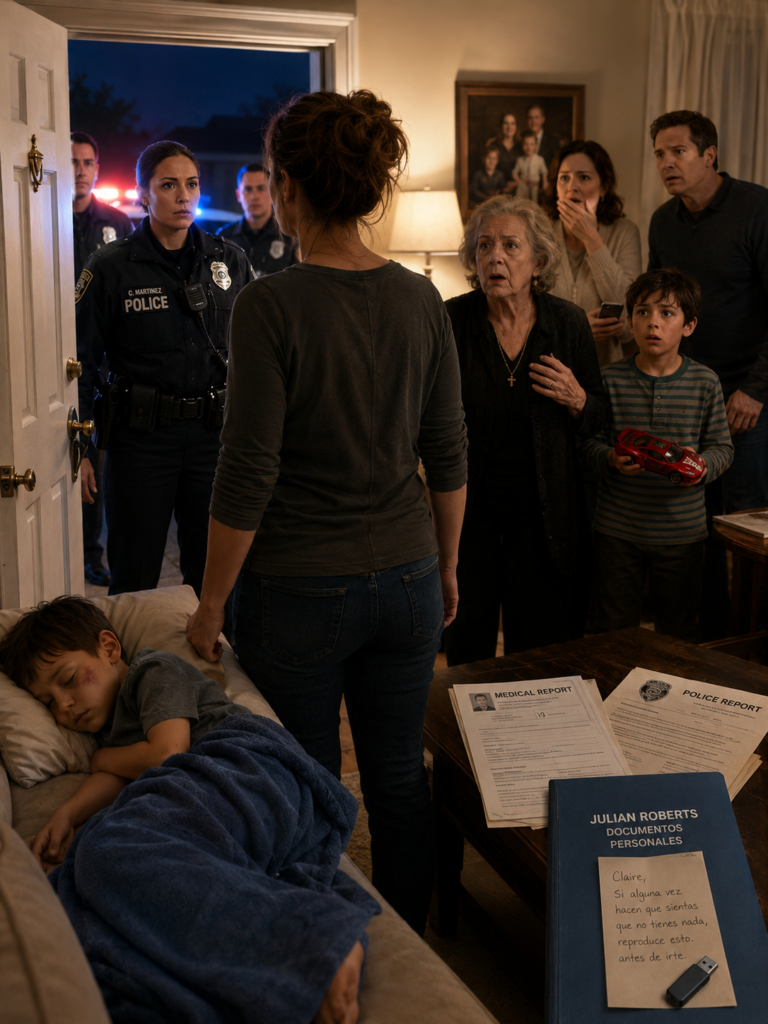
Inside were three pages, a small key, and a photograph of Julian holding a newborn Matthew in front of the hair salon where I worked. Upon seeing it, Valerie brought her hand to her neck, as if the image had squeezed her throat from the inside. My mother tried to snatch the package, but the police officer took a step forward and blocked her path. “Mrs. Theresa, don’t touch anything,” he said, with a voice so calm it sounded worse than a threat.
The notary adjusted his glasses and read that Julian, before his accident, had secretly bought the mortgage debt on that house and placed it in a trust under Matthew’s name. I felt the room spinning, because for six years I had swept, cooked, and paid bills believing they were doing me a favor by letting me sleep in the coldest bedroom. The notary continued, stating that Julian had allowed my mother to live on the property only if she protected the boy and did not dispose of his assets. As soon as he uttered the word “protected,” the social worker looked at my sleeping son’s swollen cheek.
My mother pursed her lips, but for the first time, she couldn’t find a cruel phrase to hide behind. “That’s a lie,” Valerie said, though her voice trembled and her eyes darted to the USB drive I held in my hand. Then I remembered Julian’s note and asked for permission to plug the flash drive into the TV. No one moved, not even Damian, who was staring at the red toy car on the floor as if it were suddenly on fire.
Julian appeared on the screen, skinny from his late nights at the auto shop, wearing his blue shirt and that smile that broke my heart. He said my name with a tenderness that made me feel his grease-stained hands caressing my belly back when Matthew was still kicking inside me. Then he explained that he had discovered my mother and Valerie visited a loan shark to figure out how to take any life insurance payout away from me if he passed away. My brother-in-law looked down, and in that gesture, I knew he had also heard something and chosen silence.
Julian recounted that he decided to buy the house’s past-due debt because Theresa was going to lose it and because I wouldn’t bear to see her out on the street. But he also said he didn’t trust her, which is why he made everything ironclad so that, upon Matthew turning seven or in the event of any proven abuse, the administration of the estate would pass immediately to me. When the video showed my mother signing a receipt accepting those conditions in exchange for keeping a roof over her head, she let out a small, miserable sound, like a trapped animal.
The room exploded without a sound; it was an explosion of faces falling, of truths force-swallowed, and of cake turning to dust in their mouths. Valerie tried to say she didn’t know anything, but in the folder were monthly wire transfers Julian had set aside for Matthew that never reached my hands. Each deposit showed as withdrawn the exact same day into a joint account held by my mother and sister.
I felt like throwing up, not because of the money, but because of all the times Matthew asked me for chocolate milk and I told him we couldn’t afford it. I remembered his torn sneakers, his lunches split in half, and my nights sewing uniforms while Valerie showed off expensive new purses. “We were managing it,” my mother babbled, lifting her chin as if she could still command the air. “You were stealing it,” I replied, and my own voice surprised me because it came out clean, without fear, without asking for permission.
The social worker took photos of Matthew’s cheek, the medical report, and the bruises described on the hospital intake sheet. The police officer asked everyone for ID, and the notary handed me the small key, explaining that it opened a safe deposit box holding original documents, deeds, and another recording.
Damian stood up slowly and walked toward my sleeping son, but Valerie yanked him by the arm in desperation. “Don’t go near that boy,” she ordered, repeating without realizing it the same phrase she had spat her entire life. Damian pulled free and started to cry, not with a tantrum, but with a new kind of shame he didn’t know where to put. “I didn’t know it was from his dad,” he said looking at the red toy car, and his childish voice pierced the room deeper than any accusation.
Valerie tried to silence him, but he kept talking, confessing that his mom used to tell him Matthew didn’t deserve nice things because we were just passing through. My sister turned pale, and my mother glared at her with fury because the favorite grandson had just broken their theater from the inside.
I picked up the toy car, wiped a stain of gravy off the wheel with my sleeve, and placed it on Matthew’s chest. My son shifted in his sleep and hugged the toy with that sad trust of children who love even after being hit. It was right then, seeing his little closed hand, that I stopped feeling pity for my mother. Pity had been her favorite rope to tie me down, but that night it snapped like an old string.
“I want it on the record that my son and I are leaving this house, but that no one will ever remove us from what belongs to us again,” I said, and the notary wrote down every word as if laying new bricks beneath my feet. My mother let out a broken laugh and said I wouldn’t last a week on my own, that a woman with a sick child and no husband always ended up coming back. Before, that sentence would have folded me, but now I had a medical report in my hand and Julian’s name on every paper like an invisible pillar.
The social worker asked to speak with me privately, and in the kitchen where they had humiliated me so many times, she explained the temporary protective measures. She said Matthew shouldn’t stay under the same roof as his abusers and that the police report would allow us to request a restraining order while the investigation moved forward. I nodded, looking at the refrigerator covered in magnets from trips we were never invited to. In one corner, a drawing by Damian was still hung up, framed with gold tape, while Matthew’s had ended up in the trash because, according to my mother, they were in the way.
I pulled out the only drawing I kept from my purse, folded into quarters, where my son had painted his dad as a sun over a red car. The social worker looked at it and her eyes welled up with tears, but she didn’t say anything, because some tender moments need silence so they don’t break.
When we returned to the living room, my brother-in-law was no longer defending anyone. He was sitting with his hands clasped, sweating through his Sunday shirt, understanding that his comfort also had blood on its edges. Valerie begged him to do something, to call his lawyer, to not allow this embarrassment. He looked at her as if he finally recognized her and asked how many times she had seen Matthew locked in the laundry room. My sister opened her mouth, but no words came out, and that silence answered for her.
The police officer announced that my mother had to accompany him to give a statement regarding the assault and that Valerie would also have to answer for the alleged embezzlement and the reported abuse. Theresa straightened up with the pride of women who confuse authority with cruelty. “I did what I could for you,” she said, looking at me as if I were an ingrate rather than the daughter she had left begging for love.
Then, for the first time in my life, I didn’t argue her version of events. I just stepped close enough for her to hear me without the others breathing down our necks. “No, Mom. You did whatever you wanted, and starting today, you’re going to learn that a child is not disciplined with fear, and a daughter is not kept with chains.” Her eyes filled with tears, but her crying was no longer the key to unlocking my guilt.
They led her to the patrol car without handcuffs, but with everyone’s eyes on her, which sometimes weighs more than metal. Neighbors peeked through their curtains, and I remembered how many times I had lowered my head so no one would ask why my mother was shouting my name like an insult.
Valerie tried to follow her, but the social worker asked her to stay, and my sister collapsed onto the couch where Matthew had been sleeping minutes before. That couch, which had always been Damian’s throne, was left empty like a discarded crown.
Damian gently picked up the red toy car from Matthew’s chest, kissed its plastic roof, and placed it back where it belonged. “I’m sorry,” he whispered, and even though I wasn’t ready to forgive anyone, I understood that he was also a child built on lies. I didn’t hug him, but I didn’t push him away either, because justice shouldn’t become the very same stone they had thrown at us.
My brother-in-law offered to take us to a hotel, perhaps out of guilt or fear, but I rejected his help. I opened Julian’s box one more time and found, behind the papers, a set of keys to a small storefront in the Maplewood neighborhood. There was a note where he told me he dreamed of seeing me cut hair in my own salon, with a yellow sign and a blue chair for Matthew to do his homework. I cried until my throat hurt, but I cried standing up, not on my knees.
That early morning, we left with two suitcases, my son’s backpack, and the red toy car safely tucked away like a relic. Matthew woke up in the cab, confused by the city lights and by my jacket draped over his shoulders. Matthew asked with a voice so small it pierced me like a needle if Grandma wasn’t going to hit him anymore. I squeezed him tight and promised him that no one would ever touch him again without the whole world finding out.
I didn’t promise him that everything would be easy, because wounded children deserve gentle truths, not fake fairytales. I told him we were going to have a home where his drawings would be hung on the wall, where his toys wouldn’t be plunder, and where his name would be spoken in full. Matthew closed his eyes and, for the first time in months, fell asleep without clenching his fists.
The next morning, when I opened the storefront in Maplewood, the dust sparkled in the sunlight as if Julian had been waiting there all this time. Before rolling up the metal gate, I called the District Attorney’s office, confirmed my appointment, and understood that justice didn’t begin with revenge, but with never disappearing again. I penciled the words “Claire and Matthew’s Salon” on the metal gate, and next to it, I drew a little red car.
Over the following weeks, I gave statements, cried, signed papers, took Matthew to therapy, and learned that healing is also exhausting, but it isn’t humiliating. The judge upheld the protective order, and my mother, who always flaunted her last name like a shield, had to explain every blow in front of strangers. Valerie returned a portion of the money, and my brother-in-law handed over text messages where she and Theresa mocked my double shifts and Matthew’s torn shoes.
Damian sent a letter with a new blue plastic toy car, and I put it away without opening the door to the past. I didn’t show it to Matthew to force him to forgive; I saved it for him for when his heart was bigger than his wound.
On his first day of classes at his new school, Matthew asked to carry the red toy car in his backpack, not to show it off, but to feel like his dad was walking right next to him. That afternoon he drew three people under a yellow sign and wrote “my family” in crooked letters, and right then I understood that Julian hadn’t left us a house or money, but a way out.
My name is Clara Jensen. I’m thirty-four, and a year ago I would have laughed if someone told me my marriage would end before I even realized it was already dead.
But at 2:47 a.m. on a Tuesday, laughter no longer existed in me.
The house was unnaturally quiet. I had fallen asleep on the couch, the TV muted, the screen washing the room in pale light. When my phone vibrated, I reached for it lazily, assuming it was nothing—maybe Ethan texting from his work trip in Vegas.
Instead, my breath vanished.
The first thing that loaded was a photo.
Ethan—my husband of six years—standing beneath the neon glow of a Vegas wedding chapel.
Beside him was Rebecca, his coworker.
At that moment, something sharp and steady locked into place inside me. Ethan thought he had destroyed me—but he’d forgotten who managed everything he was walking away from.
By 3:15 a.m., I moved with ruthless clarity.
Every credit card in his wallet—canceled.
Passwords—changed.
The house deed—mine.
The accounts—mine.
His access—revoked.
At 3:30, I called a locksmith.
“I’ll pay double,” I said. “Now.”
By dawn, the locks were changed. The house was sealed.
Ethan Jensen, newly married, no longer belonged anywhere inside it.
At 8 a.m., pounding shook the door.
Two police officers stood outside. Ethan had called them, claiming I’d locked him out of his home.
I showed them the Vegas message.
The older officer sighed. “He married someone else. This isn’t a police matter.”
They left.
I slept for two hours—deep, dreamless.
By afternoon, I knew Ethan would return. He always did.
At 2 p.m., he showed up with Rebecca, his mother Margaret, and his sister Lily.
His belongings were already boxed and labeled in the garage.
Margaret screamed. Lily mocked. Ethan tried to posture.
“This house was mine before I met you,” I said calmly. “Your name was never on it.”
Their confidence collapsed.
Rebecca’s credit card declined when she tried to rent a truck.
Then Ethan’s declined too.
The Vegas fantasy cracked in real time.
When Lily sneered that I was alone and bitter, I stepped close and answered quietly:
“I have my home. My career. My freedom. And I don’t have Ethan. That’s the best part.”
They packed. They left.
Then came the smear campaign.
Ethan, his mother, and his sister flooded social media, painting me as abusive and controlling. People I knew started believing it.
I called David, my tech-savvy friend.
Within hours, he uncovered everything—messages between Ethan and Rebecca, bragging about stealing money from my accounts to fund their affair.
I posted the screenshots. No commentary. Just truth.
The internet turned on them instantly.
Next came harassment, false accusations, even an attempted break-in—all documented, all forwarded to my lawyer.
Finally, Ethan begged through my mother.
She shut him down.
Then Rebecca’s mother called, asking me to take Ethan back because her daughter “couldn’t afford him.”
I laughed and hung up.
The final act took place in court.
The judge read the evidence.
Affair. Theft. Bigamy.
The verdict was swift.
The divorce was granted.
I kept my home and assets.
Ethan left with nothing but his belongings—and six months of alimony to pay me.
Outside the courthouse, his family erupted into chaos. Coffee flew. Security intervened. Ethan disappeared without a word.
Within weeks, both Ethan and Rebecca lost their jobs due to company policy.
Their entire world collapsed.
Mine finally opened.
I sold the house, bought a bright downtown condo, and breathed again.
At the gym, I met Jacob—kind, steady, uncomplicated. One morning he handed me a coffee with two words written on the cup:
Not Ethan.
I laughed harder than I had in years.
On my wall hangs a framed copy of Ethan’s Vegas marriage certificate—not as pain, but proof.
Because people like Ethan don’t need revenge.
They write their own ending.
All you have to do is step aside and let it happen.
For one second, my whole world went silent.
Not quiet.
Silent.
The kind of silence that comes after an explosion, when your ears are ringing and your mind refuses to understand what your body already knows.
I stood in the linen closet with my back against the shelves, my hand pressed so hard to the wall that my palm ached, and I listened to my daughter cry inside my bedroom.
My little girl.
The same girl who used to fall asleep on my chest during thunderstorms. The same girl who once taped a crooked paper crown to my lunch cooler because she said construction workers were “kings of fixing things.” The same girl who had gone quiet right in front of me while I kept calling it teenage moodiness because that was easier than calling it pain.
“I sent the pictures like my mom told me to,” Lily sobbed. “Please don’t make me go back to Dr. Keller’s office.”
The man inside my room made a sound. Not a laugh exactly. Something colder.
“You think tears change anything?” he said.
My vision went red.
I don’t remember deciding to move.
I remember the closet door slamming open.
I remember the hallway tilting.
I remember my own voice, deeper than I had ever heard it, tearing out of me like something wild.
“Get away from my daughter.”
The bedroom door was half-open.
I kicked it the rest of the way.
The man spun around.
He was not Dr. Keller.
He was younger. Maybe thirty-five. Clean shirt. Expensive watch. Hair gelled neatly like he belonged behind a desk instead of standing in my bedroom with my daughter shaking on the edge of my bed.
Lily was fully dressed, thank God. Hoodie. Jeans. Shoes still on. Her face was wet, her hands trembling in her lap, her eyes wide with terror.
The man looked at me, then at the doorway, then at the window like his brain was measuring distance.
“No,” I said. “You’re going to explain it to the police.”
His face changed then.
Not fear.
Calculation.
“You call the police,” he said quietly, “and your daughter’s life is over.”
Lily made a broken sound behind me.
I tightened my fist in his shirt.
“What did you say?”
The man swallowed, but his eyes stayed sharp.
“Ask your wife.”
That was when I noticed the phone in his hand.
Not my phone. Not Lily’s.
His.
The screen was lit. Recording.
I ripped it from his fingers and hurled it against the wall. It cracked, bounced off the dresser, and fell face-down on the carpet.
The man lunged for it.
I hit him once.
I am not proud of that.
But I will not lie and say I regret it.
He dropped like a sack of wet cement, clutching his mouth, blood spreading between his fingers.
Lily screamed again, but this time it was fear of me, and that cut deeper than anything.
I stepped back immediately.
“Baby,” I said, turning to her. “Lily, look at me.”
She stared at the floor.
“Look at me.”
Slowly, she raised her eyes.
I had seen my daughter scared before. Bad dreams. Emergency rooms. A fever so high when she was six that I drove through two red lights.
But this was different.
This was fear that had learned to live in her bones.
“I’m here,” I said. My voice broke. “I’m here now.”
The man groaned on the floor.
I took my phone from my pocket with shaking hands and dialed 911.
The dispatcher answered.
I gave my address.
Then I said the words no father should ever have to say.
“There’s a man in my house. He was threatening my daughter. She’s a minor. Send police. Send an ambulance.”
Lily flinched at the word minor like it exposed her.
I moved between her and the man on the floor.
The dispatcher kept asking questions. Was he armed? Was anyone injured? Was the suspect still there?
I answered as best I could while watching him.
He tried to sit up.
“Don’t,” I said.
He froze.
Then, from downstairs, the front door opened.
“Michael?” Maria called.
Her voice floated up the stairs, normal and irritated.
“Why is your truck not—”
She stopped.
Maybe she saw my work boots by the back door.
Maybe she heard Lily crying.
Maybe some guilty part of her already knew the house had changed.
Her footsteps came up the stairs fast.
She appeared in the doorway in her dental clinic scrubs, purse still on her shoulder, mouth open.
Her eyes went first to me.
Then Lily.
Then the man bleeding on the floor.
And finally the broken phone.
For a second, nobody spoke.
Then Maria whispered, “What did you do?”
I almost laughed.
Not because it was funny.
Because those were the first words out of her mouth.
Not Lily, are you okay?
Not who is this man?
Not Michael, what happened?
What did you do?
The truth stepped into the room and stood between us.
I looked at my wife of eighteen years, the woman I had built a life with, the woman who held my hand when Lily was born, the woman who had slept next to me while my daughter disappeared inside herself.
“What did I do?” I said.
Maria’s face hardened.
“Michael, you need to calm down.”
The man on the floor wiped his mouth and said through blood, “Maria, fix this.”
Maria closed her eyes.
Just for a second.
But I saw it.
Recognition.
Not surprise.
Not confusion.
Recognition.
Lily curled forward, both arms around her stomach.
I turned toward her.
“Lily,” I said softly, “do you know him?”
She looked at Maria first.
That answer told me more than words could have.
“Lily,” I said again, “look at me, not her.”
Maria snapped, “Don’t pressure her.”
I stepped between them.
“You don’t get to tell me how to talk to my daughter right now.”
Maria’s face twisted. “You have no idea what’s going on.”
“Then explain.”
She stared at me.
Downstairs, sirens wailed in the distance.
For the first time, Maria looked afraid.
Not for Lily.
For herself.
She dropped her purse on the floor and stepped toward me.
“Michael, listen to me. This is complicated.”
“No,” I said. “It got real simple when I heard my daughter begging a grown man to stop.”
The man on the floor said, “You’re making a mistake.”
I turned on him so fast he leaned back.
“You say one more word before the police get here, and you’ll need a straw for dinner.”
Maria grabbed my arm.
“Michael!”
I shook her off.
Lily whispered, “Dad.”
I looked at her.
Her lips trembled.
“Please don’t let Mom talk to me alone.”
That sentence killed whatever was left of my old life.
I walked to Lily and knelt in front of her.
“I won’t,” I said. “Not ever again.”
The police arrived four minutes later.
Four minutes can be a lifetime.
In those minutes, Maria paced like a trapped animal. The man sat on the carpet with his back against the dresser, glaring at me. Lily didn’t move from the bed. And I stood between all of them, one hand holding my phone, the other clenched so tightly my nails cut into my palm.
When the officers entered, everything happened quickly.
Two patrol officers came up first, hands near their holsters. A third stayed downstairs. I raised both hands and told them I was the homeowner. The man on the floor immediately started talking.
“He attacked me,” he said. “He assaulted me. I was invited here.”
“By who?” one officer asked.
The man hesitated.
Maria said, “By me.”
The room went colder.
The officer looked at Maria. “Ma’am, who is he?”
Maria swallowed. “A coworker.”
Lily made a small sound.
I said, “He threatened my daughter. She said he made her send pictures and mentioned Dr. Keller’s office.”
The officer’s expression changed. Just slightly. Enough.
He looked at Lily.
“What’s your name, sweetheart?”
She didn’t answer.
I said, “Her name is Lily. She’s fifteen.”
The officer’s voice softened. “Lily, are you hurt?”
Maria answered, “She’s fine.”
The officer turned his eyes to her.
“I asked Lily.”
Maria’s mouth shut.
Lily stared at her shoes.
“I don’t know,” she whispered.
That was enough.
The officers separated us.
The man was cuffed first after they found his ID and the broken phone. His name was Eric Vance. I had never heard it before. Maria kept saying it was a misunderstanding, that I had walked in at the wrong moment, that Lily was emotional.
But every time Maria spoke, Lily shrank.
The female officer noticed.
She gently asked Lily if she wanted to wait downstairs away from her mother.
Lily looked at me.
I nodded.
“I’ll be right behind you,” I said.
She stood on shaky legs. When she passed Maria, Maria reached for her wrist.
“Lily, don’t make this worse.”
The female officer stepped between them.
“Do not touch her.”
Maria’s face went white.
Those four words were the first real justice I heard that day.
At the station, the story came out in pieces.
Not all at once.
Trauma doesn’t spill neatly. It leaks. It comes in fragments. A sentence. A pause. A sudden sob. A detail that seems small until it opens a door to something terrible.
I was not allowed in the first interview. That was standard, they told me. They needed Lily to speak freely. A child advocate sat with her. A detective from the Special Victims Unit arrived. A counselor came too.
I sat in a plastic chair under fluorescent lights, my elbows on my knees, staring at a vending machine full of snacks nobody wanted.
Mrs. Alvarez came to the station after an officer called her.
She sat beside me without asking.
For a while, neither of us spoke.
Then she put a hand over mine.
“I’m sorry,” she said.
I looked at that old woman, the one I had dismissed as nosy, lonely, dramatic.
“You saved her,” I said.
She shook her head. “No. She saved herself by surviving long enough for someone to listen.”
I covered my face.
That was when I finally cried.
Not loud. Not dramatic.
Just a broken man folding in half in a police station because the truth had arrived, and it was bigger than anything he knew how to carry.
The detective came out after almost two hours.
Her name was Detective Harris. She looked like someone who had trained herself not to show shock because shock didn’t help victims.
She sat across from me.
“Mr. Torres,” she said, “Lily gave us permission to share some information with you. Not all of it. Some will remain private unless she chooses otherwise.”
I nodded.
My throat was dry.
“Is she safe?”
“She is safe right now.”
Right now.
I hated those words.
Detective Harris opened a folder.
“Your daughter says this began about seven months ago.”
Seven months.
Seven months of dinners. Seven months of school mornings. Seven months of me asking, “You okay?” from the hallway and accepting “fine” like it was an answer.
Detective Harris continued.
“Dr. Alan Keller owns the dental clinic where your wife works.”
I knew that name.
Of course I knew that name.
Maria had mentioned him for years.
Dr. Keller said this. Dr. Keller bought lunch. Dr. Keller gave bonuses. Dr. Keller invited staff to a holiday dinner.
I had shaken his hand once at a charity 5K.
He had complimented Lily’s braces.
My stomach turned.
“According to Lily,” Detective Harris said carefully, “your wife began bringing her to the clinic after school last fall. At first, she told Lily she needed help with filing and cleaning exam rooms. Then Dr. Keller became involved. He gave Lily gifts. Gift cards. Makeup. A tablet. Your wife told Lily to be grateful.”
I stared at the detective.
The vending machine hummed behind me.
“Why?” I asked.
Detective Harris did not answer immediately.
That told me the answer was bad.
“Your wife appears to have significant financial problems.”
I blinked.
“We don’t have money problems.”
Detective Harris looked at me with something like pity.
“You may not have known about them.”
I thought of Maria’s new purse. Her overtime shifts. The credit card statements that came electronically now because she said paper bills were clutter. The way she got angry when I offered to sit down and budget.
Detective Harris went on.
“We’re investigating whether your wife accepted money or favors in exchange for facilitating access to Lily.”
The room moved under me.
I gripped the arms of the chair.
“No,” I said.
Not because I believed Maria was innocent.
Because the sentence was too monstrous to let into the room.
Detective Harris let me sit with it.
Then she said, “Eric Vance appears to be connected to Keller. We believe he was sent to intimidate Lily today because she stopped responding to messages.”
I looked up.
“Messages?”
“Lily kept some of them.”
Hope and horror hit me at the same time.
“She has proof?”
“She may. We have her phone now. We’ll need warrants for the rest.”
“Where is Maria?”
“In custody.”
The words should have relieved me.
They didn’t.
They opened a pit.
“My wife,” I whispered, and then corrected myself because the word had turned poisonous. “Maria. She knew?”
Detective Harris held my gaze.
“Lily believes she did.”
Believes.
That was detective language. Court language. Careful language.
But I had seen Maria’s face in the bedroom.
I knew.
The next time I saw Lily, she was wrapped in a gray blanket that made her look younger than fifteen.
She sat in a quiet room with soft chairs and a box of tissues on the table. Her eyes were swollen. Her hair was loose around her face. She looked exhausted in a way sleep would not fix.
When I walked in, she looked at the advocate beside her.
The woman nodded and stepped out.
I stayed near the door.
“I won’t come closer unless you want me to,” I said.
Lily’s face crumpled.
“Dad.”
I crossed the room and knelt in front of her chair. She leaned forward slowly, like she was afraid she might break, and then she fell into my arms.
I held her carefully.
Not tightly.
Carefully.
Like she was made of glass and fire.
“I’m sorry,” she sobbed.
I pulled back just enough to look at her.
“No.”
“But I lied.”
“No.”
“I didn’t tell you.”
“No, baby. No.”
She shook her head, crying harder.
“I thought you’d hate me.”
That one split my chest open.
I took her face in my hands.
“Listen to me. Nothing that happened is your fault. Nothing. Not one second of it. You hear me?”
Her eyes searched mine like she wanted to believe but didn’t know how.
“I should have known,” I said. “I should have listened. I should have asked better. That is on me. But what they did? That is on them.”
She whispered, “Mom said you’d leave.”
I closed my eyes.
“She said if you found out, you’d look at me different.”
I opened them again.
I made myself say the truest thing I had ever said.
“I do look at you different.”
She froze.
I continued before fear could take her.
“I look at you and see the strongest person I have ever known.”
Her mouth trembled.
“I’m not strong.”
“You survived.”
She shook her head.
“You survived,” I said again. “And now you don’t have to survive alone.”
She folded into me again.
That night, Lily did not come home.
Neither did I.
The police told me the house was part of an active investigation. They needed to collect evidence. Devices. Documents. The broken phone. Maria’s laptop. My desktop. Lily’s room would be photographed, not because she had done anything wrong, but because evidence hides in ordinary places.
I hated the idea of strangers in her room.
Lily hated the idea of going back there even more.
Mrs. Alvarez offered her guest room.
“No,” I said at first. “We can get a hotel.”
But Lily looked at Mrs. Alvarez and whispered, “Can I stay with you?”
Mrs. Alvarez took her hand.
“Mi casa es tu casa, mija.”
So we went next door.
I had lived beside Mrs. Alvarez for eleven years and had never been past her front entryway. Her house smelled like cinnamon and lemon cleaner. There were framed photographs everywhere—children, grandchildren, a husband who had died five years earlier. She made tea neither of us drank and set out blankets.
Lily slept on the couch because she did not want a closed bedroom door.
I slept in the armchair beside her.
At 2:13 a.m., she woke screaming.
I was up before my brain was.
“Lily. Lily, it’s Dad.”
She thrashed once, then opened her eyes.
For a second, she didn’t know where she was.
Then she saw me.
She covered her mouth, embarrassed.
“I’m sorry.”
I had already learned to hate those words from her.
“Don’t apologize.”
Mrs. Alvarez came from the hallway in a robe, holding a small lamp.
“Bad dream?” she asked.
Lily nodded.
Mrs. Alvarez sat on the other end of the couch.
“Then we turn on lights,” she said. “Bad dreams are cowards. They hate lights.”
For the first time in months, Lily almost smiled.
The next morning, my brother Daniel flew in from Denver.
I had called him at dawn and said only, “I need you.”
He didn’t ask for details until he arrived.
Daniel was younger than me by four years, a firefighter, the kind of man who looked calm even when everything burned. When I told him what happened, he stood in Mrs. Alvarez’s kitchen with both hands on the counter and stared out the window for a long time.
Then he turned around and said, “Tell me what you need.”
Not what happened.
Not are you sure.
Not how could Maria.
Tell me what you need.
That was love in its most useful form.
“I need Lily safe,” I said.
“Done.”
“I need a lawyer.”
“I’ll find one.”
“I need to not kill anyone.”
Daniel looked at me.
“I’ll help with that too.”
By noon, he had found a family attorney and a criminal victim advocate. By evening, we had filed for an emergency protective order against Maria and anyone associated with Dr. Keller. The judge granted temporary custody to me and barred Maria from contacting Lily.
Maria tried anyway.
First through calls.
Then texts.
Then from an unknown number.
Lily’s phone was with the police, but Maria messaged my phone.
Michael, this is not what you think.
Please don’t ruin our family.
Lily is confused.
Keller is powerful. You don’t understand who you’re dealing with.
Then, finally:
If you loved your daughter, you would keep this quiet.
I showed the detective.
She read the message, took a screenshot, and said, “That helps.”
I stared at the phone.
My wife had just threatened me using my love for my child.
And for the first time since I kicked open that bedroom door, something inside me settled.
Grief was still there.
Rage too.
But beneath both was clarity.
Maria was not a mystery anymore.
She was a danger.
And dangers get removed.
The arrests began three days later.
Dr. Alan Keller was taken from his clinic at 10:42 a.m. while patients sat in the waiting room and a hygienist cried behind the reception desk. Detectives seized computers, external drives, office cameras, appointment logs, financial records, and a locked cabinet in his private office.
Eric Vance, the man I found in my bedroom, was charged first for entering my home and threatening Lily. More charges came later.
Maria was charged too.
I will not list every charge. Some words do not deserve space.
What matters is this: they thought Lily was alone, and she wasn’t.
They thought fear would keep her quiet, and it didn’t.
They thought money, reputation, and shame would protect them.
They were wrong.
But justice did not feel like victory.
Not at first.
It felt like paperwork.
Court dates. Interviews. Medical appointments. Therapy referrals. School meetings. Insurance calls. Password changes. Bank freezes. Lawyers. Detectives. Advocates. Forms with boxes too small for the size of what had happened.
Lily moved through those first weeks like a ghost.
She ate when I sat beside her.
She slept only with lights on.
She jumped when someone knocked.
She could not stand the smell of mint toothpaste.
The first time she saw a white dental coat on a commercial, she ran to the bathroom and vomited.
I learned quickly that saving someone from danger is not the same as healing them.
The rescue is loud.
Healing is quiet.
Healing is sitting on the floor outside a bathroom door at midnight saying, “I’m here,” even when the person inside cannot answer.
Healing is buying six kinds of toothpaste until one doesn’t make your daughter shake.
Healing is learning that “Do you want a hug?” is better than assuming.
Healing is asking, “Do you want advice, or do you want me to listen?”
Healing is realizing that being a father is not providing a roof.
It is becoming shelter.
A month after the arrests, Lily asked to go home.
Not to live.
Just to see it.
The house had been released back to us. Daniel and I had cleaned it as best we could. We repainted my bedroom. Replaced the bed. Changed every lock. Installed cameras. Threw away anything Maria left behind except legal documents and a few items Lily chose to keep.
Most of Maria’s things went into boxes in the garage.
Lily stood in the driveway staring at the house like it was a person who had betrayed her.
“You don’t have to go in,” I said.
“I know.”
“We can sell it.”
“I know.”
She hugged herself.
“I want to see my room.”
We went inside together.
Mrs. Alvarez watched from her porch, phone in hand, ready to call Daniel if needed.
Lily walked slowly through the living room, past the kitchen, up the stairs. At the top, she stopped outside my old bedroom door.
The new paint was a different color.
The door was open.
She didn’t look inside.
She went straight to her room.
I stayed in the hall.
She stood in the doorway for a long time.
Then she said, “She used to come in here after.”
I closed my eyes.
Maria.
“She’d sit on my bed and tell me I had to be mature,” Lily said. “She said sometimes girls have to do things they don’t like to help their families.”
My hands curled into fists.
Lily turned around.
“She said you’d never understand because you were simple.”
I almost smiled, but it hurt too much.
“She was right about one thing,” I said. “I don’t understand.”
Lily looked down.
“I kept waiting for her to become my mom again.”
I had no answer for that.
So I said the only thing I could.
“I’m sorry she didn’t.”
Lily nodded.
Then she stepped into her room and opened the curtains.
Sunlight filled the space.
Dust floated in the air.
On her desk sat the paper crown she had made me years ago. Crooked. Faded. One corner bent.
I had forgotten it existed.
Lily picked it up.
“You kept this?”
“Of course.”
“You wore it?”
“On lunch break. Whole crew saw it.”
She gave a tiny laugh.
It lasted less than a second.
But it was real.
I held onto it like a match in the dark.
School became its own battlefield.
The administration knew enough to protect her privacy, but teenagers have a way of sensing blood in the water. Rumors started. Not accurate ones. Rumors rarely are. But cruel enough.
Lily lasted three days before calling me from the bathroom.
“Dad,” she whispered, “I can’t.”
I left work immediately.
My foreman, Big Mike, saw my face and didn’t ask.
“Go,” he said.
When I got to the school office, the counselor looked apologetic.
“We can arrange accommodations,” she said.
I looked at Lily, curled in a chair with her hood up.
“What do you want?” I asked.
She blinked like nobody had asked that in a long time.
“I want to go home.”
“Then we go home.”
The counselor started, “Mr. Torres, long term—”
I held up a hand.
“Long term starts tomorrow.”
We enrolled Lily in online classes while we figured out the rest. Daniel helped set up a desk in Mrs. Alvarez’s spare room because Lily still felt safer there during the day.
Mrs. Alvarez became part grandmother, part guard dog.
She made soup.
She watched the street.
She sat with Lily through panic attacks and taught her how to crochet crooked little squares that became crooked little blankets.
One afternoon, I came home and found them at the kitchen table, arguing about a telenovela.
“She should not forgive him,” Lily said.
Mrs. Alvarez gasped. “But he lost his memory!”
“Convenient.”
“She loves him!”
“He lied before the amnesia.”
Mrs. Alvarez pointed at me. “Michael, tell your daughter love is complicated.”
I looked at Lily.
Lily looked at me.
For a second, something heavy passed between us.
Then I said, “Love should not require you to disappear.”
Lily looked back at the TV.
Mrs. Alvarez nodded slowly.
“Fine,” she said. “The girl should leave him.”
Lily smiled.
A real one this time.
Small, but real.
The trial took eleven months to begin.
In those eleven months, Maria changed stories three times.
First, she claimed Lily had invented everything because she was angry about household rules.
Then she claimed Keller manipulated her too.
Then she claimed she had suspected something inappropriate but had been too frightened to stop it.
Her lawyer tried to paint her as another victim.
Maybe some part of that was true.
Maybe Keller had power over her.
Maybe debt had cornered her.
Maybe shame had eaten her alive.
I spent many nights wrestling with those maybes.
But none of them changed the one thing that mattered.
She had a choice.
Lily did not.
At the preliminary hearing, Maria saw Lily across the hallway and started crying.
“My baby,” she said.
Lily stiffened beside me.
I stepped in front of her.
Maria’s lawyer touched her elbow, warning her not to speak.
But Maria kept looking over my shoulder.
“Lily, please. I’m your mother.”
Lily’s hand found mine.
She squeezed once.
Then she stepped around me.
Her voice shook, but it carried.
“No,” she said. “You were supposed to be.”
Maria’s face collapsed.
Lily turned and walked away.
I followed.
That was the day I understood that courage is not loud most of the time.
Sometimes courage is a girl with trembling hands saying one sentence and refusing to look back.
When the trial finally began, the courtroom was smaller than I expected.
I don’t know why that surprised me. Maybe because the pain was so huge I thought the room would have to be huge too.
But it was just benches, tables, flags, microphones, a judge, twelve jurors, and too many people breathing the same air.
Keller wore a gray suit.
Eric Vance wore navy.
Maria wore cream, like innocence could be chosen from a closet.
Lily did not testify in open court the way I feared. The judge allowed accommodations because of her age and the nature of the case. Her recorded forensic interview was played. Additional testimony came from detectives, digital analysts, financial investigators, clinic employees, and one former patient’s mother who had once complained about Keller’s behavior and been ignored.
The evidence was worse than I knew.
Bank transfers.
Encrypted messages.
Deleted files recovered.
Security footage from the clinic.
Appointment logs altered by Maria.
Text messages where she told Lily to “stop being dramatic” and “do what Dr. Keller says or everything falls apart.”
A message from Keller to Maria:
Your husband suspects nothing.
I had to leave the courtroom after that one.
Daniel followed me into the hallway.
I leaned against the wall, shaking.
“Seven months,” I said.
Daniel stood beside me.
“I know.”
“I ate dinner with her.”
“I know.”
“I slept next to her.”
“I know.”
“My daughter was upstairs dying inside, and I slept next to the person helping it happen.”
Daniel grabbed my shoulder.
“You know now.”
I looked at him.
His eyes were wet.
“You know now,” he repeated. “And since the second you knew, you have not left that girl’s side.”
I wanted that to be enough.
It wasn’t.
But it was something.
On the fourth day of trial, the prosecutor called Mrs. Alvarez.
She wore her best blue dress and silver cross necklace. She looked tiny walking to the witness stand, but when she took the oath, her voice was steady.
She told the jury what she heard.
The afternoons.
The crying.
The pleading.
How she first wondered if she was mistaken.
How she finally confronted me.
The defense tried to make her sound like a gossip.
“Mrs. Alvarez,” Keller’s attorney said, “isn’t it true you often pay close attention to your neighbors’ private lives?”
Mrs. Alvarez looked at him calmly.
“When a child screams, privacy is no longer the most important thing.”
The jury heard that.
Everyone did.
The attorney tried again.
“You never saw Dr. Keller in the Torres home, correct?”
“No.”
“You never saw Mr. Vance harm Lily Torres, correct?”
“No.”
“So all you had were sounds through a wall?”
Mrs. Alvarez leaned toward the microphone.
“I had a child’s fear through a wall. That was enough for me.”
The prosecutor did not ask another question.
She didn’t need to.
Maria took a plea before the jury got the case.
I found out in the hallway.
Her attorney approached mine, they spoke quietly, and then my lawyer turned to me.
“She’s pleading guilty to several charges in exchange for testifying against Keller and Vance.”
Lily was sitting beside me, earbuds in but no music playing. She heard everything.
“What does that mean?” she asked.
“It means,” my lawyer said gently, “your mother is admitting guilt.”
Lily stared at the floor.
“Because she’s sorry?”
No one answered fast enough.
So I did.
“Because she’s trying to reduce her sentence.”
Lily nodded like she had expected that.
“Okay.”
“Are you okay?” I asked.
She looked up at me with tired eyes.
“I don’t think okay is the goal today.”
“What is?”
“Not breaking.”
I took her hand.
“Then we’ll do that.”
Maria testified the next morning.
I will never forget the sound of her voice in that courtroom.
Small.
Careful.
Rehearsed.
She admitted Keller had given her money. She admitted she brought Lily to the clinic. She admitted she ignored Lily’s distress. She admitted she lied to me. She admitted Eric Vance had gone to our house to scare Lily into silence.
But even then, she wrapped every admission in excuses.
“I was under pressure.”
“I thought I could control the situation.”
“I didn’t understand how serious it was.”
“I made terrible mistakes.”
Mistakes.
Leaving your keys in the truck is a mistake.
Forgetting an anniversary is a mistake.
What Maria did was not a mistake.
It was a series of doors she opened and then locked behind our daughter.
The prosecutor asked her, “Did Lily ever ask you to stop taking her to Dr. Keller’s office?”
Maria lowered her head.
“Yes.”
“How many times?”
“I don’t remember.”
“More than once?”
“Yes.”
“More than five times?”
Maria started crying.
“Yes.”
“Did you tell her that if she told her father, he would abandon her?”
Maria covered her mouth.
The judge told her to answer.
“Yes.”
Lily stood abruptly.
“I need air,” she whispered.
We left before Maria could look at her.
Outside the courthouse, Lily bent over with her hands on her knees, breathing too fast.
I crouched in front of her.
“In for four,” I said, repeating what her therapist taught us. “Hold for four. Out for six.”
She tried.
Failed.
Tried again.
Daniel blocked the sidewalk so nobody stared too closely.
Mrs. Alvarez rubbed Lily’s back.
Lily gasped, “I hate her.”
I said, “That’s allowed.”
Then she cried harder.
“I still want her to love me.”
I closed my eyes for one second.
“That’s allowed too.”
Because healing was full of contradictions.
She could hate Maria and miss her.
She could be safe and still scared.
She could know it wasn’t her fault and still feel shame.
She could survive and still grieve the girl she had been before.
A week later, the verdict came.
Guilty.
Keller: guilty.
Vance: guilty.
Maria had already entered her plea.
The courtroom did not erupt. Real life is not television. There was no cheering. No dramatic collapse. Just a strange release of breath from people who had been holding it too long.
Keller stared straight ahead.
Vance cursed under his breath.
Maria cried silently.
Lily did none of those things.
She leaned against me and whispered, “Can we go home?”
I knew which home she meant.
Not the old house.
Not yet.
Mrs. Alvarez’s.
“Yes,” I said. “We can go home.”
Sentencing happened six weeks later.
By then, Lily had started therapy twice a week. She had also started painting. Not well, according to her. Beautifully, according to me, though she said fathers were legally required to think that.
She painted doors mostly.
Closed doors.
Open doors.
Doors with light underneath.
Doors in empty fields.
Doors underwater.
I asked once what they meant.
She shrugged.
“I don’t know yet.”
That answer was better than silence.
At sentencing, Lily chose to read a statement.
I asked three times if she was sure.
The third time, she said, “Dad, I need you to trust me.”
So I did.
She stood at a podium too tall for her until the advocate adjusted the microphone.
The courtroom waited.
Maria stared at her like a starving person looking at food.
Lily did not look back.
She looked at the judge.
“My name is Lily Torres,” she began. “For a long time, I thought my life was over. I thought what happened to me would be the only thing people saw when they looked at me. I thought I had become something broken and dirty and impossible to love.”
I gripped the bench.
“But I learned something. I learned that shame belongs to the people who hurt you, even when they try to hand it to you. I learned that fear can live in your body after the danger is gone, but that does not mean the danger won. I learned that sometimes the first person who believes you saves your life.”
Mrs. Alvarez wiped her eyes.
Lily continued.
“My father did not save me because he was perfect. He saved me because when he finally saw the truth, he chose me. Every day since then, he has chosen me. Mrs. Alvarez chose me. My uncle chose me. My therapist chose me. And now I choose me.”
She paused.
Her hands were shaking.
But her voice did not break.
“To Dr. Keller, Eric Vance, and Maria Torres: you do not get the rest of my life. You took enough. I am taking back my name, my body, my room, my future, and my voice. I hope the court gives you enough time to understand what you did. But whether you understand or not, I am done carrying it for you.”
She stepped back.
For a moment, nobody moved.
Then the judge removed his glasses.
I will not repeat everything he said, but I remember one sentence.
“Justice cannot return what was stolen, but it can name the theft and hold the thieves accountable.”
Keller received decades.
Vance received years that would carry him deep into middle age.
Maria received less than Keller, more than she expected, and exactly enough that Lily would be an adult long before Maria walked free.
When the judge read Maria’s sentence, Maria turned around.
Her eyes found Lily.
“I love you,” she mouthed.
Lily looked at her for a long moment.
Then she turned away.
Outside the courthouse, the sky was bright blue and merciless.
Reporters waited near the steps. Our lawyer guided us through a side exit to avoid them. Still, one called out, “Mr. Torres, do you have a statement?”
I stopped.
Lily squeezed my hand.
“You don’t have to,” she whispered.
I looked at her.
“Neither do you.”
She nodded.
So I turned toward the reporter.
“My daughter is not a headline,” I said. “She is a child who deserved protection. Listen when children change. Listen when neighbors warn you. Listen before the screaming gets loud enough to hear through walls.”
Then we left.
A year later, I sold the house.
Not because Lily demanded it.
Because one morning I woke up, walked downstairs, and realized I had been living inside a crime scene with furniture.
I asked Lily what she thought.
She was eating cereal at Mrs. Alvarez’s kitchen table, hair messy, wearing one of my old flannels over her pajamas.
She considered the question seriously.
“Can we choose the next one together?”
“Absolutely.”
“Can it have a room with good light?”
“Yes.”
“And no dental offices nearby?”
I almost choked on my coffee.
She smiled.
Dark humor, her therapist said, could be a bridge.
So I crossed it with her.
“No dental offices nearby,” I promised.
We found a small house fifteen minutes away, close enough for Mrs. Alvarez to visit and far enough that the old street stopped appearing in every dream.
It had three bedrooms, a lemon tree in the backyard, and a front porch with terrible paint.
Lily chose the room facing east.
“Morning light,” she said.
Daniel helped us move. Big Mike and half my crew showed up with trucks. Mrs. Alvarez supervised like a general and scolded everyone who carried boxes incorrectly.
At the end of the day, Lily stood in her new room surrounded by boxes.
I knocked on the open door.
“Pizza’s here.”
She looked around.
“I think I want to paint it yellow.”
“Then we paint it yellow.”
“Not baby yellow. Warm yellow.”
“Warm yellow.”
“And I want a lock.”
That one hit me.
She saw my face and quickly said, “Not because of you. Just because I want to decide who comes in.”
I nodded.
“Then we get a lock. And I knock. Every time.”
Her eyes softened.
“I know.”
I installed the lock the next morning.
Then I stood outside her door and knocked.
She opened it.
I held up the tiny key.
“Yours,” I said.
She took it and closed her hand around it.
That key mattered more than the house deed.
Two years passed.
Not easily.
Not magically.
There were setbacks. Panic attacks. Court appeals. Nights when Lily cried because healing felt unfairly slow. Days when I found myself standing in grocery aisles unable to choose pasta because grief had ambushed me between the sauce and canned tomatoes.
There were also good things.
Small at first.
Then bigger.
Lily went back to school, a different one, halfway through junior year. She joined an art club. She made a friend named Zoe who had purple hair and a laugh like a car refusing to start. She got her driver’s permit. She burned pancakes. She adopted a three-legged orange cat from a shelter and named him Judge Judy.
She started applying to colleges.
Art therapy programs.
Social work programs.
Psychology.
“Maybe I want to help kids,” she said one evening.
We were sitting on the porch, watching Judge Judy stalk a moth he had no chance of catching.
“You don’t have to turn pain into purpose,” I said.
“I know.”
“You’re allowed to just live.”
“I know.”
She leaned her head on my shoulder.
“But maybe living can include helping.”
I kissed the top of her head.
“Then whatever you choose, I’m proud.”
She groaned.
“You say that when I choose cereal.”
“I’m proud of your cereal instincts.”
“Dad.”
“What? Very advanced.”
She laughed.
This time it lasted.
On Lily’s eighteenth birthday, we had a party in the backyard.
Nothing huge. Daniel came. Mrs. Alvarez came with tamales. Zoe came with balloons. A few friends from school. Big Mike stopped by with a toolbox because he said every adult needed one.
Lily wore a green dress and combat boots.
Her hair was shorter now, cut to her chin. She had painted tiny gold suns on her fingernails. Around her neck was a necklace Mrs. Alvarez gave her, a little silver door that opened and closed.
When it was time for cake, she made everyone sing twice because Daniel came in late on the first round.
After she blew out the candles, she looked at me across the table.
There are moments when you see your child not as the baby they were or the adult they’re becoming, but as every age at once.
I saw Lily at three, holding a stuffed rabbit.
At seven, missing both front teeth.
At ten, building a cardboard castle in the living room.
At fifteen, shaking on the edge of my bed.
At eighteen, standing under string lights, alive.
Not unscarred.
Not untouched.
But alive.
Later that night, after everyone left, she found me on the porch.
“You okay?” she asked.
I smiled.
“Isn’t that my line?”
“You overuse it.”
“I’m working on it.”
She sat beside me.
For a while, we listened to the desert night.
Then she said, “I’m glad you came home early.”
My throat tightened.
“Me too.”
“I used to be mad that you didn’t know sooner.”
I looked down.
“You had every right.”
“I know.”
She nudged my shoulder.
“But I’m not mad tonight.”
I nodded, unable to speak.
She continued, “I used to think that day was the day everything ended. But maybe it was the day the lie ended.”
I looked at her.
She was watching the dark street, calm in a way that no longer frightened me.
“The truth hurt,” she said. “But at least it was real.”
I thought about the old house. The closet. The hallway. The scream through the wall. Maria’s face. Keller’s suit. Vance’s blood on the carpet. Mrs. Alvarez’s hand over mine in the police station.
Then I thought about yellow paint. A door lock. Crooked crochet blankets. College brochures. Burned pancakes. Laughter.
“Yes,” I said. “It was real.”
Lily reached into her pocket and pulled out something folded.
Paper.
Old.
Careful.
She handed it to me.
It was the crown.
The one she made when she was little.
The construction-paper crown with crooked points and faded marker.
King of Fixing Things.
I laughed once, but it came out broken.
“I found it when we moved,” she said. “I kept it.”
I ran my thumb over the childish letters.
“I didn’t fix everything.”
“No,” she said. “You didn’t.”
The honesty hurt, but not like before.
“Some things can’t be fixed,” she said. “But they can be protected. They can be rebuilt. They can become something else.”
I looked at my daughter.
She smiled gently.
“You helped me become something else.”
I put the crown on my head.
It barely fit.
Lily laughed so hard Judge Judy ran from under the porch.
And there it was.
The sound I thought I had lost forever.
My daughter’s laughter.
Clear.
Free.
Hers.
Three months later, Lily left for college.
We packed her things into the truck before sunrise because Phoenix heat has no mercy. Mrs. Alvarez cried into a dish towel. Daniel pretended not to cry by checking the tire pressure four times. Zoe hugged Lily like she was leaving for war instead of Tucson.
I carried the last box to the truck.
It was labeled ART STUFF / DO NOT CRUSH / DAD THIS MEANS YOU.
At the dorm, Lily chose the bed by the window.
Morning light again.
I helped assemble shelves and hang string lights. She placed the silver door necklace on her desk. The paper crown went on the top shelf beside a framed photo of us from her birthday.
When everything was done, there was nothing left to fix.
That was the hardest part.
She walked me downstairs.
Students and parents moved around us, carrying laundry baskets and lamps, beginning ordinary lives.
At the curb, I hugged her.
“Call me if you need anything,” I said.
“I know.”
“Any time. Day or night.”
“I know.”
“And lock your door.”
“Dad.”
“And eat real food.”
“Dad.”
“And if anyone makes you uncomfortable—”
She pulled back and gave me a look.
I stopped.
She smiled.
“I know how to ask for help now.”
I swallowed.
“I know you do.”
She hugged me again.
This time, she held on longer.
“Thank you for choosing me,” she whispered.
I closed my eyes.
“Always.”
When I drove away, I looked in the rearview mirror.
Lily stood on the sidewalk in the morning sun, one hand raised.
For a second, I saw the frightened girl in the gray blanket.
Then I blinked, and she was gone.
In her place stood a young woman with scars, strength, keys in her pocket, and a door of her own.
I drove home alone.
The house was quiet when I entered.
Not too quiet anymore.
Just quiet.
Judge Judy limped into the hallway and yelled at me for dinner. I fed him, washed my hands, and stood for a moment in Lily’s yellow room.
The bed was made.
The curtains were open.
Sunlight rested on the floor.
I knocked on the doorframe out of habit.
No answer.
No fear.
No screaming.
Only light.
My phone buzzed.
A text from Lily.
Made it through my first dorm meeting. Weird people. Good weird. Also, I ate a vegetable, so please calm down.
A second message followed.
Love you, Dad.
I sat on the edge of the bed and typed back.
Love you too, baby. Always.
Then I looked at the open door.
For years, I thought being a father meant building walls strong enough to keep the world out.
I was wrong.
Being a father meant listening when something sounded wrong behind those walls.
It meant believing the scream.
It meant opening the door.
And sometimes, if you are lucky, if you are patient, if the people you love are braver than the pain that tried to bury them, you get to watch that same door become an entrance instead of an escape.
That is where our story ended.
Not in a courtroom.
Not in the old house.
Not with punishment, though punishment came.
It ended in a yellow room filled with morning light, with my daughter safe enough to leave, strong enough to live, and loved enough to know she could always come home.
And this time, when the house was quiet, I was not afraid.
Because somewhere, beyond the walls I could no longer see, Lily was laughing.
And no one was making her stop.
Part 3 — The Last Door
For a while, I believed the worst part of our lives had already happened.
That was the first mistake hope made.
Hope is not stupid. People say it is, but it isn’t. Hope is brave. Hope looks at a burned house and says, Maybe something can grow here. Hope sees a girl who once could not sleep without every light on, and then watches her walk across a college campus with a backpack full of sketchbooks, and hope whispers, See? The story can still turn.
And for a while, ours did.
Lily called me every Sunday night.
At first, she called because she promised she would. Then she called because she wanted to. I could hear the difference. In the beginning, her voice carried the tightness of a girl reporting that she had survived another week. Later, slowly, something else returned.
A lift.
A spark.
A little impatience when I asked too many questions.
“Dad,” she said one night, laughing, “I am not going to starve because I forgot to text you a picture of dinner.”
“You sent me a picture of coffee and a granola bar.”
“That is dinner in college language.”
“That is a cry for help.”
“It was almond butter.”
“Oh, well then. A feast.”
She laughed again, and I leaned back on the porch with the phone to my ear, staring at the lemon tree in our backyard like it had personally given me a miracle.
She talked about classes. About Zoe visiting. About a professor who wore turquoise earrings and believed every painting was “an argument with silence.” About a girl on her dorm floor who sang opera in the shower. About a stray campus cat that only trusted Lily.
She was building a life.
Not a perfect one.
She still had bad nights. Sometimes she called at two in the morning and said nothing for a full minute. I learned not to fill the silence too fast.
“I’m here,” I would say.
“I know,” she would whisper.
Sometimes that was all she needed.
During her second semester, she started volunteering at a children’s advocacy center near campus. When she told me, I tried not to react too strongly. I was proud, terrified, and selfishly angry that the world had given her pain and then dared to need her compassion.
“You don’t owe anyone that,” I told her.
“I know.”
“Helping can reopen things.”
“I know.”
“You’re allowed to protect your peace.”
She was quiet for a moment.
Then she said, “Dad, I think this is me protecting it.”
I closed my eyes.
She was eighteen. She had already learned things some adults spend their whole lives avoiding. And still, she wanted to become gentle instead of hard.
That was Lily.
The summer after her freshman year, she came home with two suitcases, three new piercings in one ear, and a painting wrapped in brown paper.
“For the living room,” she said.
The painting was of a door.
Of course it was.
But this one was different from the others. It stood open in the middle of a desert. Behind it was not a room, not darkness, not a hallway.
Behind it was the ocean.
I stared at it for a long time.
“What does it mean?” I asked.
Lily smiled.
“I know now.”
I looked at her.
“It means escape isn’t always running away,” she said. “Sometimes it’s finding a place inside yourself nobody touched.”
I had to turn around and pretend to inspect the frame because my eyes were burning.
She stayed home for eleven weeks.
Those weeks were the closest thing to peace I had ever known.
She worked part-time at a bookstore. She and Mrs. Alvarez watched their telenovelas and yelled at the screen. Daniel came over on weekends. Judge Judy slept at Lily’s feet like he had been waiting all year for his person to return.
Sometimes, late at night, I would pass her yellow room and see light under the door.
I always knocked.
Every single time.
Sometimes she said, “Come in.”
Sometimes she said, “Not now.”
Both answers felt like gifts.
In August, before she went back to Tucson, we drove out to the desert at sunrise. Lily wanted to take photos for a project. She wore a white shirt, jeans, and boots. Her hair was longer again, moving in the warm wind.
She stood on a rock with her camera raised, sunlight spilling over her face.
For one sharp second, I saw everything at once.
The little girl with the paper crown.
The teenager wrapped in a gray blanket.
The young woman standing in morning light.
I took out my phone and snapped a picture.
She turned at the sound.
“Dad, don’t take pictures from that angle.”
“It’s a father angle.”
“That’s not a thing.”
“It is now.”
She rolled her eyes, but she was smiling.
That photo became my favorite.
I did not know it would also become the last picture I took of her.
The call came on a Thursday night in November.
There are sounds a phone can make that divide a life.
Before it rings, the world is one shape.
After you answer, it is another.
I was washing a coffee mug when my phone buzzed on the counter. Unknown number. Tucson area code.
I almost ignored it.
Then something in my chest tightened.
“Hello?”
A woman asked, “Is this Michael Torres?”
“Yes.”
“Mr. Torres, this is Officer Bennett with the Tucson Police Department.”
The mug slipped from my hand and shattered in the sink.
I remember that sound clearly.
Sharp.
Final.
The officer kept talking, but the words came through water.
Collision.
Intersection.
Hospital.
Critical.
Daughter.
Lily.
I do not remember driving to Tucson.
I remember Daniel’s truck because he took my keys from me. I remember Mrs. Alvarez in the back seat praying under her breath in Spanish. I remember gripping my phone so hard the screen cracked at the corner.
I remember calling Lily’s number again and again.
No answer.
No answer.
No answer.
At the hospital, a nurse led us through doors that opened too slowly.
A doctor met us in a private room.
Private rooms are where hospitals put grief before it has a name.
He had kind eyes. I hated him for that.
“Mr. Torres,” he said, “your daughter sustained severe injuries.”
“No,” I said.
He paused.
I heard Daniel inhale behind me.
“We are doing everything we can.”
“No.”
People say denial is refusing reality.
That is not true.
Denial is your body trying to stand in front of a bullet your soul cannot survive.
I asked to see her.
They hesitated.
I said, “I am her father.”
They let me in.
Lily lay in a bed surrounded by machines. Tubes. Wires. Bandages. Her face was swollen, but still hers. A bruise darkened one side of her cheek. Her hand lay on top of the blanket, small and still.
I took it carefully.
Like before.
Like always.
“Baby,” I whispered. “I’m here.”
The machines answered for her.
Beep.
Breath.
Beep.
Breath.
I sat beside her until time stopped meaning anything.
Doctors came and went. Nurses adjusted things. Daniel spoke to people because I could not. Mrs. Alvarez sat in the corner with a rosary wrapped around her fingers.
A detective came sometime after midnight.
The other driver had run a red light.
Drunk.
Speeding.
He walked away with a broken arm.
Lily had been three blocks from the advocacy center.
She had been bringing art supplies for a children’s workshop.
In the passenger seat, they found paper suns she had cut out by hand.
Tiny yellow suns.
For kids she had never met yet.
That detail broke something in me that had held through everything else.
She had survived monsters.
She had survived betrayal.
She had survived courtrooms and nightmares and the kind of fear that makes a child apologize for being hurt.
And then a stranger with alcohol on his breath ran a red light.
I wanted the universe to answer for that.
It never did.
For thirty-six hours, we waited.
I talked to her the whole time.
I told her Judge Judy was being dramatic. I told her Mrs. Alvarez had brought tamales to a hospital waiting room because apparently grief needed feeding. I told her Daniel had cried and would deny it later.
I told her about the lemon tree.
I told her the yellow room was waiting.
I told her she had to come home because I still had not learned how to be a father without worrying, and she still had to teach me.
At one point, near dawn, her fingers moved.
Just slightly.
I jumped.
“Lily?”
Her eyelids fluttered.
The nurse came in.
“Lily, sweetheart,” the nurse said gently, “can you hear us?”
Her eyes opened halfway.
Cloudy. Tired. Far away.
But she found me.
She knew me.
I bent close.
“Dad,” she breathed.
It was barely sound.
“I’m here.”
Her lips trembled.
“Did I… miss Sunday?”
I laughed and sobbed at the same time.
“No, baby. You didn’t miss anything.”
Her eyes shifted toward the window. The blinds were closed, but morning light pressed around the edges.
“Open,” she whispered.
I did not understand.
Then I did.
The blinds.
The light.
I crossed the room and opened them.
Pale sunrise entered slowly, touching the floor, the machines, the white blanket, her still hand.
Lily looked at it.
A tear slipped from the corner of her eye.
“Morning,” she whispered.
“Yes,” I said. “Morning light.”
She tried to smile.
I took her hand again.
She looked at me for a long time, like she was trying to memorize my face, and I wanted to tell her not to do that. I wanted to tell her there would be years. Birthdays. Bad cooking. Graduation. Arguments about rent. Phone calls. Gray hairs. A thousand ordinary things.
But her eyes knew something mine refused to.
“Dad,” she whispered.
“I’m here.”
“Don’t… close… the door.”
My whole body went cold.
“No,” I said. “No, Lily. Don’t say that.”
She squeezed my fingers with the last strength she had.
“Promise.”
I shook my head.
“Baby, please.”
“Promise.”
I could not deny her anything.
Not then.
Not ever.
“I promise,” I said.
Her breathing changed after that.
The machines noticed before I did.
People came into the room quickly. Too quickly. Voices rose. Hands moved. Someone pulled me back. Daniel held me while I fought him without meaning to.
“No,” I said. “No, no, no, no.”
The doctor called time at 7:12 a.m.
Morning light filled the room.
And my daughter was gone.
There is no sound for that.
People think grief is crying.
It is not.
Crying comes later.
Grief, at first, is an empty room inside your body where every wall has collapsed.
I stood beside Lily’s bed and waited for the world to correct itself.
It did not.
I touched her hair.
Still soft.
Still Lily.
I told her I loved her.
I told her again.
I told her until my voice failed.
The funeral was held six days later.
I do not remember choosing flowers. I do not remember approving the photo. I do not remember what I wore.
I remember the line of people.
So many people.
Her professors came. Students from her dorm came. Children’s center staff came carrying a box of the yellow paper suns she had made. Big Mike and my whole crew stood in the back, heads bowed, hands folded in front of them like boys in church.
Mrs. Alvarez sat in the front row and held the silver door necklace in her palm.
Daniel gave the first speech.
He said Lily was not defined by what happened to her, but by what she made after.
Zoe spoke next.
She cried so hard at first she couldn’t read the paper in her hands. Then she put it down and said, “Lily made people feel like locked rooms could have windows.”
No one moved.
Then it was my turn.
I walked to the front with the paper crown in my hands.
The old one.
King of Fixing Things.
I had found it on her dorm shelf when I went to pack her things.
I stood behind the microphone and looked at the crowd.
For a moment, I could not speak.
Then I looked at Lily’s photo.
She was standing in the desert, sunlight on her face, annoyed at my father angle.
“My daughter once believed she was broken,” I said. “She was wrong. The people who hurt her were broken. The systems that missed her pain were broken. The silence around her was broken. But Lily was never broken.”
My hands trembled around the crown.
“She was hurt. She was afraid. She was angry. She was tired. But she was also funny, stubborn, brilliant, and kinder than the world deserved. She survived things no child should survive, and somehow, after all of it, she still wanted to help other children find light.”
I stopped.
Breathed.
Failed.
Tried again.
“When Lily was little, she made me this crown. It says ‘King of Fixing Things.’ I kept it because I thought fathers were supposed to fix everything.”
I looked down at the crooked paper points.
“I know now that some things cannot be fixed. Some losses do not become lessons. Some pain does not turn beautiful because time passes. Sometimes the door opens, and the person you love is still taken from you.”
The room blurred.
“But I also know this. Lily’s life did not end in that hospital room. It lives in every child she helped. Every painting she left behind. Every person who learned from her that shame belongs to the guilty. Every morning I open the curtains because she asked me not to close the door.”
I placed the crown beside her photo.
“I was her father. That was the greatest honor of my life. And if love could have kept her here, she would have lived forever.”
After the funeral, people came to the house.
They brought food. Flowers. Cards. Words that tried to help and mostly failed.
I thanked them because I knew they were trying.
When everyone finally left, the house became quiet.
Too quiet.
For the first time since we moved in, I was afraid of the silence again.
I walked to Lily’s yellow room.
The door was open.
Just as I promised.
Her bed was made. Her books lined the shelf. The painting of the desert door and the ocean behind it hung on the wall. On the desk sat a small box from her dorm.
Inside were sketches.
Notes.
Receipts.
A cracked tube of yellow paint.
And an envelope with my name on it.
Dad.
My hands went numb.
I sat on the floor because I did not trust my legs.
The letter was dated three weeks before the accident.
Dad,
My therapist says I should write letters even when I don’t plan to send them. She says sometimes the heart needs a room where it can speak without being interrupted.
So this is that room.
I want you to know something.
I know you still blame yourself.
You think I don’t see it, but I do. I see it in the way you pause outside my door. I see it when you ask if I’m okay and try to sound casual. I see it when you look at old pictures of me like you’re apologizing to the girl in them.
Dad, I need you to hear me.
You did not destroy me.
They tried to.
You helped me come back.
I was angry for a long time. Sometimes I still am. But I never stopped loving you. Not even in the worst days. Especially not then.
When you opened that bedroom door, I thought my life was over because everyone would know. But now I think that was the first moment my life belonged to me again.
You always say I’m strong.
I think I learned that from you.
Not because you never fell apart.
Because you did fall apart and stayed anyway.
That’s what love is, I think.
Staying.
I don’t know what happens next in my life. I’m scared a lot. But I’m also excited, and that feels like a miracle.
Please be happy someday.
Not instead of missing me.
Just with it.
Like opening curtains in a room that still remembers the dark.
Love you always,
Lily
I read the letter once.
Then again.
Then I folded over it and cried until there was nothing left in me but breath.
Months passed.
Then a year.
The drunk driver went to prison. People told me justice had been served.
I did not argue.
I also did not believe them.
Justice is a word people use when they need grief to stand in a straight line.
Mine never did.
It wandered.
It hid.
It ambushed me in grocery stores when I passed almond butter. It sat beside me on Sunday nights when my phone did not ring. It climbed into my truck when I saw a girl with chin-length hair crossing the street.
But I kept the door open.
Every morning, I opened the curtains in Lily’s room.
I watered the lemon tree.
I fed Judge Judy.
I answered messages from Lily’s friends when they missed her.
I donated art supplies to the advocacy center every November. Yellow paper. Gold paint. Brushes. Sketchbooks.
The center named a room after her.
The Lily Torres Art Room.
On the wall, they hung her painting of the desert door with the ocean behind it.
Children painted there now.
Children who were scared.
Children who were learning that fear was not the end of them.
The first time I visited, a little boy was painting a house with every window open.
I stood in the doorway and cried quietly.
Mrs. Alvarez slipped her hand into mine.
“She is still doing good,” she whispered.
I nodded.
But I wanted her alive more than I wanted her legacy.
That is the ugly truth of grief.
It does not care how meaningful the loss becomes.
It wants the person back.
Years later, people would say I became softer.
Maybe I did.
I listened more.
To children.
To neighbors.
To silence.
Especially to silence.
When a child stopped laughing, I noticed. When a woman down the street said she was worried about the boy next door, I did not brush her off. When someone said, “It’s probably nothing,” I remembered Mrs. Alvarez at my gate, pale and trembling, telling me my daughter screamed every afternoon.
Probably nothing can be a locked door.
Probably nothing can be a child waiting for one adult to care enough to knock.
I never remarried.
I never moved again.
The yellow room stayed yellow.
Some people thought that was unhealthy.
Maybe it was.
But every home has a sacred place, even if nobody calls it that. Lily’s room became mine.
Not a shrine.
A promise.
The door stayed open.
The curtains stayed open.
Morning light came in every day whether I deserved it or not.
On the fifth anniversary of her death, I drove to the desert before sunrise.
I carried the paper crown, now carefully sealed in a clear box, and Lily’s letter folded in my shirt pocket.
The sky slowly turned pink.
Then gold.
Then blue.
I stood where I had taken my favorite photo of her.
For a moment, I could almost see her on the rock again, camera in hand, rolling her eyes at me.
“Dad, don’t take pictures from that angle.”
I smiled.
Then I broke.
“I miss you,” I said to the empty desert.
The wind moved through the brush.
No answer came.
Not really.
But the sun rose anyway.
And maybe that was the cruelest mercy.
The world continues.
Even when your child does not.
I went home after sunrise.
Judge Judy met me at the door, older now, slower, still angry at the universe. I fed him. Made coffee. Walked down the hall.
Lily’s door was open.
Morning light lay across the floor.
On the desk was her letter.
On the wall was a copy of her painting.
On the shelf was a photograph of her laughing under birthday lights.
I stood there for a long time.
Then I knocked on the open door.
Once.
Softly.
Habit.
Love.
Madness.
Prayer.
No one answered.
No one ever would.
I stepped inside anyway and opened the curtains wider.
Because I had promised.
Because she had asked me not to close the door.
Because once, my daughter screamed inside a house and no one listened soon enough.
Because once, she survived.
Because once, she laughed.
Because once, morning light touched her face, and she called me Dad.
The house was quiet.
This time, I was afraid.
But I stayed.
That was all I had left to give her.
So I stayed in the quiet, with the door open, waiting for a voice I would never hear again.
And somewhere beyond every wall I could not break through, beyond every road I could not turn back, beyond every morning that arrived without her permission, my Lily was gone.
The light remained.
But my daughter did not.
For five years, I kept Lily’s door open.
Not halfway.
Not just a crack.
Open.
Every morning, before coffee, before work, before Judge Judy screamed at me from the hallway like a tiny orange landlord, I walked to my daughter’s yellow room and opened the curtains.
Sometimes the sun came in bright.
Sometimes rain grayed the glass.
Sometimes dust floated in the light like the room itself was breathing.
I would stand there for a minute.
Not praying exactly.
Not talking, not always.
Just standing.
A father keeping a promise to a daughter who had asked him, with her last breath, not to close the door.
People called it grief.
Therapists called it ritual.
Mrs. Alvarez called it love.
Maybe it was all three.
But on the morning the envelope came, it felt like the room was waiting for me.
I found it in the mailbox between a grocery flyer and a water bill.
Official state seal.
Department of Corrections.
My name typed neatly across the front.
Michael Torres.
I knew before I opened it.
My hands knew.
My stomach knew.
Some bad news has a smell, even through paper.
I stood in the driveway with the sun hitting my face and the envelope trembling between my fingers.
Mrs. Alvarez was watering her roses across the street. She saw me stop moving.
“Michael?” she called.
I didn’t answer.
I tore the envelope open.
The first sentence blurred.
Then the words sharpened.
Maria Torres has petitioned for a sentence reduction hearing.
For a moment, I was back in that bedroom.
The broken phone.
Lily on the bed.
Maria in the doorway saying, “What did you do?”
Not “Is she okay?”
Not “My baby.”
What did you do?
I folded the letter once.
Then again.
Too carefully.
Like if I made the paper small enough, the past would stay small too.
It didn’t.
Mrs. Alvarez crossed the street in her slippers, water still dripping from the hose behind her.
“What is it?”
I handed her the letter.
She read it once.
Her face hardened in a way I had seen only a few times.
“She wants out?”
“She wants less time.”
“That woman wants many things.”
I laughed once.
It was empty.
“Apparently good behavior. Cooperation. Rehabilitation.”
Mrs. Alvarez looked at me over the top of the page.
“And what do you want?”
I looked toward my house.
Toward the yellow room.
Toward the door that had stayed open all these years.
“I don’t know.”
She folded the letter and handed it back.
“Yes, you do.”
I wanted to say I wanted Maria to rot.
I wanted to say I wanted Dr. Keller and Eric Vance and the drunk driver and every person who had ever looked away from my daughter’s pain to wake up every morning with the kind of grief that chewed bone.
I wanted to say I wanted five minutes alone with all of them.
But Lily’s letter lived in my shirt drawer.
Please be happy someday.
Not instead of missing me.
Just with it.
So I said the truth.
“I want it to be over.”
Mrs. Alvarez’s eyes softened.
“Then maybe this is the last door.”
I hated that word.
Door.
Everything in our lives had become a door.
The closet door I opened too late.
The bedroom door Lily begged me not to close.
The courtroom doors.
The hospital door.
The dorm room door.
The yellow door.
The one I kept open because it was the only thing left I could obey.
I looked at the letter again.
The hearing was in three weeks.
Three weeks.
Long enough for dread to unpack its bags.
Short enough that I couldn’t pretend it was far away.
That night, I called Daniel.
He answered on the second ring.
“Please tell me Judge Judy finally learned manners.”
“Maria filed for a sentence reduction.”
Silence.
Then a chair scraped on his end.
“When?”
“Three weeks.”
“She can do that?”
“Apparently.”
Daniel exhaled hard.
“What are you going to do?”
“I don’t know.”
“That means you know and you hate it.”
I closed my eyes.
My little brother had become annoyingly wise after surviving our worst years beside us.
“I don’t want to see her,” I said.
“Then don’t.”
“I don’t want her thinking silence means forgiveness.”
“Then speak.”
“I don’t want to spend one more second of my life inside what she did.”
Daniel was quiet.
Then he said, “Mike, you won’t be speaking for what she did. You’ll be speaking for who Lily was.”
That sentence stayed with me.
For two days, I carried it around like a stone in my pocket.
Then I drove to Tucson.
Not for the hearing.
Not yet.
I drove to the Lily Torres Art Room.
The children’s advocacy center had grown since Lily first volunteered there. A new wing had been added after a fundraising campaign I had tried to avoid and somehow ended up leading. There was now a small garden out back, a therapy dog named Waffles, and a mural painted along the hallway.
The mural showed a desert, a blue ocean, and a door standing open between them.
Lily’s door.
Her painting had become something larger than canvas.
I stood in front of it with my hands in my pockets.
A woman’s voice behind me said, “She still brings people in.”
I turned.
Maya Reynolds, the center director, walked toward me holding a stack of folders. She was in her early fifties, with silver-streaked hair, tired eyes, and the kind of calm that came from years of helping children carry impossible stories.
“Morning, Michael.”
“Morning.”
She looked at the mural.
“Rough week?”
I almost smiled.
“You read faces for a living?”
“Children’s faces mostly. Adults are easier. They pretend less convincingly.”
I handed her the letter.
She read it without interrupting.
Then she lowered the page.
“Are you going?”
“I don’t know.”
Maya didn’t give me advice right away.
I respected her for that.
She walked with me into the art room.
It was empty at that hour. Small tables. Stacks of construction paper. Washable paint. Crayons. A shelf of clay. Aprons hanging from hooks. On one wall, in simple black letters, were Lily’s words from her statement:
Shame belongs to the people who hurt you.
I had objected to putting her words on the wall at first.
It felt too public.
Too raw.
Then a twelve-year-old girl saw the sentence during opening week, stood still for almost a full minute, and whispered, “Can I write that down?”
After that, I stopped objecting.
Maya set the folders down.
“You know what I think?” she asked.
“What?”
“I think closure is usually a word people use when they want grief to behave.”
I looked at her.
She shrugged.
“I don’t believe in closure. Not the way people sell it. The door doesn’t close. You don’t stop loving them. You don’t stop remembering the before and after.”
“That’s comforting,” I said dryly.
She smiled a little.
“I believe in completion.”
“What’s the difference?”
“Closure says, ‘This no longer hurts.’ Completion says, ‘This no longer controls the whole room.’”
I looked around the art room.
Yellow paper suns hung from the ceiling. Each one had been made by a child. Some were neat. Some were wild. Some were angry black circles with yellow lines stabbing outward.
All of them were still suns.
Maya said, “Maybe this hearing is not about Maria. Maybe it’s about you deciding she doesn’t get the whole room anymore.”
I turned away because my eyes had started to burn.
“I’m tired.”
“I know.”
“I was tired before Lily died. I’ve been tired since.”
“I know.”
“I don’t want to be brave.”
Maya stepped beside me.
“Then don’t be brave. Be honest.”
That was what I did.
For the next three weeks, I wrote.
Not a speech.
Not at first.
I wrote memories.
Lily at three, asleep on my chest during a thunderstorm.
Lily at seven, putting stickers on my hard hat.
Lily at ten, making the paper crown.
Lily at fifteen, whispering, “Please don’t let Mom talk to me alone.”
Lily at eighteen, laughing under string lights.
Lily in the hospital, asking me not to close the door.
I wrote until my hand cramped.
I wrote ugly things.
I wrote kind things.
I wrote things I would never say aloud.
One night, I wrote Maria’s name at the top of a page and stared at it for twenty minutes.
Then I wrote:
You were supposed to love her more than you feared anything.
That was the whole truth.
Everything else was detail.
The morning of the hearing, I put on a dark suit I hated.
Daniel flew in the night before and slept on my couch. Mrs. Alvarez arrived at six with coffee, tamales, and her rosary.
“You are not wearing that tie,” she said the second she saw me.
I looked down.
“What’s wrong with it?”
“It says funeral.”
“It’s black.”
“Exactly. This is not a funeral. This is a witness.”
She reached into her purse and pulled out a blue tie.
“Where did you get that?”
“Lily chose it for your birthday one year. You forgot because men are useless with drawers.”
I touched the fabric.
Small blue pattern.
I remembered suddenly.
Lily had been sixteen, still fragile but trying. She had stood in the store holding three ties and said, “Dad, you dress like a contractor even at restaurants.”
I had said, “I am a contractor.”
She had rolled her eyes.
I put the blue tie on.
Mrs. Alvarez adjusted it herself.
“There,” she said. “Better.”
Daniel drove.
Nobody talked much.
At the courthouse, the hallway smelled like old paper, coffee, and fear.
I had smelled it too many times.
Maria’s attorney was already there.
So was a woman from the corrections department.
So was a victim services advocate who greeted me gently and explained what would happen, though I already knew enough.
Then a door opened.
Maria walked in.
For five years, I had imagined seeing her again.
In my imagination, she looked like the woman from the bedroom doorway.
Sharp.
Defensive.
Clean scrubs.
Hard eyes.
But the woman who entered was smaller.
Thinner.
Hair streaked with gray.
No makeup.
Prison beige.
Her wrists were not cuffed in front of the room, probably because this was not the kind of hearing where they wanted chains to speak before people did.
For a second, she looked almost ordinary.
That angered me more than anything.
Monsters should look like monsters.
Betrayal should mark the face.
It doesn’t.
Maria saw me.
Her mouth opened slightly.
Then her eyes moved past me, searching.
For Lily.
Maybe habit.
Maybe performance.
Maybe punishment from God.
There was no Lily behind me.
Only Daniel.
Only Mrs. Alvarez.
Only the people who had stayed.
Maria sat with her attorney.
She did not look at me again until the hearing began.
The judge was not the same one from the trial. This one was a woman with silver hair and a voice that made nonsense feel unwelcome.
Maria’s attorney spoke first.
He talked about rehabilitation.
Courses completed.
Work assignments.
Good conduct.
Her cooperation in the prosecution of Dr. Keller and Eric Vance.
Her remorse.
That word entered the room like it owned a seat.
Remorse.
I looked at Maria.
She was crying quietly.
I had seen her cry before.
At the trial.
At sentencing.
In the hallway when Lily said, “You were supposed to be.”
I still did not know whether she cried because she understood what she had done or because consequences had finally found her address.
Then Maria spoke.
She stood slowly, hands clasped.
“Your Honor,” she said, “I have spent every day regretting my actions.”
Actions.
Such a clean word for dirty things.
“I failed my daughter. I failed my family. I was manipulated by a powerful man, but I accept responsibility for my part. Prison has changed me. Therapy has changed me. Faith has changed me.”
Mrs. Alvarez made a small sound beside me.
Not loud.
Enough.
Maria continued.
“I know I can never undo the pain I caused. I know Lily suffered because of me.”
Her voice broke on Lily’s name.
My hands closed around the paper in my lap.
“Since my daughter’s death,” Maria said, “I have carried a grief no mother should carry.”
That was when something inside me went still.
No mother should carry.
No mother.
The audacity of it almost made me stand too early.
Maria wiped her face.
“I am not asking the court to forget what happened. I am asking for a chance to serve the rest of my sentence in a way that reflects who I am now, not only who I was at my worst.”
The judge turned to me.
“Mr. Torres, you may speak.”
I stood.
For a second, my knees felt wrong.
Daniel’s hand touched my back once.
Then he let go.
I walked to the podium.
The room narrowed.
Maria was to my right.
I did not look at her.
I looked at the judge.
“My name is Michael Torres,” I began. “I am Lily Torres’s father.”
My voice did not shake.
That surprised me.
“I have listened today to many words. Rehabilitation. Cooperation. Remorse. Good conduct. Change. I do not dismiss those words. Maybe Maria Torres has changed. Maybe prison has taught her things that love, marriage, motherhood, and a terrified daughter could not.”
Maria flinched.
I kept going.
“But this hearing is not only about whether Maria has changed. It is about whether the consequences of what she did should be reduced. And to answer that, the court must remember what she did without making it smaller.”
I unfolded my paper.
Then I didn’t read from it.
I didn’t need to.
“Maria did not make one mistake. She made choices. She chose secrecy. She chose money. She chose fear. She chose to tell our daughter that her father would abandon her if he knew the truth. She chose to let powerful men near a child who begged her to stop.”
The judge watched me closely.
“She has said she failed Lily. That is true. But failure sounds passive. Like something slipped. Like she tried to hold on and couldn’t. That is not what happened. Maria let go.”
Maria covered her mouth.
I finally looked at her.
Only once.
“You were supposed to love her more than you feared anything.”
Her face collapsed.
I turned back to the judge.
“My daughter survived what Maria helped happen. She survived court. She survived shame that was never hers. She survived nightmares, panic attacks, school rumors, therapy, testimony, and the slow work of becoming herself again. She went to college. She painted. She volunteered with children. She laughed again.”
I stopped.
Breathed.
“She died at eighteen because a drunk driver ran a red light. That is another grief. A separate grief. But I need this court to understand something clearly. Maria does not get to use Lily’s death as proof that she has suffered enough.”
The courtroom went silent.
“My daughter’s death did not erase what was done to her. It did not turn Maria into the center of the story. It did not make the harm complete and therefore easier to file away.”
My voice tightened, but it held.
“Lily wrote me a letter before she died. In it, she asked me to be happy someday, not instead of missing her, but with it. I am trying. I am trying every morning when I open her curtains. I am trying when I donate art supplies to the center where she volunteered. I am trying when I speak to parents who are afraid they missed something. I am trying because my daughter wanted life, even after all the people in this room know she had reasons to give up.”
I placed both hands on the podium.
“So I am not here asking for cruelty. I am not here because revenge will bring Lily back. It won’t. Nothing will. I am here asking for the original sentence to stand because some doors should not be opened early simply because the person behind them has grown tired of the room.”
The judge’s expression did not change, but her eyes sharpened.
“Maria Torres had many chances to protect Lily. Lily had no chance to choose Maria as a safer mother. The sentence should remain.”
I stepped back.
That was all.
No shouting.
No collapse.
No dramatic moment.
Just truth placed on the table and left there.
Maria’s attorney tried to respond.
The judge listened.
The corrections representative spoke.
The advocate clarified procedure.
Then the judge denied the petition.
Original sentence affirmed.
Maria made a small wounded sound.
I felt nothing at first.
No victory.
No relief.
Just the strange emptiness that comes when a fight ends and your body does not yet believe it.
The hearing adjourned.
I was almost to the door when Maria said my name.
“Michael.”
Daniel turned first.
Mrs. Alvarez stiffened.
The advocate stepped closer.
I stopped, but I did not turn around.
Maria’s voice shook.
“Please.”
I closed my eyes.
There are moments when silence is mercy.
There are moments when silence is punishment.
There are moments when silence is simply the last clean thing you own.
I turned.
Maria was standing beside her attorney, crying openly now.
“I never got to say goodbye to her,” she said.
The room seemed to tilt.
For one second, I saw Lily in the hospital bed.
Morning light.
Her fingers in mine.
Don’t close the door.
Maria took one step toward me.
“I know you hate me,” she whispered. “But I loved her.”
Mrs. Alvarez made a sharp sound.
Daniel said, “Mike.”
I raised one hand.
Not to stop him.
To steady myself.
Then I looked at the woman who had once been my wife.
“No,” I said.
Maria froze.
“You loved the idea that she belonged to you. You loved being called her mother. You loved having a daughter when it made you feel whole. But love is not ownership. Love is not silence. Love is not asking a child to disappear so an adult can survive her own shame.”
She sobbed once.
I did not soften.
“You don’t get goodbye from me. Lily gave you her last words in court when she said you were supposed to be her mother. That was more than you deserved.”
I turned and walked out.
For the first time in years, I did not feel the hallway follow me.
Outside, the sky was brutally blue.
The same kind of sky from Lily’s sentencing.
The same kind of sky from her funeral.
The world had terrible timing with beauty.
We stood near the courthouse steps.
Daniel looked at me.
“You okay?”
“No.”
He nodded.
Mrs. Alvarez took my hand.
“But I’m done,” I said.
They both looked at me.
I said it again, because I needed to hear it too.
“I’m done with her.”
That night, I went into Lily’s room and opened the curtains even though it was dark outside.
Then I sat on the floor and read her letter.
Please be happy someday.
Not instead of missing me.
Just with it.
For five years, I had understood that sentence as permission.
That night, it felt like an instruction.
So I did something I had avoided for too long.
I took out my phone and called Maya.
She answered even though it was late.
“Michael?”
“I want to make the foundation official.”
She was quiet for a second.
Then she said, “Lily’s foundation?”
“Yes.”
“What changed?”
I looked around the yellow room.
The open door.
The painting.
The paper crown sealed in its clear box.
“Maria doesn’t get the whole room anymore.”
Maya exhaled softly.
“No,” she said. “She doesn’t.”
We built the Lily Torres Foundation slowly.
Correctly.
No glossy tragedy campaign.
No pictures of Lily used to make strangers cry unless I approved every one.
No language that made her sound like a symbol before she was a person.
The foundation had three purposes.
Art therapy scholarships for children who had survived abuse.
Emergency grants for families leaving unsafe homes.
Training programs for parents, teachers, neighbors, and clinic workers on warning signs adults like me once explained away.
The first board meeting happened at my kitchen table.
Daniel came with a laptop and three legal pads.
Maya came with bylaws.
Mrs. Alvarez came with food and informed us she was not on the board because boards were “where people talk too much,” but she would supervise anyway.
Zoe came from Tucson with purple hair now dyed blue.
She carried a folder of Lily’s sketches.
“I think she would want these used,” Zoe said.
I hesitated.
She saw my face and touched the folder.
“Not the private ones. The door drawings. The suns. The hands.”
I opened the folder.
There was a sketch I had never seen.
A small girl standing in front of a wall.
On the wall was a door.
The door had no handle.
But beside the girl stood another person holding out a key.
Under it, Lily had written:
Sometimes help is the handle.
I covered my mouth.
Nobody spoke.
Then Mrs. Alvarez said, “That goes on the brochure.”
Daniel wiped his eyes and pretended to cough.
The first fundraiser was held six months later in a community hall with bad carpet and good lighting.
I expected maybe fifty people.
Over three hundred came.
Construction workers from my old crew.
Teachers from Lily’s second high school.
Her professors.
Children’s center staff.
Neighbors.
Parents I had never met.
Survivors who did not introduce themselves as survivors but whose eyes told me they understood the room.
We displayed Lily’s art along the walls.
Not like a museum.
Like windows.
Doors in fields.
Doors underwater.
Doors with light beneath them.
Suns.
So many suns.
At the front of the room, we placed one photograph.
Lily in the desert.
Morning light on her face.
Annoyed at my father angle.
I stood before the crowd with my hands around the microphone.
Five years earlier, I had spoken at my daughter’s funeral holding a paper crown and believing the best of my life had already ended.
That night, I was still grieving.
But grief had company now.
Purpose.
Community.
A different kind of love.
“I want to tell you something about Lily,” I said. “Not about what happened to her. About her.”
The room quieted.
“She hated mushrooms. She said they tasted like someone dared dirt to be food. She liked bad reality TV, but only if she could criticize everyone’s decisions. She once named a three-legged cat Judge Judy because she said he looked judgmental and had survived enough to earn a title.”
People laughed.
Real laughter.
I smiled.
“She was not an angel. Please don’t turn hurt children into angels. Angels don’t get to be angry. Angels don’t get to be messy. Angels don’t get to burn pancakes and fail parallel parking twice and tell their fathers they dress like contractors at restaurants.”
More laughter.
My throat tightened, but I kept going.
“Lily was a person. A full person. And what we are building in her name is not a monument to her pain. It is a tool made from her courage.”
I looked at the art on the walls.
“I cannot bring my daughter back. I have made peace with the fact that there is no door I can open that leads to that. But I can help open doors for children still here. We all can.”
That night, the foundation raised enough money to fund the art room for three more years.
Enough for emergency hotel stays.
Enough for training programs in twenty schools.
Enough to begin.
Afterward, when the chairs were folded and the hall was nearly empty, Zoe found me standing near Lily’s photo.
“She’d be embarrassed,” Zoe said.
I smiled.
“She would say we were being dramatic.”
“She would say the tablecloths were ugly.”
“They were.”
Zoe laughed, then cried, then hugged me.
“I miss her,” she whispered.
“I know.”
“She should be here.”
“I know.”
“I hate that she isn’t.”
“Me too.”
Then Zoe stepped back and wiped her face.
“But I’m glad this is.”
I looked around the room.
At the leftover programs.
The donation box.
The children’s paintings waiting to be packed.
“Me too,” I said.
That was when I understood something.
Not closure.
Never closure.
Completion.
A grief that no longer controlled the whole room.
Years moved differently after that.
Not faster.
Not easier.
Just differently.
The foundation grew.
We trained teachers to notice when a bright student suddenly stopped turning in homework.
We trained dental assistants, nurses, coaches, church volunteers, bus drivers, neighbors.
We told them the things I wished someone had told me louder.
A child does not have to say the exact words to be asking for help.
Fear can look like anger.
Silence can be a scream with no air.
A “family matter” can be a locked door.
And if something feels wrong, knock.
Then knock again.
Then call someone who can open it.
Every November, on the anniversary of Lily’s accident, we delivered art supplies to centers across the state.
Yellow paper.
Gold paint.
Brushes.
Sketchbooks.
No speeches on those days.
Just boxes.
Just work.
Just Lily’s suns going where they were needed.
Judge Judy died when he was very old and still furious.
He went in his sleep on Lily’s yellow bed, curled in the morning light like he had finally found a court that pleased him.
I buried him under the lemon tree.
Mrs. Alvarez stood beside me with a tissue.
“That cat was rude,” she said.
“He loved you.”
“He judged me.”
“That was his love language.”
She nodded solemnly.
“Then he loved everyone.”
We placed a small stone there.
Lily would have laughed.
Mrs. Alvarez grew older too.
So did I.
My beard went white.
My knees became unreliable.
Daniel’s children started calling me Uncle Mike even though I was technically their uncle already, which they found hilarious for reasons no adult understood.
Sometimes, young survivors who had grown up came back to the foundation.
They sent graduation photos.
Wedding invitations.
Baby announcements.
One girl, now a nurse, wrote:
The Lily Room was the first place I painted myself with a face.
A boy, now in community college, wrote:
I still have the yellow sun. I keep it in my car.
I kept every letter in a wooden box beneath Lily’s painting.
Not because they made the loss worth it.
Nothing made the loss worth it.
But they proved something had grown around the wound.
Not over it.
Around it.
Ten years after Lily died, the state passed a child protection training bill that Maya, Daniel, and I had spent years fighting for.
The press called it Lily’s Law.
I hated and loved that in equal measure.
The law required youth-serving medical offices, after-school programs, and licensed child service providers to complete expanded training on grooming, coercion, mandated reporting, and family-facilitated abuse.
It was not perfect.
No law is.
But it was something.
At the signing ceremony, the governor mispronounced my last name, which would have made Lily snort.
I stood at the podium afterward and looked out at cameras, advocates, legislators, survivors, and families.
There had been a time when reporters made me feel like my daughter was being turned into a headline.
This time, I knew exactly why I was there.
“My daughter once said fear can live in your body after the danger is gone, but that does not mean the danger won,” I said. “Today is not the end of danger. Today is not magic. Today is not a promise that no child will ever be missed again. But today we make it harder for adults to ignore the signs. Today we make it harder for silence to hide behind professionalism, reputation, and family privacy. Today, in Lily’s name, we knock sooner.”
The applause came slowly.
Then all at once.
I looked down at the first row.
Mrs. Alvarez sat there in a wheelchair now, wrapped in a blue shawl, clapping harder than anyone.
Daniel stood behind her.
Zoe stood beside Maya.
For a moment, I saw the shape of a family I had not expected to have.
Not replacement.
Never replacement.
But real.
After the ceremony, a woman approached me with a little girl beside her.
The child was maybe nine.
She held a yellow paper sun.
The mother’s eyes were wet.
“I just wanted to say thank you,” she said.
I nodded, because I had learned that thank you sometimes carried stories people did not want to tell in public.
The little girl looked up at me.
“Was Lily nice?”
The question hit me so cleanly I almost laughed.
“Yes,” I said. “But not boring nice.”
The girl frowned.
“What does that mean?”
“It means she was kind, but she would still tell you if your painting needed more glitter.”
The girl considered this seriously.
Then she held out the sun.
“This is for her.”
I took it with both hands.
“Thank you.”
She looked past me toward the framed photo we had brought for the ceremony.
Lily in the desert.
“She looks happy.”
I looked too.
“Yes,” I said. “She was.”
And for the first time, that sentence did not feel like betrayal.
She was happy.
Not always.
Not enough years.
Not as long as she deserved.
But she had been happy.
Under string lights.
In yellow rooms.
On desert mornings.
With burned pancakes.
With Judge Judy.
With Zoe.
With me.
The story of my daughter was not only terror and loss.
It was also laughter.
It was also paint.
It was also terrible tablecloths.
It was also a girl who made suns for children she had not met yet.
That realization did not heal me.
It freed something.
That evening, I went home alone.
The house was quiet.
Not empty.
Quiet.
There is a difference, though it took me years to learn it.
I fed no cat.
There was no cat left to yell at me.
I made coffee anyway, even though it was too late for coffee. Lily would have judged me for that.
Then I walked down the hall.
The yellow room waited.
The door was open.
The curtains were open.
Morning light was gone now, replaced by the blue softness of evening.
On the desk were Lily’s letter, the paper crown, and the little yellow sun the girl had given me that afternoon.
I stood at the doorway for a long time.
Then I did something I had not done in fifteen years.
I asked the room a question.
“Can I come in?”
Of course, no one answered.
But the silence did not punish me anymore.
I stepped inside.
Sat on the bed.
Took Lily’s letter and read it one more time.
Please be happy someday.
Not instead of missing me.
Just with it.
I folded it carefully.
Then I took out a new sheet of paper.
For years, I had written to courts.
To lawyers.
To donors.
To lawmakers.
To parents.
To anyone who might help me keep another child alive.
But I had never written directly back to Lily.
Not really.
That night, I did.
My Lily,
I kept the door open.
I opened the curtains.
I fed your rude cat until he decided to go argue with God.
I tried to listen better.
I tried to knock sooner.
I failed sometimes. I got angry. I got tired. I missed you so badly that some mornings I hated the sun for coming up without you.
But I stayed.
Like you said love does.
Maria asked to come home early. I told the truth. She stayed where the court put her. Keller never got free. Vance did not get to scare anyone in our name again. The man who ran the red light served his sentence, and I eventually stopped needing him to suffer every minute in order to prove you mattered.
You mattered before anyone was punished.
You mattered before any law carried your name.
You mattered when you were three and sticky with popsicle juice.
You mattered when you were fifteen and scared.
You mattered when you were eighteen and making yellow suns for children.
You matter still.
We built the foundation. We passed the law. We filled rooms with paint and paper and people who listen.
I still miss you.
That part did not get smaller.
But the room got bigger.
There is space now for missing you and loving others.
There is space for grief and coffee.
For tears and bad jokes.
For silence and music.
For the life I did not want after you, but have learned to live because you asked me to.
You told me not to close the door.
I won’t.
But I understand now.
An open door is not only for waiting.
Sometimes it is for letting light out.
Love you always,
Dad
I placed the letter beside hers.
Two letters now.
A conversation grief had delayed but not destroyed.
Then I took the paper crown from its clear box.
It was fragile.
The marker had faded.
King of Fixing Things.
I held it in my lap and smiled.
“I didn’t fix it all,” I said aloud.
The house held the words gently.
“I know that now.”
I set the crown back on the shelf.
Not hidden.
Not sealed.
Just there.
A crooked paper crown made by a little girl who had believed her father could fix anything, and a man old enough to understand that love was never about fixing everything.
It was about staying.
It was about listening.
It was about opening doors.
The next morning, I woke before sunrise.
Habit.
My knees complained when I stood.
I made coffee.
The house smelled like lemon cleaner because Mrs. Alvarez had visited the day before and criticized my standards.
I walked to Lily’s room.
At the doorway, I paused.
For years, I had opened the curtains because I was afraid not to.
Because a promise had become a rope tied around my ribs.
Because if I stopped, maybe I would be leaving her.
But that morning felt different.
I opened the curtains slowly.
Sunlight entered.
Warm.
Ordinary.
Merciless.
Merciful.
It touched the floor, the desk, the letters, the paper crown, the yellow sun, the painting of the desert door with the ocean behind it.
I stood there and waited for the old fear.
It did not come.
Sadness came.
Love came.
Missing came.
But not fear.
I looked at the open door.
Then, for the first time, I understood what Lily had given me.
Not a command to keep grieving forever in one room.
A way out.
Don’t close the door.
She had not meant stay trapped.
She had meant stay open.
Open to pain.
Open to memory.
Open to help.
Open to life.
Open to the children still knocking.
Open to joy when it dared return.
I sat on the edge of her bed and let the morning light touch my hands.
Then my phone buzzed.
A message from Maya.
First training under Lily’s Law starts today. Full room. Thought you’d want to know.
I typed back.
She would want more glitter on the slides.
Maya replied immediately.
Already added.
I laughed.
Out loud.
In Lily’s room.
Not because grief was gone.
Because love was still here.
That afternoon, I went to the advocacy center.
The new training room was packed. Teachers, nurses, receptionists, coaches, volunteers. People who looked nervous. People who looked bored. People who did not yet understand that one sentence in one training might someday make them the adult a child needed.
I stood at the back while Maya spoke.
On the wall behind her was Lily’s door.
The desert.
The ocean.
The impossible passage from one world into another.
Maya pointed to it.
“This painting was made by a young woman named Lily Torres,” she said. “She believed doors mattered. She believed children deserved adults who listened before it was too late. Today we begin there.”
A woman in the front row raised her hand.
“What if we’re wrong?” she asked. “What if we report something and it turns out to be nothing?”
Maya looked toward me.
Not asking me to answer.
Offering.
I walked to the front.
The room turned.
I placed both hands on the podium.
“Then a child learns adults are paying attention,” I said. “That is not nothing.”
No one spoke.
I continued.
“I was wrong once. Not because I suspected and reported. Because I noticed and explained it away. I told myself my daughter was moody. Tired. Growing up. I told myself my wife had things handled. I told myself privacy mattered more than discomfort. I told myself probably nothing.”
I looked around the room.
“Probably nothing is sometimes nothing. Sometimes it is everything. Your job is not to be perfect. Your job is to refuse convenient blindness.”
A man in the second row lowered his eyes.
Good.
Let it land.
After the training, a few people came up to shake my hand. I accepted, but I did not linger. The work was not about me.
I walked into the Lily Torres Art Room.
Children would arrive in an hour.
The tables were ready.
Yellow paper stacked neatly.
Paint jars closed.
Brushes washed.
On the wall, Lily’s sentence remained:
Shame belongs to the people who hurt you.
Below it, someone had added a new framed line from her sketch:
Sometimes help is the handle.
I sat at one of the tiny chairs.
My knees hated it.
I stayed anyway.
A little boy came in early with a counselor.
He stopped when he saw me.
“Are you the art teacher?” he asked.
“No,” I said. “I’m just visiting.”
He looked suspicious.
Children are good judges.
“You look too big for that chair.”
“I made a poor decision.”
He nodded like this confirmed something important.
Then he looked at the yellow paper.
“Can I make a sun?”
“Absolutely.”
He sat across from me.
The counselor gave me a small nod and stayed near the door.
The boy picked up scissors, then paused.
“What if it comes out ugly?”
I thought of Lily.
Burned pancakes.
Crooked crowns.
Doors underwater.
Tiny suns found in a wrecked car.
I slid a sheet of yellow paper toward him.
“Then it will be an honest sun.”
He considered that.
Then he started cutting.
The sun came out lopsided.
Wild.
Perfect.
He held it up.
“It looks weird.”
“Yes.”
“Is that bad?”
“No.”
He stared at it.
Then he smiled.
“It needs glitter.”
I laughed.
“Yes,” I said. “It does.”
And right there, in that room with my daughter’s name on the wall, I felt the story settle.
Not end like a door slammed shut.
End like a house finally safe enough to sleep in.
Maria would remain in prison.
Dr. Keller would die behind walls that could not be bought open.
Eric Vance would grow old with his choices.
The drunk driver would carry Lily’s name through every year he had left.
Mrs. Alvarez would keep correcting my tie.
Daniel would keep showing up.
Zoe would keep changing her hair color.
The foundation would keep opening rooms.
Children would keep making strange, beautiful suns.
And Lily—
Lily would not come back.
That truth stayed.
Clean.
Cruel.
Final.
But she would also not disappear.
Not into a courtroom file.
Not into a hospital record.
Not into a headline.
Not into the silence Maria once tried to build around her.
My daughter had a name.
A voice.
A room.
A law.
A thousand yellow suns.
And a father who finally understood that keeping a promise did not mean standing forever in the same doorway.
It meant carrying the light through it.
That evening, I went home.
I opened Lily’s door.
I opened the curtains.
Then I left the room and walked back into the rest of the house.
For the first time, that did not feel like abandonment.
It felt like permission.
Outside, the lemon tree moved in the wind.
Mrs. Alvarez called from across the street, asking if I had eaten.
Daniel texted a picture of his youngest wearing a construction-paper crown.
Maya sent a photo from the training room: thirty adults holding yellow suns, all of them awkward, all of them listening.
I stood on the porch as the sky turned gold.
The house behind me was quiet.
The door inside was open.
And somewhere in that quiet, not as a ghost, not as a voice, not as a miracle, but as memory strong enough to live with, my daughter remained.
Not trapped in the room.
Not trapped in the day I lost her.
Not trapped in what they did.
Lily was in the light on the floor.
In the paint under a child’s fingernails.
In every adult who knocked sooner.
In every survivor who learned shame had been handed to the wrong person.
In every open door.
I took a breath.
Then another.
The grief stayed.
So did I.
But this time, I did not stay because I was waiting for a voice that would never answer.
I stayed because life was still calling from the other rooms.
And at last, after all the doors we had opened, broken, feared, and kept, I walked toward it.
My mother struck me so hard that my earring ripped free, the crack of it echoing across the wedding lawn louder than the violin quartet. Before the sting even had time to settle, she pointed toward the gate and said, “Get out if you want to defend that old beggar.”
The guests acted like they weren’t staring. Crystal glasses shimmered in the afternoon light. White roses wound around the golden arch. My brother Daniel stood by the altar in his tailored tuxedo, jaw clenched, silent, while my grandfather sat alone behind two green catering bins that reeked of spoiled fruit and leftover champagne.
Six hours. That was how far he had traveled to be here.
He arrived in a dark wool coat, carrying the same worn leather bag he always used—the one my mother despised because it looked “cheap.” He hugged me first, softly, like I was still ten years old coming home bruised from school. “You look strong,” he said. “That matters more than pretty.”
Then my mother swept in, diamonds blazing at her throat. “Not there,” she snapped when he stepped toward the family section. “We don’t need the bride’s family asking questions.”
Grandfather blinked once. “Questions about what, Elena?”
“About why Daniel’s grandfather looks homeless.”
I had heard her cruelty before. But this cut like a blade. My grandfather was seventy-eight. His shoes were old because he preferred them that way. His watch was simple because he hated showing off. He lived quietly, spoke gently, and never once in my life asked anyone for anything.
Still, the wedding planner followed her orders. A server dragged a folding chair over the gravel path and placed it near the service lane, half-hidden behind floral waste and stacked cardboard. As if he were something to conceal until the photos were done.
For ten minutes, I sat beside him behind the trash bins while wealthy guests drifted past with towers of shrimp and easy laughter. Daniel glanced over once, then looked away. My father adjusted his cufflinks and avoided us entirely. My future sister-in-law, Vanessa, leaned in to whisper something to Daniel, and they both smirked.
Grandfather rested his hands on the cane across his knees. “You don’t need to burn for me, Mira.”
“I’m already burning.”
His gaze lifted toward the sky, calm and unreadable. “Good. Fire has its uses.”
That was when my mother stormed over, furious that I was damaging the image. Her perfume arrived before her voice. “You always do this,” she hissed. “You always choose embarrassment.”
“He is your father-in-law.”
“He is a stain.”
I stood. “No. He’s the only decent person in this family.”
Her hand struck before I finished. The slap snapped my head to the side. Gasps rippled nearby. Then my father grabbed my elbow hard enough to bruise and shoved me toward the exit path. “Leave. Now. Don’t come back and ruin your brother’s day.”
I stumbled, caught myself, and turned back. Grandfather hadn’t moved. But something in his expression had changed—an ancient stillness that chilled me more than any shouting could.
Then he reached into his old leather bag, pulled out a phone I had never seen before, and made one quiet call.
“Bring it in,” he said.
That was all.
At first, no one noticed.
The quartet resumed. Guests relaxed. My mother smoothed her silk dress and wore that brittle smile she used after violence, as if cruelty were just another detail she had arranged perfectly. Daniel took Vanessa’s hand. The officiant cleared his throat. The wedding carried on, convinced it had crushed the only dissent.
I stood outside the main seating area near the iron gates, my cheek throbbing, anger sharpening every breath. One valet looked at me with pity. Another stared past me and suddenly straightened.
A distant roar rolled across the sky.
Not thunder. Engines.
Guests tilted their heads upward one by one. Glasses paused halfway to painted lips. Even the violinists faltered. Above the distant line of trees, a sleek white jet circled low, sunlight flashing off its body like a blade.
Daniel frowned. “What the hell is that?”
Vanessa let out a nervous laugh. “Probably some rich idiot trying to show off.”
Then Grandfather stood.
Not slowly. Not unsteadily. He rose with the effortless authority of a man used to being obeyed. The cane wasn’t support—it was posture, habit, maybe performance. He stepped away from the trash bins, and for the first time that day, people truly looked at him.
A black convoy rolled in through the service road: three luxury SUVs, polished like mirrors. Security stepped out first—sharp suits, earpieces, precise movements. One approached my grandfather and inclined his head.
“Sir. We’re ready.”
My mother’s face went pale. “Sir?”
Grandfather ignored her. He looked at me instead. “Mira, come stand with me.”
So I did.
The wedding planner, now trembling, rushed over clutching seating charts. “I’m so sorry, there must have been a misunderstanding—”
“There was,” Grandfather said. “You mistook kindness for weakness.”
My father recovered first—greed always gave him courage. He forced a laugh and stepped forward, hands open. “Arthur, come on. Let’s not be dramatic on Daniel’s wedding day.”
Arthur.
He only used Grandfather’s first name when he wanted money.
Grandfather’s gaze sliced through him. “You made it dramatic when you fed your father’s father to the flies.”
A murmur spread across the guests. Vanessa’s mother whispered to someone. A businessman in the front row stared hard at my grandfather, then at the jet, then back again. Recognition moved through the crowd like electricity.
Of course. They knew the name.
Arthur Vale.
Founder of Vale Aeronautics. Investor in defense logistics, medical transport, and half the coastal redevelopment projects. The man whose companies employed thousands, whose philanthropy built hospitals, whose interviews were so rare people argued online about his age because no one could confirm it. He had disappeared from public view after my grandmother died, letting everyone assume he was retired, diminished, irrelevant.
My family knew exactly who he was.
That was the filthiest part.
For years, they had pretended he was poor because he dressed simply and refused to fund their vanity. They mocked his coat, his house, his old car. They told relatives he was “confused” and “living off savings.” They hid him from useful connections and dragged him out only when they needed signatures, introductions, donations. When he refused, they called him stingy.
“You told people he needed help,” I said, looking at my parents.
Mother snapped, “He likes playing poor!”
Grandfather gave a cold smile. “No, Elena. I like knowing who worships money.”
One of the security men handed him a folder.
He passed it to me.
Inside were copies of bank transfers, emails, and a draft contract. My father’s company letterhead. Daniel’s name. Vanessa’s family trust. My mother’s messages. They had been negotiating behind Grandfather’s back for weeks, telling the bride’s family that Arthur Vale would announce a major investment partnership at the reception. They had used his name, his reputation, even forged language implying his support.
Daniel swallowed. “That was Dad’s idea.”
My father snapped, “Shut up.”
Grandfather’s eyes turned to ice. “Wrong answer. All of you chose the wrong person.”
The ceremony never happened.
It unraveled in front of everyone, the way rotten silk tears all at once.
Grandfather nodded to one of his attorneys, a woman in navy who had arrived with the convoy and now stepped forward holding a slim tablet. “Since my family enjoys spectacle,” he said, his voice carrying clearly across the lawn, “let us have truth.”
She read calmly.
Cease-and-desist orders had already been filed that morning against my father’s company for fraudulent use of Arthur Vale’s name and image in private investment discussions. A complaint for attempted inducement under false representation was ready for submission. The venue contract, funded through a holding company tied to my father, was in breach due to misrepresented sponsorship and insurance coverage. The bank financing Daniel had quietly secured for his “luxury hospitality venture” depended on Arthur’s supposed backing; without it, the loan would collapse by sunset.
Vanessa stepped back as if the ground had turned to fire. “Daniel… you said your grandfather approved everything.”
Daniel’s face drained. “He was supposed to. Eventually.”
My mother lunged toward Grandfather. “You would destroy your own family over a seating mistake?”
“No,” he said. “Over character.”
She looked around desperately for support, but the guests had shifted. Wealthy donors, city officials, business owners—all suddenly invested in distance. No one wanted to be seen beside people who publicly humiliated the very man they had been trying to court for years.
My father tried anger next. “You can’t prove intent.”
The attorney turned the tablet and played an audio file.
My mother’s voice rang out—clear, sharp—from a planning call three nights earlier. Seat him out of sight. Arthur always dresses like a scavenger, and once the papers are signed, he can sulk all he wants. Daniel just needs one photo with him if the investors ask.
Silence fell like an ax.
Vanessa stared at Daniel as if he were a stranger. “You used your own grandfather as bait?”
He reached for her. She stepped back.
Then came the final cut.
Grandfather looked at me. “Would you like to do it?”
I understood immediately. For years, I had worked quietly in his legal foundation, auditing family grant requests because he trusted my judgment and said I saw patterns others missed. Two months earlier, I had flagged irregularities in charitable funds routed through shell vendors tied to my father’s company. We had waited, watched, gathered evidence. Today didn’t create their downfall—it only chose the stage.
So I faced the crowd, my family, and the bride’s stunned relatives.
“My father diverted nonprofit funds into event consulting accounts,” I said. “My mother approved the invoices. Daniel signed one of the authorizations. We have the paper trail. Investigators were being notified tomorrow. Grandfather suggested waiting to see whether any of them still had a conscience.”
I touched my swollen cheek. “Now we know.”
Security stopped my father when he lunged toward me. Venue staff, suddenly efficient, guided guests back. Vanessa slipped off her engagement ring with steady fingers and placed it in Daniel’s hand.
“You deserve each other,” she told my parents, then walked beneath the flower arch they had worshipped all day.
My mother finally broke. “Mira, please. Tell him not to do this.”
I looked at the woman who had sla:pped me for defending a man she thought disposable. “I’m not doing anything,” I said. “I’m just not saving you.”
Three months later, the photographs from that day vanished from society pages, replaced by court notices, bankruptcy filings, and one quietly brutal article about reputations built on borrowed names. My father lost his company. My mother lost every committee seat she had clawed her way onto. Daniel lost Vanessa, the loan, and the illusion that charm could outtalk evidence.
I moved into the coastal house with Grandfather for a time, where mornings smelled of salt and cedar instead of perfume and lies. He taught me to fly one of his smaller planes. The first time we rose through the clouds into clean blue sky, he glanced at me and smiled.
“Still burning?” he asked.
I looked down at the shrinking world below and felt, for the first time in years, something better than anger.
And underneath it, he wrote: “That child isn’t Daniel’s. He’s mine. I’ve had the DNA test results since Matthew was six months old.”
I stared at the screen.
The photo was of a medical file. It showed a sheet with a laboratory seal, full names, percentages, and signatures. I didn’t understand all of it, but I did understand the sentence highlighted in yellow: “Paternal biological probability: 99.99%.” Alleged father: Sergio Alarcon. Minor: Matthew Alarcon Torres.
I showed the phone to Daniel. My husband went even whiter.
“Then why did Alejandra text me that?” he whispered.
Before I could answer, Sergio sent another message. “Because she wants Daniel to sign a paternity acknowledgment. Not out of love. For money.”
I felt the kitchen go cold.
The coffee was still on the table. The breakfast was getting cold. Outside, the morning routine of the neighborhood continued as usual—a trash truck drove past, a neighbor was watering her walkway. But a massive fracture had just opened in my home.
Daniel sat down. “I don’t understand anything.”
“Well, understand quickly,” I told him, “because if your ex is using a child as a bargaining chip, nobody in this house is going to play blindly.”
Sergio called. I put him on speakerphone.
“Mariana?” he asked. His voice didn’t sound furious. It sounded exhausted. That worried me even more.
“Yes.”
“Thank you for sending me the screenshot. Alejandra took my phone last night. I barely just got it back because she stepped into the shower.”
Daniel leaned toward the phone. “Sergio, I knew absolutely nothing about this.”
“I believe you,” he responded.
That surprised me. “Why?” I asked.
Sergio let out a dry laugh. “Because she’s done this before.”
My skin crawled. “With whom?”
Discover more
Kitchen design
Coffee maker
Kitchen appliances
“With my cousin. With a former boss. With an old college classmate. Every single time she needs money, she threatens to change Matthew’s last name and tell the boy that another man is his real father.”
Daniel buried his face in his hands. “Then why are you still with her?”
There was silence on the line. Then, the sound of a plate moving in the background. “Because Matthew is my son. And because she uses him to punish me.”
At that, my anger subsided a little. Not toward Alejandra, but for that little boy. Matthew was seven years old and already living in a house where the adults hurled his last name around like a weapon.
“Where is Alejandra right now?” I asked.
Sergio lowered his voice. “In the bedroom. She’s packing a suitcase. She says she’s leaving with Matthew and that Daniel is going to help her. She says if I don’t sign over the deed to the apartment, I’ll never see the boy again.”
Daniel looked at me. I raised my hand to silence him.
“Sergio, listen to me,” I said. “Do you have Matthew’s birth certificate?” “Yes.” “Do you have the complete DNA report?” “Yes.” “Do you have the text messages with the threats?” “Years of them.” “Then don’t argue with her. Don’t insult her. Don’t touch her. Gather everything up and leave with the boy if you can do it without a fight. If not, call 911 or go to the nearest family justice center immediately. This is no longer just drama between exes.”
Daniel stared at me as if he didn’t know who I was. Perhaps he didn’t know this side of me. Honestly, neither did I. For years, I thought that if an ex ever showed up with a child, I would smash plates, cry in the bathroom, or scream at my husband. Yet there I was, in my slippers, with my hair tied back, organizing a legal defense before even finishing my morning coffee.
Because my pride was one thing. A child was another. And you do not improvise when a child’s life is on the line.
“We’re in the Lincoln Park area,” Sergio said. “There’s a family court nearby, but I don’t know what to do first.”
“First, protect the boy,” I said. “Then handle the paperwork. Do you have anyone who can go with you?” “My sister lives in Evanston.” “Call her. And forward me everything you have. Daniel and I are heading your way.”
Daniel’s eyes went wide. “We are?”
I hung up. “Yes, we are.” “Mariana, this isn’t our problem.”
I shot him a look so cold he sat up straight. “A woman just text you claiming her child is yours. Of course it is our problem. But we are going to handle this the right way: with proof, truth, and boundaries.”
Daniel lowered his gaze. “And what if he really had been mine?” The question came out tiny. Pained. Thoroughly human. For the first time since the text arrived, I saw the man behind the panic.
“Then we would have faced it too,” I told him. “But we aren’t going to let Alejandra dictate our lives with a text message.”
We dressed in silence. On the drive over, the city seemed to move on indifferently. The traffic on the main avenue was heavy. People were buying breakfast at local stands, commuters were rushing to work. Everything continued, even though my marriage was sitting right beside me like a cracked glass.
Daniel tried to take my hand. I didn’t let him.
“It’s not a punishment,” I told him. “It’s just that right now, I need to manage my anger without any artificial filters.”
He nodded. “I swear to you, I didn’t know.”
“I hope so. Because if I find out you did, there won’t be enough lawyers or prayers in the world to rescue you from me.” He didn’t answer.
We arrived at a nice residential building—the kind with a doorman, well-manicured landscaping, and neighbors who greet you as if they don’t hear shouting through the walls. Sergio was waiting outside, a child’s backpack slung over his shoulder.
He was a tall man, with deep dark circles under his eyes, a wrinkled shirt, and the expression of someone who had spent years sleeping with one eye open. Beside him stood Matthew. The boy had large eyes, messy hair, and a plastic dinosaur clutched in his hand. He didn’t look as much like Daniel as he had appeared to on Facebook. In photos, you see what you fear. In person, Matthew carried Sergio’s exact tired gaze.
Daniel went completely still. Not like a father caught in a lie, but like an adult facing a child who hadn’t asked for any of this chaos.
“Hi, Matthew,” I said gently. The boy hid behind Sergio’s leg.
“She’s nice,” his dad told him softly. “She’s here to help us.”
Help. What a massive word for a woman who, just hours ago, wanted to hurl hot coffee at her husband.
We went up to the apartment. Alejandra stepped out of the bedroom wheeling a pink suitcase. She was beautiful, yes. Far too put-together for a crisis: perfect lipstick, a crisp white blouse, sweet perfume. When she saw Daniel, she smiled.
Then she saw me. And the smile shattered. “What are you doing here?”
“Good to see you too,” I responded.
Daniel spoke first. “Alejandra, why did you text me that lie?” She adjusted her hair. “Because it’s the truth.”
Sergio pulled out the folder. “No, it isn’t.” “Stay out of this,” she snapped at him. “I am his father.” “Only when it suits me.”
The phrase slipped right out of her mouth. And with that, she gave herself away completely.
Matthew squeezed his toy dinosaur. I noticed it. Alejandra didn’t. Sergio did, and he immediately stepped between the boy and her. “Matthew, go with your aunt.”
A serious-looking woman with glasses and a tote bag appeared at the doorway—undoubtedly Sergio’s sister. The boy sprinted toward her. Once the front door clicked shut, Alejandra’s demeanor transformed entirely. The fragile girl and the confused ex-girlfriend vanished. What remained was pure rage.
“You ruined my play,” she spat, glaring at me.
I almost applauded her. “Look at that. At least we’re finally speaking clearly.”
Daniel took a step forward. “What did you want from me?” “What life owes me.”
Sergio let out a bitter laugh. “Your life doesn’t get paid for by altering Matthew’s birth certificate.”
Alejandra hurled her purse at him. It missed, but the impact against the sofa shook a nearby floor lamp. “You don’t understand anything! Your mother treats me like a parasite. Your family audits every single dollar I spend. The apartment is in your name. The car is too. I’m the one who raised that child.”
“You’ve used him,” Sergio said.
She whipped around to face Daniel. “You were supposed to help me.”
Daniel shook his head slowly. “I would have demanded a paternity test. And if he were mine, I would have taken full responsibility. But I was never going to sign a document built on a lie.”
Alejandra laughed mockingly. “Always so righteous. That’s exactly why I left you.” “No,” I chimed in. “You left him because you were already sleeping with Sergio.”
She glared at me with pure venom. “Shut up. You don’t even know who I am.”
“I know enough. I know you text my husband at eight in the morning to drop a bomb in my home. I know your son hears far more than you think he does. And I know that if you keep speaking like that, we are going to settle this at the police station, not in your living room.”
She turned pale. “Don’t threaten me.” “I’m not threatening. I’m organizing.”
Sergio laid the printed text messages on the table. There were years of emotional abuse and manipulation detailed on those pages. “If you don’t deposit the money, you don’t see Matthew.”“I’m going to tell him you’re not his real dad.”“I’m going to look for Daniel.”“Your son can have a different last name whenever I want.”“Sign over the apartment and everyone stays happy.”
I read them in silence. So did Daniel. Every sheet of paper was a door locking in front of Alejandra.
“I’ve already spoken with a family attorney,” Sergio said. “I am filing for full custody. A strict visitation schedule. And a psychological evaluation. I am not letting you use him as a negotiating tool anymore.”
Alejandra sank into a chair. For the first time, she looked genuinely frightened. “You’re trying to take my son away from me.”
Sergio took a deep breath. “I want Matthew to stop being afraid of loving me when you’re in the room.”
That phrase left her completely speechless. It hit me hard too. Because not all blows leave physical bruises. Sometimes they are delivered by forcing a child to pick a side in a war they don’t even comprehend.
We went to the family justice center that very afternoon. It wasn’t elegant, and it wasn’t fast. It was standard bureaucracy: photocopies, long lines, crowded waiting rooms, tired officials, families waiting on plastic chairs. Sergio submitted the messages. Daniel gave a formal statement confirming he received the text and had zero biological relationship with Matthew. I handed over the screenshot with the timestamp.
Alejandra arrived later with her mother. She walked in weeping, claiming that everyone was ganging up on her. Until the family court officer asked her if she had any medical documentation or proof that Daniel was the father. She didn’t. Then they asked about Sergio’s DNA results. That was when she started claiming that “none of that mattered.”
It did matter. It mattered because Matthew wasn’t a wildcard to be played. It mattered because a child’s reality cannot be altered based on rent payments, anger, or a bank account balance.
That night, when Daniel and I finally walked back into our house, breakfast was long gone. The kitchen felt heavy with the weight of the day. I left my keys on the counter and kicked off my slippers.
Daniel stood there, frozen. “Do you hate me?”
I thought about lying, but I couldn’t. “No.” He let out a long sigh of relief. “Thank you.” “But I am not okay, either.”
The relief vanished from his face. “I know.”
“Today I learned that a woman could knock on our door using a child, even if it’s a complete lie, and my entire life could fall apart in three seconds.” “I felt that too,” he said.
I looked at him. “No, Daniel. You felt scared. I felt like the home where I sleep could stop being mine because of a history I never lived.”
He sat down. “What do you need from me?”
Good question. I thought about it. “Transparency. If Alejandra ever texts you again, you tell me immediately. If you ever get a sudden urge to play the savior for that woman, you tell me before you make an idiot out of yourself. And we are going to marriage counseling.”
He opened his mouth, perhaps to say it wasn’t necessary, but he closed it. Good. “Yes,” he said. “Let’s go.”
Months went by. Sergio’s legal case was difficult. Alejandra didn’t lose parental rights, but she lost the freedom to use Matthew as a hostage. The court mandated supervised exchange protocols, family therapy, and strict legal boundaries. The birth certificate remained untouched; Sergio remained his legal father. Matthew kept his last name, and little by little, he stopped glancing anxiously at the door every time his mother raised her voice.
One afternoon, we ran into them at the local park. He was walking alongside Sergio, eating a lime popsicle that was melting all over his hand. When he saw us, he hid slightly at first, but then he waved at me with his toy dinosaur. “Hi, lady.” “Hi there, champion.”
Sergio walked over to us. “Thank you for that day.” “Don’t thank me,” I told him. “Just give your son stability.” “I’m trying my best.”
Matthew looked over at Daniel. “Are you the man my mommy said was my dad?” Daniel knelt down to his level. “Yes. But your real dad is right there.” He pointed to Sergio.
Matthew nodded, as if he needed to hear it from every adult in his life for the ground to finally stop shaking beneath his feet. “I know,” the boy said. “My dad knows how to make pancakes with smiley faces.”
Sergio laughed. I did too. Daniel didn’t; his eyes filled with tears—not out of a sense of lost fatherhood, but from finally realizing the sheer magnitude of the damage a single lie could have caused.
Alejandra took longer to fall from her pedestal. The last time she text me was from an unlisted number. “Happy now? You left me all alone.”
I replied to her exactly once. “No. I left you with the consequences.” Then I blocked her.
My marriage never went back to the way it was before, either. And thank goodness for that. There are things that shouldn’t return to their original shape, because that shape was fragile and you just didn’t know it yet.
Daniel and I went to counseling at a small clinic downtown. The therapist had a wilting plant in the window and a patience that drove me mad. In that room, we talked about trust, fear, boundaries, hidden messages, and my deep-rooted need to control everything whenever I feel like the world is sliding out of my grasp.
“You didn’t act out of revenge that day,” the therapist noted during a session. I laughed. “Maybe a little bit.” “You acted out of justice.” I liked that answer better.
A year later, on a random Tuesday, Daniel left his phone on the kitchen table while he went to take a shower. A text notification buzzed. I saw Alejandra’s name pop up on the screen.
My entire body tensed up. I didn’t open it. I waited for him. When he walked out, I pointed to the device. He picked it up, read the screen, and handed it to me without me even asking.
“Matthew wants to invite Sergio to his school festival. Can you tell him not to be late? I changed my number.”
I stared at the message. “Why is she texting you instead of him?”
Daniel made a face. “Because she’s still Alejandra. But I already forwarded it to Sergio and told her to stop using me as a middleman.”
He showed me his reply. There it was. Clear. Firm. Entirely devoid of drama.
I felt a rare sense of peace. Not because Alejandra had changed, but because Daniel had finally learned exactly where to place the boundaries.
That night, we ate a simple dinner at the kitchen counter. Nothing elegant. Nothing out of a drama novel. Just a quiet table, a phone sitting face-up, and the absolute certainty that lies lose all their power the exact moment everyone refuses to hide them anymore.
Sometimes people ask me if I regret texting Sergio that morning. No. Not even a little bit.
Because if I had stayed quiet, Alejandra would have pitted two men against each other over a child who already had a dedicated father. She would have sowed permanent doubt in my marriage, poison in Sergio’s home, and left one more deep psychological wound in Matthew.
Some women mistake quiet endurance for dignity. I don’t. Dignity doesn’t always speak in a whisper. Sometimes it takes a screenshot, tracks down the spouse, sends the message, and prepares another cup of coffee while the truth begins to unravel with its hands full of proof.
And on that Tuesday, I learned a lesson I will never forget: when a lie knocks on your door, you are under no obligation to invite it inside to sit down. You can throw open the window, turn on the lights, and call out to everyone else who has every right to see exactly what was being hidden in the dark.
For one long, unbearable second, the entire lawn seemed to stop with him.
The maid’s hand slipped from her mouth.
Her face had gone white.
The little boy stood there shaking now, not with fear anymore, but with the pain of finally saying the words he had carried too long.
“She told me,” he whispered, “that if I ever found you… I should ask you to touch my hand before I asked you for the truth.”
The man’s legs nearly gave out.
He grabbed the wheelchair again, staring at the child like the world had tilted under him.
“No,” he said, but the word was weak.
Not angry.
Not sure.
The boy blinked back tears.
“My mom worked here,” he said.
“She wore the same uniform.”
Now the man’s eyes snapped to the maid standing behind them.
She looked wrecked.
He knew that look.
It was the look of someone who had hidden something for years and had just realized it couldn’t stay buried anymore.
The man’s voice cracked.
“Margaret…”
The maid’s eyes filled.
She stepped forward slowly, hands shaking.
“I wanted to tell you,” she said. “I tried.”
The boy looked between them, confused and hurt.
The man’s face hardened in disbelief.
“What is she talking about?”
Margaret’s throat tightened.
“His mother was Clara.”
That name hit him like a blow.
Clara.
The former housemaid.
The woman with the soft laugh.
The woman he had once loved in secret.
The woman who disappeared the same week his father found out about her pregnancy.
He had searched for her.
For months.
Then been told she had run away with another man and never wanted to see him again.
He had believed it.
Or maybe he had forced himself to.
The little boy took one tiny step closer.
“She didn’t run away,” he said.
The man looked at him, shattered.
The boy’s voice was small, but steady.
“She got sick.
And before she died… she told me your name.”
Margaret broke into tears.
“She came to the gate three years ago,” she said. “She was weak… carrying him… begging to see you. But your father was still alive then. He ordered security to turn her away.”
The man stared at her like he could barely understand the words.
“No…”
Margaret nodded through tears.
“He told her you never wanted the child. He gave her money and threatened her. I found her later. She was already leaving.”
The boy’s whole face crumpled now, but he forced himself to go on.
“She gave me this.”
He reached into the bib pocket of his overalls and pulled out a tiny silver button on a threadbare chain.
Old.
Worn.
Simple.
The man’s hand flew to his own vest.
One button was missing from an old family watch-chain he had once given Clara as a promise.
He dropped to his knees in the grass in front of the child.
Not because his legs failed.
Because his heart did.
His voice came out broken.
“She kept it?”
The boy nodded, crying openly now.
“She said if you ever looked at it and cried… then I should forgive you.”
That destroyed him.
The man reached forward with trembling hands, then stopped just short of the boy’s face, as if he didn’t deserve to touch him.
“I didn’t know,” he whispered.
“God help me, I didn’t know.”
The little boy’s mouth trembled.
“For a long time,” he said, “I hated you.”
The man shut his eyes, tears falling hard now.
“I know.”
“But Mom said sick hearts make bad fathers.”
The man looked up at him through tears.
“And she said… maybe one day yours would wake up.”
Silence.
The maid was sobbing now.
The wind moved softly through the lawn.
The white mansion stood behind them like a witness to everything it had hidden.
Then the boy lifted his hand.
Slowly.
Carefully.
This time, the man didn’t hesitate.
He took it.
And the moment their fingers locked, the child stepped into him, and the man wrapped both arms around his son and held him like he was trying to make up for every lost year in a single breath.
The boy cried into his shoulder.
The man cried harder.
Margaret turned away, covering her face, overwhelmed.
After a long moment, the boy pulled back just enough to look at him.
“Do you still mean it?” he asked softly.
The man frowned through tears.
“Mean what?”
“The fortune.”
The man almost laughed through the crying.
“It’s yours,” he said. “Every bit of it.”
But the boy shook his head.
“No.”
He looked up at the mansion, then back at his father.
“I just want to live where nobody lies to me again.”
That broke the man all over again.
He kissed the boy’s forehead and pulled him close.
“You will,” he whispered.
“You’ll live with me.”
Then he looked back at Margaret, eyes wet but clear now.
“And no one in this house will ever bow their head again for telling the truth.”
The maid started crying harder.
Because on that lawn, under the bright daylight, three impossible things had happened at once:
A man had stood.
A child had found his father.
And a mansion full of old lies had finally fallen.
The father stared at the small silver chain around his daughter’s ankle and felt something colder than rage settle into his chest.
Because he knew that anklet.
He had seen it before — not on a child, but in a velvet jewelry box upstairs among the woman’s monogrammed pieces. A decorative little thing she once laughed about at dinner, saying she liked initials on everything she “kept close.”
Now it was on his daughter.
The girl curled her toes inward, embarrassed that he had seen it.
That tiny movement told him everything.
This wasn’t one bad afternoon.
This was a system.
The father knelt in front of her properly now.
Not as a businessman.
Not as a man protecting his pride.
As a father who had come home too late.
His voice softened only for her.
“Who put this on you?”
The girl’s lip trembled.
She looked at the woman in black first.
Then back at him.
That hesitation was answer enough, but she whispered it anyway:
“She said I had to earn my room.”
The room changed after that.
The father closed his eyes for one second.
Because suddenly every odd thing from the past few months made sense — the child growing quieter, the nervous smiles on video calls, the way she always insisted she was “helping” when he asked what she had done that day, the strange distance in the woman’s voice whenever he called from work trips.
He had mistaken silence for adjustment.
Obedience for maturity.
Fear for shyness.
The woman in black found her voice again, but it was thinner now.
“You’re overreacting.”
He stood up slowly.
That was when she realized the worst thing possible:
he was no longer angry in a way she could argue with.
He was decided.
The father reached into his pocket, ended the phone call, and turned the screen toward her. She didn’t need to see the details to understand. The house transfer. The revoked access. Security alerts already moving. Her smile was gone now.
“Please,” she said, trying one last time to make it sound reasonable. “She needed discipline.”
The father looked at her the way people look at things they can no longer believe they once allowed near what they loved.
Then he answered, very quietly:
“She needed a mother. You gave her chores.”
That line finished it.
The little girl was still on her knees, but not because anyone was forcing her now.
Because she still hadn’t learned that she was safe.
He bent, slid one arm under her knees and the other around her back, and lifted her from the wet marble.
She held onto him too fast, too tightly.
That was what hurt the most.
Not that she cried.
That she clung like rescue was unfamiliar.
Her small hand caught at his collar.
And against his shoulder she whispered the sentence that shattered whatever strength he had left:
“I scrubbed before you came so she wouldn’t be mad.”
The father held her closer.
The woman in black said nothing after that.
Because some accusations are so complete they don’t need to be spoken by adults.
And in the cold white foyer, among soap streaks and dropped pride, the truth stood clear:
he had not come home to find a child helping around the house.
He had come home to find his daughter being trained to feel grateful for cruelty.
My oldest son called me at midnight. He works for the FBI: “Turn everything off. Go to the attic, lock the door, and don’t tell your son-in-law.” I whispered, “You’re scaring me.” He shouted, “Just do it!” I obeyed. Through a crack in the attic floor, I saw something that made my blood run cold.
At 63 years old, I still sleep with one eye open.
My late wife, Marsha, used to say that about me. She would roll over in bed after some tiny noise in the house had pulled me awake and whisper, “Gavin Pierce, you’d hear a moth sneeze in a thunderstorm.”
She was not wrong.
So when my phone buzzed at 12:04 a.m. on a Thursday in November, I was already halfway awake before the first ring died.
I live in Raleigh, North Carolina, in the Mordecai neighborhood, on one of those old streets where the oak trees are older than the houses and everybody knows your car by the sound of its engine. It is a quiet street, a good street, the kind of place where nothing happens except leaves falling, dogs barking, porch lights clicking on at dusk, and neighbors pretending they are not checking whether you brought the trash cans back from the curb.
Nothing happened there.
Not usually.
Not until that night.
I looked at the phone screen.
Dominic.
My chest did something it had not done in years.
My oldest boy had not called me after 9:00 p.m. since his mother’s funeral. Dominic Pierce does not do late-night calls. Dominic does 7:00 a.m. check-ins, birthday texts sent 2 days early, and Christmas cards with handwritten notes inside like it is still 1987. He is the most disciplined human being I have ever produced, and I say that as a man who spent 22 years as a shift supervisor at a paper mill and never once showed up late.
I answered before the second buzz.
“Dom.”
His voice was flat.
Not panicked.
Worse than panicked.
Controlled.
The way a man sounds when he has rehearsed a phone call for a long time and still hates every word he has to say.
“Don’t talk,” he said. “Just listen. I need you to do exactly what I say, and I need you to do it right now.”
I sat up.
“Boy, it’s midnight.”
“Dad.”
Something in that 1 word sat me straight up like a board.
I had heard Dominic use that tone exactly twice in my life. Once when he told me his mother’s cancer had spread. Once when he told me he was going to prison for something he did not do.
“I’m listening,” I said.
“Turn off every light in the house. Don’t touch your laptop. Don’t touch the router. Go upstairs to the attic. Lock the door from the inside. And Dad…”
He stopped.
I could hear him breathing.
“Do not tell Tristan.”
The room went cold.
Tristan Hale was my son-in-law, my daughter Delilah’s husband of 9 years. He had been sleeping in the guest bedroom on the other side of my wall for the past 4 days because, according to him, his firm was doing renovations on their downtown Charlotte condo and it was more comfortable to stay at Dad’s place for a few days.
I had believed him.
I had made the man pot roast.
I had let him drink my good Blanton’s.
“Dominic,” I whispered, “you’re scaring me.”
“Good,” he said, and his voice cracked only slightly at the edge. “Be scared. Be quiet. Go. Now.”
I did not ask another question.
I moved through my house in the dark like a ghost I had been practicing to become. 12 steps to the hallway. Past the framed photos of the kids at Wrightsville Beach. Past Marsha’s cross-stitch still hanging by the linen closet.
Home is where the heart is.
I had thought it corny when she first hung it there. Now I found it devastating.
I pulled down the narrow attic stairs and climbed up without turning on the hall light. The old steps creaked beneath me, but not enough to wake anyone who was not listening for them. I eased the hatch back into place and locked the small latch from the inside the way I had done during hurricane prep years earlier.
Then I sat down on an old moving box labeled Marsha — winter clothes and tried to remember how breathing worked.
I did not know it yet, but I was sitting 3 feet above a secret that had been buried for 8 years.
The attic in my house is a half-finished thing. Marsha always wanted to convert it into a reading room. We talked about adding insulation properly, putting in a skylight, maybe lining the low walls with bookshelves and setting a chair near the round windows. It never happened. Cancer arrived first. After she was gone, the attic became what attics become in houses where grief has its own storage system: insulation, old furniture, cardboard boxes, tax records, Christmas decorations, the leftovers of lives we could not quite throw away.
There are 2 round windows facing the backyard. They let in just enough neighbor’s porch light to give shape to the darkness. I could see the slant of the roof, the old trunk with Delilah’s college blankets, the stack of paint cans I had meant to take to the recycling center 5 years ago.
At first, all I could hear was my own blood.
Then I heard movement below.
The guest bedroom was directly under the east side of the attic. There was a crack in the floorboards near that wall, a long, narrow seam where the wood had warped from a leak we fixed 2 summers ago. I found it by accident, pressing my palm to the floor to steady myself. I lowered myself carefully and put my eye to the crack more out of instinct than intention.
The guest bedroom below was dark.
Then the lamp clicked on.
Tristan Hale stood in the middle of the room in his undershirt and slacks, looking at his watch.
He looked exactly like he had always looked to me: a man assembled from a catalog. Neat. Purposeful. Handsome in a way that never quite reached his eyes. He worked in private equity, or that was what he told people at parties. Capital allocation and asset restructuring. I used to joke that I needed a translator to have dinner with my own son-in-law. Delilah would laugh. Tristan would smile like he was doing me a favor.
He crossed to the far side of the guest room, to the corner where I kept an old armoire that had belonged to Marsha’s mother.
He did not struggle with it.
He moved it.
Moved it like he had done it before. Like he knew exactly how much it weighed and where to put his hands.
Underneath the armoire was a section of hardwood floor that looked identical to the rest, except Tristan reached down, pressed 2 fingers along the baseboard, and a panel lifted clean.
Beneath that panel was a safe.
I want you to understand something. I have lived in that house for 26 years. I built 2 of the rooms with my own hands. I know every creak in the floors, every soft place in the drywall, every light switch that sticks when it rains, every door that settles differently in winter than it does in July.
I did not know that safe existed.
How long?
That was my first thought.
How long has that been there?
Tristan spun the dial left, right, left. He had it open in under 20 seconds. He reached inside and pulled out a thick folder bound with a rubber band. Then he sat on the edge of the bed, opened it, and through the narrow crack in the attic floor I could see the top page in the lamp light.
It was an official-looking document, lots of text, signatures at the bottom. I could not read the body from where I was, but I could see the header.
Last Will and Testament.
Below it, in smaller print:
Marsha Elaine Pierce.
My hands stopped working for a moment.
Marsha had a will. Of course she had a will. We drew it up together in 2009 with an attorney on Glenwood Avenue. I watched her sign it. I held her hand while she did because she had just finished her second round of chemo and her handwriting shook. I had a copy downstairs in my filing cabinet in a green folder labeled Important in Marsha’s handwriting.
The estate was settled 2 years after she passed.
It had been divided between Dominic, Delilah, and me, with a small disbursement to Sienna, Delilah’s college roommate and godmother to her kids, whom Marsha had loved like a niece. That was the will. That was the only will.
I had been there.
So what was Tristan Hale doing pulling a document out of a hidden safe in my house at 12:17 in the morning?
I pressed my eye so hard to that crack I could feel the wood grain against my cheekbone.
Tristan turned 1 page, then another. Then he stopped, pulled out his phone, and began photographing pages. Calm. Methodical. The way a man completes a task he started a long time ago.
He had been in my house for 4 days.
He had waited until he was sure I was asleep.
Dominic had said, Do not tell Tristan.
Not Be careful.
Not There might be a situation.
Do not tell Tristan.
Like a man who knew exactly what I would be walking into. Like a man who had been building toward this specific night.
I sat back against the attic wall in the dark and did the math.
Dominic had gone to prison 8 years earlier.
Charged with federal wire fraud.
Evidence had appeared from nowhere. A case had moved impossibly fast. Dominic refused a public defender because he knew something was wrong with the shape of it, even if he could not yet prove what. He served 22 months at Butner Federal Correctional Institution. He came out quieter than he went in, quieter in a way he never fully stopped being. Somehow, later, he got his record partially expunged. I still do not fully know how. Then he landed back on his feet and joined the FBI.
I always thought that last part was Dominic being Dominic: turning pain into purpose, forcing meaning from what had been done to him. Marsha would have cried at the badge ceremony if she had lived to see it.
But sitting in that attic, listening to Tristan Hale photograph a will that should not exist, I began to think maybe Dominic had not joined the FBI out of inspiration.
Maybe he had joined it out of intention.
The lamp clicked off below me.
I did not move for a long time.
I just sat there in the dark, surrounded by Marsha’s winter coats and the smell of cedar, while something that felt like the ground shifted beneath everything I thought I knew.
One thought kept circling back, quiet and sharp as a blade.
Tristan Hale was about to have the worst anniversary dinner of his life.
I just did not know yet how right I was.
Dawn in Mordecai does not announce itself. It simply replaces the dark by degrees. Gray bleeds into the oak trees. The neighbor’s porch light clicks off. The first bird starts making noise like it has something to prove.
By 4:47 a.m., I had been in the attic for nearly 5 hours. My knees were telling me about every one of them. I had not slept. I had barely moved. I sat on the box of Marsha’s winter clothes, back against the wall, running the same math over and over as if the answer might change if I tried it from a different angle.
It did not change.
My phone buzzed once.
A text from Dominic.
Still up there?
I typed back:
Where else would I be?
The 3 dots appeared.
Then:
Come down. Side door. Leave the lights off. He’s here.
Dominic’s car, a gray Chevy Tahoe that looked like every other gray Chevy Tahoe in the federal government’s fleet, was parked 2 houses down on Elm Street with the engine off. I slipped out the side door in my house slippers like a man who had completely lost control of his own life, crossed the yard in the November cold, and got into the passenger seat.
My son looked like he had not slept in 3 days, which I would later learn was accurate. He was 38 years old, and that morning he looked 45. He also looked more like his mother than he ever had. Same jawline. Same eyes that did not waste time on anything that did not matter.
He wore dark civilian clothes. No visible badge. No Bureau windbreaker. Just Dominic, my boy, sitting in the dark with a file folder on his lap thick enough to choke a horse.
I looked at him for a long moment.
“Pot roast,” I said.
He blinked.
“What?”
“I made that man pot roast, Dominic. I let him drink my Blanton’s.”
Something moved across his face.
Not quite a smile.
The memory of one.
“I know, Dad.”
“You could have called me sooner.”
“I couldn’t.”
He said it quietly, and I heard the weight in it. Legal weight. Procedural weight. The weight of 8 years of waiting.
“Not until I had the physical evidence,” he said. “Everything before tonight was circumstantial. I needed him to go for the safe.”
I turned toward him fully.
“You knew about the safe?”
“I’ve known about the safe for 14 months.”
The cold outside had nothing on the feeling that settled into my chest.
“Talk,” I said.
He talked for 41 minutes.
I did not interrupt him once, which, if you know me, is the closest thing to a miracle Raleigh, North Carolina, has ever produced.
It started the way the worst things often start.
With money.
Marsha’s estate had not been enormous. There was the house, a life insurance policy, and a savings account she had built quietly over 30 years by clipping coupons and never once buying anything full price if she could avoid it. Combined value somewhere north of $400,000. Not generational wealth. Not the sort of money that changes a bloodline. But enough.
Enough to matter.
Enough for somebody to want more of it than they were supposed to receive.
The original will—the one I watched Marsha sign on a Tuesday afternoon in 2009 in that law office on Glenwood Avenue while I held her hand because the chemo had made her handwriting tremble—divided everything 3 ways. Equal shares to Dominic, Delilah, and me, with a $15,000 disbursement to Sienna, whom Marsha had loved from the day Delilah brought her home from UNC sophomore year.
That was the will.
But the will used to settle the estate was different.
Dominic’s share had been reduced to a token amount: $8,000. The remainder was folded into Delilah’s portion, which in practical terms meant Tristan’s portion. The man who engineered the whole thing had walked away with what should have been my son’s inheritance while my son was sitting in Butner Federal for a crime he did not commit.
“How?” I asked.
Just that 1 word.
“He had a contact at the law firm,” Dominic said. “A paralegal who got paid to swap the documents before filing. The original got buried. We think Tristan kept it as insurance.”
“Insurance against who?”
“Against Delilah.”
He said it carefully.
“In case she ever turned on him.”
I sat with that.
Tristan Hale had kept a document that could destroy him as a leash on my daughter.
I filed the thought in the back of my mind in a folder labeled Things I will deal with later so I do not put my fist through this dashboard right now.
“And the wire fraud charge?” I asked.
Dominic exhaled slowly through his nose.
“Fabricated. Tristan had a college friend at a mid-size brokerage in Charlotte. They constructed a paper trail: fake transactions, shell accounts that pointed directly at me. Then someone filed an anonymous tip with the SEC. It moved to DOJ in 6 weeks.”
He paused.
“I want you to understand how clean it was, Dad. How thought-out. This wasn’t impulse. He planned it before he proposed to Delilah.”
That sentence landed like a brick through a window.
Before he proposed.
Before Tristan Hale asked for my daughter’s hand, he had already mapped out the destruction of my son’s life as a prerequisite to marrying her. He had sat across from me at my kitchen table and asked for Delilah with a plan already moving toward sending her brother to prison.
That was the moment something shifted in me permanently.
Like a bone setting wrong.
You cannot unfeel it.
“Why didn’t you tell me any of this?” I asked. “After you got out. After you joined the Bureau. Why did I have to find out in an attic at midnight?”
Dominic turned to look at me for the first time since he had started talking.
“Because you would have gone to Delilah.”
Silence.
“And Delilah would have gone to Tristan,” he continued.
More silence.
“And Tristan would have run,” I finished.
“Or worse,” Dominic said. “He had leverage, Dad. On the paralegal. On his contact at the brokerage. On at least 2 other people connected to this. If he felt the walls closing in early, people could have gotten hurt. I needed him comfortable. I needed him walking around thinking he had won.”
“And the safe?”
“We’ve had the house under intermittent surveillance for 8 months. We knew he accessed it during a visit last Easter. We just couldn’t get eyes inside without a warrant, and we couldn’t get a warrant without probable cause that wasn’t derived from the surveillance.”
He almost smiled.
“So we waited for him to come to us.”
“You used my house as bait,” I said.
“I used his greed as bait,” Dominic replied. “Your house was just where his greed lived.”
I wanted to be angry at him.
I tried the anger on, checked the fit.
It did not sit right.
Underneath everything—the 5 hours in the attic, the pot roast, the Blanton’s, the 22 months of visiting my son in a federal facility and watching him walk out the other side quieter than he had gone in—under all of that was something that felt, God help me, like pride.
My boy had done this right.
“What happens now?” I asked.
Dominic reached into the folder on his lap and slid a photograph across to me.
I held it up to the gray morning light coming through the windshield. It was an invitation. Cream card stock. Gold lettering. I recognized Delilah’s handwriting in the return address.
Tristan and Delilah Hale.
9th Anniversary Dinner.
Saturday, November 14, 7:00 p.m.
Brasserie LaCroix, downtown Raleigh.
My oldest son called me at midnight. He works for the FBI: “Turn everything off. Go to the attic, lock the door, and don’t tell your son-in-law.” I whispered, “You’re scaring me.” He shouted, “Just do it!” I obeyed. Through a crack in the attic floor, I saw something that made my blood run cold. — Part 2
“Tomorrow night,” Dominic said. “We’re going to let him enjoy his appetizer.”
I looked at my son.
Then he took back the invitation and slid it into the folder with the care of a man handling something sacred.
“And then,” he said, “we end it.”
Part 2
I nodded slowly and looked through the windshield at my house, my oak trees, my porch. 26 years of my life stood there in the November gray, looking the same as it had the day before and utterly different from anything it had ever been.
“Sienna’s coming to that dinner,” I said.
It was not a question. Delilah had mentioned it 2 days earlier.
Sienna is flying in from Atlanta. It’s going to be so fun, Dad. You should come.
I had said maybe.
I had no idea what maybe was going to become.
Dominic glanced at me sideways.
“She’s already been briefed.”
My eyebrows went up.
“Sienna knows?”
“Sienna has known for 6 months,” he said. “She’s been helping us verify documents. She remembered details about Mom’s original will that we couldn’t get from the paper trail alone.”
I thought about Sienna.
Sharp. Quiet. The kind of woman who remembered everything and revealed nothing. Marsha had always said Sienna was the most trustworthy person Delilah had ever brought home.
Marsha, as usual, had been right.
I did not know it then, but Sienna still had 1 role to play before the end, and it was not going to be quiet.
“Go get some sleep, Dad,” Dominic said. “Tomorrow night is going to be a long one.”
I got out of the Tahoe and stood on the sidewalk in my house slippers in the November cold. Before he pulled away, I looked back at him through the window.
“Dom.”
He looked up.
“She knew, didn’t she?”
His expression changed almost imperceptibly.
“Your mother,” I said. “She knew something was wrong with Tristan.”
Dominic held my gaze for a long moment.
Then he reached over and put the Tahoe in drive.
“Get some sleep, Dad.”
He pulled away before I could ask again.
Maybe that was its own answer.
I walked back into my house past Marsha’s cross-stitch.
Home is where the heart is.
Then I stood in the kitchen in the gray morning light. Somewhere down the hall, Tristan Hale was asleep in my guest bedroom, dreaming whatever men like him dream about when they believe no one has found the thing beneath the floor.
The next evening he would be having dinner with his wife, his colleagues, and the pastor who married them.
I was going to be there.
This time, I was not making anybody pot roast.
Some men spend their whole lives waiting for justice and die before it arrives.
I was not going to be one of those men.
On Saturday, November 14, I woke at 7:00 a.m. and made myself a full breakfast: eggs, toast, coffee, the works. My mother always said a man should never do anything important on an empty stomach. She had not been wrong often.
Tristan came downstairs at 8:15 in his robe, looking rested and unbothered.
“Any coffee left?” he asked.
I smiled and poured him a cup.
Enjoy it, I thought.
Last one you’ll drink as a free man.
He sat at Marsha’s kitchen table—the one she picked out from a furniture store on Capital Boulevard in 2003—and scrolled his phone with the casual confidence of a man who believed he had won.
And why wouldn’t he?
He had been winning for 8 years.
He had sent my son to prison. He had stolen from my dead wife’s estate. He had slept in my house, eaten my food, drunk my bourbon, and sat in my church pew at Christmas with his arm around my daughter like he belonged there.
“Big night tonight,” he said without looking up from his phone.
“Sure is.”
“Delilah has been planning this dinner for months. You coming?”
I turned from the counter and looked at him.
“I would not miss it for the world, Tristan.”
He finally looked up.
Something moved across his face.
Only a flicker, barely a quarter of a second, like a man hearing a sound he could not identify.
Then it was gone.
The smile came back, assembled and polished.
“Good,” he said. “Should be a great night.”
Great was 1 word for it.
Brasserie LaCroix sat on the corner of Fayetteville and Cabarrus in downtown Raleigh, the kind of restaurant where the menu did not list prices because if you needed to know the price, you probably should not be there. Dark wood. Candlelight. White tablecloths so starched they looked like they could stand on their own. It was exactly the kind of place Tristan loved because it came with an audience built in.
I arrived at 6:45.
Dominic had told me to be early.
The dining room was already half full. I spotted the reserved section in the back immediately: a long table, 8 chairs, flowers in the center, handwritten place cards at each setting. Delilah had done all of it herself. My daughter had spent weeks planning a celebration for a man who had been planning her family’s destruction before he ever put a ring on her finger.
I sat down, ordered water, and waited.
Sienna arrived at 6:52 in a burgundy dress and the expression of a woman who had been carrying a secret for 6 months and was ready to put it down. She spotted me, crossed the room, and sat beside me without a word. Then she reached over and squeezed my hand once.
“You okay?” she asked.
“Ask me in an hour.”
She almost smiled.
“Marsha would have loved this.”
“Marsha,” I said, “would have gotten here an hour early and already had the manager briefed.”
That earned a real smile. Brief and sad and true.
The rest of the table filled in by 7:05. Two couples from Tristan’s firm arrived first. I had met them at Christmas parties over the years. Nice enough people, as far as I knew, and they had no idea what they had walked into that night. Then came Pastor Gerald Webb, the man who married Tristan and Delilah 9 years earlier at First Baptist on Hillsborough Street, a man so decent it almost hurt to look at him.
Then Delilah arrived.
She wore a green dress that made her look like her mother. She was laughing at something Tristan said as they entered together, her hand resting lightly on his arm, her face open in the way a daughter’s face opens when she believes the night ahead will be something happy.
That was going to complicate things.
That was going to complicate them considerably.
Tristan worked the table like a politician. Handshakes. Back slaps. The easy laugh he deployed like a tool. He topped off everyone’s wine before the waiter could reach it. He told a story about a golf trip that had everyone leaning in.
He was magnetic in the way certain dangerous things are magnetic.
The way fire is magnetic.
You lean toward it right up until it burns you.
He sat at the other end of the table. Once, we made eye contact. He raised his glass slightly in my direction.
I raised mine back.
Enjoy the appetizer, I thought.
Dominic said you would enjoy the appetizer.
The appetizers came and went. Bread. Salads. Wine. Candlelight. The table warmed with conversation and 9 years of Delilah believing she had married a good man.
Pastor Webb told a story about their wedding day.
“I’ve done 400 ceremonies,” he said, smiling toward Tristan and Delilah, “and I’ve never seen a groom so calm. So composed.”
Composed, I thought.
Yes.
Because by then, he had already won.
My phone buzzed under the table.
A text from Dominic.
2 minutes.
I set the phone face down and lifted my water glass. Sienna beside me had gone very still.
The main course arrived while Tristan was mid-sentence, telling a story about some deal his firm had closed, some asset restructuring in the Carolinas. The kind of story that was really just a wealth display wearing narrative clothing.
Then the front door of Brasserie LaCroix opened.
Dominic Pierce walked in.
He wore a dark navy suit, white shirt, no tie. Behind him came 2 people I did not know: a woman in a blazer and a man in a gray jacket. They moved through the restaurant the way people move when they have absolute authority and no interest in making that authority comfortable for anyone else.
The room did not stop all at once.
It died by degrees.
A table near the entrance quieted first. Then another. Then 1 of the couples from Tristan’s firm, facing the door, looked up and their expression changed in a way I could not name quickly enough.
Tristan had his back to the entrance.
Delilah saw Dominic first.
Her face opened.
“Dom. Oh my gosh, you came. I didn’t know you were—”
Then she saw the 2 people behind him, and her voice tapered off like a radio losing signal.
Dominic walked the length of the dining room without looking at anyone except Tristan.
Tristan turned around slowly, like a man hearing that sound again—the one he had not been able to identify that morning—and this time knowing exactly what it was.
The composed man.
The calm groom.
He looked at my son, and for 1 pure, unguarded, expensive moment, I watched 9 years of carefully constructed confidence leave his face completely.
There you are, I thought.
There is the real one.
Dominic stopped at the head of the table.
He looked down at Tristan Hale with the patience of a man who had waited 8 years for this exact moment and was in no hurry now that it had arrived.
“Tristan Allen Hale,” he said, quiet and controlled, “you’re under arrest for wire fraud, obstruction of justice, and tampering with a legal instrument.”
The table went to stone.
“You have the right to remain silent.”
“What is this?” Tristan said.
He had found something. Not all of it, but enough. A thin layer of composure, just enough to speak with.
“What are you doing? This is a private dinner. This is my anniversary.”
Dominic continued as if Tristan had not spoken.
“Anything you say can and will be used against you in a court of law.”
“Dominic.”
Tristan’s voice dropped.
He leaned forward slightly, and for half a second I saw the calculation happen behind his eyes.
How much does he have?
Can I negotiate this?
Is there still a play?
“Let’s be adults about this,” Tristan said. “Whatever you think you know—”
“I have the original will, Tristan.”
Silence.
Complete. Total.
The kind of silence that has weight.
“I have the safe contents,” Dominic said. “The photographs you took Thursday night. The testimony of the paralegal at Ketterman and Associates who your attorney paid $22,000 in 2015. And 8 years of financial records connecting you to the shell accounts used to fabricate the wire fraud case against me.”
Dominic tilted his head slightly.
“I also have your college roommate, who, by the way, sends his regards from his current location in federal custody in Charlotte.”
Tristan opened his mouth.
Nothing came out.
The woman in the blazer stepped around from behind Dominic with a pair of handcuffs.
Tristan Hale stood up from the head of that anniversary table, from the dinner my daughter had spent weeks planning, with the white tablecloths and the candles and the pastor who had just called him the calmest groom he had ever seen.
And he looked across the table at me.
Just me.
Like he was finally understanding something.
I looked back at him.
I did not smile. I did not speak. I just held his gaze steady and even and let him read whatever he needed to read in it.
You sat at my table, I thought.
You drank my bourbon.
You ate my pot roast.
You slept in my house.
You put my son in a cage.
You stole from my dead wife.
And you looked me in the eye every single time like I was the fool in the room.
I was not the fool in the room.
The handcuffs clicked.
Pastor Webb made a sound under his breath. One of the wives from Tristan’s firm pushed back from the table as if her chair had become hot.
Delilah had not moved.
She had not made a sound.
She sat perfectly still in her green dress with both hands flat on the white tablecloth, and her face was doing something I had no name for and did not want to look at too long.
That part, I had known, would be the hardest.
Dominic’s colleagues walked Tristan toward the door. He did not fight. His composure returned just enough to make the exit look almost managed, and I think that was the most honest thing about him. Even at the end, the performance did not fully stop.
At the door, he paused and looked back one more time.
He looked at Delilah.
She looked at her hands.
Then he walked out.
The restaurant remained quiet for what felt like a long time but was probably 45 seconds. Then somebody’s fork clinked against a plate, and the world remembered how to move.
Dominic came back to the table. He sat in Tristan’s chair at the head and looked at Delilah.
“I’m sorry,” he said. “I am so sorry I couldn’t tell you.”
She looked up at him.
Her eyes were dry, which surprised me.
Then again, she was Marsha’s daughter.
“How long?”
“8 years building it,” Dominic said. “6 months knowing enough to move.”
“The will,” she said flatly. “Mom’s real will.”
“Yes.”
Like a woman filing something away to deal with later, she asked, “And my share goes back to what Mom intended?”
“Equal,” Dominic said. “All of it. Sienna’s disbursement too.”
Delilah looked down the table at Sienna. Something passed between them, a whole conversation in a single look, the kind women who have been friends since they were 19 can have without 1 word.
Then Delilah looked at me.
“Daddy,” she said.
Her voice broke on exactly that 1 word and no others.
I got up from my end of the table, walked to her, and put my arms around her the way I had when she was 7 years old and afraid of thunderstorms.
She held on with both hands.
“I’ve got you,” I said. “I’ve always got you.”
She cried exactly once. Quietly. Briefly.
Then she straightened, wiped her face with the white linen napkin, and looked at the untouched main course in front of her.
“Is the food good here?” she asked.
I blinked.
“What?”
“The food. Is it good? I picked this restaurant, and I’ve never actually eaten here, and I would like to eat something.”
I sat back down and looked at my son, at Sienna, at Pastor Webb, who wore the expression of a man who had just watched 8 years of a sermon write itself.
Someone flagged down the waiter.
And we ate.
Part 3
3 weeks later, I came downstairs on a Tuesday morning, made coffee, and stood at my kitchen window looking out at the oak trees in the yard.
November cold had become December cold. The trees were bare now, stripped down to shape and bone. The neighborhood was quiet the way Mordecai is always quiet before the day begins: not empty, just waiting.
On the counter sat a green folder.
Marsha’s handwriting was on the tab.
Important.
I had moved it up from the filing cabinet the night before and left it there so I would see it first thing in the morning.
Inside was the copy of the original will.
Not a photocopy. Not a document image. The real thing, restored, certified, and filed correctly with the court at last.
Marsha’s actual words.
Her actual intentions.
The version where my son was not erased.
The version where nobody rewrote her choices while she was too sick to defend them.
I put my hand flat on the folder.
“Got him, Marsha,” I said to the kitchen. To the cross-stitch on the wall. To the woman who had heard a moth sneeze in a thunderstorm and loved all of us more than we probably deserved.
“Took us a while, but we got him.”
The coffee finished brewing. Outside, the first bird of the morning made noise like it had something to prove.
I poured myself a cup.
For the first time in 8 years, it tasted the way coffee was supposed to taste.
The days after Tristan’s arrest did not unfold cleanly. People like to think the handcuffs are the end of a story, but handcuffs are only the moment the truth becomes official enough for everyone else to stop pretending they cannot see it. What comes afterward is paperwork, statements, tears in inconvenient places, lawyers, calls that begin with silence, and family members trying to remember how to stand near one another without the person who had been moving the pieces.
Delilah stayed with me for 2 nights after the anniversary dinner.
She did not ask to. She simply came home with me after the restaurant, carrying her small clutch and wearing that green dress under my old wool coat because she had left her own coat in Tristan’s car. Sienna followed us in her rental car. Dominic came later, after he finished whatever federal men have to finish when an arrest 8 years in the making finally happens in the middle of a restaurant.
Delilah walked through the front door and stopped beneath Marsha’s cross-stitch.
Home is where the heart is.
She looked at it for a long time.
Then she said, “Did Mom know?”
I did not answer right away.
Because I did not know the full truth, and because with Marsha, knowing was rarely a simple thing. She noticed what others missed. She saw the hesitation inside a smile. She heard the false note in a compliment. She had never accused Tristan of anything directly. But I remembered the way she went quiet after he left a room. I remembered how she once said, “That man is always listening for the advantage.” I remembered telling her she was being hard on him, and I remembered the look she gave me, not offended, not angry, just sad that I had missed something she had seen plainly.
“I think she suspected there was something wrong in him,” I told Delilah. “I don’t know how much.”
Delilah nodded as if that was both too much and not enough.
Sienna made tea. She knew where everything was, because Marsha had trained her the same way she trained all the people she loved: by assuming they belonged in the kitchen.
We sat at the table until nearly 2:00 in the morning.
No one said much for a while. Delilah’s silence was not the old peaceful silence of a tired daughter in her father’s house. It was a sorting silence. She was rearranging 9 years of marriage inside her mind, picking up memories she had trusted and finding fingerprints on them she had not noticed at the time.
My oldest son called me at midnight. He works for the FBI: “Turn everything off. Go to the attic, lock the door, and don’t tell your son-in-law.” I whispered, “You’re scaring me.” He shouted, “Just do it!” I obeyed. Through a crack in the attic floor, I saw something that made my blood run cold. — Part 3
“He planned it before he proposed,” she said eventually.
Sienna looked down at her tea.
Dominic, who had arrived by then and stood near the sink because he could not yet make himself sit, said, “Yes.”
Delilah closed her eyes.
“I brought him into this family.”
“No,” Dominic said. “He inserted himself into this family. There’s a difference.”
She opened her eyes and looked at him.
“You went to prison because of him.”
“Yes.”
“And you let me stay married to him.”
The words hurt because they were true from where she sat, even if they were not fair from where Dominic had been forced to stand.
Dominic took the blow without defending himself quickly. That is one of the things I respect most about my son. He knows that pain sometimes has to speak before facts are allowed to answer.
“I did,” he said. “Because if I had come to you before I could prove it, he would have made me look unstable, bitter, obsessed. He already had a conviction against me. He already had everyone believing I had done what he framed me for. If you had confronted him, he would have run, destroyed evidence, or worse. And I could not risk you.”
Delilah looked at him for a long time.
Then she said, “I hate that I understand that.”
He nodded.
“I do too.”
The court proceedings took time, but Dominic had not exaggerated what he had. The original will was authenticated. The paralegal from Ketterman and Associates cooperated. The brokerage contact in Charlotte, Tristan’s old college roommate, cooperated from federal custody because men facing their own collapse often become very interested in reducing the height of the fall. Financial records connected accounts, payments, shell structures, and the fabricated paper trail that had sent Dominic to prison.
Every thread led back to Tristan.
Watching the truth become documented did not make it less terrible. It made it harder to dismiss.
Delilah filed for divorce within 2 weeks. Not quietly, not theatrically. Precisely. She hired an attorney Sienna recommended, a woman with a voice like polished stone and no patience for men who used marriages as corporate structures. Pastor Webb, who had married Delilah and Tristan, visited my house once during that period. He sat on the porch with me even though it was cold and held his hat in both hands.
“I keep replaying the wedding,” he said. “Wondering what I missed.”
“You married 2 people who stood in front of you and said the words,” I told him. “A con man’s sin does not belong to the man he fooled.”
He looked at me.
“That is generous.”
“No,” I said. “It is practical. There is enough blame to go around without assigning it to people who did not earn it.”
I was trying to believe that for myself too.
Because I had missed things.
I had sat across from Tristan for years and thought he was arrogant, polished, hollow behind the eyes, maybe unkind in the quiet ways that men like him can be unkind. But I had not seen the scale of him. I had not seen the safe beneath my own guest room floor. I had not seen the forged structure under the life my daughter was living.
A father can forgive himself for not being all-knowing only in increments.
Dominic helped me with that, though I do not think he knew he was doing it.
One Sunday afternoon, he came over alone. Delilah was with Sienna, meeting the attorney. The house felt too still, the way it had in the first months after Marsha passed. Dominic found me in the garage, staring at a shelf of old paint cans as if they were giving testimony.
“You’re doing the thing,” he said.
“What thing?”
“The thing where you stand near tools pretending not to blame yourself.”
I looked at him.
He had Marsha’s eyes. That was unfair of him in that moment.
“I let him in this house,” I said.
“So did I,” Dominic replied.
“You knew he was dangerous.”
“Not at first.”
“But later.”
“Later, I knew enough to investigate. Not enough to stop him safely.”
I looked back at the shelf.
“He slept under my roof.”
Dominic stepped beside me.
“He hid a safe under your roof,” he said. “There is a difference. One is hospitality. The other is invasion.”
That word helped.
Invasion.
It named the thing correctly.
Tristan had not simply deceived us. He had entered, arranged, concealed, and occupied. He had taken the architecture of our family and built false rooms inside it. He had used love as a hallway and grief as a lock.
Once I had that word, I could breathe around it.
Delilah changed after the arrest, though not all at once. At first, she moved through the house and through conversations like a woman walking through smoke, eyes open but not seeing everything in front of her. She stayed at my place off and on for a month, then returned to Charlotte long enough to pack what she wanted from the condo. Sienna went with her. Dominic arranged for 2 agents to be nearby, not because Tristan could reach her easily from custody, but because none of us were interested in learning too late what other contingency plans he might have left behind.
She brought back surprisingly little.
Clothes. Her grandmother’s quilt. A box of photographs. The kids’ drawings from church families and friends. A ceramic bowl Marsha had given her when she moved into her first apartment. She left the expensive furniture, the art Tristan had chosen, the wine refrigerator, the glass coffee table she had never liked but had once convinced herself was sophisticated.
When she set the ceramic bowl on my kitchen counter, she ran her fingers along the rim.
“Mom said every kitchen needs something imperfect,” she said.
“She was right.”
“She usually was.”
“Do not tell her that too often. She’ll get smug wherever she is.”
Delilah laughed.
It caught both of us by surprise.
It was the first real laugh I had heard from her since the arrest. Small, cracked, brief, but real.
Dominic heard it from the hallway and stopped walking.
I saw him close his eyes for half a second, just long enough to let it land.
The restored will did what Marsha intended. Dominic’s share was corrected. Delilah’s share was corrected. Sienna received the $15,000 Marsha had wanted her to have, and when the check came through, Sienna cried harder than she had at the anniversary dinner.
“It isn’t the money,” she said, almost angry at herself for crying.
“I know,” Delilah said.
“It’s that she remembered me.”
“She loved you,” I said.
Sienna pressed the heel of her hand to her eye.
“I know. I just didn’t know she put it in writing.”
That is what a will is, when done right. Not merely distribution. Not merely property transferred after death. It is a final act of witness. A statement saying, I knew what mattered to me, and I meant this.
Tristan had tried to rewrite Marsha’s final act.
That may have been the part I hated most.
More than the money. More than the arrogance. Almost more than what he did to Dominic, though nothing quite surpassed that.
He had taken a dying woman’s intention and treated it as a document to be optimized.
Marsha would have used fewer words than I did.
She would have called him a sorry little man and been done with it.
Months passed.
The legal system moved at its usual pace, which is to say slower than pain but faster than denial. Tristan’s attorneys tried every predictable defense. Misunderstanding. Improper handling of documents by others. Overzealous investigators. Old resentment from Dominic because of the prior conviction. None of it held. Not against the safe, the photos, the paralegal’s testimony, the financial records, the shell accounts, the brokerage contact, and Dominic’s long, careful work.
The conviction that had followed Dominic like a shadow was formally vacated. Not merely softened. Not merely sealed in a way that allowed people to pretend. Vacated. The court record acknowledged what we had known in our bones for years and what Dominic had spent 8 years proving.
He had not done it.
The day the order came through, Dominic drove to Raleigh without calling first. I found him standing on the porch when I opened the door, holding a folder in one hand.
He looked young for the first time in years.
Not young like a boy. Young like a man no longer carrying someone else’s crime inside his name.
“It’s done,” he said.
I stepped aside to let him in, but he did not move.
So I stepped out.
We stood together on the porch under the oak trees.
“Your mother would be proud,” I said.
His jaw tightened.
“I wanted her to know.”
“She did.”
He looked at me.
I do not know why I said it with such certainty. Maybe because I needed it to be true. Maybe because the dead leave us with responsibilities, and one of them is to speak for their love when memory cannot. Maybe because Marsha had known enough, seen enough, loved fiercely enough that I could not imagine death making her entirely absent from that moment.
“She knew you,” I said. “That would have been enough.”
Dominic looked away.
For a long time, neither of us spoke.
Then he handed me the folder.
I did not open it. I did not need to see the order right then. I put my arms around my son, and for the first time since he walked out of Butner Federal, he let himself lean into the hug completely.
That was the moment justice finally felt real.
Not the arrest.
Not the will.
Not the lawyer’s calls or the court filings.
That hug.
A man’s name given back to him has a weight you cannot understand until you have watched him live without it.
Delilah began rebuilding too. She moved back to Raleigh for a while, into a small rental not far from my house. The first week, she came over every morning for coffee before work. By the third week, she came twice instead of 5 times, which told me she was getting stronger. Sienna visited often from Atlanta. Pastor Webb checked in without making it feel like charity. Dominic came when he could, and when he could not, he called.
Sometimes the 3 of us had dinner at my kitchen table.
No Tristan at the head.
No performance.
No man with polished stories and hidden safes.
Just my children, the chairs they had grown up in, and Marsha’s cross-stitch on the wall where it belonged.
One evening, Delilah looked toward the hallway and said, “I keep thinking about the restaurant.”
“Which part?”
“When they took him out, and I asked if the food was good.”
I smiled despite myself.
“That was a very Marsha thing to do.”
“I know,” she said. “I think that’s why I did it. I needed to prove something was still normal.”
“That is not a bad instinct.”
“It felt insane.”
“Most survival instincts do from the outside.”
She considered that.
“The food was good.”
“It was.”
“I hate that.”
“So would your mother.”
Delilah laughed again.
Easier that time.
That is how healing came back into the house: not grandly, not permanently, not all in one piece. It came in laughter that surprised the person laughing. It came in Dominic falling asleep in my recliner during a football game because he finally trusted the room enough to stop guarding himself. It came in Sienna putting Marsha’s disbursement toward a scholarship fund in her name instead of keeping it, though I told her Marsha would have wanted her to buy something impractical and beautiful at least once. It came in Delilah asking me to teach her how to make pot roast and then getting irritated when I told her there was no exact recipe.
“There has to be a recipe,” she said.
“There is a method.”
“That is exactly the kind of unhelpful thing Mom used to say.”
“Then you are learning from the right people.”
The first time she made it herself, the carrots were too soft and the meat needed another hour. She apologized like she had failed an exam.
I ate 2 servings.
“So did Tristan know how to cook?” I asked.
She rolled her eyes.
“Tristan knew how to order in a way that made other people feel underdressed.”
“That sounds right.”
She looked at the pot roast, then at me.
“I should have seen him.”
“Maybe,” I said. “Maybe not. He spent a long time making sure you didn’t.”
She was quiet.
“Did you see him?”
I thought about the man at my kitchen table. The man drinking my bourbon. The man smiling like he was doing the world favors.
“I saw pieces,” I said. “Not the structure.”
She nodded slowly.
“That sounds like something Dom would say.”
“Your brother gets his metaphors from me.”
“He gets his stubbornness from you too.”
“Your mother contributed plenty.”
At that, Delilah smiled.
The case against Tristan made news, though not as much as it could have. Federal crimes involving forged documents, wire fraud, and a vacated conviction do not usually become dinner-table conversation unless a celebrity is attached. That was fine with me. We were not looking for spectacle. We were looking for record, and record was enough.
Tristan’s old colleagues distanced themselves immediately. Men like him always attract people who can admire confidence until consequences make admiration inconvenient. His firm released a statement. Pastor Webb preached a sermon the following Sunday about truth buried under houses, and every person in the pews knew exactly what he meant even though he never said Tristan’s name.
I sat beside Delilah during that service. Dominic sat on her other side.
When Pastor Webb said, “No secret room is beyond the reach of justice when the foundation itself begins to speak,” Dominic leaned slightly toward me and whispered, “That’s a bit much.”
I whispered back, “He watched a federal arrest over steak. Let the man have his metaphor.”
Delilah pressed her lips together to keep from laughing.
Marsha would have loved that too.
On the 1-year anniversary of the dinner at Brasserie LaCroix, Delilah insisted we go back.
I thought it was a terrible idea.
Dominic said it was Delilah’s choice.
Sienna flew in from Atlanta and said if we were going to reclaim a haunted restaurant, we were ordering dessert first.
So we went.
Same restaurant. Different table. No place cards. No flowers except the small arrangement the restaurant put there without being asked. The waiter did not recognize us, or if he did, he was professional enough to pretend otherwise.
Delilah wore blue instead of green.
Dominic wore a tie this time, because Sienna said he looked too much like an undercover agent without one. He told her he often was an undercover agent. She told him that was exactly the problem.
I sat there with my water glass and looked around the room.
For a moment, I could see it again: Tristan at the head of the table, Dominic entering, the handcuffs, Delilah’s hands flat on the cloth. Then the room in front of me returned to itself. Sienna was reading the dessert menu aloud like a formal proclamation. Delilah was laughing. Dominic was shaking his head. The candles were just candles.
That is how a place becomes yours again.
You sit in it with different truth.
When dessert came, Delilah raised her glass.
“To Mom,” she said.
“To Marsha,” Sienna said.
“To the woman who knew,” Dominic added.
We looked at him.
He shrugged slightly.
“I think she did.”
I lifted my glass.
“To Marsha,” I said. “Who would have briefed the manager, corrected the spelling on the menu, and told us all to stop looking so serious.”
We drank.
Outside, downtown Raleigh moved through the November night as if nothing had ever happened there. Cars passed. People laughed on the sidewalk. The world went on in the careless way the world always does, carrying tragedies and victories in the same current.
But at our table, something had been restored.
Not everything. Never everything. You do not get 8 years back. You do not erase a prison sentence from the body simply because a court vacates it from the record. You do not make a daughter unlearn the fact that she shared a bed and a name with a man who treated her family as an obstacle to be dismantled. You do not bring Marsha back to see the truth filed properly at last.
But you restore what can be restored.
A name.
A will.
An inheritance.
A brother and sister at the same table.
A father no longer wondering why his house felt haunted by something he could not name.
I still sleep with 1 eye open. I do not expect that to change. Marsha was right about me when she was alive, and she remains right now. I hear the house. I hear the pipes in winter, the branches against the windows, the neighbor’s dog when it dreams too loudly on the porch. I hear the old boards settle above the guest room, and sometimes I think about the safe that lived there without my knowledge.
The safe is gone now.
Dominic made sure of that.
The floor was repaired. The armoire stayed where Marsha’s mother had once put it, but now when I walk past the guest room, I know there is nothing buried beneath it except old wood and a lesson.
There are many ways to rob a family.
You can take money.
You can take documents.
You can take years.
You can take a man’s name and put a crime inside it.
But families are not only made of the things thieves can reach. They are made of memory, stubbornness, old cross-stitches, sisters who keep their heads at restaurant tables, sons who spend 8 years hunting the truth, daughters who ask if the food is good because they refuse to collapse on command, and dead wives whose actual words still wait in green folders until someone finds the strength to put them back where they belong.
Tristan Hale thought he had buried the truth under my own floor.
I counted the empty chairs at my own wedding. That is not the kind of detail a person exaggerates or invents for dramatic effect. I knew the exact number because I had arranged every single one of them the night before, carrying them in from a rented cargo van two at a time, unfolding each white metal frame against the cement floor of the marina’s event room while the evening fog rolled in off the water. Thirty-seven chairs in total, set in neat semicircles facing the floor-to-ceiling windows and the gray inlet beyond. I had spread the white chair covers myself, smoothing the fabric flat, tucking the corners so they hung evenly. It was the kind of work that takes longer than it should and leaves your lower back sore and your hands smelling faintly of dust and bleach.
By the time Trevor and I stood at those windows the following evening, twenty-nine of those chairs were empty.
The eight chairs that were occupied held people I would have trusted with my life: Trevor’s lead mechanic Earl, who arrived in a pressed button-down that still had the fold marks from the packaging. Mrs. Donnelly from next door, seventy-one years old, who refused to let her bad arthritis keep her home and spent the reception quietly trying to fix the cake with a plastic butter knife. Four other people who had come because they wanted to, not because family obligation made it awkward to refuse.
My entire side of the family had declined to attend.
Trevor leaned close to me at one point during the evening, his shoulder brushing mine, and said that if I kept staring at the empty chairs, the marina management was going to charge us extra for the unused seating. I laughed, genuinely and without effort, which surprised me. That was the thing about Trevor. He never rushed in with speeches about rising above or being the bigger person. He never turned my pain into a lesson. He simply stood next to me, warm and solid, until the pain found its own proportion.
The room was quiet the way places are quiet when they were designed for more people than arrived. The old air conditioner rattled in the ceiling. Outside, the thick ropes from the docked fishing boats knocked softly against the metal poles in the tide. The flowers I had trimmed in my kitchen sink that morning, stripping thorns from discount roses while old country music played on the radio, sat in their small vases on the folding tables, doing their patient best. Our two-tiered vanilla cake sat slightly crooked because the bakery delivery driver had hit a pothole on the highway. It listed gently to one side, which felt appropriate.
After a quiet dinner of catered barbecue on paper plates, Mrs. Donnelly clinked her plastic fork against her cup and hollered across the room for us to cut the cake before Earl ate the frosting clean off the base. Everyone laughed. It was a warm, uncomplicated sound. Trevor and I walked to the table, and he placed his large, calloused hand over mine on the handle of the knife, and we were just pressing down into the sponge when my phone began to vibrate.
It had been lying face down on the tablecloth beside the dessert plates. The buzzing didn’t stop. It wasn’t a single notification but a sustained, angry hum that rattled the silverware and wouldn’t let up. I ignored it for as long as I could stand. Then I turned it over.
The notifications were stacking faster than I could read them. Three missed calls from my mother. Two from my father. Four from my aunt Cheryl. And then the text messages began arriving in a waterfall of fragmented panic. My mother had written: Audrey answer your phone. It is a disaster. Call your father right this second. Khloe is completely hysterical.
I stood holding the phone with white frosting on my thumb, watching the screen light up in the dim corner of the room. There was not a single message saying congratulations. Not a word of apology for missing the ceremony. Only their emergency, arriving exactly on schedule, expecting me to drop everything and manage their collapse.
Trevor looked over my shoulder, reading the messages as they came in. Most men would have looked alarmed or offended that their new in-laws were trying to hijack their wedding dinner. Trevor didn’t look either of those things. He looked, if anything, like a mechanic standing back from an engine he had long since diagnosed and warned everyone about, watching the smoke finally pour out from under the hood. He shifted his weight off his bad knee, the one that had been rebuilt after a roadside explosion during his years as a Marine contractor overseas, and pushed his hands into the pockets of his dress pants.
“Looks like they finally saw the news,” he said.
I stared at him. My brain was still trying to process the cascading messages. He said it again, quietly, steadily, and then he took the phone out of my hand and set it face down on the table. He picked up the cake knife and handed it back to me.
“Do you want the piece with the sugar flower on it?” he asked.
I took the plate he handed me. I took a bite of the cake. It was, without question, the best thing I had tasted in months.
To understand how I was able to stand there eating cheap vanilla cake while my family’s world was being dismantled by federal agents two hours away, you have to go back six months, to the day I mailed the wedding invitations.
I dropped them at the main post office on my lunch break, a modest stack of clean white envelopes addressed in careful print. I was not asking for much. A quiet ceremony at a marina on the coast. A few hours of my parents’ time. A chance to stand in front of the people I loved and marry a man I had chosen carefully and well. Eleven days later, my mother called.
I was sitting in my car in a supermarket parking lot after a ten-hour day of auditing corporate tax returns, watching a stray shopping cart drift slowly across the asphalt. My mother used the voice she reserved for delivering bad news she didn’t want to take responsibility for, a careful, overly sweet register that signaled a disappointment was coming and I was expected to absorb it without making a scene. She told me that my younger sister Khloe had finalized the date for her engagement party to a man named Victor. The party would be held at a luxury country club ballroom two hours from my marina venue. It would occur on the exact same Saturday, during the exact same time window, as my wedding.
I gripped the steering wheel hard enough to whiten my knuckles and asked her, very slowly, what about my wedding.
She sighed. It was the sigh of a woman who considered herself a martyr for having to explain this at all. Victor’s family had paid a non-refundable deposit for the ballroom. His parents expected a certain level of sophistication. My little gathering at the marina was sweet, she said, but this was a major networking event, and I could always reschedule, couldn’t I, given how small my guest list was.
It was never about deposits or dates. It was about hierarchy, and I had always occupied the wrong tier of it. They expected me to cancel my own wedding to avoid pulling focus away from Khloe’s performance. When I refused, telling her calmly that my own deposit was also paid and my date would not change, the boycott began in silence. Aunt Cheryl suddenly had car trouble that made the one-hour drive impossible. My cousin Neil was hit with unexpected overtime. My parents deployed the classic tactic of promising to try to make it to both events, which was the polite family code for choosing the expensive party and hoping I would not make a scene about it.
I did not make a scene. I went back to planning my wedding and I let the silence tell me everything I needed to know.
The truth is that I had been preparing for something like this for years without fully admitting it to myself. I was thirty-eight years old and a senior financial compliance auditor, a woman who spent her professional life hunting down the gap between what people claimed and what the records actually showed. That training does not turn off at the office door. I had been watching Victor for months with the same involuntary professional attention I brought to every set of numbers that didn’t quite add up.
He had arrived into our family like a weather event. Loud, expensive, consuming all the oxygen in whatever room he entered. He wore brand-name polo shirts that pulled tight across his chest, watches with faces so large they looked heavy enough to cause nerve damage, and teeth that were impossibly, artificially white. He drove a pristine white BMW that kept its temporary dealership plates for eight months. I noticed this the way I noticed everything: quietly, without comment, filing it away.
He introduced himself as a high-level real estate developer and investment consultant, and he talked constantly about profit margins and offshore accounts and coastal property values. My parents, who had worked modest jobs their entire lives and lived carefully within their means, looked at him the way people look at someone they believe has arrived to rescue them from the ordinary. That first Thanksgiving, while Victor held court in the living room explaining cryptocurrency to my father, Trevor was under the kitchen sink fixing a leak my father had complained about for months but never addressed. Trevor owned a marine engineering and repair shop outright, the building and the land both. He carried zero debt. He employed six people. He had built everything he had from the ground up with his hands and his word. But because he wore steel-toed boots and drove a practical truck and had machine oil worked permanently into his skin, my family looked at him with polite, barely concealed disdain.
Khloe called him Mr. Oil Change at the dinner table after her third glass of wine. Victor laughed so hard he rattled the silverware. Trevor wiped his hands on a rag, looked at me once, and went back to fixing the house they couldn’t maintain.
Later that evening my mother pulled me into the hallway and looked at my engagement ring and asked, in a lowered voice, whether Trevor was financially stable. Not whether he was a good man. Not whether I was happy. Whether he was stable. She mentioned, in the same breath, that Victor was taking Khloe to look at penthouse condos.
I understood then, completely and permanently, what my parents valued and what I was to them.
The moment that converted my quiet awareness into something colder and more deliberate happened three months before the wedding. I had maintained a joint savings account with my mother since my early career, when my work required international travel and I needed someone with legal access to my funds in case of a medical emergency abroad. Over years of unpaid overtime and careful living I had built the balance to fifteen thousand dollars. I had not looked at it in months. It was not for daily use. It was a safety net, the kind that takes years to build and represents a specific kind of faith in the future.
On a rainy Tuesday evening I logged into the online banking portal to budget for wedding costs. The screen loaded. The available balance was zero.
My first thought was fraud. I reached for my phone to call the bank. Then I clicked into the transaction history and saw three large electronic transfers executed over two weeks, each one routed directly into my mother’s personal checking account.
I called her. My voice was the same voice I use when questioning a hostile corporate client about a six-figure discrepancy. Calm, flat, precise.
She started crying before I finished the sentence. She stammered through a justification that took three minutes and a great many tears to deliver. Khloe had maxed out her credit cards. Victor’s family required a non-refundable deposit to secure the country club for the engagement party. The catering minimum. The floral deposits. They meant to pay it back. I had a good corporate job. I could rebuild. Khloe’s future depended on making this connection work.
I listened to the whole thing. I did not interrupt. When she was finished, I told her, without raising my voice, that she had not borrowed the money. She had stolen it. I told her to consider it my final contribution to the family. Then I hung up.
I did not cry. I did not yell at anyone. I sat at my desk for a long moment in the quiet of my apartment, and then I did what I did when a client’s books revealed something criminal. I started building a file.
I drove to the bank the next morning during my lunch break and revoked my mother’s access to every account I held. I updated my emergency contacts, my beneficiaries, my HR records. I removed my name from the shared family phone plan and paid the cancellation fee without complaint. Each of these actions was deliberate and documented.
Then I turned my attention to Victor.
I bypassed the obvious and went directly to the Secretary of State’s business registry. Caldwell Coastal Properties had been incorporated ten months prior. It had no board of directors, no annual reports, no listed assets. The registered address was a commercial mailbox in a strip mall next to a discount nail salon. The county tax assessor’s database showed no commercial property holdings under the company name. A man who claimed to move millions of dollars in real estate did not own a single square foot of commercial land.
I pulled UCC filings looking for equipment loans and secured debt. Legitimate construction firms leave heavy paper trails of machinery financing. Caldwell Coastal Properties had nothing. I cross-referenced the federal contracting databases, because Victor had mentioned repeatedly and loudly over dinner that his company had secured federal housing grants for coastal veteran properties damaged in the recent hurricane season. I found the listings. And then I pulled the county permit records for the specific addresses where his company had billed for six-figure structural repairs.
No permits had been pulled at those addresses in two years. No inspections logged. The houses were abandoned lots. The work existed only on invoices. Victor was billing the federal government for the rehabilitation of veteran housing that was never touched, funneling public disaster relief funds into a shell company, and spending the proceeds on leased luxury cars and cubic zirconia engagement rings.
The final piece arrived one Tuesday evening in Trevor’s hands.
He came home late, shoulders heavy, and walked past the bathroom without stopping, which was unusual enough that I set down what I was doing and watched him. He dropped a manila folder on my desk without a word. Inside were three invoices totaling more than forty-two thousand dollars, billed from Hayes Marine and Mechanical, Trevor’s shop, to a primary contractor group connected to Caldwell Coastal Properties. The invoices detailed heavy machinery repairs and specialized equipment leasing. The signature at the bottom of each one was a crude approximation of Trevor’s handwriting.
Trevor had never performed a single hour of the work listed. His shop didn’t own the type of equipment described. Someone had stolen his business’s letterhead and his tax identification number and forged his name on documents used to justify the disbursement of federal housing funds.
Victor had gotten greedy, and then he had gotten sloppy. In his rush to manufacture legitimate-looking vendor expenses, he had borrowed the identity of the only established local business owner he knew, the man he had mocked at family dinners as a lowly mechanic, assuming Trevor was too unsophisticated to ever read a paper trail.
It was the single most arrogant mistake a person could make, and he had made it against a compliance auditor and a former Marine.
We didn’t announce anything. We didn’t call my parents or confront Khloe. We spent a weekend in the locked office building a dossier: Trevor’s real ledgers and tax returns and inventory lists alongside the fraudulent invoices, the forged signatures annotated with verified samples, the shell company filings, the county permit records showing the unperformed work, the federal grant documentation. When it was finished, it was three inches thick and entirely irrefutable. Trevor sealed it in an envelope and hand-delivered it to the regional field office of the FBI’s white-collar crime division and the Department of Veterans Affairs Office of Inspector General.
Then we went back to planning our small wedding at the marina, and we waited.
In the four weeks that followed, I maintained my position the way a person holds a line in court: without flinching, without revealing anything, without giving them the reaction they were fishing for. The family group texts were a daily dispatch of manufactured wealth. My mother sent photographs of customized ballroom sculptures and complained about the difficulty of sourcing imported orchids for the centerpieces. Khloe posted updates from the passenger seat of Victor’s BMW, her ring catching the light in ways she had clearly practiced. When my mother called to tell me Victor had just closed another deal, I told her that sounded nice and ended the call. When my father suggested the timing was unfortunate and perhaps we might consider postponing our own date, I told him I understood if they couldn’t make it and said goodbye.
The restraint was physical. There were moments when I wanted to reach through the phone and shatter their confidence. When my mother mentioned, casually, a two-thousand-dollar dress she had purchased for the engagement party, I tasted blood from biting my tongue.
But a compliance auditor knows that revealing your hand prematurely destroys the investigation. I waited.
The morning after my wedding I woke up in my own bed in a quiet apartment that smelled of coffee and bacon. Trevor was at the stove. The local news was running a segment about a federal raid on a local country club the previous evening. I was still in my pajamas when someone began hammering on our front door with the frantic, structural urgency of a person whose whole life had just come apart.
Trevor looked through the peephole. He unlocked the door without a word and stepped aside.
My parents and Khloe came into our living room looking like people who had survived a disaster and hadn’t yet been told whether they would recover. My mother was still in the dress from the party, the fabric wrinkled and wine-stained, her elaborate hair collapsed around her pale face. My father’s eyes were bloodshot, his posture the posture of a much older man. Khloe was missing one of her shoes and standing awkwardly in a torn stocking, her mascara tracked in thick lines down her cheeks. She looked around our clean apartment, smelled the breakfast cooking, and something behind her eyes seemed to short-circuit from the contrast.
Trevor closed the door and crossed his arms and did not offer them a seat or a cup of coffee. He simply stood in the entryway, immovable, while I leaned against the kitchen island with my hands wrapped around my mug.
Khloe broke first. She pointed at me and her voice went shrill and high. She said I had done this, that I was jealous, that I couldn’t tolerate seeing her marry a millionaire while I settled for a mechanic, that I had conspired to ruin her life out of spite. My father followed, his voice shaking, describing the handcuffs and the seized car and the country club manager asking them to leave. My mother collapsed onto the edge of the sofa and began the loud, theatrical weeping she had deployed my entire life whenever she needed me to absorb the consequences of something she had done.
She said I should have warned them. I worked in finance. I should have seen this coming. I was supposed to protect the family.
I let them finish. The room went quiet. Then I set my mug down on the granite counter, walked to the small desk in the corner, and picked up the black binder.
I brought it to the island and opened it without drama and read from it the way I read from audit findings to corporate boards, methodically and without inflection. The Secretary of State filings. No assets, no board, a mailbox in a strip mall. The county permit records. Three addresses, zero permits, zero inspections, two years of nothing. The federal grant documentation and the fraudulent invoices. Forty-two thousand dollars billed under Trevor’s forged name for work his shop never performed and equipment it never owned.
I slid the last page across the counter toward my mother. She looked at it. The page showed the withdrawal from my emergency account, fifteen thousand dollars moved in three transfers over two weeks, the money she had taken to fund the deposit for a party honoring a man who was now in federal custody.
Khloe looked from me to our mother. “You said Victor’s parents wired the deposit,” she said.
My mother looked at her shoes.
I closed the binder. My voice did not rise. “You are not victims,” I said, looking at the three of them standing broken in my living room. “You looked down on this man because he works with his hands. You called him a grease monkey. But Trevor builds things that actually function. Victor built a house of cards out of stolen money and you walked into it willingly because it was shiny. The fifteen thousand dollars is gone. I consider it the final cost of understanding exactly what this family is. If any of you contact Trevor’s business, ask us for money, or attempt to involve our names in the federal case, I will retain a civil litigator and the conversation will continue in a courtroom.”
Trevor walked to the front door and opened it.
They left without speaking. My father guided my mother by the elbow. Khloe followed, limping, not looking back. The deadbolt clicked into place behind them, and the sound of it was the cleanest thing I had heard in years.
What followed was not swift or cinematic. Federal investigations move at their own pace, and the collapse of a person’s fabricated life takes time to fully settle into the shape of consequences. Victor’s plea deal came six months later. He accepted eight years in federal prison and an order to pay more than two million dollars in restitution. Prosecutors had shown no mercy given that the money had been designated for disabled veterans.
Khloe had, in her ignorance, co-signed leases and shared accounts with Victor that placed her adjacent to the investigation. She avoided criminal charges, but her credit was destroyed, the vehicles were repossessed, and the bank accounts were frozen. She moved into a studio apartment and took a retail job. My parents, who had maxed their credit cards and taken a second mortgage to sustain the lifestyle Victor had demanded of them, lost the house when the debts came due. The country club kept every dollar of the deposits and cited the reputational damage of having a federal arrest occur in their ballroom. My parents moved into a rental duplex on the edge of town and began, slowly, to understand the cost of the bet they had placed.
I read the court updates from a distance with the detached attention of an auditor closing a finished file. I felt no guilt and no urge to reverse what had happened. They had made their choices with full information about the kind of person I was and the kind of person Trevor was, and they had chosen anyway.
About four months after the arrest, my mother called my work cell. I let it ring three times before answering. I said yes.
Her voice was small, stripped of everything it had once carried. She talked for ninety seconds about the foreclosure notices and Khloe’s depression and the transmission that had just died in my father’s car, and I understood the whole architecture of the call before she reached the point. She asked, finally, if Trevor might be able to take a look at it. She used the phrase, we are desperate and we have nowhere else to go.
She was asking the man she had called a grease monkey to save her.
“I’m very sorry to hear that,” I said, in the voice I used for declining fraudulent claims. “My two minutes are up. Please don’t call this number again.”
I ended the call and placed the phone face down on my desk and returned to the spreadsheet on my monitor. It was the last conversation we ever had.
The year that followed was the quietest and most productive of my life. I was promoted to director of compliance at the firm, with a salary increase and a schedule I controlled. Trevor’s business doubled. The Department of Veterans Affairs formally recognized Hayes Marine and Mechanical as a preferred vendor after the thoroughness of our submitted dossier, and within six months Trevor was managing municipal and federal coastal contracts he’d never had access to before. He hired three new mechanics and bought the lot adjacent to the shop to expand. The man they had called a grease monkey was out-earning the phantom millionaire, legitimately and permanently.
Our marriage was peaceful in the way that things are peaceful when they are built on accurate information about each other and no performance required. We took the boat out on weekends. We drank cheap beer on the water and watched the sun go down over the Gulf. We did not have screaming matches or chronic drama to process over dinner. The silence between us was companionable and earned.
On our first anniversary I was going through a box of photographs, looking for something to frame for the living room wall of the new house we had bought together. I passed over the posed portraits and found the one Mrs. Donnelly had taken on her phone that night and printed out for us: a wide shot of the marina event room, Trevor and me laughing as we cut the crooked cake, his hand over mine on the handle of the knife. In the background, perfectly in frame, thirty-seven white folding chairs sat empty in their neat semicircles.
For the first months of our marriage I had not been able to look at that image without a dull ache in my chest. But standing in our new house on our anniversary, the ache was entirely gone. I looked at those chairs and did not see rejection. I saw the precise moment the weight had been removed. I saw what it looks like when a life stops holding space for people who were never going to show up.
I bought a silver frame and placed the photograph in the center of the mantel.
Trevor came in from the garage wiping his hands on a rag and stopped when he saw it. He studied it for a moment.
“You sure you want that one up there?” he asked.
“It’s my favorite,” I said, leaning back against his chest. “It’s the best audit I ever ran.”
He laughed, low and quiet, and pressed his mouth to the top of my head.
I had believed for most of my life that being the dependable one meant carrying everyone else indefinitely, that endurance was the truest proof of love. I had been wrong about that. The most honest thing I ever did for my family was stop pretending the arrangement was fair. The most loving thing I ever did for myself was put down what I had been carrying and refuse to pick it back up.
The chairs in that photograph were not a wound. They were a door.