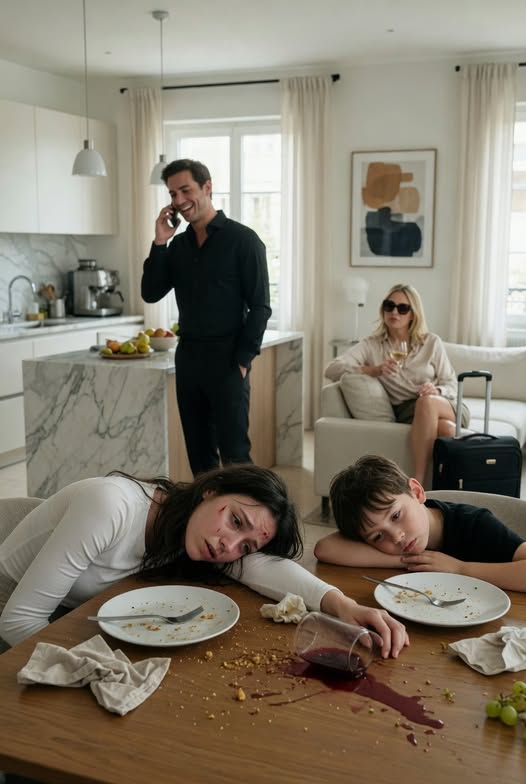
My 8-year-old daughter sent me a text saying, “DAD, COME TO MY ROOM. JUST YOU.”—then she turned around and showed me the handprints covering her back. I thought I was taking her to a piano recital that day, until one terrifying secret exposed the people she had been afraid of all along…
My name is Harrison Vance, and the worst day of my life began with a text message from my eight-year-old daughter. I was standing in my bedroom trying to finish getting dressed for Chloe’s spring piano recital when my phone buzzed on the dresser. The message was short, but something about it immediately felt wrong.
“Dad, can you help me with my dress zipper? Come to my room. Just you. Close the door.”
Chloe normally filled her texts with emojis and random spelling mistakes. This message sounded careful, almost rehearsed, and it made my stomach tighten before I even left the room.
As I walked down the hallway, my wife Meredith called from downstairs.
“Everything on schedule up there, Harrison?”
“Just finishing up,” I answered.
Even to me, my voice sounded strange.
When I entered Chloe’s room, I immediately knew something was wrong.
Her recital dress was lying untouched across a chair. Instead of getting ready, Chloe stood by the window clutching her phone with both hands. Her face was pale, and she looked terrified.
“Hey, kiddo,” I said. “Need help with the zipper?”
She shook her head.
“I lied about the zipper.”
The fear in her voice instantly erased every other thought from my mind.
“Dad, I need you to look at something,” she whispered. “But you have to promise you won’t freak out.”
My heart began pounding.
“What is it, sweetheart?”
Instead of answering, she slowly turned around.
With trembling hands, Chloe lifted the back of her shirt.
My entire world stopped.
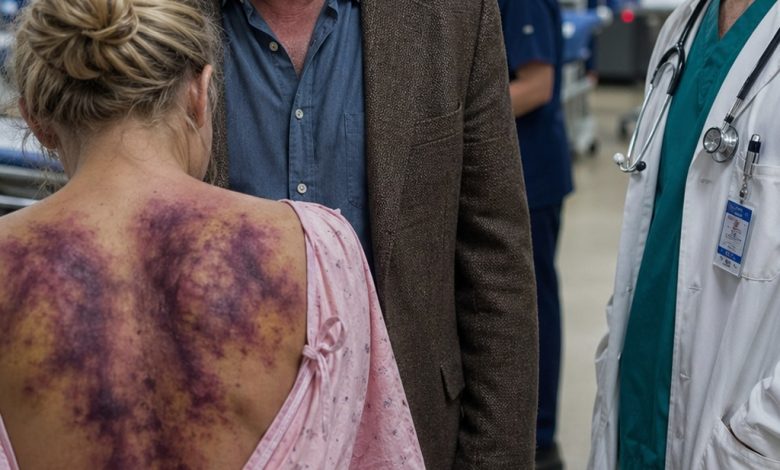
Dark bruises covered her ribs and lower back. Some were old and fading. Others were fresh, swollen, and deep purple. The marks weren’t random injuries from a playground accident.
They were handprints.
Someone had grabbed my daughter hard enough to leave fingerprints in her skin.
For a second, pure rage exploded inside me. I wanted to destroy whoever had done this. But when I saw the fear in Chloe’s eyes, I realized she wasn’t watching for anger.
She was watching to see if I would believe her.
I forced myself to stay calm and knelt beside her.
“How long has this been happening?”
A tear slid down her cheek.
“Since February.”
Then she whispered the name.
“Grandpa Richard.”
Thank you so much for reading this part of the story
I Took My Daughter Into a Fancy Restaurant to Escape the Rain… Then She Sat With the Man I Thought Had Abandoned Us
“Can I sit with you until my mom comes back?”
The little girl’s voice trembled in the middle of the most expensive restaurant in Manhattan, just as half the room turned to stare at her red rain boots, soaked coat, and purple backpack clutched tightly against her chest. She looked too small to be standing there alone, and too scared to be ignored.
The hostess had already told her twice she could not stay there.
“Sweetheart, this is not a waiting area,” the hostess said, forcing a polite smile that did not reach her eyes. “Your mother is probably outside.”
“My mom told me not to wait by the door,” the girl answered, blinking back tears. “She said if I ever got separated, I should find a place with people and stay still.”
A few women at a nearby table looked annoyed. A man in a tailored suit muttered that this was ruining the atmosphere.
No one stood up.
No one except Alexander Vale.
Everyone in New York knew that name. He owned ports, shipping companies, warehouses, and enough real estate to make powerful men lower their voices when he walked into a room.
Alexander was the kind of man who did not need to raise his voice to be obeyed. His security team stood behind him in dark suits, watching every movement inside the restaurant.
“Sir, I can remove her,” one guard said quietly.
Alexander did not even look at him.
“Don’t touch her.”
The little girl walked carefully to his table, leaving tiny wet footprints on the polished floor. “Sorry. The lady at the front wants me to wait by the door, but there are too many people pushing outside.”
Alexander studied her face, and the hardness in his expression slowly faded.
“Sit down,” he said.
Her eyes widened. “Really?”
“Really.”
The girl climbed onto the chair with both hands, careful not to knock anything over. “Thank you. My name is Lily. I’m six, but almost seven, even though my mom says ‘almost’ doesn’t count when I’m trying to act grown.”
Alexander gave a short laugh before he could stop himself. Behind him, his security guards exchanged surprised glances.
Lily pulled a wrinkled paper from her backpack. It was a maze with astronauts and planets drawn around the edges.
“I can’t find the way out,” she said.
“Let me see.”
Alexander picked up a blue crayon from the small pack she handed him. Lily watched him carefully, suspicion written all over her little face.
“My mom says I shouldn’t trust adults who promise to fix everything too fast.”
Alexander’s hand paused over the paper. “Your mom sounds very smart.”
“She is,” Lily said seriously. “She also says serious men are usually hiding the most.”
The crayon stopped moving.
Before Alexander could answer, the front door opened hard enough to make several guests turn. A woman rushed in from the rain, soaked from head to toe, her hair stuck to her face and panic breaking through every breath.
“Lily!”
The little girl jumped from the chair.
“Mommy!”
Camila Reyes ran toward her daughter, but the moment she saw the man sitting across from Lily, her body went still. Every drop of color left her face.
Alexander stood up.
For seven years, he had tried to forget those eyes.
“Camila,” he said, barely above a whisper.
Lily looked between them. “You know the serious man?”
Camila swallowed hard. “Yes, baby. I know him.”
Alexander lowered his gaze to the little girl. Her eyes. The way she pressed her lips together. The tiny wrinkle between her eyebrows when she waited for an answer.
His chest tightened.
“When was she born?” he asked, his voice low.
“February 12,” Lily answered proudly. “My cake was vanilla, but a piece fell on the floor.”
Alexander did the math in silence.
Camila watched the truth hit him.
“Tell me I’m wrong,” he said.
Camila pulled Lily close, holding her like the whole world had suddenly become dangerous. “You’re not wrong.”
The restaurant seemed to lose all sound.
Alexander stared at the child, then at the woman he had believed walked away from him years ago.
“Is she my daughter?”
Camila closed her eyes.
“Yes,” she whispered. “Lily is your daughter.”
Before Lily could understand what had just been said, one of Alexander’s guards received a call. His expression changed at once.
He stepped close to Alexander and lowered his voice.
“Sir, they found a package with your name on it near the service entrance.”
Camila felt the floor drop beneath her.
Because the worst part was not that Alexander had just discovered he had a daughter.
The worst part was that someone else seemed to have planned the entire moment.
And if that package was meant for Alexander, then bringing Lily into that restaurant had not been an accident.
It had been a warning.
PART 2
What would you do if, after six years of silence, the man you thought abandoned you suddenly appeared in front of your daughter?
“My husband had just left for a business trip when my six-year-old daughter whispered, ‘Mommy… we have to run. Now.’ I asked her, ‘What? Why?’. She was trembling as she said, ‘There’s no time. We have to get out of the house right now.’ I grabbed our bags and reached for the d
oor… and that’s when it happened.”
My husband had just pulled out of our driveway for a “business trip” when my six-year-old daughter whispered, “Mommy… we have to run. Now.”
It was 7:18 on a gray Saturday morning, the kind of morning where the kitchen still smelled like coffee, toast crumbs were stuck to the counter, and the lemon cleaner I had sprayed on the sink made the whole room feel sharper than it should have. Outside, our mailbox flag was down. Derek’s suitcase wheels had stopped rattling across the driveway less than half an hour earlier.
He had kissed my forehead at the front door like any normal husband leaving for the weekend.
“Back Sunday night,” he said, smiling too easily. “Don’t stress about anything.”
That was Derek’s favorite sentence when there was something to stress about.
Lily stood in the kitchen doorway in her socks, clutching the stretched hem of her pajama shirt. Her cheeks were pale. Her hair was tangled from sleep. Her little hands were balled so tightly that the seams of the shirt cut into her fingers.
I tried to laugh, because sometimes your brain reaches for denial before it reaches for danger. “What? Why are we running?”
She shook her head so hard her hair swung against her cheeks. “There’s no time,” she whispered. “We have to get out of the house right now.”
The refrigerator hummed. The dishwasher clicked through its drying cycle. Somewhere down the street, a neighbor’s SUV door slammed, ordinary and distant and completely useless.
I crouched in front of her. “Lily, honey, did you hear something? Did someone come to the house?”
She grabbed my wrist.
Her palm was wet with sweat.
“Mommy, please,” she said, and her voice cracked in a way no six-year-old voice should ever crack. “I heard Daddy on the phone last night.”
My stomach tightened so fast I almost reached for the counter.
“What did you hear?”
She looked toward the living room like the walls might repeat her words back to him. “He said he’s already gone. He said today is when it’s going to happen. He said… he said we won’t be here when it’s over.”
There are sentences a child should never have to carry. Not in a backpack. Not under a blanket. Not in the dark while grown-ups think the house is asleep.
I kept my voice low. “Who was Daddy talking to?”
“A man.” Lily swallowed. “Daddy said, ‘Make sure it looks like an accident.’ Then he laughed.”
For one full second, my mind rejected it.
Derek and I fought. We fought about money. We fought about his temper. We fought about the missing hours on his so-called work trips and the hotel charges he said were “client stuff.” We fought about the way he could turn any question into proof that I was dramatic, insecure, ungrateful.
But murder did not fit inside my marriage until my daughter said it out loud in her cotton pajamas.
I didn’t give myself permission to break down.
Fear is fast. Thinking is slow.
“Okay,” I said, forcing my voice steady. “We’re leaving. Right now.”
I moved like my body had been rehearsing this without telling me. I grabbed my purse from the chair, shoved my phone charger inside, then pulled the emergency folder from the cabinet above the microwave. My mother had made me keep it there after Lily was born: birth certificate, Social Security card, insurance cards, passport copies, two bank statements, and a county clerk copy of our marriage license in a blue folder labeled DOCUMENTS in my own handwriting.
At 7:23 a.m., I took one picture of Derek’s printed flight itinerary still sitting under the coffee mug by the sink.
Not because I understood everything.
Because proof disappears when scared people move too slowly.
I took Lily’s backpack from the hook by the laundry room. I added her inhaler, a granola bar, and the little stuffed rabbit she slept with every night. I did not take coats. I did not take toys. I did not take the family photo from the hallway where Derek had his hand on my shoulder like he owned the right to stand there.
Lily bounced near the front door, whispering, “Hurry, Mommy. Please hurry.”
I wanted to call 911. I wanted to scream. I wanted to drag Derek’s name through every police report, every family court hallway, every school office form I had ever filled out alone.
Instead, I slid my phone into my back pocket, kept one hand on Lily’s shoulder, and reached for the doorknob.
That was when the lock clicked.
Not from my side.
From the porch.
Lily stopped breathing beside me.
And then someone on the other side of our front door whispered my name…
My in-laws mailed my 6-year-old daughter an adorable brown teddy bear for her birthday. She smiled for a moment, then suddenly went still and asked, “Mommy, what is it?” When I leaned in and looked closer, my face drained of color. I did not scream. I took action—and three days later, police were standing at their door.
For my daughter’s sixth birthday, my in-laws sent her a sweet brown teddy bear wrapped in gold paper and finished with a satin pink ribbon.
Lily squealed the second she saw the box waiting on our porch.
“Grandma and Grandpa remembered!” she said, bouncing barefoot across the living room carpet.
I smiled, even though my stomach tightened slightly. My husband, Daniel, had not spoken to his parents in almost eight months. Not since the fight about boundaries, unexpected visits, and the way his mother, Margaret, kept telling Lily that “Mommy was too strict” every time I refused something.
Still, it was Lily’s birthday. I did not want to darken the day.
“Go ahead,” I said. “Open it.”
She ripped through the wrapping paper, lifted out the bear, and hugged it right away. It was soft, brown, and almost ridiculously cute, with shiny black eyes, a stitched smile, and a small red bow around its neck.
Her arms loosened around the bear. Her smile vanished.
“Mommy,” she whispered, holding it away from herself. “What is it?”
I moved closer.
At first, I thought she meant the tag. A small white gift tag was tucked under the bow. But then I saw the bear’s left eye. It did not match the right one. The right eye was glossy and flat. The left eye had a tiny dark circle at the center, too deep, too exact, like a pinhole.
My mouth went dry.
I carefully took the bear from Lily.
“Sweetheart,” I said, keeping my voice steady, “go help Daddy put candles on the cake.”
She frowned. “Is it broken?”
“Maybe,” I said. “I’ll check it.”
Daniel looked over from the kitchen, saw my face, and immediately walked toward me. I turned the bear over in my hands. There was a seam along the back, but near the battery compartment, I felt something solid. Not a music box. Not stuffing. A square.
Daniel whispered, “Claire?”
I did not answer.
I carried the bear into our bedroom, closed the door, and set it on the dresser. Then I switched off the lights. The left eye faintly glimmered.
Daniel’s face changed.
“No,” he breathed.
I searched the bear carefully and found a hidden switch under the stitched fabric near its leg. My fingers trembled, but I did not scream. I did not call Margaret. I did not accuse anyone.
I took pictures. I put the bear in a drawer. Then I called my brother, Aaron, a detective in another county.
He listened without cutting me off.
Then he said, “Claire, do not open it yourself. Do not destroy it. Put it in a paper bag, not plastic. I’m calling someone.”
Three days later, police were at my in-laws’ door.
PART 2
By the time police reached Margaret and Richard Whitmore’s white colonial house in West Hartford, I already understood the bear was not some innocent toy with a faulty part.
A technician had come to our house the morning after Lily’s birthday. He wore plain clothes, carried a black case, and introduced himself only as “Evan from digital forensics.” Aaron stayed beside him the entire time, not as a detective on the case, he reminded me, but as my brother.
Evan placed the teddy bear on our dining table as though it belonged in an evidence room. Because, apparently, it did.
Lily was at school. Daniel had called out of work and sat beside me, pale and silent, one hand wrapped around a mug of coffee he never touched.
Evan used a small blade to cut open the seam along the bear’s back. Inside, hidden behind the stuffing, was a compact wireless camera module with a microphone, battery pack, and microSD card. The lens had been positioned perfectly behind the bear’s left eye.
Daniel stood so quickly his chair scraped against the floor.
“My parents didn’t do this,” he said, but his voice carried no certainty.
Evan did not look up. “Someone did.”
He removed the card, slid it into a reader, and opened the files on his laptop. There were short recordings, each marked with dates and times. The first file had been created two weeks earlier, long before the bear ever reached our home.
That was when Daniel stopped trying to defend them.
The footage showed Margaret’s kitchen table. Her hands appeared in the frame, thin and manicured, turning the bear’s head toward herself.
Then Richard’s voice came from somewhere off camera.
“Are you sure this is legal?”
Margaret answered, “It’s our granddaughter. We have a right to know what goes on in that house.”
Daniel covered his mouth.
I felt something icy slide down my spine.
There were more clips. Margaret testing the sound. Richard complaining that the battery would not last long. Margaret saying, “Claire has poisoned him against us. If we can prove she screams at Lily, or neglects her, or says something unstable, we’ll have what we need.”
“What she needs for what?” I asked.
Evan’s face stayed professional, but his eyes softened. “Custody pressure. Family court. Maybe blackmail. That’s for investigators to determine.”
Police did not storm in that same day. They documented everything first. They took the bear. They interviewed Daniel and me separately. They asked about the history with his parents, whether they had keys to our house, whether they had ever threatened us.
Daniel told them about the last argument.
Margaret had appeared at Lily’s school months earlier and tried to sign her out early without permission. The office called me. I refused. Margaret later screamed at Daniel that we were “keeping Lily hostage.”
Richard had not screamed. He rarely did. He simply stood behind his wife and said, “Your mother is heartbroken.”
That was always how he took part. Quietly. Completely.
Three days after the birthday party, two officers and one detective went to the Whitmore house with a warrant.
Daniel and I were not there, but Aaron later told me what happened.
Margaret opened the door smiling, clearly assuming they were neighbors or church volunteers. When Detective Hollis identified himself, her smile disappeared. Richard came out from the den and asked, “What’s this about?”
The detective said, “We’re here regarding electronic surveillance equipment sent to a minor child.”
Margaret’s first words were not, “What equipment?”
They were, “Claire is behind this.”
That sentence told everyone enough.
PART 3
Detective Hollis later called the search “productive,” which sounded far too neat for what it actually was.Doors & Windows
Inside Margaret and Richard Whitmore’s house, police found packaging for the camera module in a drawer under takeout menus. They found printed instructions with highlighted sections about motion detection, night vision, and remote viewing. They found a second device still unopened in Richard’s desk.
But the laptop mattered most.
It was Margaret’s laptop, the silver one she used for church newsletters, recipes, and long emails to relatives about how Daniel had “changed” since marrying me. In a folder hidden under the name “Lily Memories,” investigators found downloaded clips from the teddy bear.
There was no footage from inside our home because I had noticed the camera before it had been activated in Lily’s room. But there were test recordings, screenshots of our social media pages, a scanned copy of Lily’s school calendar, and a document titled “Concerns About Claire.”
When police showed us that document two days later, Daniel read only the first page before pushing it away.
I read every page.
It was a plan.
Margaret had written down dates, incidents, and accusations, most of them distorted beyond recognition. One note said, “Claire isolates Lily from paternal family.” Another said, “Daniel appears afraid to contradict wife.” A third said, “Need proof of emotional instability.”
There were blank spaces under some claims, as though she had been waiting to fill them in later.
The hidden camera had been intended to give her that “proof.”
“She was building a case,” I said.
Detective Hollis nodded. “That appears to be the direction.”
Daniel sat beside me in the interview room, looking as if the floor had opened beneath him. He had always known his mother was controlling. He knew she could be vicious when challenged. But knowing someone is difficult is not the same as seeing proof that they planned to spy on your child.
“Our child,” he said quietly. “She put a camera in our child’s toy.”
No one corrected him. No one softened the words.
The legal process moved slowly at first, then suddenly all at once.
Margaret and Richard were questioned separately. Richard tried to shrink himself inside every sentence.
He said Margaret had ordered the camera. He said Margaret had sewn it into the bear. He said he had only “helped with the technical part” because she did not understand the setup.
But the receipts told a more complete story. The camera had been bought with Richard’s credit card. The software account had been created using his email. His phone had been used to test the live feed.
Margaret, meanwhile, gave a performance.
She cried. She shook. She told Detective Hollis she was “a concerned grandmother.” She said she was afraid for Lily. She said I had a temper, though she could not give one example that did not involve me telling her no. She said Daniel was being controlled. She said the bear was only meant to “protect” Lily.
Detective Hollis asked, “Protect her from what?”
Margaret answered, “From being taken away from us.”
That was the sentence that followed me home.
Not “from danger.”
Not “from abuse.”
From being taken away from us.
As if Lily were a family heirloom. As if my daughter’s life was a room Margaret believed she had been shut out of.
After the charges were filed, Daniel stopped sleeping properly. He would wake at two or three in the morning and check the windows, the back door, the garage. Sometimes I found him standing in the hallway outside Lily’s room, arms crossed, staring at the teddy bear-shaped nightlight she had picked out herself from Target after the police took the other one.Doors & Windows
“I should have cut them off sooner,” he said one night.
I leaned against the wall beside him. “You were raised to think their behavior was normal.”
“That’s not an excuse.”
“No,” I said. “But it’s an explanation.”
He nodded, although I could tell it gave him little comfort.
Lily only knew part of the truth. We told her the bear had a camera inside it, and that adults were not allowed to hide cameras in children’s toys. We told her Grandma and Grandpa had made a very serious mistake and that we would not be seeing them for a while.
She asked if they were angry with her.
Daniel dropped to his knees in front of her so quickly I thought he might fall apart.
“No, baby,” he said, holding her hands. “You did nothing wrong. Nothing.”
“Then why did they do it?”
He looked at me.
I answered because he could not.
“Because sometimes grown-ups make selfish choices when they want control. That does not make it your fault.”
Lily thought about that for a long time.
Then she said, “I don’t want any more surprise presents.”
And just like that, my six-year-old had learned something she never should have had to learn.
The first court hearing took place in early October. The leaves outside the courthouse had started turning red and gold, and the air smelled like rain on pavement. Daniel wore a navy suit. I wore a gray dress and flats because I wanted to feel steady.
Margaret arrived with Richard and a lawyer. She looked smaller than usual, but not weaker. Her hair was sprayed perfectly. Her pearls rested neatly against her throat. When she saw Daniel, her face collapsed.
“My son,” she whispered.
Daniel did not step toward her.
Her expression hardened for half a second before she remembered where she was. Then she started crying again.
The prosecutor presented the evidence: unlawful surveillance, attempted invasion of privacy, use of an electronic device to intercept audio, and the aggravating factor that the target was a minor inside a private home. The exact charges depended on state statutes, the prosecutor explained, but the court understood the seriousness.
Margaret’s lawyer argued that no footage had been captured inside our home, that the device had never successfully recorded Lily in her bedroom, and that Margaret had acted out of “misguided concern.”
The judge looked down over her glasses.
“Misguided concern does not require hidden recording equipment,” she said.
I remember that clearly.
I also remember Margaret turning her head to stare at me after the judge said it, as if I had somehow put those words into the judge’s mouth.
A protective order was issued that day. Margaret and Richard were forbidden from contacting us directly or indirectly. No calls. No letters. No gifts. No messages through relatives. No showing up at Lily’s school, our home, Daniel’s workplace, or any of Lily’s activities.
When the order was read aloud, Margaret made a small sound, like an injured animal.
Daniel closed his eyes.
I wanted to feel victorious. I did not. I felt exhausted.
The family fallout arrived fast.
Daniel’s aunt Patricia called first. She left a voicemail saying, “Your mother is devastated, and Claire needs to stop escalating this.”Parenting books
Daniel deleted it.
Then his cousin Mark texted: “Was it really necessary to involve police? They’re old. They made a mistake.”
Daniel answered with one sentence: “They hid a camera in my daughter’s teddy bear.”
Mark did not respond.
For weeks, relatives tried to shrink the crime by making Margaret seem delicate. They talked about her loneliness, her anxiety, her fear of losing her granddaughter. They mentioned Richard’s heart medication. They spoke of forgiveness as if forgiveness meant pretending evidence did not exist.
But Daniel did not bend.
One evening, after another cousin sent a message suggesting a “family meeting,” he typed a reply and showed it to me before sending.
“My daughter’s privacy and safety are not family discussion topics. Anyone who minimizes what happened will not have access to us.”
He stared at the screen for a long time after he sent it.
“That sounded harsh,” he said.
“It sounded like a father,” I replied.
The case did not become a dramatic trial. Margaret and Richard eventually accepted a plea agreement. They avoided jail time, which angered me at first, but the conditions were strict: probation, fines, mandatory counseling, surrender of surveillance equipment, no contact with us, and a permanent record tied to what they had done.
The judge also extended the protective order.
Margaret tried to speak at sentencing. She stood with a folded tissue in both hands and said she had only wanted to make sure Lily was safe.
The judge asked whether she understood why hiding a camera inside a child’s toy was a violation.
Margaret hesitated.
That hesitation answered the question.
Richard spoke next. His voice was low. “I should have stopped it.”
Daniel, sitting beside me, whispered, “Yes, you should have.”
Richard looked toward him, but Daniel stared straight ahead.
After court, Margaret attempted one last scene in the hallway. She stepped toward us, forgetting or ignoring the order, and said, “Danny, please. I’m your mother.”
Detective Hollis, who had attended the hearing, immediately moved between them.
“Mrs. Whitmore,” he said, “step back.”
Her face flushed. “I just want to talk to my son.”
Daniel finally looked at her.
“No,” he said. “You wanted access. That’s different.”
For once, Margaret had nothing to say.
Life did not return to normal quickly. It came back in pieces.
We changed locks, passwords, school pickup permissions, pediatrician privacy settings, and every emergency contact form. We checked smoke detectors, nightlights, stuffed animals, and picture frames. I hated that we did. I hated that every innocent object looked suspicious for a while.
Lily began asking before accepting gifts.
“Who sent it?”
“Did you check it?”
“Can it see me?”
Every question cut into me. But little by little, she asked less often. Children heal unevenly. One day she refused to sleep with any stuffed animals. A month later, she carried a purple rabbit everywhere and named it Waffles.
Daniel started therapy. Not because he was broken, but because he finally understood that growing up with Margaret had trained him to question his own boundaries. He learned to say out loud the things he used to bury.
“My mother confuses love with possession.”Parenting books
“My father enables harm by staying quiet.”
“I don’t owe access to people who hurt my family.”
Those sentences changed him. Not instantly, but steadily.
As for me, I stopped replaying Lily’s birthday quite so often. For a while, I kept seeing the bear’s left eye, that tiny black circle staring out from a toy meant to be pressed against my daughter’s chest. I kept wondering what might have happened if Lily had not noticed something strange.
But she had.
That mattered.
Lily had seen what the adults tried to hide.
On her seventh birthday, she asked for a backyard party with cupcakes, bubbles, and a bounce house shaped like a castle. We invited her classmates, our neighbors, my brother Aaron, and Daniel’s aunt Patricia was not included.
Near the end of the party, Lily opened presents at the picnic table while Daniel and I stood close by.
There were art supplies, books, a glittery backpack, and a box with a stuffed fox inside.
Lily lifted it, studied its face, then looked at me.
“Mommy?”
I stepped closer. “Want me to check it?”
She nodded.
I checked the seams, the eyes, the tag, and the battery compartment that did not exist. Then I handed it back.
“All clear.”
She hugged the fox.
For the first time in a year, I watched her hold a stuffed animal without fear passing across her face.
Daniel took my hand under the table.
Across the yard, children screamed with laughter as bubbles drifted above the grass. The late afternoon sun turned everything warm and golden. Lily ran toward the bounce house with the fox tucked under one arm, her ponytail swinging behind her.
Daniel squeezed my hand.
“I think we’re okay,” he said.
I watched our daughter climb into the castle and vanish among laughing children.
“No,” I said softly. “We’re better than okay.”
Because the truth was, the teddy bear had not destroyed our family.
It had revealed the part of it that had already been dangerous.
And once we saw it clearly, we finally locked the door.
Under carefully strung fairy lights, the colors of Princeton University glowed against the dark velvet sky of a warm summer night.
I stood near the patio with a glass of sparkling water in my hand, watching my eighteen-year-old daughter, Grace. She stood by the glowing edge of the pool, laughing with her friends, her dark hair catching the light. She looked radiant. She looked unstoppable.
She looked nothing like the terrified eight-year-old girl I had met ten years earlier.
A decade. I had spent ten years building safety beneath her feet. I had wiped away the silent tears over AP Calculus at 2:00 AM. I had held her through night terrors after her biological mother, Camille, packed one suitcase and walked out, saying she needed a “freer lifestyle.” I paid for the tutors, the violin lessons, the college prep courses, and every tool that helped shape her brilliant mind into something strong enough to conquer the Ivy League.
I was the architect of Grace’s survival, peace, and success.
Across the manicured lawn stood my husband, David.
He was by the outdoor bar, holding expensive scotch and entertaining his smug golf friends. He wore a custom navy blazer bought with money from my marketing agency.
“It’s all about genetics and discipline,” David boasted loudly. “I always knew my girl was Princeton material. A child needs a strong father to build a legacy.”
I took a careful sip of water and swallowed the bitter taste of his lie.
David hadn’t attended a parent-teacher meeting in years. He hadn’t paid for SAT prep. He hadn’t stayed up during heartbreaks, panic attacks, or college essays. He appeared only for award banquets, graduations, and photos he could post online to look like a devoted father.
But I didn’t care about credit.
The estate, the cars, the party, the entire lifestyle—all of it came from my successful marketing agency. David was a mid-level regional manager who loved spending my money to look powerful.
Tonight was supposed to be about Grace.
Her victory.
Her joy.
The beautiful result of ten years of invisible love.
I signaled the caterer to bring out the custom three-tiered crimson cake.
Then the iron security gates at the end of the driveway buzzed open.
A sleek cherry-red rented sports car rolled in.
The engine revved before going silent.
The doors opened.
And a ghost from ten years ago stepped out.
Camille.
She did not look sorry. She did not look ashamed. She looked like a woman arriving to claim a prize she had not earned.
She wore a tight crimson designer cocktail dress that matched the party theme. Her hair and makeup were perfect. She had not called Grace once in ten years. Not for birthdays. Not for Christmas. Not for graduations.
Yet she crossed my lawn as if she owned it.
My heart slammed against my ribs.
I moved toward Grace, ready to place myself between them.
But David was faster.
He didn’t look surprised.
He walked straight to Camille with a wide, sickening smile. He wrapped his arm around her waist and pulled her close.
Then he grabbed the microphone from the DJ.
“Ladies and gentlemen, may I have your attention?”
The crowd turned.
Grace froze by the pool. The color drained from her face.
“Tonight, we are not only celebrating my brilliant daughter’s acceptance to Princeton University,” David announced. “We are also celebrating a long-awaited reunion.”
His eyes found mine.
“Camille and I have been talking for months. We realized our family belongs together. So tomorrow morning, I will be filing for divorce from Sarah.”
Gasps spread across the lawn.
David raised his hand, enjoying the silence.
“My real, biological family is finally back together just in time to send Grace off to make us proud,” he continued. “And I want to thank Sarah publicly for keeping the seat warm.”
He smiled at me.
“Thank you, Sarah, for being such an effective nanny. Thank you for raising Grace for free. Your services are no longer required. You are dismissed.”
For three seconds, the garden was completely silent.
Then one of David’s golf friends laughed.
The laughter spread.
Some guests clapped, believing they were witnessing a romantic reunion instead of a public execution.
Camille waved smugly and leaned against David’s shoulder.
I stood still, my face burning with hum!liation. I waited for Grace to break. I waited for her to run to the woman who had given birth to her.
But Grace did not move toward Camille.
Camille opened her arms wide and walked toward her.
“My beautiful girl,” she cooed loudly. “Mommy is finally home. I missed you so much. We’re going to have so much fun in Princeton. I’ve already started looking at apartments near campus.”
David beamed like a man who believed he had won.
He thought DNA would erase a decade of absence.
He thought he could crush me, steal half my wealth, and walk away with the “Princeton Dad” trophy.
He thought he had outplayed me.
I stood still.
I didn’t cry.
I didn’t scream.
Because I had spent ten years teaching Grace one thing above all else:
how to recognize her own worth.
The crowd waited for the emotional reunion.
Grace looked at Camille’s open arms.
Then at David’s smug face.
Then she looked directly at me.
She did not look like a scared child.
She looked like a queen.
Grace set her red plastic cup on the patio table and walked calmly to the DJ booth.
Then she ripped the microphone from David’s hand.
A sharp screech silenced the crowd.
Grace stood beneath the lights, straight-backed and steady, radiating the confidence I had spent ten years building into her.
She looked at the woman in red.
“Camille,” she said, her voice cold through the speakers.
Camille froze.
“You do not get to abandon an eight-year-old because you needed to ‘find yourself’ in Miami,” Grace said. “You do not get to ignore ten years of birthdays, Christmases, school events, and graduations, then show up and take credit for an Ivy League acceptance letter you didn’t help write. You are a stranger in a cheap dress. Do not call yourself my mother.”
“My father just publicly thanked Sarah for raising me for free,” Grace said. “He thinks he’s clever. He thinks he won the divorce. He thinks he outsmarted everyone here.”
Then she looked directly at him.
“That speech was dramatic, David. But your timing is interesting, considering I went to the county courthouse with Sarah at 8:00 AM this morning.”
David froze.
“The courthouse?” he asked.
“I went there to finalize my adult adoption,” Grace said.
The garden fell silent.
“That means Sarah is now legally and officially my only recognized mother. Camille’s rights are gone by default. And more importantly, David, the multi-million-dollar educational trust Sarah created for my Princeton tuition has a morality clause.”
Grace smiled.
“The trust requires your immediate and permanent eviction from Sarah’s property to remain active. You don’t get the Princeton Dad trophy. You don’t get the money. And you don’t get me.”
Silence replaced the applause.
David’s face drained of color.
He looked at me.
I stood on the patio, calm now, and smiled.
The guests emptied out within minutes.
David’s golf friends rushed toward the valet, suddenly desperate not to be associated with him. The caterers quietly disappeared into the kitchen. The party died under the fairy lights.
David stood alone on the grass, shaking.
“Sarah,” he stammered. “What is she talking about? You can’t evict me. We’ve been married ten years. Half of this is mine. The house, the agency, the cars.”
I picked up the manila envelope I had placed on the patio table hours earlier.
Then I handed it to him.
“You should read the prenuptial agreement you insisted on signing ten years ago,” I said. “Back then, you thought my marketing startup would fail, and you didn’t want my debt touching your salary. You demanded complete asset separation.”
David stared at the envelope.
“What’s mine is mine,” I said. “What’s yours is yours. The estate, the agency, the investments, and the accounts are all legally mine. The only thing you own is the credit card debt you built flying Camille here first-class and renting that ridiculous Jaguar.”
Camille’s head snapped toward him.
“Debt?” she said. “You told me Sarah was controlling the accounts. You said the divorce settlement would fund Boston.”
“He lied,” Grace said, stepping beside me and taking my hand. “He’s broke. He’s always been broke. He’s just a parasite.”
Camille stared at David in disgust.
“You’re pathetic.”
“Camille, wait,” David begged.
“Don’t touch me!” she shouted, pulling away.
“You have thirty minutes to leave our property,” Grace said coldly, “or I’ll call the police for trespassing.”
Camille didn’t cry. She didn’t look at Grace. She simply stormed back to the rented sports car and drove off into the night.
David was left alone beneath the deflating crimson and white balloons, holding divorce papers and a thirty-day eviction notice.
He opened his mouth to beg.
I didn’t give him a final word.
I squeezed Grace’s hand.
Together, we turned our backs on him and walked into our house. The glass doors locked behind us, leaving him outside in the dark where he belonged.
Inside the quiet kitchen, we shared a slice of the Princeton cake.
My phone buzzed.
It was my lead attorney.
Private investigators confirmed David’s hidden debt accounts. He owes over $150,000 to secondary lenders in his name. Without your income, he will default by the end of the month. Bankruptcy is unavoidable.
I smiled.
The parasite had finally been cut off from the host.
Four months later, the crisp autumn air moved through the fiery leaves of Princeton’s campus.
I carried a box of textbooks into Grace’s dorm room and set it on the wooden desk.
Grace stood by her bed, hanging a framed photo on the brick wall. It was a picture of the two of us on the courthouse steps the morning the adoption became official. We were both smiling with pure, victorious joy.
Through my attorneys, I had heard the final collapse of David’s ego back home.
Without my money, his hidden debts and failed investments crushed him. He filed for bankruptcy and moved into a small rented studio. His country club friends vanished. No one wanted to be seen with a broke, hum!liated man.
Camille disappeared back to Europe after maxing out the last of David’s credit.
They became ghosts.
Irrelevant shadows in a life now filled with peace.
“Are you sure you don’t need me to stay one more night?” I asked Grace, smoothing the Princeton blanket on her bed. “I’m worried we didn’t pack enough sweaters.”
Grace turned and wrapped her arms around my neck.
“I’ll be fine, Mom,” she whispered.
That word warmed something deep inside me.
“You spent ten years organizing my life,” she said. “You fought the monsters away. Now go home and build your agency. I’m exactly where you taught me to be. I’m ready.”
I hugged my daughter tightly, tears filling my eyes.
They were not tears of betrayal.
They were tears of victory.
“I love you, Grace,” I said. “I’m so proud of the woman you are.”
“I love you too, Mom,” she said.
When I walked out of the dorm and into the historic courtyard, I looked back at the third-floor window.
Grace stood there waving.
Brilliant. Fierce. Untouchable.
Ready to conquer the world.
I smiled and waved back, then stepped into the bright autumn sun.
I had lost a parasitic, narcissistic husband, and I had endured a night of profound hum!liation. But in the fire of that betrayal, I had forged a masterpiece. And I walked away with the absolute, unshakeable certainty that no one, no matter their DNA or their arrogance, could ever take my daughter away from me again.
My sister Amy vanished when we were teenagers. No note. No explanation. Just an empty room and the denim jacket she always wore—the one with the frayed cuff she refused to fix.
Life kept moving. School ended. Jobs changed. People changed. But the space she left never truly closed.
“She said I needed it more than she did,” the woman replied. “It was her way of letting go.”
I held the jacket. Memories, laughter, and silence came rushing back. But it felt different now—not empty, not heavy. She hadn’t disappeared; she had chosen her path.
“I’ve wondered about her all these years,” I said softly.
“She was okay when I met her,” the woman replied. “That’s what I know.”
It wasn’t everything—but it was enough.
As we parted, the ache I’d carried for sixteen years softened. Closure doesn’t always come with answers. Sometimes it comes in fragments: a jacket, a memory, a stranger who holds a piece of someone you thought you’d lost.
The sentence cut my life in two before I even made it to the dining room.
I was carrying a pumpkin pie down the hallway of my parents’ house outside Pittsburgh, both hands wrapped around the cold tin, trying not to drop it on the carpet my mother had made such a big deal about replacing.
The air smelled like glazed ham, cloves, butter, and the cinnamon candle she saved for company.
The Steelers game was roaring from the den.
My father’s ice clicked in a glass.
The cheap gold garland around the kitchen doorway scratched against the trim every time the heat kicked on.
Then I heard my mother say, “She owes us.”
I stopped so fast the pie shifted in my hands.
My Aunt Sandra said something soft, almost a laugh, the kind people use when they want to sound harmless.
“Well,” Sandra said, “Emily’s done pretty well for herself.”
“She should,” my mother answered. “We fed her for eighteen years.”
That was all.
One sentence.
One ordinary sentence said in an ordinary kitchen while the ham stayed warm and the football announcers kept yelling from another room.
But it landed in me like a receipt for my whole life.
I set the pie down on the hallway table because my hands were starting to shake.
For fifteen years, I had sent my parents $4,000 every month.
Not almost every month.
Not when I could spare it.
The transfer had gone out like a second rent payment, so regular and so expected that nobody in my family spoke of it as help anymore.
It was simply something that happened, like the electric bill clearing, or the mortgage draft, or the trash getting picked up on Wednesday.
I started when I was twenty-three.
My father, Richard Bennett, had hurt his back at the steel plant, and my mother called me from their kitchen crying so hard I could barely understand her.
They were three months behind on the mortgage.
There were late notices.
There were pills my father needed.
There was a fear in my mother’s voice I had never heard before.
I had just gotten my first paralegal job in Boston.
My apartment was small enough that I could touch the counter and the stove without moving my feet.
I remember standing there in socks, staring at a packet of ramen, and telling my mother it would only be temporary.
I believed that when I said it.
I believed a lot of things at twenty-three.
Temporary became one year.
Then five.
Then ten.
Then fifteen.
The mortgage got current.
The roof needed replacing.
The prescriptions went up.
The property taxes were due.
The insurance premium jumped.
The old SUV became “unsafe,” so a newer one appeared in their driveway, and somehow I knew about the payment before I knew about the color.
Then the kitchen cabinets were “falling apart.”
They had looked perfectly fine to me, but my mother cried and said she was embarrassed to have people over.
So I sent extra.
That became the kitchen update I was standing inside when she told my aunt I owed her for being fed as a child.
Some families only call it sacrifice when they are standing on the receiving end.
The moment you stop bleeding quietly, they call it selfish.
At dinner that Christmas night, I did not confront her.
I passed the mashed potatoes.
I smiled at my father’s joke about the Steelers.
I asked Sandra if she wanted whipped cream with her pie.
I kissed my mother’s cheek when she asked me to get more gravy.
My voice stayed calm.
That calm frightened me more than rage would have.
Rage would have been easy to explain.
Calm meant something in me had already stepped back.
At 10:14 p.m., I locked the guest room door and opened my banking app.
The floral wallpaper looked yellow in the bedside lamp.
My suitcase sat open on the chair.
I had not even changed out of my dinner clothes.
After rent, credit card minimums, and the last-minute flight home, I had $611.83 left.
I stared at the number for so long it stopped looking real.
My next automatic transfer to my parents was scheduled for January first.
Four thousand dollars.
More than six times what I had left.
I called Claire.
Claire was my financial adviser, but that title sounds colder than what she had actually been to me.
For a year, she had been the person across a conference table telling me, gently and repeatedly, that I could not rescue people by drowning myself.
She had shown me charts.
She had asked me about retirement.
She had watched me explain away every crisis my mother sent to my phone.
That night, when she picked up, I whispered, “Stop the transfer.”
There was a pause.
Then she said, “Emily, are you sure?”
“Shut down the family account,” I said. “Effective tonight.”
She asked again, softer that time.
I looked at the wallpaper my mother had chosen during the remodel I paid for.
“For the first time in fifteen years,” I said, “I am.”
The next morning, my mother handed me a shopping list before I left for the airport.
She did not ask whether I had slept.
She did not ask why my eyes looked swollen.
She stood at the sink with her coffee and said, “If you get a chance after your flight, order that air fryer your father wanted.”
Then she added, “The good one, not the cheap one.”
I folded the list once and put it in my coat pocket.
I did not trust myself to speak.
On the plane back to Boston, my phone buzzed before we even pulled away from the gate.
Don’t forget January might need to hit early because of the holiday.
I read it twice.
There was no “Can you send it?”
There was no “Are you okay?”
There was no “Thank you for fifteen years of keeping us afloat.”
Just a reminder.
Like I was a utility bill with a daughter’s name attached.
When I got home, I did not unpack.
I put my suitcase by the door, made coffee I barely tasted, and sat at my kitchen table with my laptop open.
Then I started pulling records.
Bank statements.
Wire confirmations.
Mortgage transfers.
Prescription reimbursements.
Insurance payments.
Credit card balances.
Screenshots of text messages.
The transfer history exported by date, amount, and receiving account.
The recurring-payment schedule from the banking app.
The mortgage-servicer confirmations that showed the months I had covered.
I labeled the folders by year.
I wrote notes in the margins.
I documented everything because guilt gets blurry until numbers make it sit still.
By midnight, the recurring monthly transfers alone totaled $720,000.
That did not include the extra roof payment.
It did not include the kitchen.
It did not include the SUV help.
It did not include flights home or gifts or the emergencies that had always somehow arrived right after I got paid.
Seven hundred and twenty thousand dollars.
And I had $611.83 to my name.
Not because I had been reckless.
Not because I had bought designer bags.
Not because I had taken luxury vacations.
Because I had obeyed.
On December 29, my mother texted again.
Did you send it?
A minute later, another bubble appeared.
Mortgage drafts before the holiday weekend.
Then another.
And I already put the deposit down for New Year’s Eve food.
I looked at those three messages for a long time.
Three dots appeared.
Then disappeared.
Then appeared again.
I typed, I can’t anymore.
Her answer came back almost instantly.
Can’t or won’t?
That was the moment I knew she had been waiting with the phone in her hand.
I did not answer her.
I printed everything instead.
On New Year’s Eve, I drove back to Pittsburgh with the folder on the passenger seat and my old black coat buttoned over the torn lining.
The road was gray.
The sky hung low over the highway.
Every mile felt like I was driving toward a version of myself I should have met years earlier.
My mother opened the door looking annoyed first and surprised second.
“You should have called,” she said.
“I know.”
She stepped back because there was nothing else to do.
The house was warm with noise.
My father was in the den.
Sandra stood in the kitchen arranging appetizers on the remodeled counters.
The cinnamon candle was burning again.
The same candle.
The same kitchen.
The same little performance of family comfort.
My mother opened her mouth like she was about to ask whether I had brought wine.
Instead, I walked past her into the dining room and laid the folder in the middle of her holiday spread.
“What is this?” she asked.
I looked straight at her.
“Since we’re talking about what I owe,” I said, “I thought we should finally do the math.”
My father came in frowning.
Sandra followed with a paper napkin still in her hand.
My mother’s face tightened the second she saw the first transfer record.
That was how I knew she understood before anyone else did.
I spread out page after page.
Mortgage payments.
Monthly deposits.
The roof year.
The SUV year.
The kitchen year.
The prescription year.
Then I slid my current bank balance across the table.
$611.83.
The room froze.
A fork rested halfway off a dessert plate.
Sandra’s hand hovered over a stack of napkins.
My mother’s thumb stopped on the edge of a statement.
From the den, the football game kept shouting like another family, somewhere else, was still having a normal holiday.
Nobody moved.
My father picked up the summary page.
I watched his eyes move down the column.
I watched him reach the total.
All the color drained out of his face.
“Patty,” he said quietly, “what exactly have you been taking from her?”
My mother did not look at him.
She looked at me.
That hurt more than I expected.
Not because she looked sorry.
Because she looked betrayed.
As if I had done something cruel by putting the truth on paper.
I pulled out the last sheet from the folder.
“No,” I said. “The real question is what you think I still owe after this, because if we’re counting everything tonight, then you haven’t even seen the part that shows the transfer was already canceled.”
My mother’s hand froze.
Sandra made a small sound and covered her mouth.
My father looked at me so sharply that I thought, for one second, he might be angry.
Instead, he sank into the chair.
“You canceled January?” my mother said.
Her voice was thin and hard.
“I canceled every automatic deposit,” I said.
“You can’t do that before the mortgage draft.”
“I already did.”
“You don’t get to just cut us off.”
“I didn’t cut you off,” I said. “I stopped paying a bill no one ever admitted belonged to me.”
She stood there with all her holiday food around her and no sentence ready.
That was new.
My mother had always had sentences.
She had sentences for bills.
Sentences for neighbors.
Sentences for why my father needed help.
Sentences for why I should understand.
Sentences for why temporary needed to last just a little longer.
My father held the page with both hands.
“How long did you know?” he asked her.
She turned on him then.
“Don’t you start,” she said.
His face changed.
It was not loud.
It was not dramatic.
But something in him seemed to sit up straighter.
“Patty,” he said, “answer me.”
She looked toward Sandra.
Sandra looked down at the napkin in her hands.
Nobody rescued her.
That was the first real consequence I saw.
Not shouting.
Not punishment.
Just the silence of people finally refusing to make her version of things comfortable.
“I handled the bills,” my mother said.
That was all.
Three words that covered fifteen years of my life.
My father’s voice shook. “I thought Emily was helping sometimes.”
I almost laughed.
Not because it was funny.
Because sometimes is such a gentle word for a wound that has a schedule.
“Dad,” I said, “it was four thousand dollars every month.”
He looked at me then.
Really looked.
At my coat with the torn lining.
At the circles under my eyes.
At the printed balance.
His mouth opened and closed.
“I didn’t know,” he said.
I believed him halfway.
That was the hardest part.
My father had not made the calls.
He had not texted me mortgage reminders.
He had not asked for the air fryer.
But he had lived inside the comfort my money bought.
There are different kinds of not knowing.
Some are innocent.
Some are convenient.
Sandra pulled out a chair and sat down slowly.
“Emily,” she said, “honey, why didn’t you say something?”
I looked at her.
Then at my mother.
Then at the pages covering the table.
“I did,” I said. “For fifteen years. I said it every month in dollars.”
No one answered.
My mother’s eyes shone, but the tears did not fall.
I knew those tears.
They had raised money from me before.
This time, they met paperwork.
“I am not sending January,” I said.
My mother sucked in a breath.
“I am not sending February,” I continued. “I am not sending March. The account is closed. Claire has the confirmation. I will help Dad review what bills are necessary and what can be sold, canceled, refinanced, or handled without me. But the monthly transfers are over.”
My father stared at the papers.
Sandra whispered, “Patricia.”
My mother snapped, “Don’t.”
That one word cracked across the room.
For one ugly heartbeat, I wanted to shout.
I wanted to list every birthday I had spent alone because flights were too expensive.
I wanted to tell her about the winter coat.
I wanted to tell her about the man named David who had asked me what I wanted our life to look like and how I had let him go because I could not imagine building a future with an invisible mortgage sitting between us.
I wanted her to hurt the way I had hurt quietly.
Instead, I placed the folded shopping list on the table.
The air fryer was still written on the third line.
My mother stared at it.
My father looked at it, too.
That tiny piece of paper did what the $720,000 had not.
It made the room ordinary again.
It made the cruelty small enough to understand.
“You gave me this the morning after Christmas,” I said. “After I flew home. After I had paid for the kitchen you were standing in. After you told Sandra I owed you for feeding me.”
My mother’s face changed.
There it was.
Not guilt exactly.
Recognition.
“I didn’t mean it like that,” she said.
“Yes,” I said. “You did.”
The sentence sat between us.
No one touched it.
My father put the summary page down carefully, like it was something breakable.
“I’m sorry,” he said.
I waited.
He swallowed.
“I should have asked more questions.”
That was not enough.
It was also the first honest thing anyone at that table had said to me in years.
I nodded once.
My mother wiped at one eye.
“So what,” she said, “you’re just leaving us to lose the house?”
There she was again.
The old door.
The old guilt.
The old room I had lived in for fifteen years.
“No,” I said. “You are going to decide what you can afford. Dad is going to see the full budget. If the SUV has to go, it goes. If the house is too much, you talk to the mortgage company. If the kitchen remodel made you feel rich, you can sit in it while you learn what rich actually costs.”
Sandra looked down at the table.
My father closed his eyes.
My mother whispered, “You sound cold.”
“I am not cold,” I said. “I am tired.”
That was the truth under everything.
Under the anger.
Under the folder.
Under the $611.83.
I was tired.
Not for a week.
Not for a season.
For fifteen years.
I gathered the pages slowly, but I left the copies on the table.
My father asked if I would stay.
My mother did not.
I looked around that dining room with its holiday plates and warm lights and the little American flag magnet on the refrigerator in the kitchen behind it.
It looked like family.
It smelled like family.
For years, I had confused that with being safe.
“I’m going back to Boston tonight,” I said.
Sandra stood.
“Emily, it’s New Year’s Eve.”
“I know.”
My father tried to hand me the summary page.
I shook my head.
“Keep it.”
He looked at the total again.
His hands trembled.
My mother finally sat down.
She did not apologize.
Not then.
Maybe she did not know how to say sorry without turning it into a bill.
I walked to the front door.
The porch light was on.
My car was cold when I got inside.
For a minute, I sat in the driveway and let myself shake.
Then my phone buzzed.
It was Claire.
You okay?
I looked through the windshield at the house I had helped keep standing for almost half my life.
Then I typed back, Not yet. But I’m done paying to pretend I am.
On January first, no transfer went out.
The world did not end.
The mortgage company did not call me.
My mother did, seven times.
I let each call go to voicemail.
By afternoon, my father texted me a photo of the dining table.
The papers were still there.
Under the photo, he wrote, I’m going through them.
I cried when I read that.
Not because everything was fixed.
Nothing was fixed.
But for the first time, the truth had stopped living only in my bank account.
A week later, my father called and asked me how to export statements.
My mother did not get on the phone.
I heard her in the background once, moving dishes around too loudly.
I did not ask to speak to her.
Healing does not always begin with forgiveness.
Sometimes it begins with a stopped payment.
Sometimes it begins with a folder on a dining room table and a father finally seeing the total.
Sometimes it begins with a daughter admitting that love had become a monthly withdrawal, and that she was allowed to close the account.
For fifteen years, I had been sending my parents $4,000 every month.
Last Christmas, I heard my mother say I owed her because she fed me for eighteen years.
By New Year’s Eve, they finally understood how broke I really was.
And by New Year’s Day, so did I.
Not just broke in money.
Broke in the places where a daughter keeps hoping one more sacrifice will finally make her loved correctly.
That was the part no bank statement could show.
But the statements did one thing love had never managed to do in that house.
They made everyone count……………………..
# PART 2: THE LINE ITEM
My father took the page from my hand.
Not quickly.
Not angrily.
Carefully.
The way people pick up something fragile when they are afraid it might already be broken.
The room had gone so quiet I could hear the refrigerator humming in the kitchen.
Outside, somewhere down the street, fireworks had already started.
New Year’s Eve.
A new year waiting outside the windows while fifteen years sat on the dining room table between us.
My father adjusted his glasses.
He read the line once.
Then again.
His face changed.
Not all at once.
Slowly.
Like a man watching a familiar road disappear beneath fog.
“Why does this say the mortgage was paid off in March three years ago?”
The room stopped breathing.
Sandra’s hand flew to her mouth.
My own heart stuttered so hard I thought I had heard him wrong.
Paid off?
No.
That wasn’t possible.
I had sent money every month after that.
Every month.
Four thousand dollars.
Without fail.
I reached for the statement and read the line myself.
Mortgage Satisfaction Filed.
March 14.
Three years earlier.
My knees nearly gave out.
I looked at my mother.
She was staring at the table.
Not surprised.
Not confused.
Cornered.
My father’s voice cracked.
“Patty?”
Still no answer.
“Patty,” he repeated, louder this time. “Answer me.”
My mother folded her arms.
The same way she had folded them when I was sixteen and came home after missing curfew.
Defensive.
Certain.
Prepared to be right.
“I handled the finances,” she said.
The words landed like stones.
My father blinked.
“Handled them?” he asked. “Emily kept sending money for three more years.”
My mother’s jaw tightened.
“We still had expenses.”
“Expenses?” Sandra whispered.
My mother turned sharply toward her sister.
“Don’t start.”
But Sandra wasn’t looking at her.
She was looking at me.
And for the first time in my life, I saw pity in her eyes.
Not for my mother.
For me.
My father flipped through the pages again.
His hands were trembling now.
“Three years,” he whispered.
I did the math automatically.
Three years.
Thirty-six months.
One hundred forty-four thousand dollars.
After the mortgage had already been paid.
The number hit me harder than the total ever had.
Because the first years had been sacrifice.
These years felt different.
These years felt like something else.
My mother finally lifted her chin.
“I saved some of it.”
The room went silent again.
Saved.
Not used for bills.
Not used for emergencies.
Saved.
My father stared at her as if he had never seen her before.
“Saved where?” he asked.
She didn’t answer.
And then Sandra said softly:
“Richard… there’s another account.”
My father’s head turned.
“What account?”
Sandra swallowed.
The color had drained from her face.
“The one Patricia asked me not to mention.”
My mother’s eyes widened.
For the first time that night—
she looked afraid.
And suddenly I understood.
The canceled transfer had not been the end of the story.
It had only opened the first door.
Because somewhere out there—
my mother had been keeping money that wasn’t supposed to exist.
And judging by the look on my father’s face—
he had never known about it either.
The fireworks outside grew louder.
Midnight was less than an hour away.
But in our dining room, an entirely different countdown had just begun.
# PART 3: THE OTHER ACCOUNT
No one moved.
The fireworks outside kept bursting over the neighborhood, bright flashes leaking through the curtains like another family somewhere else was celebrating.
Inside our dining room, the air had gone thin.
My father stared at Sandra.
“What account?”
His voice was quiet.
Too quiet.
The kind of quiet that comes right before something breaks.
Sandra looked at my mother first.
Old habits.
Forty years of sisterhood don’t disappear in a single night.
“Patty…” she whispered.
My mother’s face hardened.
“Stay out of this.”
But something had shifted.
Not just in me.
In everyone.
Because secrets survive on silence, and silence had finally run out.
Sandra swallowed.
“Last spring,” she said carefully, “Patricia asked me to drive her to First Allegheny Credit Union.”
My father’s brow furrowed.
“The credit union on Grant Street?”
Sandra nodded.
My mother stood abruptly.
“Richard, this isn’t anyone’s business.”
My father slowly rose from his chair.
For the first time in my life, I realized something strange:
my father was afraid of conflict.
My mother wasn’t.
That explained more about our family than years of therapy ever could.
“What account, Patty?” he asked again.
His voice shook.
Not with anger.
With hurt.
My mother crossed her arms.
“It was savings.”
Savings.
The word landed like ice water.
Savings.
While I had worn the same winter coat for seven years.
Savings.
While I had eaten ramen after being laid off.
Savings.
While I sat in my Boston apartment staring at $611.83.
I heard myself laugh.
A small sound.
Not happy.
Just exhausted.
“How much?” I asked.
My mother looked at me.
Then away.
That was answer enough.
My father’s face had gone pale.
“Patty,” he whispered. “How much?”
No answer.
He took out his phone.
“Open the banking app.”
My mother’s head snapped up.
“No.”
The room froze.
No.
Not “I don’t remember.”
Not “Later.”
Just no.
My father stared at her.
And suddenly he looked older than I had ever seen him.
Not physically.
Spiritually.
Like a man discovering he had lived inside a story written by someone else.
“Patty,” he said quietly, “open it.”
She didn’t move.
Sandra slowly sat down.
I noticed her hands trembling.
Then she said something that changed everything.
“Richard… I thought you knew.”
My father turned.
“Knew what?”
Sandra closed her eyes briefly.
“The account statements came to my house for almost two years.”
My mother’s face went white.
My heart stopped.
“What statements?” my father asked.
Sandra’s voice barely rose above a whisper.
“The savings account.”
Silence.
Deep.
Heavy.
Terrible silence.
Then my father asked the question every person in the room was thinking.
“How much money is in it?”
My mother looked toward the window.
Toward the fireworks.
Toward anywhere except us.
Finally, she spoke.
Her voice was so quiet I almost missed it.
“A little over two hundred thousand.”
The room shattered.
My father sat down so hard the chair groaned beneath him.
Sandra gasped.
I simply stared.
Two hundred thousand dollars.
More money than I had in retirement.
More money than I had ever allowed myself to imagine keeping.
Money I thought had become medicine.
Bills.
Survival.
Family.
Two hundred thousand dollars.
My father looked at her like a stranger.
“You saved two hundred thousand dollars…”
He swallowed.
“…while our daughter had six hundred left?”
My mother finally cried.
Real tears this time.
Or maybe not.
After fifteen years, I wasn’t sure I knew the difference anymore.
“I was protecting us,” she whispered.
Us.
Not her.
Us.
Funny how that word always changes shape depending on who’s using it.
I stood slowly.
My legs felt unsteady.
Not from anger.
From grief.
Because the hardest betrayal isn’t learning someone took your money.
It’s learning they never believed your life was worth protecting too.
I picked up my coat.
The same black coat.
The one with the torn lining under the arm.
My father looked up.
“Emily…”
His voice broke on my name.
I paused.
Then he asked the question I had secretly wanted for fifteen years.
“Did you ever go without because of us?”
I looked around the dining room.
At the kitchen.
At the house.
At the remodeled counters.
At my mother.
At the folder.
At fifteen years.
And for the first time—
I told the truth.
“More times than you know.”
My father’s eyes filled.
Not with guilt.
With realization.
And sometimes realization hurts more.
I reached for the doorknob.
Behind me, my mother finally spoke.
Her voice trembled.
“Emily, wait.”
I stopped.
Then she said seven words that changed the direction of the entire night.
“I need to tell you something.”
I turned around.
She wasn’t looking at me.
She was looking at my father.
And when she opened her mouth again—
I realized the money wasn’t the biggest secret she had been keeping.
# PART 4: THE THING SHE NEVER TOLD HIM
My hand remained on the doorknob.
Outside, another burst of fireworks lit the front window blue and gold.
Inside, no one moved.
Not my father.
Not Sandra.
Not even my mother.
The room had reached that strange point where the truth becomes heavier than furniture.
My mother wasn’t looking at me.
She was looking at my father.
That frightened me more than the money.
Because for fifteen years, every difficult conversation in our family had somehow found its way back to me.
This one hadn’t.
“Patty,” my father said quietly. “What is it?”
She pressed her lips together.
I knew that look.
It was the look she wore right before deciding which version of a story people were allowed to hear.
But tonight there were too many witnesses.
Too many papers.
Too many years.
Finally, she sat down.
Not gracefully.
Just suddenly, like her legs had stopped cooperating.
“I didn’t tell you because I was trying to protect this family.”
There it was again.
Protect.
Family.
Two words that had built and broken half my life.
My father didn’t react.
He only asked, “Protect us from what?”
My mother looked down at her hands.
For the first time in my memory, she looked old.
Not because of wrinkles.
Because of wear.
The kind people carry when they’ve been holding something too long.
“When you hurt your back,” she said softly, “the doctors called me before they called you.”
My father frowned.
“What?”
She swallowed.
“The specialist.”
His face changed.
“The Pittsburgh specialist?”
She nodded once.
I stared.
Dad had seen three specialists after the accident at the steel plant.
I remembered the pills.
The braces.
The physical therapy.
The fear.
I remembered all of it.
My mother’s voice shook.
“He told me the damage wasn’t as severe as we thought.”
My father blinked.
“What are you saying?”
Her eyes filled.
Not dramatic tears.
Tired ones.
“The doctor said you could probably return to light-duty work within a year.”
The room went silent.
My father’s mouth opened.
Then closed.
Then opened again.
“No.”
Just one word.
No.
Not angry.
Wounded.
Like a man discovering someone had quietly rewritten his future.
My mother looked at him.
“I was scared.”
My father stood so abruptly the chair nearly tipped over.
“Scared of what?”
Her answer came so softly I almost missed it.
“Of losing you.”
The fireworks outside exploded again.
Inside, nobody even flinched.
My father stared at her.
“I don’t understand.”
She took a breath.
The kind people take before jumping.
“You hated the plant.”
He froze.
Even I froze.
Because she was right.
Dad had hated that steel plant.
Hated the shifts.
Hated the noise.
Hated coming home exhausted and covered in grime.
He had worked there because families need money more than dreams.
My mother wiped her eyes.
“If you went back… I thought you’d leave.”
Sandra’s hand flew to her chest.
“What?”
My mother looked ashamed for the first time all evening.
“You talked about retiring early.”
My father stared at her.
“You told me the doctors said I’d never work again.”
Her silence answered.
My heart began pounding.
No.
No.
No.
Surely not.
My father whispered, “Patty…”
He looked smaller somehow.
Not physically.
Emotionally.
As if fifteen years had suddenly shifted beneath his feet.
“You lied to me?”
She shook her head quickly.
“I only wanted to keep us safe.”
Safe.
That word again.
Always safe.
Never free.
Never honest.
My father laughed.
Not because anything was funny.
Because sometimes pain leaves the body looking like laughter.
“I gave up everything.”
His voice cracked.
“I thought I couldn’t provide anymore.”
He pressed his hands against his eyes.
“I thought I failed my family.”
My chest tightened.
Because suddenly I understood something terrible.
For fifteen years, there hadn’t been one victim in this house.
There had been two.
My father sat down heavily.
Older.
Much older.
Not in age.
In truth.
Then he looked at me.
Really looked.
And I saw it happen.
The arithmetic of regret.
Fifteen years.
One daughter.
Seven hundred and twenty thousand dollars.
A retirement stolen not by strangers—
but by fear.
His voice trembled.
“Emily…”
I met his eyes.
“I’m sorry.”
Simple words.
Late words.
But real.
And sometimes real matters more than perfect.
Tears burned behind my eyes.
Not forgiveness.
Not yet.
Just grief for the family we might have been.
Then my father turned toward my mother.
When he spoke again, his voice had changed.
Not louder.
Harder.
“Tomorrow morning,” he said quietly, “I want access to every account.”
My mother’s face went pale.
Every account.
Not just the one.
Every account.
And the fear in her eyes told me something before she ever said a word.
There was more.
Much more.
Because a woman who hid one secret rarely stops at one.
And when midnight struck twelve that night—
the year changed.
But our family changed with it.
For the first time in fifteen years—
my father had started asking questions.
And my mother looked terrified of the answers.
# PART 5: THE AUDIT
I did not stay the night.
At 11:47 p.m., I drove back to Boston while fireworks bloomed over western Pennsylvania like the sky had forgotten that some endings don’t sound like celebration.
I spent New Year’s Day asleep on my couch with my phone on silent.
When I finally turned it on that evening, I had twelve missed calls.
Nine from my mother.
Two from Sandra.
One from my father.
There was also a text from Claire.
**Proud of you. Boundaries are expensive at first. Then they become priceless.**
I read it three times.
Then I opened my father’s voicemail.
For a moment, there was only breathing.
Not words.
Just breathing.
My father had always been a man who fixed things with his hands. He built shelves. Changed tires. Repaired leaking faucets.
Words had never been his tools.
When he finally spoke, his voice sounded older.
“Emily… call me when you’re ready.”
He paused.
Then came six words I had waited half my life to hear.
**”You shouldn’t have carried this alone.”**
I cried before the message even ended.
Not because everything was fixed.
Nothing was fixed.
But grief changes shape when someone finally names it.
The next morning, I called him.
He answered on the first ring.
“Hi, Dad.”
His voice caught.
“Hi, kiddo.”
Kiddo.
I hadn’t heard that in years.
Not since before the accident.
Not since before money had quietly become the language our family spoke best.
We sat in silence for a few seconds.
Neither of us knew how to begin fifteen years late.
Finally, he said, “I’m at the bank.”
I straightened.
“The bank?”
“Patricia gave me access.”
My heart skipped.
She actually did it.
Or maybe she had realized there was no longer a version of this story she could control.
Dad exhaled heavily.
“Em… I think you should sit down.”
I was already sitting.
Suddenly, I wished I wasn’t.
“What is it?”
Paper rustled on his end.
The sound of statements.
Numbers.
Evidence.
Truth.
“The savings account wasn’t the only one.”
My stomach dropped.
Of course it wasn’t.
Secrets rarely travel alone.
“How many?” I asked quietly.
He didn’t answer immediately.
When he finally did, his voice was barely above a whisper.
“Four.”
Four.
The word echoed through my apartment.
Four accounts.
Not one.
Not two.
Four.
I closed my eyes.
Some betrayals arrive like lightning.
Others arrive like arithmetic.
Dad continued.
“There was the savings account.”
Paper shifted.
“Another investment account.”
Another page.
“A certificate of deposit.”
Then silence.
Long silence.
The kind that tells you the last answer is the worst one.
“Dad?”
His voice broke.
“There was a retirement account.”
My breath caught.
Retirement.
Not theirs.
Mine.
At least, it should have been.
“How much?” I whispered.
I wasn’t sure I wanted to know.
The answer came anyway.
“A little over three hundred and eighty thousand.”
The room disappeared.
Not literally.
But that’s how shock works.
It empties the world of furniture.
Three hundred and eighty thousand dollars.
I did the math without meaning to.
Three years after the mortgage was paid.
Extra transfers.
The account growth.
The investment returns.
My chest tightened.
Because money is strange.
It’s never just money.
Three hundred and eighty thousand dollars was:
The house I never bought.
The children I never had.
The vacations I never took.
The life I kept postponing.
My father began crying quietly.
Not loudly.
Not dramatically.
The sound of a man discovering what his comfort had cost someone else.
“I didn’t know,” he kept saying.
“I swear to God, Emily, I didn’t know.”
I believed him more today than I had two nights earlier.
Because guilt sounds different from surprise.
And this sounded like grief.
Then he said something that made me stop breathing.
“There’s another name on one of the transfers.”
I frowned.
“What name?”
Paper rustled again.
He read it slowly.
As if he couldn’t quite believe it himself.
**DAVID MARSHALL.**
The coffee mug slipped from my hand.
It hit the kitchen floor and shattered.
Because I knew that name.
Of course I knew it.
David Marshall wasn’t a stranger.
David Marshall was the man I almost married.
And suddenly I understood—
this story had never only been about money.
Because some betrayals steal your savings.
Others steal your future.
And somehow—
my mother had managed to do both………
# PART 6: THE NAME I THOUGHT I HAD LOST
The mug lay shattered across my kitchen floor.
Coffee spread between the broken pieces like a stain I couldn’t wipe away.
My father was still on the phone.
“Emily?”
I couldn’t answer.
Not immediately.
Because there are names your body remembers before your mind does.
And David Marshall was one of them.
I had not spoken to David in eight years.
Eight years.
Long enough for cities to change.
Long enough for people to marry.
Long enough for old dreams to learn how to stay quiet.
But not long enough for me to forget.
My father’s voice came through the speaker again.
“Emily?”
“Transfer to David Marshall. Fifteen thousand dollars.”
Fifteen thousand.
My knees weakened.
Not because of the amount.
Because of the impossibility.
“What’s the date?” I asked.
My father was silent for a moment.
Then he answered.
“September 14. Eight years ago.”
The room spun.
September 14.
I knew that date.
Of course I did.
It was the day David left.
Not Boston.
Me.
Or at least that was the story I had carried for eight years.
I lowered myself into a chair.
Back then, David had been thirty-two.
An architect.
Patient.
Steady.
The kind of man who listened more than he spoke.
We had been together for nearly three years.
Long enough to discuss neighborhoods.
Long enough to browse open houses we could not yet afford.
Long enough to imagine children.
Long enough to believe.
One rainy September evening, he sat across from me in my apartment kitchen.
Not this apartment.
The smaller one before.
The one with the leaking window and the radiator that knocked all winter.
He looked exhausted.
Like a man carrying something heavy.
“Emily,” he had said softly, “I don’t think I can do this anymore.”
My world had stopped.
“What do you mean?”
He looked down at his hands.
“I love you.”
The worst breakups begin that way.
“I love you,” he repeated, “but we’re building a future around emergencies that never end.”
I had cried.
Begged a little.
Not dramatically.
Just enough to shame myself later.
He held my hands while I cried.
That somehow made it worse.
“I need a partner,” he whispered. “Not another crisis.”
Then he left.
Three months later, I heard through a mutual friend that he had moved to Chicago.
I never contacted him again.
Some heartbreaks become furniture.
You stop noticing them until you accidentally walk into them in the dark.
My father’s voice pulled me back.
“Emily?”
I swallowed.
“I’m here.”
“Do you know him?”
I laughed once.
A tired sound.
“I almost married him.”
Silence.
Then my father whispered, “Oh.”
Just one word.
But inside it lived a thousand regrets.
I rubbed my forehead.
“Why would Mom send him money?”
Dad exhaled.
“That’s not the strange part.”
My stomach tightened.
There’s always another sentence.
Always.
“The transfer memo says: FOR THE WEDDING.”
The world stopped again.
Wedding?
David never married.
At least—
I didn’t think he had.
No.
This made no sense.
None.
“Maybe it’s another David Marshall,” I said.
Even as I said it, I didn’t believe it.
Dad was quiet.
Then he said the sentence that made my blood run cold.
“The bank included an address.”
I gripped the edge of the table.
Because I already knew.
Before he even spoke.
Some truths arrive before words do.
He read it slowly.
“Beacon Street. Boston.”
My old apartment building.
Not near it.
The building itself.
My chest tightened so sharply I thought something inside me had torn.
Because David had never lived there.
I had.
Which meant one impossible thing.
My mother hadn’t sent money to David.
She had gone looking for him.
Eight years ago.
Without telling me.
Without asking me.
Without my permission.
My father sounded shaken now too.
“Emily… I think your mother met him.”
I closed my eyes.
And suddenly a memory surfaced.
A Saturday.
Eight years ago.
My mother visiting Boston.
Insisting on taking a walk alone.
Gone for nearly four hours.
When she came back, she had looked strangely calm.
At the time, I thought nothing of it.
Now my hands were shaking.
Because memory is cruel.
Sometimes it waits years before revealing what it meant.
“Dad,” I whispered.
“What?”
My voice cracked.
“I think I know when she did it.”
Silence.
Then my father asked quietly:
“What did she tell him?”
I looked out my apartment window at the gray Boston sky.
And for the first time in eight years—
I wasn’t sure David had left me willingly.
Because if there was one thing this week had taught me—
it was that my mother had never been afraid of spending my money.
And perhaps—
she had never been afraid of spending my future either.
# PART 7: THE EMAIL
I didn’t sleep that night.
Not really.
I lay in bed staring at the ceiling while the city outside my apartment slowly changed from midnight to morning.
Eight years.
Eight years of believing I had been left behind.
Eight years of telling myself that love sometimes ends for no reason.
Eight years of blaming myself.
By six in the morning, I had made coffee I didn’t drink and opened my laptop.
I stared at David’s name written on a yellow legal pad.
**David Marshall.**
The handwriting looked strange.
Like it belonged to someone else’s life.
I told myself I was being ridiculous.
People break up.
Relationships fail.
Not every heartbreak is a conspiracy.
But then I remembered my mother disappearing for four hours during her visit to Boston.
I remembered how oddly cheerful she had been afterward.
I remembered one sentence she had said on the flight home.
At the time, I thought nothing of it.
Now it echoed differently.
*”Some people aren’t built for family responsibilities.”*
Back then, I assumed she meant me.
Now I wasn’t so sure.
At 8:13 a.m., my phone rang.
Dad.
I answered immediately.
“Hi, Dad.”
His voice sounded exhausted.
“I found the paperwork.”
My chest tightened.
“What paperwork?”
“The transfer records.”
Paper shuffled on his end.
“There were three payments to David Marshall.”
Not one.
Three.
I closed my eyes.
How many secrets can fit inside a family before it collapses under its own weight?
“How much?”
“Five thousand each.”
Fifteen thousand total.
The same amount.
The same date range.
Eight years ago.
The year everything ended.
Dad swallowed hard.
“Emily… there was a note attached.”
I stopped breathing.
“What note?”
His silence lasted too long.
Then he read it.
*”Thank you for understanding. This is best for everyone.”*
The coffee cup slipped from my hand.
Not again.
This time I caught it before it hit the floor.
My body remembered shock faster now.
My father sounded shaken.
“I don’t understand.”
I did.
Or at least I thought I did.
And if I was right—
I suddenly wasn’t sure whether I wanted to know the truth.
Because there are some possibilities so painful that ignorance starts to look merciful.
Dad spoke softly.
“Do you still have his number?”
I laughed quietly.
The kind of laugh people make when the alternative is crying.
“No.”
That was true.
After David left, I deleted everything.
His number.
His emails.
Photos.
Messages.
Not because I stopped loving him.
Because loving someone who is gone is like touching a hot stove repeatedly and expecting different results.
Dad was quiet.
Then he said something surprising.
“I’m sorry.”
Simple words.
But this time they carried weight.
Real weight.
Not apology for one moment.
Apology for years.
“I should have protected you.”
The sentence landed somewhere deep inside me.
Because no matter how old you become—
some part of you never stops wanting your parents to be parents.
I wiped my eyes.
Then my laptop chimed.
New email.
I almost ignored it.
Almost.
Until I saw the sender.
My breath caught.
**From: David Marshall**
No.
Impossible.
I stared at the screen.
The timestamp read 8:27 a.m.
Subject line:
**I think it’s time you knew the truth.**
My hands began shaking so badly I nearly dropped the phone.
Dad heard the silence.
“Emily?”
I couldn’t answer.
Because after eight years—
the ghost had finally written back.
And somehow—
he had found me on the exact morning I learned my mother had been sending him money.
There are coincidences.
And then there are moments that feel like doors opening.
Slowly.
Terribly.
I clicked the email.
The message was short.
Only three sentences.
**Emily,**
**I never stopped wondering if you eventually learned what your mother asked me to do.**
**I kept every letter.**
My vision blurred.
Letters?
What letters?
I looked down at the message again.
Then I saw the final line.
**I’m in Boston this week. If you’re ready, bring the blue box your mother made you throw away.**
The room disappeared.
The blue box.
My heart stopped.
Because I had never told anyone about the blue box.
No one.
Not my father.
Not Sandra.
No one.
Yet somehow—
David knew exactly what had happened to it.
And suddenly I realized something far worse than money had been stolen.
Eight years ago—
someone may have rewritten the story of my life.
And I was beginning to suspect I knew who.
# PART 8: THE BOX I THOUGHT WAS GONE
I read the email three times.
Then a fourth.
The words didn’t change.
They only became heavier.
**Bring the blue box your mother made you throw away.**
My hands trembled over the keyboard.
My father was still on the phone.
“Emily? What’s wrong?”
I swallowed.
“Dad,” I whispered, “do you remember a blue box?”
Silence.
Long enough to hurt.
Then he said, carefully, “No.”
Of course he didn’t.
My father had missed many things.
Not because he didn’t love me.
Because in our family, my mother had always been the keeper of information.
The one who remembered birthdays.
Handled bills.
Made decisions.
Edited reality.
I closed my laptop.
Eight years earlier, three weeks after David and I broke up, my mother had come to Boston for a visit.
She told me I looked exhausted.
She said I had lost weight.
She cleaned my kitchen without asking.
Mothers do that.
Or so I thought.
That evening, she stood beside me while I packed away pieces of my old life.
Photos.
Movie tickets.
Cards.
Little things that become priceless only after they’re gone.
Then she pointed at a small blue box on my bookshelf.
“Throw it away,” she said.
I remember blinking.
“What?”
“The box.”
Inside it were letters.
Not many.
Seven or eight.
Notes David had written me over three years together.
Birthday cards.
A tiny sketch of a house he once drew on a napkin and labeled:
**Someday.**
My mother crossed her arms.
“You’ll never heal if you keep living in the past.”
She sounded reasonable.
Loving.
Protective.
The way manipulation often does when it’s dressed as care.
I had cried while carrying the box to the dumpster behind my apartment building.
My mother hugged me afterward.
She told me I was strong.
She told me I would thank her one day.
For eight years, I believed her.
Now my chest hurt so sharply I could barely breathe.
Because there was one problem.
I never threw the box away.
Not exactly.
Grief makes strange archivists of us.
At the last second, I couldn’t do it.
Instead, I carried the box down to the basement storage lockers.
I slid it behind old winter clothes and forgotten dishes.
Then I never looked at it again.
Not once.
Until now.
My father’s voice pulled me back.
“Emily?”
I took a shaky breath.
“I still have it.”
“What?”
“The blue box.”
Silence.
Then Dad whispered, “Oh.”
One small word.
Heavy with all the years he hadn’t known enough to ask.
After we hung up, I stood in my apartment for nearly ten minutes without moving.
Then I grabbed my keys.
The storage room smelled like dust and concrete.
The fluorescent lights flickered overhead.
Locker 27.
I hadn’t opened it in years.
Inside sat old textbooks.
A broken lamp.
A suitcase missing a wheel.
And there—
beneath a faded blanket—
was the blue box.
Exactly where I had left it.
My knees nearly gave out.
I carried it upstairs like something alive.
Back in my apartment, I set it on the kitchen table.
For a long time, I only looked at it.
Grief changes shape over time.
Sometimes it becomes small enough to fit inside cardboard.
Finally, I lifted the lid.
Inside were letters.
Cards.
Photos.
And something else.
An envelope.
Cream-colored.
Unopened.
My name was written across the front in David’s handwriting.
**Emily.**
My breath caught.
I stared at the postmark.
Eight years old.
Eight years.
The envelope had never been opened.
Never read.
Never answered.
My hands shook so badly I almost dropped it.
Because I knew with absolute certainty—
I had never seen this letter before.
Yet somehow—
it had ended up in a box my mother insisted I throw away.
I slowly opened the envelope.
Inside was a single sheet of paper.
The date at the top was September 16.
Two days after David left.
I began reading.
And after the very first sentence—
I stopped breathing.
Because it said:
**Emily, if you’re reading this, then your mother finally gave you my letter.**
Everything inside me went still.
Not because I was surprised anymore.
But because I wasn’t.
And sometimes the worst betrayals aren’t the ones you discover.
They’re the ones your heart somehow knew all along.
# PART 9: THE LETTER HE WROTE
My hands trembled so badly I had to sit down.
The kitchen suddenly felt too small.
Too quiet.
Too full of ghosts.
I looked at the date again.
September 16.
Two days after David left.
Eight years ago.
Eight years.
Eight birthdays.
Eight Christmases.
Eight years of believing I had not been chosen.
I unfolded the letter completely.
The paper had yellowed slightly at the edges.
But David’s handwriting was unmistakable.
Steady.
Careful.
Architect handwriting.
The kind that made even ordinary words look deliberate.
I began to read.
—
**Emily,**
**If you’re reading this, then your mother finally gave you my letter. I truly hope she did.**
**By the time you see this, I may already be gone from Boston. But I need you to know something: I never stopped loving you.**
My vision blurred.
I wiped my eyes and kept reading.
**Your mother came to see me three days ago.**
The room tilted.
Three days before he left.
Three days.
I read the line again.
Then again.
As if repetition might soften it.
It didn’t.
**She asked me to meet her at a coffee shop near your apartment. She said it was urgent and concerned your future.**
My chest tightened.
That Saturday.
The four hours.
The walk she took alone.
Dear God.
I kept reading.
**She told me you were drowning financially because of your family. She said you would never stop supporting them because guilt had become part of who you were.**
Tears slipped down my face.
Because she hadn’t been entirely wrong.
That’s what made it hurt.
The most dangerous lies are built from pieces of truth.
The letter continued.
**She told me that if I truly loved you, I would let you go.**
I closed my eyes.
My body remembered that year.
The exhaustion.
The panic whenever my phone rang.
The constant fear of not having enough.
I had thought love meant enduring.
David had thought love meant rescue.
And my mother—
my mother had turned both into weapons.
I forced myself to continue.
**Then she told me something I have never been able to forget.**
My breath caught.
The next line was written darker, as though the pen had pressed harder against the page.
**She said that if we married, you would eventually resent me for taking you away from your parents.**
My chest ached.
Because I had said something like that once.
Years earlier.
During one of our worst arguments about money.
A sentence spoken in fear.
My mother had remembered it.
Saved it.
Used it.
The letter continued.
**She gave me a check for fifteen thousand dollars.**
There it was.
The transfers.
The money.
The number that had haunted me since Dad called.
I read on.
**I tried to refuse it. She told me it wasn’t payment. She called it a fresh start.**
Fresh start.
What a gentle phrase for heartbreak.
**I took the money because she made me promise one thing: that I would disappear completely and give you a chance to build the life she believed you wanted.**
My hands covered my mouth.
No.
No.
No.
This wasn’t possible.
Except it was.
Because the letter was in my hands.
And paper doesn’t forget.
The next paragraph was stained.
Water marks.
Old tears.
His tears.
Or maybe mine, delayed by eight years.
**I was wrong to accept it. I know that now. Love should never be negotiated by someone standing outside it.**
A sob escaped me.
The ugly kind.
The kind that comes from mourning not what was lost—
but what might have been.
The children we never had.
The house on a tree-lined street.
The ordinary future that suddenly felt more luxurious than any fortune.
I kept reading.
**I wrote this letter because I hoped you would one day receive it and know the truth. If you hate me, I understand. But please know this: I left because I thought I was helping you.**
Helping.
That word again.
Protecting.
Helping.
Family.
Funny how the same words can build a home—
or destroy one.
At the bottom of the page, above his signature, was one final sentence.
**If there ever comes a day when your life belongs to you again, find me.**
I stared at those words until they blurred.
Then I looked at the date.
Eight years.
Too late.
Surely too late.
My phone buzzed.
A text message from my father.
**I found something else. Call me when you can.**
My stomach tightened.
There was always something else.
Always.
I called him immediately.
He answered on the first ring.
His voice sounded strange.
Not angry.
Not sad.
Shaken.
“Emily,” he said quietly.
“I found your college fund.”
I blinked.
“My what?”
Silence.
Then he said the sentence that made the world stop again.
“It was never empty.”
The room disappeared around me.
Because my parents had told me for years that the college fund was gone.
Spent during Dad’s accident.
Spent keeping the family afloat.
Spent because there had been no other choice.
And suddenly I realized something terrible.
Maybe the money had started disappearing long before I turned twenty-three.
Long before the transfers.
Long before David.
Long before I ever knew there was a bill to pay.
Some stories begin with betrayal.
Others reveal that betrayal was there from the start…………
# PART 10: THE ACCOUNT WITH MY NAME ON IT
I forgot to breathe.
Not metaphorically.
Actually.
My chest locked so suddenly I had to put the phone on speaker and grip the edge of the kitchen counter.
“My college fund?” I whispered.
Dad was quiet for a moment.
The kind of quiet people use when they are trying to understand their own life in real time.
“Your grandmother started it when you were born,” he said.
Grandma Rose.
I closed my eyes.
She had died when I was nineteen.
Three weeks before I started college.
I still remembered her hands.
Always warm.
Always smelling faintly of peppermint and flour.
She used to press five-dollar bills into my palm and say the same thing every time.
*”Education is something nobody can repossess.”*
After she died, Mom told me the college fund had been emptied.
Dad’s injury.
Medical bills.
Children believe the stories their parents tell them about survival.
“Dad,” I said carefully, “what exactly did you find?”
Paper rustled.
I imagined him at the dining room table, surrounded by statements and years of paper ghosts.
“There was a trust account.”
My stomach dropped.
Trust.
Not savings.
Not checking.
Trust.
A legal word.
A deliberate word.
The kind that exists because someone wanted to protect the future.
“My name?” I asked.
“Yours and your grandmother’s.”
I sat down hard.
The chair scraped across the kitchen floor.
Because trusts don’t vanish.
They leave records.
Trails.
Witnesses.
“How much was in it?” I whispered.
Dad exhaled slowly.
“When your grandmother died… about ninety-two thousand.”
Ninety-two thousand dollars.
Enough for college.
Enough to begin adulthood without debt.
Enough to change a life.
Mine.
I closed my eyes.
I had graduated with loans.
Worked nights during law school.
Skipped meals.
Shared apartments with strangers.
Built my entire adulthood around scarcity.
And somewhere in all of that—
there had been ninety-two thousand dollars with my name on it.
My father sounded broken.
“I never saw the paperwork.”
That sentence told me everything.
Dad had signed what Mom placed in front of him.
Trusted what she explained.
Accepted what she summarized.
In our family, information had always traveled through one person.
And information, I was beginning to learn, is another form of power.
“Where did it go?” I asked.
He didn’t answer immediately.
When he finally spoke, his voice had changed.
Not shocked anymore.
Certain.
“That’s the strange part.”
I laughed once.
A tired, brittle sound.
There was always a strange part.
Always.
“It wasn’t spent all at once.”
My fingers tightened around the phone.
“What do you mean?”
“Withdrawals,” he said quietly. “Small ones.”
Paper turned.
“Five thousand here.”
Another page.
“Three thousand there.”
Another.
“Over years.”
Death by paper cuts.
Not one theft.
Hundreds.
Small enough to hide.
Large enough to shape a life.
My chest tightened.
Because theft isn’t always taking.
Sometimes it’s preventing someone from becoming who they might have been.
Dad cleared his throat.
“There was one withdrawal I can’t explain.”
I almost smiled.
Of course there was.
There was always one more thing.
“How much?”
“Twenty thousand.”
The number hit hard.
Not because of its size.
Because of its timing.
“It happened six months before your grandmother died.”
I frowned.
That made no sense.
Grandma Rose had been fiercely independent.
Sharp as broken glass until the very end.
She balanced her own checkbook at eighty-four.
Corrected waiters who forgot change.
Nobody moved money around Grandma Rose.
Nobody.
Unless—
No.
Surely not.
Dad spoke again.
“The authorization signature doesn’t look right.”
The world went still.
Not look right.
Not forged.
Just—
not right.
The kind of sentence that sits in a room and changes the air.
I pressed a hand against my mouth.
Because I suddenly remembered something.
The hospital.
Grandma’s final weeks.
Mom handling paperwork.
Saying Grandma was too tired to sign.
Saying she would take care of it.
Take care of it.
The phrase echoed through me.
Protect.
Help.
Family.
Take care of it.
So many gentle phrases.
So many sharp edges hidden inside them.
My father exhaled shakily.
“I called the trust administrator this morning.”
I sat up.
“You what?”
“I wanted answers.”
His voice cracked.
“Emily… the administrator remembered your grandmother.”
A pause.
Long enough to frighten me.
“What did he say?”
Dad inhaled slowly.
The kind of breath people take before opening a door that cannot be closed again.
“He said your grandmother called him two weeks before she died.”
My pulse hammered.
“Why?”
Silence.
Then:
“She said she was afraid someone was trying to access your money.”
Everything inside me stopped.
Not because I didn’t believe it.
Because I did.
Too easily.
Too quickly.
As if some hidden part of me had been waiting years to hear it spoken aloud.
Dad’s voice broke.
“There was a letter in the file.”
A letter.
Always letters.
Always paper surviving where memory failed.
“It’s addressed to you.”
My eyes filled.
Grandma.
After all these years.
“Dad…”
His own voice trembled now.
“I haven’t opened it.”
I closed my eyes.
Outside my Boston window, people hurried along sidewalks, carrying coffee cups and grocery bags.
The world kept moving.
Cars drove.
Dogs barked.
Someone laughed down the street.
Ordinary life.
The kind of life I had spent years paying for other people to have.
And suddenly I realized something that frightened me more than all the money.
This story had never been about a monthly transfer.
It had never even been about $720,000.
It was about inheritance.
Not money.
Patterns.
Silence.
Obligation passed from one generation to the next like family china nobody actually wanted.
And perhaps—
if my grandmother had truly left me a letter—
she had been trying to break that inheritance before she died.
I wiped my eyes.
“Dad,” I whispered.
“Yeah, kiddo?”
For the first time in years, the word didn’t hurt.
“Read it to me.”
On the other end of the line—
I heard paper unfold.
# PART 11: MY GRANDMOTHER KNEW
For a moment, neither of us spoke.
I could hear my father breathing on the other end of the phone.
Slow.
Uneven.
Like a man who had spent forty years believing he understood his own life and had suddenly discovered there were rooms in it he had never entered.
The sound of paper crackled softly.
Old paper.
The kind that survives people.
“Dad?” I whispered.
His voice caught.
“I’m here.”
He cleared his throat.
Then he began to read.
—
**My dearest Emily,**
**If you are reading this, then I am gone, and I pray I was wrong about the reason this letter reached you.**
My eyes closed.
Grandma Rose.
I could hear her voice in every word.
Steady.
Practical.
Loving without performance.
Dad kept reading.
**You were born with your fists clenched and your eyes open. Even as a baby, you looked at the world as though you expected to be responsible for it.**
A laugh escaped me through tears.
That sounded like her.
Always seeing things before anyone else did.
**I worry about you, my sweet girl, because the children who carry too much often grow into adults who cannot put it down.**
My chest tightened.
Because she had known.
Years before I did.
She had known.
Dad paused.
I could hear him swallow.
Then he continued.
**Love is not measured by how much pain you can endure for other people.**
The sentence hit me harder than any bank statement ever had.
I leaned forward and covered my mouth.
Because all my life, I had believed the opposite.
Hadn’t I?
Wasn’t that what I had built my adulthood around?
Sacrifice.
Endurance.
Need.
The idea that love was proven by how much of yourself you were willing to give away.
Dad’s voice shook.
**A child may help her parents. She must never become them.**
Tears slipped down my face.
My father stopped reading for a moment.
When he spoke again, he sounded broken.
“I failed you.”
Simple words.
No excuses.
No explanations.
Just truth.
And truth, I was learning, has its own kind of mercy.
“Dad—”
“No,” he said quietly. “Let me say it.”
I fell silent.
Because some apologies take years to arrive.
And interrupting them feels like closing a door someone finally found the courage to open.
His breathing steadied.
“I thought providing was enough.”
His voice cracked.
“I didn’t see what was happening.”
I looked out my kitchen window.
Snow had begun to fall over Boston.
Soft.
Quiet.
The kind of snow that changes a city without making a sound.
“I loved you,” he whispered.
Past tense.
Not because the love was gone.
Because he was talking about the father he had tried to be.
“But love without attention can still leave someone lonely.”
That sentence settled somewhere deep inside me.
Because perhaps that was true of families.
And marriages.
And all the relationships we think can survive on good intentions alone.
Dad unfolded the next page.
There was more.
Of course there was.
Grandma Rose had always believed in saying the important thing completely.
He read again.
**There is a difference between generosity and surrender. Learn it early if you can. If not, learn it eventually.**
I laughed through tears.
Eighty-four years old and still giving instructions from beyond the grave.
Then his voice changed.
Not emotional.
Alarmed.
“Dad?” I asked.
He didn’t answer.
“Dad?”
Silence.
Long silence.
Too long.
My pulse quickened.
“What is it?”
Paper shifted.
His breathing had changed.
Sharp now.
Unsteady.
Finally he spoke.
“Emily…”
His voice sounded strange.
Like someone reading a map and realizing they had been standing in the wrong country.
“There’s a second letter.”
A second letter?
I frowned.
“What do you mean?”
“It’s attached to the first one.”
His voice lowered.
“It’s addressed to Patricia.”
My mother.
I sat upright.
A letter to Mom?
From Grandma?
Why?
Dad hesitated.
Then he read the first line aloud.
And the world tilted again.
**Patricia, if Emily ever learns the truth about her trust, then you have ignored every promise you made me.**
I stopped breathing.
Because promises break all the time.
But promises to the dying—
those are different.
And suddenly I realized something terrible.
My grandmother hadn’t simply worried.
She had expected something to happen.
Expected it enough to leave instructions.
Which meant this wasn’t an accident.
It wasn’t a misunderstanding.
It wasn’t even a bad decision made under pressure.
Someone had been warned.
Years ago.
And they had done it anyway.
Outside, the snow kept falling.
Inside, my father unfolded the rest of the letter.
And for the first time in my life—
I was afraid of what my grandmother had already known……
# PART 12: THE PROMISE SHE BROKE
My father didn’t speak.
On the phone, I could hear only paper moving in his hands.
Old paper.
The kind that outlives the people who wrote it.
“Dad?” I whispered.
His breathing sounded uneven.
“I’m here.”
But his voice had changed.
Not grief.
Not shock.
Something worse.
Recognition.
As if pieces of forty years of marriage had suddenly begun rearranging themselves into a picture he no longer recognized.
“Read it,” I said quietly.
For a long moment, he didn’t answer.
Then he began.
**Patricia,**
**If this letter has been opened because Emily learned the truth about her trust, then you have broken the promise you made me beside my hospital bed.**
My throat tightened.
Hospital bed.
The way she squeezed my hand even when she was tired.
Dad kept reading.
**You told me you would protect Emily’s future, not use it to protect everyone else’s present.**
My eyes filled.
Protect.
There was that word again.
So many things had been called protection in our family.
Some of them had looked an awful lot like taking.
Dad swallowed hard.
**I know your heart, Patricia. It is generous, but it is also afraid. Fear can make good people justify terrible choices.**
I closed my eyes.
That sounded exactly like Grandma.
Never cruel.
Never blind.
Just honest.
The letter continued.
**Richard has spent his life carrying burdens with his hands. You carry them with worry. Emily carries them with sacrifice. Each of you mistakes burden for love.**
The sentence landed softly.
And because it was soft—
it hurt more.
Dad’s breath caught.
I realized then that this letter wasn’t accusing only one person.
It was describing an inheritance.
Not money.
Patterns.
The kind families pass down without realizing it.
Dad read on.
**When Emily was ten years old, she gave her birthday money to help pay the electric bill. She cried because she thought you and Richard were scared. No child should learn fear that young.**
A memory surfaced so suddenly it stole the air from my lungs.
Ten years old.
A glass jar of savings.
Forty-three dollars.
I had pushed it across the kitchen table.
Mom cried.
Dad hugged me.
Everyone called me mature.
No one called it what it was.
A child trying to rescue adults.
I had felt proud.
God.
I had felt proud.
Dad stopped reading.
When he spoke again, his voice was breaking.
“I remember that.”
I pressed a hand over my mouth.
So did I.
For years, it had been one of my favorite family stories.
Funny how memories change when someone finally gives them the right name.
The letter continued.
**Love a child. Do not lean on her. There is a difference.**
Tears slipped down my face.
Because sometimes healing begins when someone describes your pain accurately.
Not dramatically.
Accurately.
Dad’s voice trembled.
**If circumstances ever force Emily to help, make certain she knows three things: it is temporary, it is appreciated, and it is not her duty.**
Temporary.
The word nearly made me laugh.
Fifteen years.
Temporary had lasted nearly half my life.
Then Dad went quiet.
Completely quiet.
“Dad?”
No answer.
My heartbeat quickened.
“Dad?”
When he finally spoke, his voice sounded hollow.
“There’s a note.”
“What note?”
“It was clipped to the back.”
Paper shifted again.
A smaller page.
His breathing changed.
I knew that sound now.
Another door opening.
Another truth waiting.
“What does it say?”
Silence.
Long enough to frighten me.
Then he whispered:
“It’s in your mother’s handwriting.”
My chest tightened.
Mom’s handwriting?
Why would there be—
No.
No.
Dad read slowly.
As if each word weighed something.
**Mom, don’t worry. If things ever get bad, Emily will help us. She always does.**
My body went still.
The date sat beneath the sentence.
Twenty years ago.
I was fifteen.
Fifteen.
Five years before Dad’s accident.
Five years before the mortgage crisis.
Five years before the first transfer.
My father stopped breathing for a moment.
Or maybe it was me.
Because suddenly everything rearranged itself.
The money.
The guilt.
The expectations.
The certainty that I would rescue everyone.
None of it had begun after Dad got hurt.
It had begun long before.
Long enough to become normal.
Long enough to become love.
Dad spoke so softly I almost missed it.
“Emily…”
I wiped my eyes.
“Yeah?”
His voice cracked.
“I think your mother always believed you were the emergency plan.”
The sentence settled over me.
Not like anger.
Like weather.
Because some truths don’t explode.
They explain.
And explanation can be its own kind of heartbreak.
Outside, the snow continued falling over Boston.
Inside, I looked around my apartment.
My apartment.
Paid for by me.
Furnished by me.
Built by me.
For the first time in years, I noticed something strange.
It was quiet.
No requests.
No reminders.
No transfer waiting to leave my account.
Just silence.
Not empty silence.
Peaceful silence.
The kind you don’t recognize until you’ve lived without it.
Then my phone buzzed.
A text message.
From my mother.
Only four words.
**Can we talk?**
I stared at the screen.
For fifteen years, I had answered immediately.
This time—
I didn’t.
Because some stories end with forgiveness.
But real life often begins with boundaries.
And for the first time since I was twenty-three—
I understood that choosing not to answer was also an answer.
# PART 13: THE FIRST DAY OF THE MONTH
I didn’t answer my mother’s text.
Not that night.
Not the next morning.
Not for three days.
For fifteen years, my life had moved to the rhythm of her needs.
Calls returned immediately.
Crises addressed immediately.
Money transferred immediately.
Silence felt unnatural.
Like wearing someone else’s shoes.
On January 4, I woke up before sunrise.
And for the first time in fifteen years—
the first week of the month had arrived without panic.
No countdown.
No calculation.
No fear that my account would dip below zero.
I made coffee.
Real coffee.
Not the cheapest brand I usually bought.
The good one.
The kind I always picked up, looked at the price, and quietly put back on the shelf.
It tasted exactly like coffee.
And somehow, that made me cry.
Because grief is strange.
Sometimes it arrives over marriages.
Sometimes over lost years.
And sometimes over a twelve-dollar bag of coffee you never believed you deserved.
My phone buzzed.
Dad.
I answered.
“Morning, kiddo.”
His voice sounded different.
Lighter.
Not healed.
Just honest.
“Morning.”
He hesitated.
Then said, “I sold the SUV.”
I blinked.
“What?”
He gave a short laugh.
Turns out the world doesn’t end when you drive a used car.
I smiled despite myself.
Small miracles.
He continued.
“I met with the mortgage company too.”
My chest tightened.
“And?”
“They’re helping us restructure some things.”
Us.
Not you.
Not Emily.
Us.
For the first time, responsibility had found its proper address.
I leaned back in my chair.
The winter sunlight had begun creeping across my kitchen floor.
Ordinary light.
Extraordinary morning.
Dad cleared his throat.
“Your mother moved in with Sandra for now.”
I closed my eyes.
Not from satisfaction.
Just sadness.
Families rarely break all at once.
Usually they crack slowly, then suddenly.
“How’s she doing?”
The question surprised even me.
Dad was quiet.
“She’s angry.”
That, too, sounded familiar.
Anger often arrives before shame.
He exhaled.
“But I think she’s scared.”
Scared.
Maybe she was.
For years, fear had lived at the center of our family like an invisible tenant.
Fear of not having enough.
Fear of losing love.
Fear of being abandoned.
Fear can build a home.
It just can’t make one safe.
Before hanging up, Dad said something unexpected.
“I started therapy.”
I sat upright.
My father?
Richard Bennett?
The man who thought feelings should be fixed with duct tape and hard work?
“You did?”
He laughed softly.
“Your grandmother would haunt me if I didn’t.”
For the first time in weeks—
I laughed too.
After we hung up, I opened my banking app.
Habit.
Pure habit.
My eyes immediately went to the balance.
Then I stopped.
The money was still there.
Of course it was.
Nothing had left overnight.
No automatic withdrawal.
No invisible obligation.
Just numbers waiting for my own future.
I stared at the screen for a long time.
Then I did something I had never done before.
I opened a savings account.
My savings account.
Not family.
Not emergency.
Mine.
The first deposit was small.
Only five hundred dollars.
But when I pressed confirm—
my hands shook.
Because healing doesn’t always arrive in grand gestures.
Sometimes it arrives as paperwork.
That afternoon, I walked into a clothing store.
I bought a new winter coat.
Dark blue.
Warm.
No torn lining.
When the cashier handed me the receipt, I almost explained why this purchase mattered.
Then I stopped.
Strangers don’t need to understand your survival.
Only you do.
That evening, I finally opened my mother’s text again.
**Can we talk?**
Three words.
Simple words.
Words I had waited years to hear.
But not all conversations are ready the moment they’re requested.
I placed my phone face down.
And for the first time in my adult life—
I chose peace before guilt.
Outside my apartment window, snow drifted across Boston.
Inside, I wrapped myself in my new coat and sat quietly with a cup of coffee.
Nothing dramatic happened.
No revelation.
No confrontation.
Just stillness.
And after fifteen years of carrying everyone else—
stillness felt like luxury.
My phone buzzed one last time before bed.
Not Mom.
Dad.
There was a photo attached.
The dining room table in Pittsburgh.
Empty now.
No folders.
No statements.
No evidence.
Just wood.
And beneath the photo, a message:
**Your grandmother was right. Love should never feel like a debt.**
I stared at the screen until tears blurred the words.
Then I set down the phone and looked around my apartment.
My home.
My life.
My future.
For years, I had confused sacrifice with love.
But they are not the same thing.
Love gives.
Debt collects.
And somewhere between Christmas and New Year’s—
I had finally learned the difference.
**THE END**
# PART 14: SIX MONTHS LATER
Six months later, I stood in line at a coffee shop in Boston and realized something strange.
I hadn’t checked my bank account in three days.
Not because I was rich.
Not because money had stopped mattering.
But because fear no longer managed my calendar.
For fifteen years, the first day of every month had felt like standing on train tracks waiting for impact.
Now it felt like a date.
Just a date.
The barista called my name.
“Emily?”
I took my coffee and walked to the window.
Spring had finally reached Boston.
People hurried along the sidewalks carrying iced drinks and laptops. A man walked a golden retriever in a tiny raincoat. Somewhere nearby, a street musician played an old jazz tune I didn’t recognize.
Ordinary life.
I had spent so many years financing other people’s ordinary lives that I had forgotten to build my own.
My phone buzzed.
Dad.
These days, he called every Sunday.
Not for money.
Just to talk.
“Hey, kiddo.”
His voice sounded lighter now.
Therapy had not made him a different man.
Just a more honest one.
“Morning, Dad.”
He laughed softly.
“I planted tomatoes.”
I smiled.
My father had retired for real this time.
Not because of injury.
Because he finally allowed himself to.
The SUV was gone.
The mortgage had been refinanced.
The budget lived in a spreadsheet we built together.
No secrets.
No hidden accounts.
No emergency plans disguised as daughters.
“How are you?” he asked.
Not can you help.
Not do you have money.
How are you?
It still startled me sometimes.
“I’m good,” I said.
And for once, it wasn’t a performance.
He was quiet for a moment.
Then he asked gently, “Your mother called me yesterday.”
I looked out the window.
There it was.
The wound that had learned how to scar.
Mom had written letters.
Real letters.
No excuses.
No bills hidden inside apologies.
Just accountability.
Healing had come slowly.
Not dramatically.
The way real healing usually does.
She had sold jewelry.
Closed accounts.
Started counseling.
Some days I believed change was possible.
Some days I didn’t.
Both things could be true at once.
“How is she?” I asked.
Dad sighed.
“Trying.”
Trying.
At our age, sometimes trying is the bravest thing people have left.
After we hung up, I walked toward the Charles River.
Six months ago, I had been carrying folders full of bank statements.
Today, I carried nothing heavier than coffee.
Funny how freedom doesn’t always arrive with fireworks.
Sometimes it arrives quietly.
Like an empty calendar.
A funded savings account.
A winter coat without torn lining.
My phone buzzed again.
This time, it wasn’t Dad.
It was David.
I smiled before I realized I was smiling.
After the letters.
After the truth.
After long conversations and awkward silences and eight years of unfinished grief—
we had started over.
Slowly.
Carefully.
Like people rebuilding a bridge they once thought had collapsed forever.
No promises.
No guarantees.
Just honesty.
Which, I had learned, was rarer than love.
His message was simple.
**Dinner tonight?**
I looked at the river.
At the city.
At the life I had almost missed while paying for everyone else’s.
Then I typed back.
**I’d like that.**
As I slipped my phone into my pocket, my reflection caught in the coffee shop window.
I looked older than the woman who had walked into her parents’ dining room with a folder on New Year’s Eve.
But I also looked lighter.
There are many kinds of wealth.
Money is only one of them.
Peace is another.
Boundaries.
Time.
Choice.
And love that doesn’t arrive with an invoice.
For fifteen years, I had believed family was something you proved by sacrifice.
I know better now.
Love is not a debt.
And daughters are not emergency funds.
The first day of the month still comes.
It always will.
But now when it arrives, nothing leaves my account except what I choose to give.
I never told my ex-husband or his wealthy family that I was the secret owner of the multi-billion dollar company where they all worked. To them, I was just the “poor, pregnant burden” they tolerated out of obligation.
During a family dinner, my ex-mother-in-law, Diane, purposefully poured a bucket of freezing, dirty water over my head and said, smiling: “Look on the bright side… at least you finally took a bath.”
Brendan laughed with her.
Jessica, his new girlfriend, covered her mouth while letting out a giggle.
I sat there, soaked and shivering, with the water running down my hair, my dress, and my hands.
They expected me to cry.
To apologize.
To run away, humiliated.
But inside me, something went completely still.
Cold.
Clear.
At peace.
I reached into my bag, pulled out my phone, and typed a three-word message.
“Activate Protocol 7.”
Ten minutes later, the same people who had just laughed at me would be begging me to stop.
“Oops,” Diane said with a half-smile, not pretending for a second that she was sorry. The shock of the near-freezing water caused my baby to kick hard inside me.
“Try to see the positive,” she added, raising her glass. “Now you actually look presentable.”
Brendan let out a burst of laughter.
Jessica looked at my soaked shoes and said in a light voice: “Someone bring her an old towel. We don’t want that smell on the expensive linen.”
The water dripped onto the Persian rug.
The same rug I had approved three years ago in the renovation budget for the corporate headquarters.
I took a deep breath.
Not for them.
For my daughter.
Jessica laughed again.
“Who are you calling? A charity? It’s Sunday, honey.”
“Brendan,” Diane sighed while pouring more wine, “give her twenty dollars for a cab and make her disappear.”
I didn’t answer.
I opened the contact saved as “Arthur – EVP Legal” and waited.
He answered on the first ring.
“Cassidy?” he said immediately. “Are you alright?”
I looked Brendan straight in the eyes.
“No. Execute Protocol 7. Now.”
There was a brief silence on the other end.
Arthur knew exactly what that order meant.
“Cassidy… if I activate it,” he said cautiously, “the Morrisons could lose everything.”
“They already lost it,” I replied, placing the phone on the glass table. “Make it effective.”
Brendan frowned.
“Protocol 7? What the hell is that? Another one of your dramas?”
I held his gaze while the water continued to fall from my hair onto the pristine floor.
Then, outside, we heard brakes.
Footsteps.
And the sound of the front door opening, because when the head of security pronounced my real name, Brendan’s laughter died instantly…
Check the comments.
At Christmas, I gave my son a brand-new car and his wife a designer purse, still believing love meant something. Then he smiled and said his wife wanted to “teach me a lesson,” so they had no present for me. I did not cry—I simply reached into my bag, took out one envelope, and gave them the final gift that changed everything…
At Christmas, I gave my son Daniel a new car and his wife, Marissa, a designer purse, because I still believed generosity could survive disrespect.
The celebration was held at my house in Franklin, Tennessee, where I had cooked for two days and decorated the living room the way my late husband always loved it. Daniel parked the car in the driveway with a red bow tied to it. Marissa opened the purse, screamed, and hugged me as if cameras were filming.
Everyone applauded. My sister cried. My nephew whistled when Daniel started the engine from the window. For one bright hour, I allowed myself to believe we were still a family.
Daniel stood beside the Christmas tree with his hands in his pockets, smiling in a strange, rehearsed way. Marissa stood next to him, holding her new purse against her hip, her mouth curved like she already knew the joke.
“Mom,” Daniel said, loud enough for everyone to hear, “my wife told me to teach you a lesson, so no gifts this year.”
The room fell silent.
I blinked once. “A lesson?”
Marissa’s smile widened. “You always use money to make people love you. We decided not to reward that behavior.”
Daniel added, “You need to learn that we’re not children waiting for handouts.”
I looked through the window at the car I had just bought for him. Then I looked at the purse still dangling from Marissa’s arm. No one moved. No one laughed. Even my sister seemed to stop breathing for a second.
I reached into my bag, pulled out a sealed envelope, and said, “Then I have one final gift for you both.”
Daniel frowned. “What is that?”
“Open it.”
Marissa grabbed it first, still smiling. Her expression shifted before she even finished the first page.
Inside was a thirty-day notice terminating their free stay in the townhome I owned, a cancellation of the $150,000 house down payment I had planned to give them in January, and a letter from my attorney confirming that the car title would remain in my name until Daniel repaid the personal loan he had signed six months earlier.
Daniel’s face turned white.
Marissa whispered, “You can’t do this.”
I looked at the Christmas tree, the empty space where their gift to me should have been, and the expensive purse shaking in her hands.
“I just did,” I said…
Part 2
Daniel tried to laugh, but the sound came out wrong. “Mom, this is dramatic.”
“No,” I said. “Dramatic was humiliating me in front of my family after accepting a car and a purse.”
Marissa dropped the envelope onto the coffee table as if it had burned her. “We were making a point. You’re always controlling everything with money.”
I looked at her new purse. “Then give it back.”
Her fingers tightened around the strap.
That was the first honest answer she had given all night.
My attorney, Louise Parker, had warned me months earlier that Daniel and Marissa were growing reckless with my help. They lived in the townhome I had bought before retiring, paying nothing in rent while telling people they were “saving for a house.” They drove vehicles I helped finance. They used my credit card for groceries during what Daniel called a temporary rough patch.
Temporary had stretched into two years.
The $150,000 down payment was meant to be my final push to help them become independent. Louise had prepared the gift documents, but she also prepared a cancellation letter after Marissa sent me a text saying, “Once we get the house money, we can set boundaries with your mom.”
She accidentally sent it to me instead of Daniel.
I did not confront them then. I waited.
Daniel picked up the notice with shaking hands. “You’re kicking us out of the townhome?”
“I’m ending the arrangement you said made you feel like children waiting for handouts.”
My brother-in-law coughed into his napkin. My sister looked at Daniel with obvious disappointment.
Marissa’s voice sharpened. “That townhome is basically Daniel’s inheritance.”
“No,” I said. “It is my property.”
Daniel stepped closer. “Dad would never let you treat me like this.”
That hurt, but not enough to make me change my mind. My husband had spent his final year begging Daniel to stop expecting rescue and start keeping promises. Daniel cried at the funeral, then asked me two weeks later if he could move into the townhome “just until things stabilized.”
I said yes because grief had made me soft.
Now Christmas made me clear.
Marissa pointed toward the driveway. “Fine. We’ll keep the car and leave.”
I shook my head. “The keys stay on the table until Daniel catches up on the loan payments.”
For the first time that evening, Daniel looked at his wife instead of me.
She was no longer smiling.
PART 3
The rest of Christmas fell apart in fragments. Daniel threw the car keys onto the coffee table. Marissa locked herself in the guest bathroom and called her mother. My sister silently packed leftovers while everyone pretended not to hear the crying behind the door.
I did not apologize.
At nine o’clock, Daniel came into the kitchen by himself. His face was flushed, his voice lower than before. “We don’t have anywhere else to go if you make us leave.”
“You have jobs,” I said. “You have thirty days. You have the money you were supposed to be saving.”
He looked away.
That was how I learned there was no savings account. The rent-free years had been spent on vacations, clothing, restaurants, and Marissa’s online version of a life they could not afford.
Louise met me at her office the next morning. We sent formal notices by certified mail and email. The car remained parked in my garage. The purse, surprisingly, was returned in a shopping bag on my porch with a note from Marissa that said, “Hope you’re happy.”
I donated it to a charity auction for women rebuilding their lives after domestic violence.
That did make me happy.
Daniel called twice during the first week. The first time, he was furious. The second time, he was afraid. The third time, he asked whether I would still give them the down payment if they apologized publicly.
“No,” I said. “An apology is not a receipt.”
Marissa posted online about toxic in-laws and financial abuse. Then one of my nieces commented, “Didn’t you accept a car at Christmas before saying no gifts?” The post vanished within an hour.
By the end of January, Daniel and Marissa moved into a smaller apartment outside Nashville. They complained about rent, parking, and having only one bathroom. I did not save them. I also did not stop loving my son.
Love and access are not the same thing.
Months later, Daniel came to lunch without Marissa. He looked tired, but less entitled. He said, “I thought you’d always fix things.”
“I know,” I replied.
He stared into his coffee. “That was the problem, wasn’t it?”
“Yes,” I said. “For both of us.”
I kept the townhome and rented it to a young teacher who paid on time and sent me a thank-you note after moving in.
That note was the only Christmas gift from that season I kept.
By 5:03 that morning, I was standing in the center of my son’s bare nursery with blood smeared across my hand, shards of glass inside my shoes, and my whole life compressed into a cream-colored note.
For a long while, I stayed completely still.
The house was silent enough that I could hear the heating system clicking inside the walls. Somewhere below, icy air slipped through the shattered kitchen door and drifted through the vacant rooms like an intruder.
“Hannah, call me. Whatever this is, call me right now. You can be angry. You can take the house. You can take the money. But do not keep my son from me.”
My voice cracked on the final word, and I despised myself for it.
Then I called my attorney.
Not the family attorney. Not the pleasant man who dealt with prenups, charitable trusts, and discreet settlements.
I called Richard Vale.
Richard picked up on the fourth ring, his voice heavy with sleep.
“Daniel?”
“My wife is gone.”
A silence followed.
“What do you mean, gone?”
“I mean the house is empty. Sold. She took Noah. There are divorce papers at my office. And someone sent me a photo of my signature on a custody document I never signed.”
The drowsiness vanished from his voice at once.
“Where are you?”
“At the house.”
“Do not touch anything else.”
“I already broke in.”
Another silence.
“Of course you did.”
“She locked me out of my own house.”
“Daniel, listen carefully. Is there a sold sign in the yard?”
“Yes.”
“Then it may not be your house anymore.”
That sentence struck harder than it should have.
I stared around the nursery, at the pale marks on the walls where Noah’s shelves had once hung. One of them used to hold a tiny stuffed elephant, gray with floppy ears. Hannah had bought it before we even knew we were having a boy. She would press it to her stomach and say, “He kicks when he hears your voice.”
I had laughed at her back then.
I had been replying to emails.
“Daniel,” Richard said. “Go to your office. Do not call Hannah again. Do not contact this Olivia woman. Do not speak to police unless I am present.”
“Police?”
“You smashed a door in a house that may no longer belong to you.”
I shut my eyes.
“I need to find my wife.”
“No,” Richard said. “You need to find out how much of your life she legally dismantled before you noticed.”
I ended the call without responding.
Outside, dawn was beginning to wash the windows gray. Westport looked calm. Wealthy people loved calm things. Silent streets, clipped hedges, costly lies.
I moved through the empty house one final time.
In the dining room, I noticed a scratch across the floor from when Hannah and I had dragged the table ourselves because she said delivery men never understood angles. In the hallway, I saw the spot where Noah’s swing used to sit, playing soft music at three in the morning while Hannah swayed barefoot beside it, exhausted and still smiling.
In the primary bedroom, I found nothing.
That was the worst part.
Nothing.
She had not abandoned perfume bottles in rage. She had not torn clothes from their hangers. She had not smashed our wedding photographs.
Hannah had left with surgical precision.
No sound.
No chaos.
No error.
When I stepped outside, a black sedan was waiting by the curb.
For one irrational second, I thought it was hers.
Then the rear window slid down, and my father looked out at me.
Charles Whitman was wearing a navy overcoat over his pajamas. His silver hair was combed neatly. His face was shaped from the same cold stone he used with bankers and senators.
“Get in,” he said.
I did not ask how he knew.
Men like my father always knew.
The driver opened the door. I climbed into the back seat, and the car pulled away from the house that was no longer mine.
My father kept his eyes forward.
“I received a call twenty minutes ago,” he said.
“From who?”
“Board counsel.”
My throat tightened. “Why?”
“Because your wife’s attorney delivered a package to Whitman Capital at 4:45 this morning.”
I stared at him.
“That’s impossible.”
“Apparently not.”
“What package?”
At last, he turned his head.
“Financial records. Emails. Internal transfers. Expense reimbursements. Private calendar entries. Enough to make several people extremely nervous.”
My pulse began to hammer.
“Hannah doesn’t understand those documents.”
My father’s eyes narrowed.
“That is the first stupid thing you have said today, and I suspect it will not be the last.”
I looked away.
Hannah had studied art history. She loved museums, old churches, and books with broken spines. She cried during documentaries. She wrote thank-you notes by hand.
She did not belong in rooms filled with corporate counsel.
She did not belong anywhere near knives.
But then I remembered the note.
You were so busy hiding your life from me that you never noticed I was packing mine.
“How much does she have?” I asked.
“Enough.”
“That’s not an answer.”
“It is the only one you deserve at the moment.”
The car drove us toward Greenwich, toward the glass tower where Whitman Capital occupied the upper four floors. My phone buzzed again.
Olivia.
Daniel? Are you okay? Your wife just called me.
I sat up straight.
“What?” I whispered.
My father glanced across at me.
I opened the thread.
She knows everything. She said if I contact you again, my deposition will be under oath.
Another message arrived.
Daniel, what did you tell her about me?
I almost laughed.
What had I told Hannah about Olivia?
Nothing.
That had been the whole point.
Olivia Bennett was never meant to exist beyond hotel rooms, late dinners, and fake calendar blocks. She was vice president of investor relations at one of our portfolio companies, sharp, beautiful, ambitious, and reckless in the way people become reckless when they believe powerful men will shield them.
I had shielded her.
Or I thought I had.
I typed nothing in return.
At 5:52, we reached Whitman Capital.
The lobby guard refused to meet my eyes.
That was the moment I realized the disaster was no longer private.
Upstairs, the lights were already burning.
Richard Vale stood in the conference room with two other attorneys, three sealed folders, and an expression that chilled me more than the empty nursery had.
A stack of documents sat on the table.
On top was a petition for dissolution of marriage.
Under it was a custody filing.
And beneath that was a photograph of me entering the Boston hotel with Olivia.
I picked up the petition.
My hands felt dead.
Hannah Whitman v. Daniel Robert Whitman.
She had used my full name.
Not Dan.
Not Daniel.
Not husband.
Daniel Robert Whitman.
As though I had already become a stranger.
Richard gently took the paper from my hand.
“She filed at 12:01 a.m.,” he said. “Emergency protective custody, temporary financial restraining order, preservation order for corporate records, and notice of intent to subpoena.”
“For what?” I asked.
His silence answered before he did.
My father removed his gloves one finger at a time.
“Tell him.”
Richard exhaled.
“Hannah’s team alleges marital waste, concealment of assets, misuse of corporate funds, fraudulent expense reporting, and exposure of family assets to personal liability.”
I stared at him.
“That’s insane.”
“Did you buy Olivia Bennett a diamond bracelet through an executive discretionary account?”
My mouth opened.
Nothing came out.
Richard gave a single nod.
“Did you categorize hotel stays as client entertainment?”
“Everyone does that.”
My father’s hand hit the table.
Not violently.
Just once.
The room fell silent.
“Children say everyone does it,” he said. “Men who inherit billion-dollar institutions do not.”
Heat crawled up my neck.
“She had no right to take Noah.”
Richard’s expression shifted.
“That is where this becomes worse.”
He opened the custody filing and slid one page toward me.
There it was again.
My signature.
My signature beneath a statement agreeing to Hannah’s temporary relocation with Noah because of “ongoing marital instability and father’s erratic absence from home.”
“I did not sign that,” I said.
“We will challenge it.”
“I did not sign it.”
“I heard you.”
“No, you don’t understand. I didn’t sign anything like that.”
Richard studied me carefully.
“Daniel, there is a notarization.”
I snatched up the page.
A notary seal. A date. Two weeks earlier.
Two weeks earlier, I had been in Chicago.
No.
Not Chicago.
Boston.
With Olivia.
My stomach dropped.
My father leaned closer.
“Where were you on March 14?”
I knew before I even checked my calendar.
“The Four Seasons,” I said.
Richard’s jaw tightened.
“With Ms. Bennett?”
I said nothing.
My father closed his eyes for one brief second, as though looking at me had become physically exhausting.
Richard tapped the document.
“The document says it was signed at your home at 8:30 p.m. Hannah’s attorney claims there is video evidence.”
“That’s impossible.”
“Then we need to prove it.”
The conference room door opened.
My assistant, Mara, stepped inside.
She was normally flawless. That morning, her blouse was slightly creased, and her face was pale.
“Daniel,” she said softly. “There’s someone here to see you.”
“Not now.”
“She says she is here on behalf of Mrs. Whitman.”
Richard straightened.
“Who?”
Mara swallowed.
“Eleanor Price.”
My father looked toward the door.
For the first time that morning, something like surprise crossed his face.
I knew that name.
Everyone with money and secrets in Connecticut knew that name.
Eleanor Price did not lose.
She was the lawyer wives hired when they wanted revenge to appear clean. She smiled in court. She wore pearls. She spoke in phrases like “stability” and “best interests” while quietly stripping a man to the bone.
“Send her in,” Richard said.
Eleanor came in alone.
She was in her sixties, petite, silver-haired, dressed in a cream suit and carrying a leather folder. She surveyed the room, gave my father a courteous smile, then turned to me.
“Daniel.”
I hated how she said my name.
As if she already possessed the ending.
“Where is my wife?” I asked.
“Safe.”
“Where is my son?”
“With his mother.”
“You can’t do this.”
She set the folder on the table.
“Mr. Whitman, I did not do anything. Hannah did.”
Being called Mr. Whitman cut deeper than I expected.
“We will be contesting every document,” Richard said.
“I assumed so.” Eleanor opened the folder. “That is why I brought copies of the security footage, notarized recordings, bank authorizations, property transfer documents, and communications confirming Mr. Whitman’s consent.”
Richard’s eyes sharpened.
“Communications?”
Eleanor pulled out a printed sheet and pushed it across the table.
It was an email.
From me.
To Hannah.
Subject: Do what you need to do.
Hannah,
I know I have been absent. If leaving Westport for a while makes you feel safer with Noah, I won’t stop you. Sell the house if you want. I don’t care anymore.
D.
I stared at it.
My skin prickled.
“I never wrote that.”
“It came from your personal email,” Eleanor said.
“I never wrote that.”
She folded her hands.
“Then perhaps you should ask who had access to your accounts.”
The atmosphere in the room changed.
Because someone did.
Someone had access to my email. My calendar. My travel records. My passwords.
Not Hannah.
Not unless—
I stopped breathing.
Mara.
I turned slowly.
My assistant stood by the door, white as paper.
“Mara,” I said.
Her eyes filled with tears immediately.
“I’m sorry.”
The words were barely a whisper.
My father rose to his feet.
Richard said, “Do not speak without counsel.”
But I was already walking toward her.
“What did you do?”
Mara stepped back.
“I didn’t know at first.”
“What did you do?”
“She came to me last year,” Mara whispered. “After Noah was born.”
“Hannah?”
Mara nodded.
“She asked if you were really in Chicago as often as you said. I told her I couldn’t discuss your schedule. She didn’t yell. She didn’t threaten me. She just looked so tired.”
My hands clenched.
“So you betrayed me?”
Something shifted in her face then. Something sorrowful hardened into something close to anger.
“You asked me to send flowers to your wife and jewelry to your mistress on the same afternoon.”
The sentence struck like a slap.
No one said a word.
Mara wiped her cheek.
“You forgot Hannah’s birthday, Daniel. You told me to pick something tasteful and sign your name. Then ten minutes later, you asked me to book Olivia a suite in Boston with a view.”
“I paid you very well.”
“Yes,” she said. “You did. That was what made it worse.”
My father made a low sound of disgust.
Eleanor raised one hand slightly.
“Ms. Keene cooperated voluntarily. She did not forge Mr. Whitman’s signature.”
“Then who did?” Richard asked.
Eleanor looked at me.
“We believe Mr. Whitman did.”
I gave one sharp laugh.
“You’re insane.”
“We have video.”
She took out a tablet and tapped the screen.
The footage showed our Westport kitchen.
Date stamp: March 14.
Time: 8:27 p.m.
Hannah sat at the kitchen island in a gray sweater, her hair tied back. Noah’s baby monitor glowed beside her.
A man entered the frame.
My height.
My build.
My dark suit.
My face.
He sat down beside her.
Hannah pushed the papers forward.
He picked up a pen.
He signed.
My signature.
My blood turned cold.
“That is not me,” I said.
But my voice had weakened.
The man looked exactly like me.
Not similar.
Exactly.
Richard took the tablet, watched the clip twice, and turned pale.
“Daniel,” he said quietly. “Where were you at this exact time?”
I knew the truth would bury me.
Because at 8:27 p.m. on March 14, I was not in Chicago.
I was not in a meeting.
I was in a Boston hotel room with Olivia Bennett, where no one except Olivia and the hotel staff could prove I had been there.
Eleanor closed the tablet.
“Hannah is prepared to offer supervised visitation pending forensic review. She is also willing to delay public filing of certain corporate allegations if Mr. Whitman complies with all temporary orders.”
My father laughed, but there was no amusement in it.
“She is blackmailing him.”
“No,” Eleanor said gently. “She is surviving him.”
I wanted to hate her for saying that.
Instead, I pictured Hannah in the nursery at midnight, folding Noah’s tiny clothes into boxes while I texted another woman under hotel sheets.
The anger inside me flickered.
Fear replaced it.
“Let me speak to her,” I said.
Eleanor shook her head.
“No.”
“She is my wife.”
“Not in the ways that matter.”
I stepped forward.
Richard caught my arm.
“Daniel.”
I pulled away from him.
“Tell her I want to see Noah.”
“I will tell her,” Eleanor said.
“Tell her I’ll give her anything.”
At that, Eleanor’s eyes changed.
“Daniel, that is what you never understood. She stopped wanting what you could give.”
She picked up her folder.
At the door, she looked back.
“One more thing. Hannah asked me to deliver a message.”
The room went still.
Eleanor looked straight at me.
“She said, ‘Check the blue safe.’”
Then she was gone.
The blue safe.
No one spoke for several seconds.
My father was the first to break the silence.
“What blue safe?”
I looked at him.
There was a safe inside my private office behind a framed photograph of my grandfather shaking hands with a president. Blue enamel dial. Old-fashioned. Sentimental.
Hannah used to joke that it was the only ugly thing in the whole building.
I had not opened it in months.
We walked down the hallway without speaking.
Mara did not come with us.
Inside my office, the city beyond the glass was turning silver. I pulled the photograph from the wall and exposed the safe.
My hands trembled as I turned the dial.
Left. Right. Left.
It opened.
Inside, there was no cash.
No certificates.
No passport.
Only a small white box and a folded letter.
I opened the box first.
Inside lay my wedding ring.
Not mine.
Hannah’s.
The platinum band I had slipped onto her finger beneath a canopy of white roses while three hundred people watched and my father congratulated me for choosing well.
Under the ring was a tiny hospital bracelet.
Noah Whitman.
My throat tightened shut.
Richard looked away.
I unfolded the letter.
Daniel,
You always kept trophies in safes.
So I left you the only things you ever truly owned and never valued.
My ring.
Your son’s name.
Everything else was borrowed.
I wanted you to know something before the lawyers teach you how to sound innocent.
I know about Boston.
I know about Olivia.
I know about the accounts.
I know about the signatures.
But there is one thing I do not know.
I do not know whether the man in that kitchen was you.
And that should terrify you more than it terrifies me.
H.
I read the last line again.
I do not know whether the man in that kitchen was you.
The room seemed to tilt.
Richard stepped closer.
“Daniel?”
I handed him the letter.
He read it. Then read it again.
My father took it from him, and for once, he had no lecture prepared.
“What does she mean?” he asked.
I stared into the open safe.
At Hannah’s ring.
At Noah’s hospital bracelet.
At the empty space where I used to keep documents that could shift markets.
“I don’t know,” I said.
But a memory had already risen.
A dinner party two months earlier.
Hannah standing in the garden beside a man I had assumed was a donor from the museum board. Tall. Dark-haired. Similar build. His back turned to me.
When I walked over, Hannah had turned around.
Too quickly.
The man had smiled.
Only briefly.
Only before my phone rang and I stepped away.
I had forgotten his face.
Now I could not remember it at all.
At 7:12 a.m., Richard’s forensic team arrived.
At 7:40, my father called an emergency board meeting.
At 8:05, Olivia Bennett stopped picking up her phone.
At 8:19, the police arrived at my office.
Not because of the broken door.
Because of me.
Two detectives came out of the elevator holding badges, their expressions telling me they already knew exactly who I was.
“Daniel Whitman?” one asked.
“Yes.”
“I’m Detective Harris. This is Detective Lane. We need to ask you some questions regarding the disappearance of Ethan Cole.”
Richard stepped in immediately.
“My client will not answer questions without—”
I lifted one hand.
“Who is Ethan Cole?”
The detectives exchanged a glance.
Detective Lane opened a folder and pulled out a photograph.
A man smiled up from the page.
Tall.
Dark hair.
My build.
Not my face.
But close enough in dim light.
Close enough from behind.
Close enough on security footage if he wanted to be.
My mouth went dry.
Detective Harris studied me carefully.
“You know him?”
“No.”
But I had seen him.
In my garden.
With my wife.
Detective Lane slid another photo across the desk.
This one showed Ethan Cole entering the lobby of the Boston hotel.
March 14.
8:11 p.m.
My heart stopped.
He was wearing my suit.
My suit.
The one I had sent out for tailoring after a wine stain and never collected myself.
Detective Harris said, “Mr. Cole was a private investigator. He was hired six months ago by your wife.”
Richard’s voice sharpened.
“Detective, what exactly is this about?”
Harris looked at me.
“Ethan Cole vanished three days ago. His last known meeting was with Olivia Bennett.”
The name drifted into the room like smoke.
I gripped the edge of the desk.
“That’s impossible.”
“Why?”
“Because Olivia doesn’t know him.”
Detective Lane’s expression did not change.
“We have evidence suggesting otherwise.”
My father finally spoke.
“What kind of evidence?”
Detective Harris placed one final photograph on the desk.
It showed Olivia Bennett outside a parking garage at night.
She was talking to Ethan Cole.
Her face looked tense.
His looked calm.
Between them, she held a small blue flash drive.
The world narrowed to one sharp point.
The blue safe.
The blue flash drive.
Hannah’s letter.
Olivia’s messages.
The forged signature.
The man in the kitchen.
None of it was separate.
It had never been separate.
Detective Harris leaned closer.
“Mr. Whitman, when was the last time you saw Olivia Bennett?”
I heard Richard say my name.
I heard my father curse under his breath.
I heard my own heartbeat.
Then my phone buzzed.
Unknown number.
A video message.
Everyone in the room saw it appear.
Richard said, “Do not open that.”
But I already had.
The screen filled with darkness. Then a light switched on.
Olivia Bennett sat tied to a chair, mascara running down her cheeks, her wrists bound with silver duct tape. Behind her was a concrete wall.
She looked terrified.
“Daniel,” she whispered. “I’m sorry. I thought she only wanted proof. I didn’t know what he was going to do.”
A man stepped into the frame behind her.
Only his torso could be seen.
Dark suit.
My suit.
Then he bent down beside Olivia’s face.
For one nauseating second, I thought I was staring into a mirror.
But the smile was wrong.
Too calm.
Too familiar.
He looked into the camera and said, in a voice almost identical to mine, “Your wife is smarter than both of us, Daniel. But she still doesn’t know the best part.”
The video cut to black.
A second message appeared.
Ask your father about the first Daniel Whitman.
My father became completely still.
Not pale.
Not shocked.
Still.
Like a man who had just heard a dead person knock from inside a wall.
I turned toward him.
“What does that mean?”
He did not answer.
For the first time in my life, Charles Whitman looked afraid.
PART 3 — THE DEAD BOY WITH MY NAME
My father remained silent until Detective Harris repeated the sentence.
“Ask your father about the first Daniel Whitman.”
The conference room seemed to close in around us.
Richard Vale stood at my side, one hand still suspended near my phone as though he could somehow reach back through time and stop me from hitting play. Detective Lane watched my father with the motionless focus of a predator. Olivia’s face—terrified, streaked with mascara, tied to a chair—still burned inside my head.
But Charles Whitman kept staring at the black screen as if it had turned into a tomb.
“Dad,” I said.
Only then did he look at me.
I had seen my father furious. I had seen him proud, indifferent, bored, impatient. I had watched him ruin men over lunch without ever lifting his voice.
I had never seen him scared.
“Who is the first Daniel Whitman?”
His jaw shifted once.
“No one.”
Detective Harris angled his head. “That’s an interesting answer.”
Richard stepped in. “Detective, my client and his father will not participate in speculative—”
“Shut up, Richard,” my father said.
The entire room froze.
Richard closed his mouth.
My father turned toward the glass wall that overlooked Greenwich. Morning had fully arrived now, pouring cold light across the city. Against it, he suddenly looked old.
“There was another child,” he said.
My skin turned cold.
“What?”
“Before you.”
The words emerged slowly, each one pulled from some sealed basement inside him.
“Your mother and I had a son before you. Daniel Charles Whitman. He died when he was three months old.”
I stared at him.
All my life, I had been told I was my parents’ miracle. Born late. Protected carefully. Trained early. The heir. The continuation. The only son.
“The first Daniel,” I whispered.
My father nodded once.
“Why didn’t you tell me?”
“Because he was dead.”
“That’s not an answer.”
“It was the only one I had.”
Detective Lane opened a different folder. “Mr. Whitman, did the first Daniel have a twin?”
My father turned sharply.
“No.”
“Are you sure?”
His eyes flashed. “I was there when my son was born.”
“Were you there when he died?”
Silence.
My breath caught.
My father’s face hardened into something older than anger.
“My wife was,” he said.
The room shifted again.
My mother had died when I was twelve. Cancer. Private treatment. Quiet funeral. My father never remarried. He kept her portrait in the Southampton house but almost never looked at it.
“What are you saying?” I asked.
He did not answer me. He answered the detectives.
“There was a nurse. A woman named Celia Cole.”
Cole.
The name slipped beneath my ribs like a knife.
“Ethan Cole,” I said.
Detective Harris nodded. “His mother.”
My father shut his eyes.
“She worked for us briefly after the baby was born. Your mother was fragile. Exhausted. The baby was sick. There were doctors, nurses, specialists. Too many people in the house.”
“And?” I demanded.
“And one morning,” my father said, “the nurse was gone.”
Detective Lane spoke evenly. “With a child.”
My father opened his eyes.
“With my dead son’s blanket. Some clothing. Some money. Not with a child.”
Detective Harris placed a document on the table.
A birth certificate.
I saw the name.
Ethan Daniel Cole.
Date of birth: three months after the first Daniel Whitman’s death.
Mother: Celia Marie Cole.
Father: Unknown.
My mouth dried out.
“No,” I said. “No.”
Detective Lane slid a photograph beside it.
A woman in a nurse’s uniform was holding an infant.
Behind her, partly visible through the nursery doorway, stood my mother.
Young. Pale. Haunted.
And in the crib behind them—
Two babies.
Not one.
Two.
My father dropped into a chair as though his bones had finally failed him.
“That photo is fake,” he said.
But there was no strength in his voice.
Detective Harris looked at me. “We found this in Ethan Cole’s apartment three days ago. Along with financial records, surveillance files, and a private investigation contract signed by Hannah Whitman.”
My wife had not simply uncovered my affair.
She had pried open a grave my family had buried thirty-five years before.
I gripped the table.
“What was Ethan trying to do?”
“We believe he was investigating whether he was biologically related to the Whitman family,” Harris said. “He was also investigating corporate fraud tied to Whitman Capital.”
My father lifted his head.
“That is absurd.”
“Is it?” Harris asked.
I looked at him. “Why would Olivia meet him?”
“Because Ms. Bennett had access to internal communications,” Detective Lane said. “And because she may have believed Ethan Cole could protect her.”
“From who?”
No one answered.
Then my phone buzzed again.
This time, Richard grabbed it first.
“Unknown number,” he said.
“Open it.”
“Daniel—”
“Open it.”
He hesitated, then tapped the screen.
A single image appeared.
Noah.
My son.
Asleep in a car seat, one fist tucked against his cheek.
For half a second, relief almost brought me to my knees.
Then I noticed the handwritten card tucked beside him.
LIKE FATHER, LIKE SON. ONE WHITMAN HEIR IS ENOUGH.
The room exploded.
Richard cursed. Detective Lane reached for the phone. My father rose so quickly that his chair slammed into the wall.
“Where is Hannah?” I shouted.
Harris was already making a call. “Trace it.”
I snatched the phone back. “Where is my son?”
Another message appeared.
Your wife thought she escaped you. She escaped the wrong man.
My blood turned to ice.
For the first time that morning, my betrayal, my fortune, my ruined marriage, my humiliation—none of it mattered.
Only Noah.
Only Hannah.
“She’s in danger,” I said.
Richard’s face darkened. “Yes.”
My father turned to the detectives. “Find them.”
Harris stared at him. “We intend to.”
“No,” my father said, and the old Charles Whitman returned like a blade sliding free of its sheath. “You misunderstand me. Use every resource you have. I will use every resource I have. If someone has my grandson—”
“Your grandson?” Detective Lane interrupted.
The question hit hard.
My father stopped.
Because we all understood what she meant.
If Ethan Cole was the stolen first Daniel Whitman, then he was my brother.
If the man in the video looked like me, sounded like me, moved like me—
Then Noah might not be the only Whitman heir in danger.
My father’s mouth tightened.
“Find the child,” he said.
At 8:44 a.m., the office turned into a war room.
Security teams pulled traffic footage. Richard’s forensic analysts cloned my phone. Detectives issued quiet alerts, carefully, without drawing the press. My father made phone calls that sounded less like requests and more like doors being forced open.
And me?
I sat holding Hannah’s letter.
I do not know whether the man in that kitchen was you.
She had known enough to flee.
But not enough to know who she was truly fleeing from.
Mara stood outside my office, silently crying into both hands. I wanted to blame her. I wanted to blame Olivia. I wanted to blame Hannah, my father, Ethan, anyone at all.
But the truth lay beneath everything like stone.
I had created the darkness where everyone else had learned to hide.
At 9:12, Detective Harris received a location hit.
“The photo of Noah,” he said. “Metadata was stripped, but the background reflection in the car window gave us a partial street sign. South Norwalk industrial district.”
My body moved before my mind did.
Richard caught my shoulder. “You are not going.”
“That is my son.”
“That is why you are not thinking clearly.”
I turned on him. “Move.”
My father stepped between us.
“Daniel.”
“Don’t.”
His face was gray.
“You will not help Noah by walking into whatever trap this is.”
I laughed once, ugly and broken. “That’s rich coming from the man whose secret started all of this.”
He flinched.
Good.
For once, I wanted him to.
Then my phone rang.
Not unknown.
Hannah.
Everything stopped.
I answered so quickly I nearly dropped it.
“Hannah?”
For one breath, there was only static.
Then her voice came through, low and trembling.
“Daniel.”
I closed my eyes.
The sound of her voice nearly broke me.
“Where are you? Where’s Noah?”
“He’s with me.”
My knees weakened.
The detectives leaned closer. Richard motioned for me to keep her talking.
“Hannah, listen to me. Someone sent me a picture of him.”
“I know.”
“You know?”
“They sent it to me first.”
My blood chilled.
She drew in a sharp breath, like she was fighting not to cry.
“Daniel, I thought I was protecting him from you.”
I swallowed.
“I know.”
“No, you don’t. I thought I had everything measured. Your affair. The money. The lies. The signatures. Ethan was helping me. He said there was something bigger. Something about your family. Something about a baby.”
“Ethan is missing.”
“I know.”
“Hannah, where are you?”
She stayed silent for too long.
Then she whispered, “I’m in a church.”
“A church?”
“St. Agnes. The old chapel near the water.”
Detective Harris stiffened and started writing.
“I went there because Ethan told me if anything happened, I should go somewhere public but quiet. Somewhere with old cameras and no staff until noon.”
“Hannah, stay there. Don’t move.”
“Daniel.”
The way she said my name stopped my heart.
“What?”
“He’s here.”
“Who?”
Her breathing shifted.
“Noah is asleep. I’m in the sacristy. There’s someone outside the chapel doors.”
Then I heard it.
Through the phone.
A faint creak.
A footstep.
Then a man’s voice, distant but unmistakable.
My voice.
“Hannah,” it called gently. “Open the door.”
Her breath broke apart.
I stood completely still.
Because hearing another man use my voice to speak to my wife felt like hearing my own ghost arrive to collect my sins.
“Hannah,” I said. “Do not open that door.”
The man outside laughed softly.
And then, through her phone, he said:
“Daniel, you should have stayed in Boston.”
PART 4 — THE MAN WHO WORE MY FACE
We arrived at St. Agnes in seven minutes.
It should have taken eighteen.
My father’s driver drove like a man who had been promised either wealth or absolution. Police cruisers trailed behind us without sirens, with black SUVs following after them. Richard sat next to me, talking quickly into two phones. Detective Harris rode up front, jaw clenched, his gun already drawn but held low.
I did not pray.
I had never been taught how.
But when the chapel came into view through the mist—gray stone, a narrow steeple, an old cemetery sloping down toward the water—I heard Hannah breathing through my phone, and I made promises to anything that might be listening.
Take the money. Take the company. Take my name. Just leave them alive.
“Hannah,” I whispered. “Are you still there?”
There was no answer.
Only silence.
Then Noah began to cry.
The sound tore through me.
The SUVs stopped abruptly.
Detective Harris turned around. “You stay in the vehicle.”
I opened the door anyway.
Richard caught my coat. “Daniel.”
I looked at him.
Whatever he saw in my face made him release me.
The chapel doors were standing half open.
Inside, the sanctuary smelled of dust, candle wax, and aged wood. Morning light spilled through the stained glass in fractured colors, red and blue spreading across the stone floor like wounds. The pews were empty. Candles flickered near the altar.
“Hannah!” I called.
A cry came from the right side.
The sacristy.
Detective Lane moved first, weapon raised. Harris followed. I was behind them before anyone could hold me back.
The sacristy door was open.
Hannah stood inside, clutching Noah to her chest. Her hair had come loose, her face was pale, and one cheek was marked with tears. She wore jeans, a black sweater, and the same gray wool coat I had given her three Christmases ago.
For one suspended second, she looked at me not like a husband, not like an enemy, not like the man who had shattered her heart.
She looked at me like Noah’s father.
“Daniel,” she breathed.
I stepped toward her.
Then someone behind me said, “Careful.”
I turned.
He was standing near the altar, holding Olivia Bennett in front of him with one arm locked around her throat and a small black pistol pressed beneath her jaw.
The sight froze everyone inside the chapel.
He wore my navy suit.
My white shirt.
My watch.
My haircut.
And almost my face.
Not exactly identical at close range. The eyes were different. Mine were my mother’s, gray with blue around the edges. His were darker, colder, set beneath brows that gave him a permanent look of private amusement. But the jaw, the height, the mouth, the way he tilted his head—
He was the answer to a question my family had buried alive.
Ethan Cole smiled.
“Hello, brother.”
My father stepped in behind me and stopped completely.
Ethan’s smile widened.
“Hello, Father.”
Charles Whitman made a sound I had never heard from him before.
Not grief.
Not fear.
Recognition.
“No,” he whispered.
Ethan laughed softly. “That’s what everyone says at first.”
Olivia whimpered. Her wrists were bound. Blood marked one corner of her mouth. When her eyes found mine, they were filled with terror and accusation.
“Daniel,” she sobbed. “I’m sorry.”
Ethan pressed the gun harder. “She says that a lot now.”
Detective Harris lifted his weapon. “Ethan Cole, lower the gun.”
“Which name are we using?” Ethan asked. “Cole? Whitman? Daniel? The spare? The mistake?”
Hannah held Noah more tightly.
My son had stopped crying. His tiny face was red and crumpled against her shoulder.
“Hannah,” I said softly. “Come to me.”
She did not move.
I deserved that.
Ethan noticed.
“Oh, that’s delicious,” he said. “Even now, she’s not sure which monster to trust.”
“Let Olivia go,” I said.
He looked at me with open pleasure.
“You ruined her, you know. Not me. You taught her every rule. Smile at the right men. Take the gifts. Keep the receipts hidden. Pretend powerful people don’t bleed on you when they fall.”
Olivia shut her eyes.
Ethan leaned closer to her ear. “But she was useful. She got me into your hotels. Your systems. Your little calendar lies.”
“You used her,” I said.
“She used you first.”
The truth struck Olivia harder than the gun did. She sagged, and Ethan held her upright like a doll.
My father stepped forward.
“Ethan.”
The name cracked something in the air.
Ethan’s gaze shifted to him.
“For thirty-five years,” Ethan said, “I wondered what you would sound like when you said my name.”
My father swallowed.
“I didn’t know.”
Ethan’s face changed.
There it was. The wound beneath the act.
“Yes, you did.”
“No.”
“You had two sons. One sick, one healthy. One heir, one inconvenience. My mother told me everything.”
“Celia lied.”
“Celia saved me.”
My father shook his head. “Celia stole you.”
“She took the baby your wife couldn’t bear to look at.”
The sentence hit my father like a bullet.
I looked at him.
His eyes were wet.
“My wife was ill,” he said. “After the first Daniel died—after we thought he died—she broke. She believed she heard crying in empty rooms. She accused nurses. Doctors. Me. Then Celia disappeared, and your mother said there had been another child. A second child. I thought grief had taken her mind.”
Ethan’s smile faded.
“You expect me to believe that?”
“No,” my father said. “I don’t expect anything from you.”
For once, Charles Whitman had no command left in him.
Only ruin.
Ethan’s hand trembled around the gun.
Detective Lane shifted slightly.
Ethan saw it.
“Don’t.”
Everyone froze.
Hannah whispered, “Ethan, please.”
He looked at her then.
Something in him softened.
“Hannah,” he said, “you were the only decent person in that house.”
My stomach twisted.
“You used her too,” I said.
Ethan’s eyes snapped back to mine.
“I protected her from you.”
“You forged my signature.”
“No.” He smiled again, smaller this time. “You did.”
“I wasn’t there.”
“Your body wasn’t.” He tapped his temple with the gun barrel, making Olivia flinch. “But everything else was. Your passwords. Your email. Your voice recordings. Your signature samples. Your suit. Your arrogance. You made impersonating you embarrassingly easy.”
Richard’s voice came from behind me. “Digital fraud. Identity theft. Kidnapping. Assault. Whatever sympathy you think this buys you, it’s gone.”
Ethan laughed. “Lawyers. Always arriving after the sin and calling themselves civilization.”
Hannah stepped forward.
My whole body tightened.
“Ethan,” she said softly. “You told me you wanted the truth.”
“I did.”
“This isn’t truth.”
His face tightened.
She continued.
“You found me when I was desperate. You gave me evidence. You helped me leave. I believed you.”
“You should still believe me.”
“I believe Daniel hurt me,” she said.
The words landed in me, deserved and sharp.
“I believe he lied. I believe he humiliated me. I believe he made me feel invisible in my own marriage.”
My throat closed.
“But Noah is not his company,” Hannah said. “He is not your inheritance. He is not revenge.”
Ethan stared at her.
Then he looked at Noah.
For one terrifying instant, I saw calculation come back.
My father saw it too.
“Ethan,” he said. “Take me.”
Everyone turned.
My father stepped away from the detectives, hands visible.
“You want the Whitman name? The truth? The man who failed you? Take me.”
“Dad,” I said.
He ignored me.
“I should have searched harder. I should have believed your mother. I should have dug up every grave and questioned every nurse until I found you. Whatever happened then, I let money make silence convenient.”
Ethan’s eyes shone.
“Stop.”
“No.”
My father took one more step.
“I built an empire on control. I called it discipline. I called it legacy. But it was fear. I lost one son, so I turned the other into a monument. And I never noticed he was becoming hollow.”
I stared at him.
His voice broke.
“I failed both my sons.”
Ethan’s gun lowered half an inch.
Detective Harris saw it.
So did Olivia.
She moved.
Not much. Just enough.
She drove her heel backward into Ethan’s shin and dropped her weight.
The gun went off.
The sound shattered the chapel.
Hannah screamed.
Noah wailed.
Olivia fell.
Ethan stumbled.
Detective Lane fired once.
Ethan spun and crashed into the altar steps, the gun skidding across the stone floor.
I ran—not toward Ethan, not toward Olivia, not toward my father.
Toward Hannah.
She stood frozen, Noah crying against her chest. I reached them and stopped just short, terrified to touch what I no longer had the right to hold.
“Are you hit?” I asked.
She shook her head.
Olivia sobbed from the floor, alive, blood staining her arm.
Ethan lay near the altar, gasping, one hand pressed to his side. Detective Harris kicked the gun away and knelt beside him.
My father walked slowly to Ethan.
No one stopped him.
Ethan looked up at him, pale-faced, his eyes furious and childlike.
“Did she love me?” he whispered.
My father knelt.
For the first time in my life, I saw Charles Whitman touch another person gently.
He placed a hand on Ethan’s hair.
“I don’t know,” he said, voice breaking. “But I should have.”
Ethan laughed once, a wet and broken sound.
Then his eyes moved to me.
“You think this ends with me?”
My blood went cold.
He smiled.
“Ask Hannah what she found in the foundation.”
Then he lost consciousness beneath the colored light.
PART 5 — THE HOUSE THAT WAS BUILT ON BONES
Ethan survived.
That was the first impossible thing.
The second was that Hannah allowed me to ride in the ambulance with her and Noah.
Not beside her.
Not holding her hand.
Not forgiven.
But present.
I sat on the narrow bench opposite them while Noah hiccupped himself into sleep against her chest. Hannah stared through the rear window, her face blank from shock. A faint smear of dust marked her cheek, and I wanted so badly to wipe it away that my fingers hurt.
I did not move.
Some privileges disappear quietly. Others are ripped away beneath sirens.
At the hospital, Noah was examined and declared unharmed. Hannah had bruises around one wrist where Ethan had grabbed her outside the chapel before she locked herself in the sacristy. Olivia was taken into surgery for a bullet wound through her upper arm. Ethan was placed under guard.
My father vanished with the detectives.
Richard found me beside a vending machine at noon.
“You need to come with me,” he said.
“Where?”
“The Westport house.”
I looked up.
“Hannah sold it.”
“The buyer hasn’t taken possession yet. And crime scene technicians are there.”
I rose slowly.
“What crime scene?”
Richard’s face was drained of color.
“You heard what Ethan said.”
Ask Hannah what she found in the foundation.
I had thought it was another threat. Another puzzle.
But Hannah, sitting ten feet away in the waiting room with Noah asleep in a hospital bassinet beside her, closed her eyes when Richard said it.
She knew.
“Hannah,” I said.
She opened her eyes.
For a moment, all the anger between us simply sat there, exhausted.
“What did you find?”
Her voice was nearly gone.
“When I was preparing the sale, the inspection found an old sealed room under the east addition.”
My mind searched the layout of the house.
The east addition.
The wine cellar. The gym. The guest wing.
“My father built that addition when I was a teenager,” I said.
“I know.”
She looked at Noah, then back at me.
“There was a box in the foundation wall.”
“What kind of box?”
“A metal medical file box. Wrapped in plastic. Inside were infant records. Two hospital bracelets. Blood typing reports. Letters from your mother to a lawyer. And a cassette tape.”
“A tape?”
Hannah nodded.
“Your mother’s voice.”
My knees weakened.
Richard said gently, “Hannah gave everything to her attorney. Her attorney gave copies to law enforcement this morning.”
I could not breathe properly.
My mother had been dead for twenty-three years, and suddenly she was speaking from inside the walls of my house.
The house Hannah had sold.
The house I believed belonged to me.
The house that had never truly belonged to me at all.
We drove there in silence.
The SOLD sign still stood in the yard. Yellow police tape now crossed the broken kitchen door I had smashed only hours earlier. Crime scene vans crowded the driveway. Neighbors watched from behind curtains, consuming the disaster like expensive wine.
Inside, the emptiness felt different.
Not as if Hannah had erased me.
As if she had uncovered something.
A technician led us downstairs. Behind the wine cellar, where custom stonework had hidden a structural cavity, part of the wall had been opened. The smell of damp concrete and old dust seeped out.
Detective Harris stood inside with my father.
Charles Whitman looked like he had aged a decade since the chapel.
On a folding table sat sealed evidence bags.
Documents.
Photographs.
A tiny blue knit cap.
Two hospital bracelets.
One read: Daniel C. Whitman.
The other read: Infant B. Whitman.
My hand gripped the doorway.
Infant B.
Not named.
Not grieved.
Not recorded.
Only a letter.
Detective Harris gestured toward an old cassette player. “Mrs. Whitman’s counsel authorized us to play a duplicate.”
My father whispered, “No.”
But no one listened.
The tape clicked.
Static filled the cellar.
Then my mother’s voice entered the room.
Young.
Shaking.
Terrified.
“Charles, if you are hearing this, then I failed to make you listen while I was alive.”
My father shut his eyes.
The tape hissed.
“They told me Daniel died. They told me there was only one child. But I remember two cries. I remember two bassinets. I remember Celia holding the smaller one. I remember Dr. Markham saying it would be kinder if I forgot.”
Somewhere behind me, a chair scraped.
My mother continued.
“I was medicated. Everyone said grief made me confused. But Celia came to me before she disappeared. She said one baby was sick, yes. But not dead. She said my father-in-law had arranged to remove him because two heirs complicated things, especially if one was medically fragile.”
My head snapped toward my father.
He was staring at the floor.
“My father,” he whispered.
My grandfather.
The portrait in my office.
The presidential handshake.
The old king of Whitman Capital.
My mother’s voice cracked.
“Charles, I begged you. You told me your father would never. But your father would. He would do anything to protect the line from scandal, weakness, uncertainty. He called our son defective.”
Hannah covered her mouth.
The tape clicked again.
“If I vanish into grief, remember this: there were two Daniels. One kept. One taken. And the one they took is still alive somewhere.”
The tape ended.
No one moved.
For a long time, all I could hear was the house settling above us, the same house where Hannah had rocked our son to sleep while the bones of my family’s crime rested beneath our feet.
My father’s voice barely sounded human.
“I didn’t know.”
Detective Harris said nothing.
My father looked at me.
“Daniel.”
I could not look back at him.
Because suddenly my entire life had taken a shape I hated.
The pressure. The grooming. The perfection. The name. Daniel Robert Whitman, polished and sharpened and displayed.
I had not been raised as a son.
I had been raised as a replacement.
And Ethan had been raised as a theft.
Hannah touched the evidence bag holding the blue cap without truly touching it.
“Ethan found part of this before I did,” she said. “He knew enough to hate you. Not enough to know who truly did it.”
Richard looked at Harris. “Where is Dr. Markham?”
“Dead,” Harris said. “Eleven years.”
“And Celia Cole?”
“Dead six months ago.”
Ethan’s mother.
Six months.
The same time he approached Hannah.
“He waited until she died,” I said.
Harris nodded. “Her belongings included letters, partial records, and your mother’s name. That likely started him.”
I thought of Ethan’s face in the chapel.
Hello, brother.
He had not come only for money.
He had come for the life he believed I had stolen.
And I, who had stolen so much from Hannah without thought, had somehow become the face of the original theft.
A technician entered quietly and handed Detective Harris a tablet.
Harris watched something, then looked up.
“We recovered footage from traffic cameras near the chapel. Ethan did not act alone.”
My stomach dropped.
“Who?”
Harris turned the tablet around.
A black SUV appeared on the grainy screen near St. Agnes.
A woman stepped out.
Dark coat.
Hair tucked under a scarf.
She opened the rear door.
For a moment, her face turned toward the camera.
Richard cursed.
My father stared.
Hannah whispered, “No.”
I recognized her instantly.
Mara Keene.
My assistant.
The woman who had cried in my office.
The woman who had apologized.
The woman who had given Hannah my schedule and Ethan my access.
Harris said, “She disappeared from your office shortly after the chapel incident.”
My phone buzzed.
A message from Mara.
I tried to stop him. I’m sorry. But you still don’t understand. Ethan wasn’t the only one looking for the first Daniel.
A second message followed.
Your mother had a daughter too.
PART 6 — THE DAUGHTER NO ONE NAMED
I read Mara’s message six times before the words finally made sense.
Your mother had a daughter too.
Then the cellar seemed to tilt beneath me.
“No,” my father said.
It was not disbelief.
It was begging.
Detective Harris took the phone from my hand. “Trace it.”
Richard looked from Mara’s message to my father. “Charles?”
My father gripped the edge of the folding table.
“There was no daughter.”
Hannah kept her eyes fixed on him.
“You said there was no second son.”
He flinched as if she had struck him.
The technician came back with another evidence bag from inside the wall cavity. Inside it was a fragile envelope sealed with wax. The handwriting was my mother’s.
Not graceful like Hannah’s.
Frantic.
Detective Harris opened it with care and unfolded a page.
His face changed as he read.
Then he offered it to my father.
My father would not take it.
So Harris read it aloud.
“Infant A: male. Infant B: male. Infant C: female. Live births. Private transfer ordered by C.W. Sr. Attending physician: Markham. Nurse: Celia Cole.”
The cellar fell silent.
Three children.
My mother had delivered three children.
One kept.
Two erased.
The room spun around me.
I thought about my childhood birthdays in rooms filled with orchids and adults. My father’s hand resting on my shoulder. My mother watching from a distance, smiling too hard, already half a ghost.
Had she looked at me and seen not a miracle, but proof of a crime?
Had she loved me?
Had she hated herself for being allowed to keep me?
Hannah stepped closer, her voice soft but steady.
“Daniel. Sit down.”
I almost laughed.
After everything, she was still the one who noticed when I was about to collapse.
“I’m fine.”
“You’re not.”
No. I was not.
Detective Harris said, “We need to find Mara Keene.”
Richard rubbed a hand across his face. “Mara worked for Daniel for nine years. Full access. Calendar, travel, medical, corporate.”
“And personal,” Hannah said quietly.
I looked at her.
She did not look away.
“She knew when Daniel lied. She knew when I cried. She knew when Noah was born. She knew everything.”
That shame had weight.
Heavy. deserved.
Another message arrived on my phone.
This one was not from Mara.
Unknown number.
A photograph.
Mara sat inside a parked car, her face bruised, her lip bleeding. Behind her, through the window, was water. A marina.
She held a handwritten sign.
EAST DOCK. ONE HOUR. BRING HANNAH. NO POLICE.
Under it was one more line:
I want my name.
My father swore.
Detective Harris immediately said, “No one is going to any dock without law enforcement.”
Hannah’s face had become very still.
“No,” I said.
Everyone looked at me.
“No. Hannah isn’t going anywhere near this.”
Hannah gave me a tired look. “You don’t get to decide where I go.”
“I’m trying to keep you alive.”
“You should have tried being faithful first. We’re past what you want.”
The sentence hit hard, but there was no cruelty in it. Only truth.
I nodded once.
“You’re right.”
That surprised her.
Maybe it surprised me too.
“I don’t get to decide,” I said. “But I am asking you not to go.”
Her eyes softened for half a second. Then Noah stirred in the carrier beside her, and that softness turned into steel.
“If Mara is your sister, she is Noah’s aunt. If she has answers, I need to hear them.”
My father whispered, “She is not my daughter.”
Hannah turned on him.
“No. She may be your father’s victim. There is a difference.”
Charles Whitman had no answer.
Fifty minutes later, we reached the East Dock with police hidden everywhere.
Hannah wore a wire under her coat. I wore one too. Detective Harris hated the entire plan, which was the only reason I trusted it. Richard threatened lawsuits against everyone across three jurisdictions and came anyway.
Fog covered the marina, turning the masts into black needles. Boats rocked gently against their slips. The air smelled like salt, diesel, and rain.
Mara stood at the far end of the dock.
Alone.
Her hair was loose, her face bruised exactly as it had been in the photograph. She wore no coat despite the cold.
“Mara,” I called.
She gave a faint smile.
“Daniel always arrives like he owns the weather.”
I stopped ten feet away.
Hannah stood beside me.
Mara looked at her. “You brought him.”
Hannah’s voice remained calm. “You asked for me.”
“I asked because you listen.”
“You helped Ethan take my child.”
Mara’s face crumpled.
“No. I swear to God, Hannah, I didn’t know he would go near Noah.”
“You gave him access.”
“I gave him Daniel.”
The words hung in the air.
Then Mara looked at me.
“You were easy to hate.”
I accepted that.
“I know.”
She blinked, startled.
Good.
Let the truth finally do something useful.
Mara wrapped her arms around herself.
“My mother was Celia Cole.”
Hannah inhaled sharply.
I looked at Mara—really looked at her.
Dark hair. Gray eyes. My mother’s eyes.
My eyes.
“My mother raised Ethan,” Mara said. “But she didn’t raise me. I was placed with another family through a private adoption. No records. No questions. Money every year from a trust I didn’t understand.”
My father whispered behind me, “Dear God.”
Mara’s gaze shifted to him, cold and burning.
“You knew my mother as a thief. She was seventeen when your father paid her to carry two infants out of that house and disappear. Seventeen. She kept Ethan because he was sick and no agency wanted him. She let me go because she thought I’d survive better without her.”
Her voice trembled.
“She wrote to me when she was dying. She told me about the Whitmans. About the babies. About the money. About the mother who screamed for children everyone told her she imagined.”
My chest hurt.
Mara looked back at me.
“I came to work for you because I wanted to see what they kept.”
The sentence emptied something inside me.
“And what did you see?” I asked.
She laughed softly.
“A spoiled, brilliant, miserable man doing everything his father taught him. Performing perfection. Buying silence. Making women carry the weight of his emptiness.”
Hannah’s eyes flicked toward me.
I had no defense.
None that would not insult her further.
“Why help Hannah?” I asked.
Mara wiped her face.
“Because she loved you before she understood you. And because Noah deserved not to become another Whitman raised inside a lie.”
A sound came from one of the boats.
Detective Harris’s voice cracked through my earpiece. “Movement starboard.”
Mara heard it too. Her eyes widened.
“He’s here.”
“Ethan?” Hannah asked.
Mara shook her head.
“No. The man who helped him.”
A figure stepped out of the fog behind a moored yacht.
Older. Tall. Lean. Wearing a black raincoat.
My father made a strangled sound.
“That’s impossible.”
The man moved into clearer light.
I knew his face from boardroom portraits and oil paintings.
But older.
Thinner.
Alive.
My grandfather.
Charles Whitman Sr.
The empire’s dead king.
The man supposedly buried eight years earlier in a private mausoleum beneath a marble angel.
He smiled at us.
“Families,” he said, voice dry as paper, “are so difficult to manage once they learn to read.”
PART 7 — THE KING WHO FAKED HIS GRAVE
For a moment, no one moved at all.
Even the fog around him seemed to stop breathing.
Charles Whitman Sr. stood at the end of the dock as if death had returned something it could not stomach. His hair was white, his face carved with deep lines, but his posture was still royal. The last time I had seen him, he was lying in an open casket, hands folded over his chest, a flag pin fixed to his lapel.
I had stood beside my father while senators cried into linen handkerchiefs.
Now the dead man was smiling at us.
“Grandfather,” I said.
He tilted his head. “Daniel.”
Then his gaze shifted to Mara.
“My dear, you have caused considerable inconvenience.”
Mara shook, but she did not retreat.
“You stole us.”
He sighed. “Such dramatic language.”
Police shifted within the fog.
He raised one hand.
From the yacht behind him, two armed men appeared.
Detective Harris’s voice hissed in my earpiece. “Nobody fires. Child nearby. Civilians exposed.”
Hannah instinctively stepped closer to Noah’s carrier behind Richard.
My grandfather noticed the movement.
“Ah,” he said. “The baby.”
I moved in front of them.
His eyes settled on me with mild amusement.
“There he is. The heir with a spine at last. Pity it took adultery, kidnapping, and family archaeology.”
My father stepped forward.
“You were dead.”
“Legally, yes.”
“You let me bury you.”
“I allowed you to inherit under supervision.”
My father’s face twisted. “Supervision?”
“You were always sentimental, Charles. Too much guilt. Too much softness where decisive cruelty was required.”
My father gave one stunned laugh. “You murdered my family.”
“I preserved it.”
“You stole my children.”
“I removed complications.”
The plainness of it stole the air from my lungs.
Mara made a sound like an injured animal.
My grandfather turned toward her. “You were never meant to suffer. You had a trust. A stable placement.”
“I had no name.”
“You had a life.”
“Not mine.”
His eyes went cold.
“Very few people get the life they think they deserve.”
Then he looked at Hannah.
“And you. The pretty wife who opened the wall.”
Hannah lifted her chin.
“You should have built it better.”
For one sharp second, admiration flickered across his face.
Then it disappeared.
“You cost me decades of planning.”
“Good.”
I almost smiled despite everything.
My grandfather’s gaze returned to me.
“Ethan was useful until grief made him theatrical. Mara was useful until conscience infected her. Olivia was useful until fear loosened her tongue. Your wife was useful because she knew how to be underestimated.”
My stomach turned.
“You were behind Ethan.”
“I corrected his direction.”
“You told him to impersonate me.”
“I told him the truth would hurt more if delivered in your handwriting.”
My father lunged then.
Not like an old man.
Like a son.
Two officers grabbed him before the armed men could raise their weapons.
“You monster,” my father said.
My grandfather looked nearly bored.
“I made you rich enough to confuse morality with decoration.”
Richard spoke quietly into his phone, still recording, still maneuvering. “This is over. There are officers everywhere.”
“Of course there are,” my grandfather said. “That is why I chose water.”
The yacht engine rumbled to life.
My heart dropped.
He was leaving.
With evidence. With answers. With the same effortless certainty that had allowed him to bury children and resurrect himself through paperwork.
Mara stepped toward him.
“No.”
“Mara,” Hannah warned.
Mara ignored her.
“No more disappearing.”
My grandfather’s expression sharpened. “Child, I disappeared before you knew how to walk.”
“You won’t do it again.”
One of the armed men lifted his gun.
Everything happened at once.
Detective Lane shouted.
Hannah screamed.
I moved without thinking.
Not toward my grandfather.
Toward Mara.
I slammed into her from the side just as the shot cracked across the dock. Pain ripped through my shoulder like fire. We crashed onto the wet boards. The world flashed white.
Someone fired back.
Glass shattered on the yacht.
The engine roared.
Mara was beneath me, crying.
“You’re hit,” she said.
“I noticed.”
Boots thundered over the boards. Police flooded the dock. My grandfather’s men retreated toward the yacht. The boat lurched away from the slip, ripping a line free.
My grandfather stood at the stern, one hand resting on the rail.
Still smiling.
Then Hannah did something no one expected.
She ran.
Not away.
Forward.
“Hannah!” I shouted.
She grabbed the loose mooring line as it whipped across the dock and looped it around the cleat with both hands. The yacht jerked violently sideways.
Richard lunged forward to help her. Detective Harris followed. The line snapped tight, screaming under the strain.
My grandfather stumbled.
For the first time, he looked surprised.
The yacht slammed against the side of the dock hard enough to throw one gunman overboard.
Police surged forward.
My father broke free and ran onto the gangway.
“Dad!” I yelled.
He reached his father near the stern.
The two Charles Whitmans faced each other above the churning black water.
The old man’s voice carried through the fog.
“You never had the stomach.”
My father looked back once.
At me.
At Hannah.
At Noah’s carrier.
At Mara, bleeding rainwater and tears onto the dock.
Then he turned back to the man who had shaped every ruin in our family.
“No,” my father said. “I never had the truth.”
He hit him.
Not gracefully. Not with boardroom control.
A son’s punch.
My grandfather fell against the rail. Police seized him before he could recover.
And just like that, the dead king was placed in handcuffs.
Not defeated by money.
Not by lawyers.
Not by legacy.
By a woman who tied a rope and refused to let him disappear.
I tried to stand and nearly passed out.
Hannah was suddenly beside me, her hands on my face.
“Daniel. Stay awake.”
Her voice sounded distant.
“You tied the boat,” I mumbled.
Her eyes filled with tears.
“You got shot.”
“I’ve done worse things for less impressive women.”
She made a sound caught between a sob and a laugh.
“Don’t flirt while bleeding.”
“Not flirting. Confessing.”
The world blurred.
Mara knelt beside us.
“I’m sorry,” she whispered.
Hannah looked at her, then did the impossible.
She reached out and took Mara’s hand.
“We’ll sort sorry out later.”
At the hospital, they removed a bullet from the flesh of my shoulder. Nothing vital, the surgeon said, as though the body were a spreadsheet and not a place where fear lived.
By evening, the story erupted.
Not publicly. Not yet.
But inside law enforcement, inside Whitman Capital, inside sealed court filings and emergency hearings, the old empire began to split open.
Charles Whitman Sr. had staged his death through offshore medical networks and controlled assets through hidden proxies. He had funded Ethan’s investigation, then turned him into a weapon. He had used Mara’s access. He had planned to discredit me, control Hannah through custody chaos, recover the foundation documents, and bury the triplet scandal forever.
But he had underestimated three people.
Hannah, who noticed walls.
Mara, who wanted her name.
And me, who finally had something to lose that money could not replace.
At midnight, Hannah entered my hospital room.
Noah slept in a rolling bassinet beside her.
For a long moment, neither of us said anything.
Then she said, “You saved Mara.”
“I think she saved us first.”
Hannah nodded slowly.
“She did.”
Silence returned.
I looked at Noah.
“He’s beautiful,” I said.
Her face softened.
“Yes.”
“I missed so much.”
“Yes.”
“I don’t know how to fix that.”
“No,” she said. “You don’t.”
The honesty hurt. It also steadied me.
“I’m not asking you to come back.”
Her eyes lifted to mine.
“I’m asking for the chance to become someone Noah doesn’t have to recover from.”
Tears gathered in her eyes, but she refused to let them fall.
“That’s the first honest thing you’ve said to me in a long time.”
“I know.”
She stepped closer and placed Noah in my uninjured arm.
My son stirred, then settled against me with a sigh so tiny it broke something open in my chest.
Hannah watched us.
No forgiveness.
Not yet.
But not nothing.
And after the day we had survived, not nothing felt like grace.
PART 8 — THE BILL NO BILLIONAIRE COULD PAY
Three months later, I stood inside a courtroom and listened as my grandfather pleaded guilty under a name that had once made bankers straighten their backs.
Charles William Whitman Sr. admitted to identity fraud, obstruction, kidnapping conspiracy, unlawful confinement, financial crimes, and involvement in an illegal private adoption scheme that had taken two newborns from their mother and buried the truth beneath trusts, intimidation, and concrete.
He offered no apology.
Men like him confused confession with strategy.
But when the judge ordered him held without bail, and the bailiff placed a hand on his arm, he turned back to look at us.
At my father.
At me.
At Mara.
At Hannah, holding Noah near the back of the courtroom.
For the first time, he looked small.
Not powerless.
Small.
As though the truth had shrunk him down to human size.
Ethan Cole accepted a plea deal a few weeks later.
He confessed to impersonation, fraud, kidnapping Olivia, and threatening Hannah. His lawyers shaped a careful argument out of trauma, manipulation, and the permanent wound of being made into a ghost. It was true.
It still was not enough to make him innocent.
I visited him once before sentencing.
He sat behind reinforced glass, thinner than before, his bullet wound still making his movements stiff.
“Brother,” he said.
“Ethan.”
He smiled faintly. “You kept the name.”
“So did you.”
He looked down.
“They gave me Cole. Your grandfather gave me nothing. My mother gave me Ethan. I think I’ll keep that part.”
I nodded.
For a while, neither of us spoke.
Then he asked, “Does he hate me?”
“Our father?”
The word felt unfamiliar.
Ethan’s jaw tightened.
I answered with care.
“No. He hates himself.”
Ethan looked away quickly, but not before I saw his eyes shine.
“Good.”
“Maybe.”
He laughed under his breath.
“You always sound like a man trying on humility.”
“I’m new at it.”
“That part is obvious.”
For the first time, I laughed.
Not with joy. But honestly.
He looked back at me.
“Is Hannah safe?”
“Yes.”
“And the baby?”
“Noah is safe.”
His face shifted at Noah’s name.
“I wouldn’t have hurt him.”
“I want to believe that.”
He nodded once.
“That’s fair.”
Before I left, he pressed his palm against the glass.
Not theatrically. Not sentimentally.
Just there.
After a moment, I lifted my hand and placed it against the glass on my side.
We did not become brothers in that moment.
Life is not that generous.
But we stopped being strangers.
Mara chose her name in a courthouse on a rainy Thursday.
Mara Celia Whitman-Cole.
She said it aloud once, then cried so hard Hannah had to hold her upright.
My father came.
He stood in the back, silent, broken, trying to learn tenderness the way some men learn a foreign language late in life—awkwardly, slowly, with shame in every mispronounced word.
Afterward, Mara faced him beneath the courthouse awning.
“You don’t get to be my father because a document says so,” she told him.
He nodded.
“I know.”
“You don’t get to buy forgiveness.”
“I know.”
“You don’t get to tell me what I should feel.”
“I know.”
She studied him.
Then she handed him an umbrella.
“But you can walk me to the car.”
My father accepted it as though it were both a crown and a sentence.
They walked together through the rain.
Not touching.
But beneath the same shelter.
Whitman Capital did not remain unchanged.
It remained smaller.
Cleaner.
Bleeding.
My father resigned as chairman. I stepped back from executive control while the investigations continued. Regulators circled. Journalists hunted. Former allies disappeared with remarkable speed.
Money, I learned, has plenty of friends until it grows a conscience.
Richard Vale stayed my attorney, though he seemed to take visible satisfaction in saying, “I warned you,” at least twice each week.
Olivia Bennett testified.
She lost her job, her reputation, and almost her life. I wrote her a letter apologizing without asking her to forgive me. She never replied.
She did not owe me a reply.
That was another lesson I was learning.
Hannah and I finalized our divorce in June.
No courtroom war. No public spectacle.
She kept primary custody of Noah. I was given supervised visitation at first, then unsupervised afternoons, then weekends as I kept arriving sober, honest, and on time.
The Westport house went to a young couple from New York who only knew the price had been excellent and the foundation had been fully repaired.
Hannah moved into a smaller home near the water.
Not hidden.
Only hers.
The first time I arrived for visitation, I stood on her porch holding a diaper bag, a stuffed elephant, and a fear I could not name.
She opened the door.
Noah squealed from inside.
I swallowed.
“Hi.”
Hannah looked at the stuffed elephant. “You remembered.”
“I found the same one online. The original was gone.”
Her eyes softened.
“Not gone,” she said.
She stepped aside.
In the living room, on a low shelf beside Noah’s books, sat the original gray elephant.
Worn.
Floppy-eared.
Safe.
My chest tightened.
Noah crawled toward me with wild determination, one sock half off, his mouth open in a delighted shout.
“Da!”
I froze.
Hannah froze too.
Noah slapped both hands against the floor and shouted again.
“Da!”
The sound broke me in a way the scandal had not, the bullet had not, the empty nursery had not.
I sat down on the floor because my legs could not hold me.
Noah climbed into my lap and grabbed my shirt with both fists.
Hannah turned away, but not before I saw tears.
I did not ask what they meant.
Some moments are too sacred to interrogate.
That autumn, Hannah invited me to Noah’s first birthday.
Not as her husband.
Not exactly as family.
As Daniel.
The party was held in her backyard beneath strings of warm lights. Mara arrived with a gift wrapped terribly. My father came early and assembled a wooden toy kitchen with the grim concentration of a man negotiating peace during wartime. Ethan sent a card from prison with a drawing of an elephant and one sentence:
Tell him the truth earlier than they told us.
Hannah read it twice, then placed it in Noah’s memory box.
Near sunset, I found her standing by the fence, watching Noah smear cake all over his face while Mara laughed and my father pretended not to cry.
“He looks happy,” I said.
“He is.”
“You did that.”
She glanced at me.
“We did some of it.”
The word we landed softly.
Dangerously.
I did not reach for it too quickly.
“Hannah,” I said, “I know I can never repay what I cost you.”
She looked toward the trees.
“No,” she said. “You can’t.”
I nodded.
“That bill in the nursery. Your ring. Noah’s bracelet. I thought it was punishment.”
“It was.”
I smiled faintly.
“Fair.”
Her mouth curved, almost against her will.
“But it was also a receipt,” she said.
“For what?”
“For the life I was done paying for alone.”
The wind passed through the yard. Noah shrieked with laughter as Mara dabbed frosting onto my father’s nose. Charles Whitman, former titan of finance, looked utterly defeated by vanilla buttercream.
Hannah’s shoulder brushed against mine.
Just once.
By accident.
Maybe.
“I don’t know what happens next,” she said.
“I don’t either.”
“That used to scare me.”
“And now?”
She looked at Noah.
“Now it feels honest.”
One year after the morning I came home from another woman’s bed, I stood before a different house.
Not a mansion.
Not a prize.
A white cottage with blue shutters and a crooked mailbox.
Hannah stood beside me holding Noah, who was chewing on the collar of my jacket. Mara was on the porch arguing with my father about whether a lemon tree could survive Connecticut. Ethan’s first parole hearing was still years away, but he wrote every month. Olivia had moved to Portland and opened a consulting firm under her mother’s name.
The Whitman mausoleum was sealed.
My grandfather would die in prison beneath fluorescent lights, without portraits, without speeches, without anyone calling him a king.
Hannah looked at the cottage, then at me.
“You’re sure?”
“No.”
She laughed.
The sound healed something I had no right to expect healed.
“I’m terrified,” I admitted.
“Good.”
“Good?”
“Means you understand what matters now.”
The cottage was not ours.
Not exactly.
Hannah had bought it.
I paid rent for the small office above the detached garage, where I now ran a foundation for victims of illegal adoptions and sealed-family fraud. Mara handled operations. My father funded it anonymously until Mara discovered it and forced him to attend board meetings like a normal donor.
Hannah and I were not remarried.
We were not pretending the past had become beautiful simply because we survived it.
But on Sundays, I cooked dinner badly in her kitchen while Noah threw peas and Hannah corrected my knife skills. Some nights, after Noah was asleep, we sat on the porch and talked until the stars came out. Sometimes we talked about lawyers and custody calendars. Sometimes we talked about grief. Sometimes we said nothing at all.
Once, in December, she reached for my hand.
I let her decide how long to hold it.
The shocking part was not that my life collapsed.
It was that the collapse revealed people beneath the wreckage who were still alive.
My wife, who had become stronger than my lies.
My son, who loved me before he could understand my failures.
My sister, who entered my life through betrayal and stayed through truth.
My brother, who was both victim and villain and still something more complicated than either.
My father, who learned too late that legacy without love is only another kind of orphanage.
And me.
Daniel Robert Whitman.
Not the first Daniel.
Not the perfect Daniel.
Not the heir.
Just a man who came home at 4:17 in the morning and found a SOLD sign in his yard.
I thought Hannah had left me a bill no billionaire could ever pay.
I was right.
But I had misunderstood what the bill required.
It did not require money.
It required truth.
It required patience.
It required showing up when no one clapped.
It required becoming smaller, kinder, steadier.
It required a lifetime of payments made one honest day at a time.
On Noah’s second birthday, Hannah handed me a small box wrapped in sage-green paper.
Inside was a platinum ring.
Not hers.
Mine.
My old wedding band, the one I had stopped wearing long before she left, polished clean.
I looked at her, unable to speak.
She smiled through tears.
“Not a proposal,” she said.
“I know.”
“Not forgiveness in full.”
“I know.”
“Just… proof of payment received.”
My hand trembled as I put it on.
Noah clapped because he thought everything was cake.
Mara cried openly.
My father looked up at the ceiling.
Hannah stepped close and kissed my cheek.
Soft.
Brief.
Enough.
And for the first time in my life, standing in a small kitchen with frosting on my sleeve and my son laughing at my feet, I understood that happiness was not ownership.
It was not victory.
It was not reclaiming the life I had lost.
It was being allowed, after everything, to help build a better one.