When the lawyer opened my uncle’s will, my mom leaned back in her chair like she already owned the place. “Relax, Avery,” she laughed. “We’re family. Of course we’ll all share the millions.” My dad sat beside her, nodding slowly like the money was already sitting safely in his account. The last time they had looked that confident, I was sixteen and they were walking out of our small rental near the shores of Lake Superior in a quiet town called Harbor Point, leaving behind an empty refrigerator, a dead phone, and a short note that basically said I would figure things out on my own. I did figure it out, just not in the way they ever imagined. My name is Avery Collins, and when my parents left me hungry and alone at sixteen, the only person who showed up was my uncle, a man they always dismissed as distant and obsessed with work. He took me in without hesitation, pushed me harder than anyone ever had, and helped me build a life where every bill was paid because I earned it myself. Years later, that life was the reason I was sitting in a conference room in downtown Denver, staring at the two people who had abandoned me, now pretending they had raised me with care and sacrifice. My mom smiled at the lawyer with that polished expression she used when she wanted something. “We’re family, right,” she said. “Let’s not make this complicated.” But it was already complicated long before that moment. The lawyer cleared his throat, turned to the final pages, and began reading a section of the will my parents did not even know existed. Their smiles stiffened before he finished the first sentence, and I could see confusion slowly turning into something sharper and more desperate. They thought they had walked into easy money, but they had no idea my uncle had prepared for exactly this situation. What he wrote there did not just take away their expectations, it destroyed any chance they had of taking anything from me. 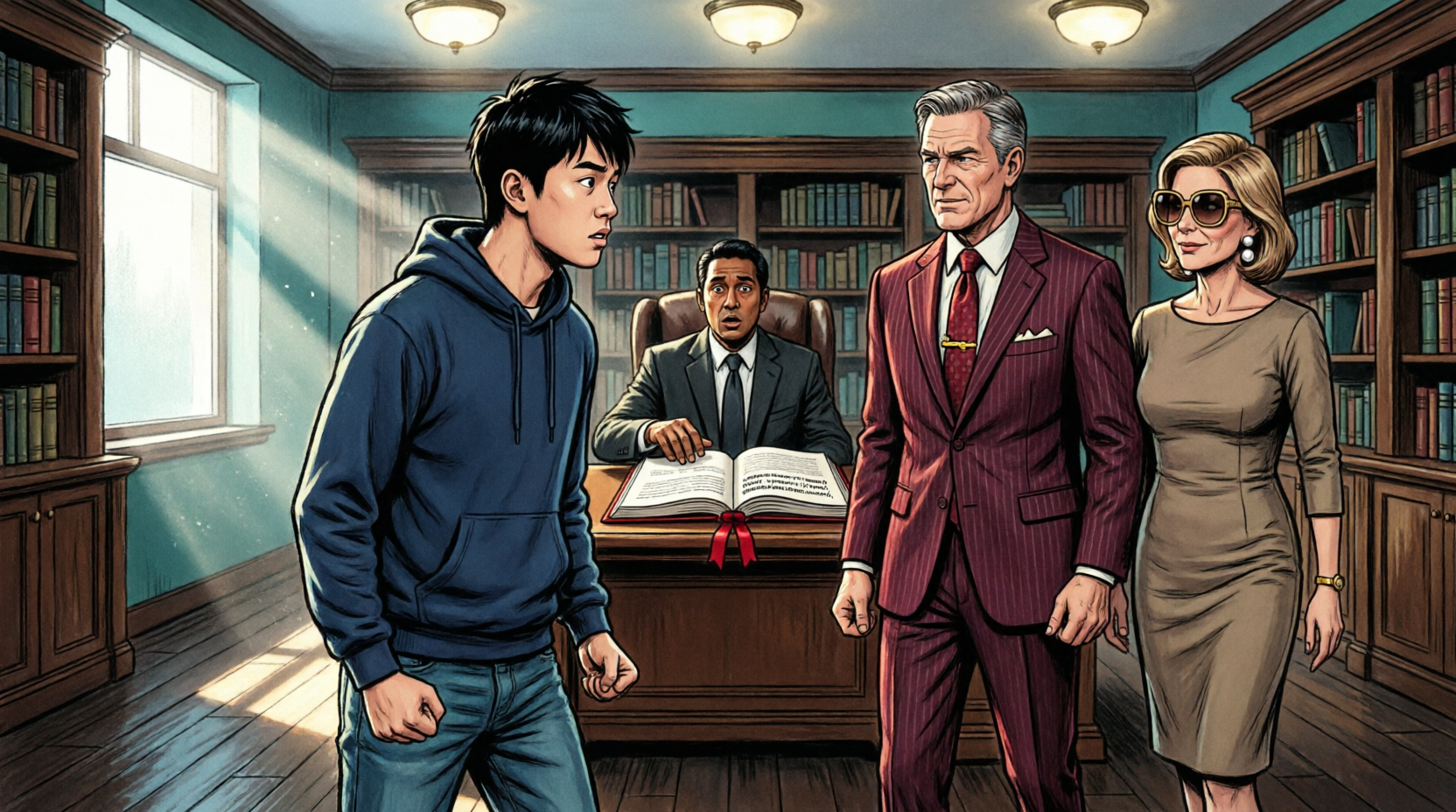 Before my parents left, our life in Harbor Point looked normal from the outside, with neighbors who waved from their porches and summer evenings filled with the sound of kids riding bikes along cracked sidewalks. Inside our house, things were already breaking down in ways no one else could see. My dad, Gregory Collins, was supposed to work at a local repair garage, but most weekends he disappeared to a nearby casino and came home smelling like beer and frustration. My mom, Diane, slowly stopped showing up to her job at a grocery store and spent her days on the couch scrolling through her phone or watching reality shows, barely noticing when I came or went. At first we still had small traditions that made life feel stable, but those faded as arguments about money grew louder and unpaid bills piled up on the kitchen counter. The refrigerator went from full to half empty, then nearly bare, and my mom would wave toward the pantry and say there were noodles so I would be fine. I started working at a small ice cream shop after school, handing over my paycheck because I believed it would help. It never stayed long enough to matter. One cold morning, I woke up to a silence that felt wrong even for our house. Their bed was made, their closet half empty, and the kitchen held nothing but spoiled milk and a few wilted vegetables. A folded note sat on the table with my name on it. “Avery, we can’t do this anymore.
Check This Out

Dermatologist: The #1 Peptide You Need To Tighten Crepey Skin
169
42
56

Cardiologists: 2 Veggies Will Kill Your Belly & Arm Fat Overnight
563
141
188

Cardiologists: 2 Veggies Will Kill Your Belly & Arm Fat Overnight
708
177
236
Your uncle will take care of you. We’re sorry. Take care of yourself.” I read it over and over until the words blurred, realizing there was no plan and no way to reach them. Within days, the landlord was banging on the door demanding rent I could never pay, and I knew I could not stay there alone. I went to the school counselor, told her everything, and within hours a social worker arrived with a clipboard and calm eyes. She documented the empty fridge, the note, and the unpaid bills, then told me they had contacted a relative. That was the first time I heard his name spoken like it mattered to me. Elliot, my father’s older brother, the one they always described as cold and disconnected from real life. When he arrived, he did not hug me or ask how I felt. He looked around the apartment once, then looked at me and said, “Pack what you need, anything you actually use, we are leaving today.” I grabbed a bag with clothes and school notebooks, and followed him without knowing if I was being rescued or simply moved somewhere else. The city he lived in felt unreal compared to everything I knew. Highways stretched endlessly, glass buildings rose into the sky, and everything moved faster than my thoughts could keep up. His house sat in a quiet suburb with clean streets, trimmed lawns, and homes that looked untouched by the kind of chaos I came from. Inside, everything was organized, quiet, and controlled. “Shoes off at the door,” he said calmly, already stepping out of his. He showed me a room that became mine, with a real bed, a desk, and a closet that was not already full of someone else’s life. “You will start school here soon,” he said.
Check This Out
Dermatologist: The #1 Peptide You Need To Tighten Crepey Skin
342
86
114

Dermatologist: The #1 Peptide You Need To Erase All Wrinkles
730
183
243
Cardiologists: 2 Veggies Will Kill Your Belly & Arm Fat Overnight
100
25
33
“But first we need structure.” That word defined everything that followed. My days were scheduled down to the hour, with fixed times for waking up, eating, studying, and learning new skills. If I broke a rule, he did not yell or argue. He adjusted my privileges in a way that made it easier to follow the rules than to resist them. At first I pushed back, skipping routines and testing boundaries, but he remained calm and consistent. Over time, stability replaced chaos, and I started to change. He transferred me to a private academy where expectations were higher, and although I struggled at first, he guided me without offering empty comfort. “Failure is feedback,” he told me one evening while reviewing my work. “Use it.” Those words stayed with me as I improved and pushed myself further than I ever had before. Years passed, and I applied to universities I once believed were out of reach. When I was accepted to one across the country, I realized my life had completely shifted. I studied hard, built skills, and eventually returned to work with him, starting from the bottom and earning every step forward. By the time I was twenty eight, I was leading major projects and helping grow his company into something far bigger than before. I thought my past was behind me until the night everything changed again. We were having dinner when he told me quietly that he had late stage pancreatic cancer, and there was no cure. The words felt unreal, but he approached it the only way he knew how. “We treat it like a project,” he said. “Limited time, clear priorities.”
Check This Out
Dermatologist: The #1 Peptide You Need To Tighten Crepey Skin
125
31
42
Dermatologist: The #1 Peptide You Need To Erase All Wrinkles
868
217
289
Cardiologists: 2 Veggies Will Kill Your Belly & Arm Fat Overnight
414
104
138
Life shifted into a new routine focused on treatment, care, and preparation. He gradually transferred responsibilities to me, ensuring I could handle everything without him. Ten months later, he passed away at home, exactly as he wanted. The funeral was small, and I spoke about the man who rebuilt my life from nothing. A few weeks later, I was called to the reading of his will. I expected something simple, but instead I walked into that room and saw my parents sitting there as if they belonged. They greeted me like nothing had happened, smiling and speaking as though we were a normal family. Then the lawyer began reading. Everything, including the house, investments, and majority ownership of the company, was left to me. My parents immediately objected, insisting they should be involved and share in the inheritance. That was when the lawyer revealed the truth. Years earlier, Elliot had legally adopted me, making me his sole heir. My parents had signed the documents themselves. Then came the final clause. If anyone attempted to challenge the will, the entire estate would be liquidated and donated to a children’s cancer foundation. No one would receive anything. The room fell silent as the reality settled in. My parents tried to argue, threaten, and negotiate, but the legal structure left them with nothing.
Check This Out
Dermatologist: The #1 Peptide You Need To Tighten Crepey Skin
148
37
49
Dermatologist: The #1 Peptide You Need To Erase All Wrinkles
614
154
205
Cardiologists: 2 Veggies Will Kill Your Belly & Arm Fat Overnight
359
90
120
They left angry and defeated, but they did not stop trying. They called, sent messages, and eventually showed up at my house despite a restraining order. I documented everything and called the police when they refused to leave. They were arrested for violating the order, and the situation quickly became public. Their lives unraveled as consequences followed their actions. I moved forward, focusing on the company and creating scholarship programs to help others in situations like mine. Months later, I saw their car pass slowly by my house late at night, never stopping, just watching from a distance. They looked smaller than I remembered, no longer powerful, just people who had made irreversible choices. That was when I understood something clearly. My uncle had not just left me money, he had given me the tools to build a life and the protection to keep it safe. Family was not defined by blood, but by who chose to stay when leaving would have been easier. And in the end, that was the only inheritance that truly mattered. The lawyer adjusted his glasses.
The room had already gone quiet after the adoption clause.
It had already gone quiet after the challenge provision.
But now his expression changed in a way I had never seen before.
Almost as if he had reached the part my uncle cared about most.
“There is one final document,” he said.
My mother frowned.
“What document?”
The lawyer carefully unfolded several pages.
“A personal letter.”
My father rolled his eyes.
“A letter?”
The lawyer ignored him.
“Mr. Elliot Collins instructed that this letter be read only if Gregory and Diane Collins appeared at the will reading.”
For the first time all afternoon, my parents looked uncertain.
The lawyer began reading.
“Dear Gregory and Diane,
If you are hearing this, then you have shown up for something you never showed up for before.”
The room became perfectly still.
My father’s jaw tightened.
My mother’s smile disappeared.
The lawyer continued.
“When Avery was sixteen years old, you left her with an empty refrigerator, unpaid bills, and a note.
You did not call.
You did not return.
You did not ask whether she had enough food.
You did not ask whether she felt abandoned.
You simply left.”
My mother shifted uncomfortably.
My father stared at the table.
The lawyer kept reading.
“I know this because I spent years helping Avery recover from a wound neither of you ever acknowledged.”
My mother’s face flushed.
My father finally interrupted.
“This isn’t necessary.”
The lawyer looked up.
“It is required.”
Then he continued.
“You may tell yourselves you did your best.
You may tell yourselves life was difficult.
You may tell yourselves circumstances forced your choices.
But there is one fact neither of you can escape.
You abandoned your child.”
Nobody spoke.
Even the air seemed heavy.
“You left.
I stayed.”
My throat tightened.
The lawyer paused briefly before continuing.
“And because I stayed, I witnessed every moment that followed.”
The next pages described things I had forgotten.
Moments I never knew my uncle remembered.
The first night I cried in my bedroom because I thought my parents might come back.
The weeks I refused to unpack my suitcase.
The day I failed a math exam and secretly worried he would abandon me too.
The night Stanford accepted me.
The morning I graduated.
The first time I led a project.
The first time I stood before hundreds of employees and presented a company strategy.
The lawyer read every detail.
Each memory felt like a thread connecting me back to the man who had quietly watched me grow.
Then came the line that broke me.
“Avery spent years believing she was difficult to love.
I hope one day she understands she was never difficult.
The adults around her simply failed.”
Tears blurred my vision.
For a moment I could not breathe.
Across the table, my mother looked away.
My father stared at the floor.
The lawyer continued.
“If Avery chooses to forgive you someday, that decision belongs entirely to her.
But forgiveness is not an inheritance.
It cannot be demanded.
It cannot be purchased.
And it certainly cannot be claimed because someone died.”
The room remained silent.
Then came the final paragraph.
“The fortune you hoped to receive was never the point.
The company was never the point.
The house was never the point.
The investments were never the point.
The point was Avery.
And you lost her long before you lost any money.”
Nobody moved.
Nobody spoke.
The lawyer slowly lowered the letter.
For several seconds the room remained completely silent.
Then my mother started crying.
Not loudly.
Not dramatically.
Just quiet tears rolling down her cheeks.
My father looked older than he had when he walked in.
Much older.
For the first time, neither of them argued.
Neither demanded money.
Neither threatened legal action.
They simply sat there.
Because there was nothing left to fight.
The truth had already won.
PART 4
The weeks after the will reading were strangely quiet.
Too quiet.
I buried myself in work.
Board meetings.
Investor calls.
Expansion plans.
Everything my uncle had prepared me for.
Yet every night I found myself rereading his letter.
Some paragraphs had become worn from handling.
Others I practically knew by memory.
One evening I stayed late at the office.
The city lights glowed beyond the windows.
Most employees had already gone home.
I was reviewing quarterly projections when my assistant knocked softly.
“You have a visitor.”
I frowned.
“At this hour?”
She nodded.
“She says it’s important.”
A few moments later, my mother stepped into the office.
Alone.
No father.
No demands.
No performance.
She looked nervous.
I had never seen that before.
“Avery.”
I remained seated.
“What do you want?”
Her eyes filled immediately.
“I don’t know where to start.”
“Try the truth.”
She nodded slowly.
Then she sat down.
For nearly an hour she talked.
Not excuses.
Not justifications.
Truth.
Or at least more truth than I had ever heard.
She admitted how bad things had become.
How gambling debts consumed my father.
How depression consumed her.
How they convinced themselves my uncle could give me a better life.
How every month that passed made it harder to call.
Harder to explain.
Harder to admit what they had done.
“I told myself you hated us.”
I stared at her.
“Why?”
“Because if you hated me, then I could pretend you didn’t need me.”
The honesty hurt more than excuses.
Because it felt real.
“I checked your graduation online,” she whispered.
My chest tightened.
“What?”
She nodded.
“Stanford streamed it.”
I said nothing.
“I watched.”
Tears slid down her face.
“You looked so happy.”
For the first time in years, I saw something that looked like genuine regret.
Not regret for losing money.
Not regret for public embarrassment.
Regret for losing time.
And unlike money, time never came back.
When she left that night, nothing was fixed.
Nothing was forgiven.
But something had changed.
A door had opened a fraction of an inch.
PART 5
Six months later, the company announced the largest initiative in its history.
The Elliot Collins Foundation.
A scholarship and mentorship program for abandoned, neglected, and disadvantaged teenagers.
The launch event attracted media attention across the country.
Hundreds attended.
Community leaders.
Business owners.
Teachers.
Students.
Reporters.
Former scholarship recipients.
As I stood backstage preparing to speak, I found myself thinking about a sixteen-year-old girl staring at an empty refrigerator.
A girl who believed her life was over.
A girl who had no idea what waited ahead.
The host announced my name.
Applause filled the room.
I stepped onto the stage.
Rows of faces stretched before me.
Cameras flashed.
The giant screen behind me displayed a photograph of my uncle.
Strong.
Serious.
Steady.
Exactly as I remembered him.
I smiled.
Then began.
“When people hear stories like mine, they usually focus on what was lost.”
The room grew quiet.
“The abandonment.
The pain.
The betrayal.”
I paused.
“But that’s not the whole story.”
Faces watched attentively.
“The more important part is what happened next.”
The screen changed.
Photos appeared.
My first school picture after moving in with Elliot.
My graduation.
My first day at the company.
Images spanning years.
“I was not saved by money.”
The audience remained silent.
“I was saved by consistency.”
More silence.
“Someone showed up.
Again.
And again.
And again.”
I looked toward my uncle’s photograph.
“He taught me that love is not always loud.
Sometimes love looks like structure.
Sometimes it looks like accountability.
Sometimes it looks like somebody refusing to give up on you.”
Many people were crying now.
Including me.
Then I announced the foundation’s first commitment.
Five hundred scholarships.
Full mentorship.
Housing support.
Career development.
Mental health resources.
Everything I wished someone had offered me at sixteen.
The audience rose to their feet.
The applause lasted several minutes………………..
Leave a Reply