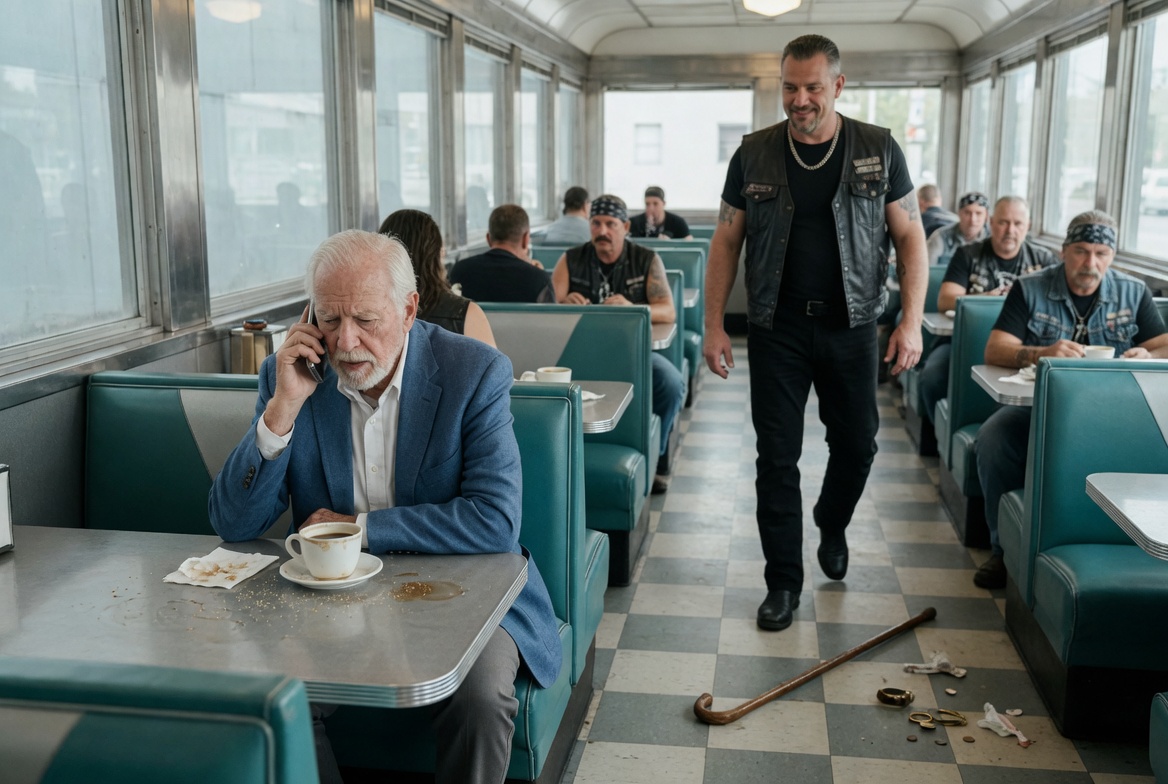
 The old man always sat in Booth Seven. Same diner. Same black coffee. Same quiet stare out the window.
The place sat just off Route 66 in northern Arizona, a low-slung building with a flickering neon sign that said OPEN even when the door was locked. The locals called it Maggie’s, though no one remembered a Maggie. The booths were cracked vinyl, the counter chipped, the coffee strong enough to keep truckers awake through two states.
And every Tuesday at exactly noon, the old man came alone.
The waitresses knew him as Mr. Carter. White hair. Trimmed beard. A worn wooden cane that he leaned against the booth with care, like it mattered more than it looked. He always ordered the same thing—black coffee, no sugar—and he always paid in cash. He didn’t linger. Didn’t talk. But there was something about him that made people lower their voices without realizing why.
Not fear.
Not exactly.
Respect, maybe. Or the echo of it.
That Tuesday started no differently.
He was already halfway through his coffee when the bikers walked in.
Six of them.
They didn’t enter so much as take over. The door slammed against the bell, laughter rolled in before they did, and the entire diner shifted around them. Leather vests, heavy boots, rings that caught the light when they gestured too wide. They spoke too loud, sat too hard, owned space that didn’t belong to them.
Their leader came in last.
Rex Dalton.
He was the kind of man built to be noticed—broad shoulders, shaved head, a scar that cut across his eyebrow like a permanent warning. He didn’t scan the room. He didn’t need to. He assumed everything in it would eventually turn toward him.
And then it did.
Because Rex saw the old man.
Something about quiet dignity always bothered men like him. It was like a mirror they didn’t want.
Rex smiled.
Slow. Mean.
He walked straight over.
“Well, look at this,” he said, slapping the edge of Booth Seven. “A king in a diner.”
The old man didn’t look up.
Didn’t answer.
That made the others laugh.
Rex leaned closer. “You deaf, old man?”
Still nothing.
The laughter grew louder, rougher, encouraged by the lack of resistance. It was supposed to be easy. That’s what made it fun.
Then Rex reached for the cane.
He didn’t hesitate. Didn’t test the moment.
He just grabbed it.
The wood scraped against the booth as he yanked it free. The sudden motion knocked the table, sending a glass of water tipping over. It shattered on the floor with a sharp crack.
The diner erupted.
Rex walked down the aisle swinging the cane like a trophy, grinning as if he had just proved something.
“Careful,” one of his guys shouted. “He might need that!”
More laughter.
Phones started coming out—half hidden, half bold.
But the old man didn’t react.
He didn’t yell.
Didn’t beg.
Didn’t even watch Rex at first.
He simply looked at the empty space where the cane had been.
Then at the water dripping from the table.
Then, slowly, he lifted his gaze.
Not to Rex’s face.
To his vest.
Inside the leather collar, barely visible unless you were close enough, was a faded silver hawk patch.
Time-worn.
Almost forgotten.
But not by him.
Something shifted.
It wasn’t anger.
It wasn’t fear.
It was recognition.
The old man reached into his jacket and pulled out a small black key fob.
Rex saw it and laughed again, though this time it didn’t land as easily.
“What, old man? Gonna beep me to death?”
The old man pressed a button.
A soft click.
He lifted the fob to his ear like he’d done it a thousand times before.
“It’s me,” he said.
The diner quieted—not instantly, but enough that the edges of laughter started to fade.
A pause.
“Bring them.”
He lowered the fob.
Rex smirked, but something about it had weakened.
Outside, tires screamed.
Heads turned.
Another engine.
Then another.
Three black SUVs slid into the gravel lot, headlights cutting through the diner windows like searchlights.
The room went still.
Doors opened.
Men stepped out.
Dark suits. Clean lines. No wasted movement.
They didn’t rush.
They arrived.
The bikers stopped laughing—one by one.
Rex turned slightly, trying to keep control of something that was already slipping.
“What is this?” he asked, but his voice had lost weight.
The old man looked at him now.
Really looked.
Then back to the silver hawk stitched into his collar.
“When you wear a mark,” the old man said quietly, “you’re supposed to know what it means.”
Rex frowned. “It means we don’t take orders from anyone.”
A faint smile touched the old man’s face—not amused. Not kind.
“No,” he said. “It means you remember who came before you.”
Silence pressed in.
Rex’s jaw tightened. “I don’t answer to ghosts.”
The old man nodded slightly, as if confirming something.
“That patch,” he said, “came from a man who built something out of nothing. A man who taught loyalty before pride. Discipline before noise.”
Rex shifted. “You talk like you knew him.”
“I did.”
The door to the diner opened.
The men in suits stepped inside.
No raised voices. No sudden movement. But their presence filled the space in a way that changed everything.
One of them stopped just behind Rex.
Not touching him.
Not threatening.
Just… there.
Rex didn’t turn around.
He didn’t need to.
He could feel it.
The old man’s gaze dropped to the cane in Rex’s hand.
“Set it down,” he said.
Rex hesitated.
Just long enough for everyone to see it.
Then, slowly, he lowered the cane.
It hit the floor with a dull, final sound.
The old man reached for it—but didn’t stand.
Not yet.
Instead, he looked back at the patch.
“Because if that came from the man I think it did…” he said.
Then he met Rex’s eyes.
“…you just stole your grandfather’s cane.”
The words didn’t echo.
They didn’t need to.
They landed.
Rex’s face didn’t change at first.
Then it did.
Subtle.
Barely there.
But real.
“My grandfather’s dead,” he said.
“Yes,” the old man replied. “He is.”
Silence stretched.
“You knew him?” Rex asked, quieter now.
The old man finally stood.
Slowly.
Carefully.
Not weak—just deliberate.
“I didn’t just know him,” he said.
“I am him.”
The diner stopped breathing.
Rex stared.
“That’s not possible.”
“You didn’t ask,” the old man said. “You never cared to.”
Rex’s mind scrambled, trying to rearrange what he thought he knew. His grandfather had been a story—a name, a legend passed down in pieces. A man who built something that others later twisted into something louder, rougher, easier.
A man who disappeared.
No one ever said he was alive.
No one ever said he wasn’t.
“You walked away,” Rex said, grasping at something.
“I stepped aside,” the old man corrected. “There’s a difference.”
“For what? This?” Rex gestured around. “You traded everything for a booth and coffee?”
The old man looked at him—not angry, not disappointed.
Just steady.
“I traded noise for peace,” he said. “I wanted to see what you would do with what I built.”
Rex swallowed.
“And now you’ve seen.”
The old man nodded.
“Yes.”
The room held its breath.
“Then what?” Rex asked. “You take it back?”
The old man shook his head.
“No.”
That answer hit harder than anything else.
“I don’t want it,” he said. “Not like this.”
Rex frowned. “Then why bring them?”
The old man glanced at the men in suits.
“Because you forgot something,” he said.
“What?”
“That respect isn’t taken.”
He gestured to the cane.
“It’s earned.”
Silence settled again.
Heavy.
Real.
Rex looked at the cane on the floor.
Then at the patch on his vest.
Then back at the man in front of him.
For the first time since he walked in—
he didn’t have anything to say.
The old man bent slowly, picked up the cane, and leaned on it—not because he had to, but because it was his.
He turned toward the door.
The men in suits stepped aside instantly.
No hesitation.
No question.
Just understanding.
As he reached the exit, he paused.
Not turning fully back.
Just enough.
“You can keep the name,” he said.
“But if you wear it… learn what it costs.”
Then he walked out.
The SUVs pulled away moments later, as quietly as they had arrived.
Inside the diner, no one spoke.
Rex stood where he was, the noise gone, the weight of something unfamiliar settling in its place.
Not fear.
Not power.
Something else.
Something he hadn’t felt in a long time.
Or maybe ever.
He reached up and touched the faded silver hawk on his collar.
And for the first time—
it didn’t feel like a badge.
It felt like a question.
About what it really meant to carry something that was never supposed to be loud… but lasting.
Leave a Reply