Category: Uncategorized

  • My 11-year-old grandson called me in terror after hearing his teenage sister screaming from inside his stepfather’s room.

    My eleven-year-old grandson called me in panic after hearing his teenage sister screaming inside his stepfather’s bedroom. I rushed to the house, forced my way through the door, and the second I stepped inside, everyone froze because what I found was far worse than an ordinary family argument.

    When my eleven-year-old grandson, Caleb, called me, his voice was so low and frightened that I could hear his breathing tremble.

    “Grandma,” he said, “please come over. Mia is screaming in Dad’s room.”

    I was already grabbing my keys before he had finished speaking. Caleb was not a child who exaggerated. He was the kind of boy who said sorry to furniture after bumping into it. If he sounded that scared, something was truly wrong.

    “Where is your mother?” I asked.

    “At work. She won’t answer. Please hurry.”

    I drove across Maple Hollow as if speed limits had vanished. My daughter, Lisa, had married Darren Briggs three years before. In public, he was courteous, useful at church barbecues, always wearing that neat little smile people use when they want to be admired. But I had never trusted him. Not once.

    When I arrived at the house, the front door was unlocked. Caleb stood in the hallway in his dinosaur pajamas, pale as paper, pointing upstairs.

    “She told him to stop,” he whispered. “Then she screamed.”

    My knees nearly gave way.

    I hurried up the stairs, one hand tight around the railing. The bedroom door at the end of the hall was shut, but I could hear voices behind it. Darren’s voice, low and sharp. Mia’s voice, strangled with fear.

    “Open this door!” I shouted.

    Everything went quiet.

    Then something crashed.

    I did not wait. I drove my shoulder into the door once, then again, then kicked near the handle with every bit of rage my old body could carry. The door flew open.

    Everyone froze.

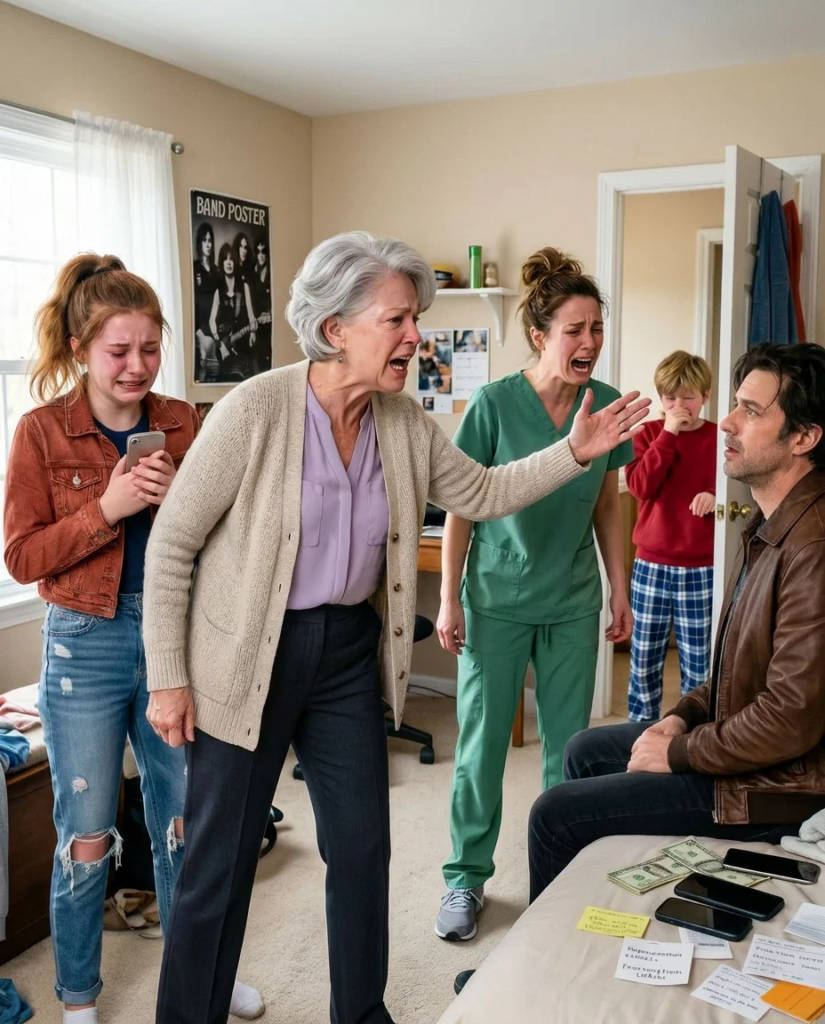
    Darren stood beside the bed, his face red and stunned. Mia, fifteen years old, stood by the dresser with tears streaming down her cheeks, gripping Darren’s phone in both hands. Her backpack was open on the floor. Papers were scattered everywhere. A small black flash drive had rolled under the nightstand.

    And on the bed, partly hidden beneath Darren’s jacket, were piles of cash, fake prescription labels, and a second phone flashing with a message notification.

    Mia looked at me as if I had pulled her back from the edge of a cliff.

    “He’s not my dad,” she said, voice trembling. “And he’s been stealing Mom’s patient records from the clinic.”

    Darren’s stunned expression disappeared. His eyes turned cold.

    “Give me the phone, Mia.”

    I stepped between them.

    “No,” I said.

    Then Lisa appeared in the doorway behind me, still wearing her scrubs, her face drained of color. She had finally noticed the missed calls and raced home.

    Darren looked at his wife, then at me, then at Mia, then at Caleb peeking from the hallway.

    For the first time since I had known him, he had no smile prepared.

    Part 2

    At first, Lisa said nothing. She stared at the cash on the bed, then at the prescription labels, then at the phone shaking in Mia’s hands.

    “What is this?” she asked.

    Darren breathed out slowly, as though he were the only reasonable adult in a room full of hysterical children. “It’s not what it looks like.”

    “That is what every guilty man says when he has run out of lies,” I said.

    He turned his head toward me. “You need to leave my house, Evelyn.”

    I laughed once, but there was no humor in it. “Your house? My daughter pays the mortgage. My daughter pays the taxes. My daughter pays for the groceries you eat while pretending to be a husband.”

    Lisa flinched, but she did not correct me.

    Mia lifted Darren’s phone. “Mom, I found messages. He has been sending patient names, birthdays, insurance details. I didn’t understand all of it at first, but then I saw your login on his laptop.”

    Lisa opened her mouth, but no words came out.

    Darren took one step forward.

    Caleb cried out from the hall. “Don’t!”

    That single word changed the whole room. Lisa finally moved. She crossed to Caleb and pulled him behind her. Her face, which had been stunned and confused, hardened into something I had not seen for years.

    “Darren,” she said, “sit down.”

    He blinked. “What?”

    “Sit down on that chair and do not move.”

    The order shocked him because he had spent years training Lisa to ask permission before breathing too loudly. But she was not asking now.

    Darren’s jaw tightened. “You’re making a mistake.”

    “No,” Lisa said. “I made the mistake three years ago.”

    Mia started sobbing. I gently took the phone from her and handed her my car keys. “You and Caleb go sit in my car. Lock the doors. Do not open them for anyone but me or your mother.”

    Mia hesitated.

    “Go,” Lisa said.

    The children left, their footsteps racing down the stairs.

    Darren’s expression changed. With the children gone, he tried on another mask. Sadness. Hurt. Betrayal.

    “Lisa,” he said softly, “your daughter has misunderstood. I was trying to help us. You know the bills, the pressure—”

    “You used my clinic credentials.”

    “I borrowed them.”

    “You sold private medical information.”

    His face twitched. “You can’t prove that.”

    I held up the phone.

    He lunged.

    I had been ready. Maybe I was seventy-one, maybe my knees complained every morning, but I had spent forty years dealing with angry men at a courthouse records desk. I knew the way a man’s shoulders changed before his hands did. I stepped back, and Lisa grabbed the heavy ceramic lamp from the nightstand.

    “Do not touch my mother,” she said.

    Darren stopped.

    For several seconds, no one breathed.

    Then sirens rose in the distance. Caleb must have called 911 from my car, exactly the way I had taught him. Smart boy. Brave boy.

    Darren heard them too. His face changed one final time. No charm. No apology. Only calculation.

    He looked toward the window.

    Lisa saw it. “Don’t.”

    But Darren was already moving.

    PART 3

    Darren did not leap from the window. That would have been too dramatic, too reckless, too unlike him.

    He was not careless. That was what made him dangerous.

    He moved toward the window first, drawing our eyes there, then suddenly pivoted and shoved past Lisa toward the door.

    The lamp slipped from her hand and smashed across the floor.

    “Darren!” she shouted.

    I grabbed his sleeve, but he twisted free with enough force to throw me against the dresser. Pain shot through my hip. Lisa screamed my name, but I waved her off. We could not lose those phones. We could not lose the evidence. We could not allow him to reach Mia and Caleb.

    Darren thundered down the stairs.

    From outside, Caleb screamed, “Grandma!”

    That sound put strength back into my legs.

    Lisa and I ran after him. I was slower, but I knew the layout of that house. Darren reached the bottom of the stairs and headed straight for the front door. He yanked it open, then stopped.

    Two police cruisers were pulling up to the curb.

    For one brief moment, he looked almost offended, as though the law had interrupted his private life without making an appointment.

    Then he turned and sprinted toward the kitchen.

    Lisa chased him. I stayed near the front entrance, gripping the wall, trying to breathe through the pain in my side. One officer rushed toward me.

    “Ma’am, are there children inside?”

    “In my car,” I said. “Driveway. Two kids. The man is in the kitchen. His name is Darren Briggs. He may have phones with stolen medical information.”

    The officer nodded and signaled to his partner.

    From the kitchen came the noise of drawers opening and cabinets slamming. Darren was searching for something. Not a weapon, I hoped. A back door key, maybe. His car keys. Anything that could give him a way out.

    Lisa’s voice cut through the noise. “It’s over!”

    Darren shouted something I could not understand.

    Then a chair fell.

    The two officers moved fast, one through the hallway and the other around the outside toward the back entrance. I made my way to the living room window. My car sat in the driveway with its doors locked. Mia was in the front passenger seat, Caleb crouched low in the back. Mia held my old emergency phone in both hands, still connected to the dispatcher. Her eyes found mine through the glass.

    I pressed my palm against the window.

    She pressed hers against the car window.

    That tiny gesture nearly broke me.

    A minute later, Darren came out of the kitchen with one officer behind him and another blocking the back door. Something was clenched in his fist.

    “Drop it,” the officer ordered.

    Darren smiled then. Not his church smile. Not his husband smile. A thin, trapped smile.

    “You don’t know what you’re doing,” he said. “My wife has mental health issues. Her mother hates me. The girl is unstable. This is a family misunderstanding.”

    Lisa stepped into the hall behind him, pale but steady. “I am a registered nurse at Westbrook Women’s Health Clinic. My husband used my work credentials without permission. There is evidence upstairs. My daughter found it. My son called for help because he heard her screaming.”

    Darren looked at her as if she had betrayed him simply by telling the truth.

    The officer repeated, “Drop what’s in your hand.”

    Darren opened his fist.

    A tiny memory card fell to the floor.

    The officer cuffed him before he could crush it beneath his shoe.

    Then he fought, not like a mastermind, not like the powerful man he had pretended to be, but like an ordinary coward who had run out of rooms to control. He cursed Lisa. He cursed Mia. He called Caleb a liar. He called me a bitter old woman. Every word made him seem smaller.

    Mia and Caleb were brought inside after Darren was secured in the cruiser. Mia would not look toward the front yard where he sat behind the glass. Caleb clung to Lisa with both arms wrapped around her waist.

    “I’m sorry,” he kept saying. “I didn’t know what to do.”

    “You did exactly right,” Lisa told him. “You called Grandma. You called 911. You protected your sister.”

    Mia stood away from them, her arms wrapped tightly around herself. She looked older than fifteen and younger than fifteen at the same time.

    I approached her slowly. “Sweetheart.”

    She shook her head. “I didn’t scream because he hurt me.”

    “I know.”

    “He grabbed my wrist when I took the phone. He said if I told Mom, she’d go to prison because it was her login. He said no one would believe me because he was the adult.”

    Lisa covered her mouth.

    Mia’s voice broke. “I thought he was going to delete everything.”

    I pulled her into my arms. She resisted for half a second, then collapsed against me.

    The officers searched Darren’s room with Lisa’s permission. They found three prepaid phones, two flash drives, printed patient lists, and a notebook filled with usernames, passwords, and payment amounts. They also found copies of Lisa’s signature, practiced over and over on a yellow legal pad.

    That was the part that made her sit down.

    “He was going to frame me,” she whispered.

    One of the officers, a woman named Sergeant Dana Whitaker, crouched in front of her. “Mrs. Briggs, based on what we see here, you need to contact your employer immediately and ask for legal counsel. You are not under arrest. But this is serious, and the clinic will need to protect its patients.”

    Lisa nodded as though she understood the words, but I could tell she was still trapped inside the betrayal.

    The next hours passed in fragments. Statements. Photographs. Evidence bags. A detective arriving. Mia explaining how she first noticed Darren leaving Lisa’s home office at night. Caleb admitting he had seen Darren hide a second phone inside a winter boot in the closet. Lisa crying when she realized both children had been too afraid to tell her because they thought she loved Darren more than she would believe them.

    That hurt her worse than anything else.

    “I never wanted you to feel that,” she told them.

    Mia wiped her face with her sleeve. “You always defended him.”

    Lisa closed her eyes.

    There was no simple answer because it was true.

    Darren had been clever. He never began with cruelty. He began with favors. Picking up groceries. Repairing the sink. Driving the kids to school. Then came the comments. Mia was dramatic. Caleb was too sensitive. I was interfering. Lisa was overworked and forgetful. Slowly, he made himself seem like the reasonable one while everyone else became the problem.

    By the time Lisa noticed the cage, she had already learned to call it marriage.

    That night, she did not sleep in that house. None of them did. They came home with me.

    Mia took the guest room. Caleb slept on the couch with every light turned on. Lisa sat at my kitchen table until after midnight, still in her scrubs, her hands wrapped around a mug of tea she never drank.

    “I almost didn’t come home,” she said.

    I sat across from her. “But you did.”

    “I saw Caleb’s missed calls, then Mia’s, then yours. I thought maybe someone was sick. I never imagined…”

    “No one imagines the person at their breakfast table is building a trap under the floor.”

    She looked toward the hallway where her children were finally quiet. “Mia said she screamed because he grabbed her.”

    “Yes.”

    “And Caleb heard.”

    “Yes.”

    Lisa bent forward, pressing her fingers against her forehead. “My children were alone with him.”

    I reached across the table and covered her hand. “They are here now.”

    “That doesn’t erase it.”

    “No. It gives us a place to start.”

    The investigation grew quickly. Darren had not been working alone. The stolen patient information had been sold to a man in Ohio who used it for insurance fraud and illegal prescription billing. The clinic suspended Lisa for two weeks while they reviewed her access history, but the digital logs helped her. Darren had used her credentials during times when she was documented with patients, driving home, or clocked out. Security cameras showed him entering the clinic parking lot on evenings when he had claimed to be at the gym. A warrant for his laptop exposed everything.

    Lisa was cleared, though “cleared” did not mean unharmed. She still had to face coworkers who whispered, angry patients, and administrators who cared more about liability than her humiliation. But she faced it.

    Mia gave her statement to the detective. Her hands shook the entire time, but she did not take back a single word. Caleb met with a child counselor and drew a picture of my car with locks on all four doors. At the bottom, he wrote: Safe place.

    I kept that drawing on my refrigerator.

    Darren tried calling Lisa from jail. She refused every call. He sent letters. She handed them unopened to her attorney. He blamed addiction, debt, stress, childhood pain, misunderstanding, and love. He used every word except guilt.

    When the plea deal came months later, he accepted prison time for identity theft, fraud, unlawful access to protected medical information, and obstruction. There were other charges too, words meant for courts and files and people carrying briefcases. I cared less about the names than the result: he would not be coming home.

    The day after sentencing, Lisa drove to the house with me, Mia, and Caleb. She wanted the children to decide what stayed and what went.

    Darren’s room was stripped first.

    Not carefully. Not respectfully.

    Mia carried his jackets out and dropped them into black trash bags. Caleb threw away the winter boots where the phone had been hidden. Lisa removed the bedspread, the curtains, the framed baseball print he loved, every trace of him that had made the room feel like his territory.

    Then she painted the walls herself.

    Soft yellow.

    Mia chose it.

    For a while, life stayed uneven. Caleb still startled at loud male voices. Mia checked the locks three times before bed. Lisa apologized too often, sometimes for things no one blamed her for. Healing did not arrive like sunrise. It came more like scattered matches in a dark room.

    But it came.

    Mia joined the school newspaper and wrote an article about digital privacy without mentioning her family. Caleb started carrying my old whistle on his keychain, though he never had to use it. Lisa kept going to counseling even after she said she felt fine, because Mia told her, “Fine is what you say when you don’t want people asking.”

    That girl had always seen more than adults gave her credit for.

    One year later, we gathered in my backyard for Caleb’s twelfth birthday. Burgers were on the grill, blue balloons were tied to the fence, and Mia was laughing with two friends near the porch. Lisa stood beside me, watching them.

    “I keep thinking about that phone call,” she said.

    “So do I.”

    “If Caleb hadn’t called you…”

    “He did.”

    “If Mia hadn’t been brave…”

    “She was.”

    Lisa nodded. Tears filled her eyes, but she smiled through them. “And if you hadn’t kicked that door open?”

    I looked at my grandson, who was trying to blow out trick candles while everyone shouted advice. I looked at my granddaughter, alive and laughing, sunlight catching the copper in her hair. I looked at my daughter, no longer shrinking inside her own home.

    “I would kick it open again,” I said.

    Mia glanced over then, as if she had heard me. She lifted her paper cup toward me.

    Caleb saw and raised his too.

    Lisa lifted hers.

    So I raised mine back.

    No speech. No grand ending. Just the four of us standing in the ordinary light of an American backyard, holding plastic cups, knowing exactly what had almost been lost.

    And knowing, with the quiet certainty that comes after surviving the truth, that Darren Briggs had left the house for good.

  • I Married a Wealthy Older Man for Security—What I Learned After His Passing Changed My Life

    For most of my adult life, making ends meet felt like a constant challenge. Every month followed the same pattern: carefully counting every dollar, prioritizing bills, and hoping there would be enough left over for groceries and unexpected expenses.

    At 32, I was working long shifts as a waitress. The job paid the bills—barely—but it often left me exhausted. My days revolved around survival, and dreams of a more comfortable future seemed increasingly distant.

    Then, one evening, everything changed.

    An Unexpected Meeting

    I was working at a charity gala, serving guests in an elegant ballroom filled with people whose lifestyles felt worlds away from mine. It was the kind of event where staff members blended into the background, unnoticed unless someone needed assistance.

    That night, however, one guest noticed me.

    His name was Russell.

    He was much older than I was, confident yet approachable, and unlike most people at the event, he treated me with genuine kindness. Instead of simply requesting another drink, he asked how I was doing and whether I had been on my feet all day.

    The question caught me off guard.

    It wasn’t the words themselves that mattered—it was the sincerity behind them. For the first time in a long while, I felt seen.

    After that evening, Russell stayed in touch. We began speaking regularly, and our conversations quickly became a comforting part of my routine. He was thoughtful, patient, and genuinely interested in my life.

    Over time, our connection grew stronger.

    A Practical Decision

    A few months later, Russell proposed.

    It wasn’t a dramatic, movie-style moment. There were no grand speeches or extravagant gestures. Instead, he offered something simple: stability, support, and a future free from the financial struggles that had defined much of my life.

    His proposal made me think carefully about what I wanted.

    I knew many people would judge the age difference between us. Russell was nearly 30 years older, and I understood how the situation might appear to outsiders. Still, I believed he cared for me, and I appreciated the security he offered.

    Eventually, I accepted.

    For me, it felt like a practical decision and the beginning of a new chapter.

    A Difficult Welcome

    While Russell welcomed me warmly into his life, not everyone shared his enthusiasm.

    His children, particularly his daughter Marlene, were skeptical from the start. They questioned my motives and assumed I had married their father solely because of his wealth.

    Family gatherings were often uncomfortable. Conversations felt strained, and I constantly sensed that I was being evaluated rather than accepted.

    Marlene rarely hid her feelings.

    She viewed me as an outsider—someone who didn’t belong in a family that had spent generations building success and wealth.

    Although I tried to remain respectful and avoid conflict, the tension never truly disappeared.

    Fortunately, Russell always stood by my side.

    Whenever criticism surfaced, he defended me calmly but firmly. His confidence reassured me, even when I felt unwelcome.

    At one gathering, after an especially uncomfortable exchange, Russell simply said:

    “She’ll receive exactly what she deserves.”

    At the time, I assumed he was speaking generally about fairness and respect.

    Years later, I would discover that his words carried a much deeper meaning.

    Life Together

    Despite what others assumed, life with Russell wasn’t defined by luxury.

    The most meaningful parts of our relationship were the small moments.

    He remembered the details that most people overlooked. He knew how I liked my tea, left a light on when he knew I couldn’t sleep, and always asked thoughtful questions about my day.

    For someone who had spent years feeling invisible, those gestures meant everything.

    Russell often reminded me that my value wasn’t tied to how hard I worked or how much I sacrificed.

    At first, I struggled to understand that perspective. I had spent my entire life earning everything through effort and persistence.

    Yet his kindness gradually helped me see life differently.

    An Unexpected Loss

    Then came devastating news.

    Russell received a serious medical diagnosis, and doctors informed us that his time was limited.

    The weeks that followed were incredibly difficult.

    Family members gathered around him, emotions ran high, and uncertainty filled every room. Through it all, Russell remained remarkably calm.

    One day, he took my hand and quietly told me to trust him.

    I didn’t know exactly what he meant.

    Before I had the chance to ask, he passed away.

    The Lawyer’s Surprise

    Following the funeral, Russell’s family gathered at his attorney’s office for the reading of his will.

    The atmosphere was tense.

    Everyone expected discussions about property, assets, and inheritance.

    Instead, the lawyer began with something unexpected: a small wooden box.

    Inside was a photograph taken years earlier at the charity event where Russell and I first met. In the picture, I was laughing while carrying a serving tray.

    The image seemed ordinary, yet it clearly held special meaning for him.

    Some family members appeared confused.

    Then the lawyer opened a letter Russell had written.

    As the contents were read aloud, the room became silent.

    The letter described the qualities Russell admired most: kindness, resilience, honesty, and perseverance. He explained why he had chosen the path he did and how carefully he had considered every decision.

    When the formal will was finally presented, everyone was stunned.

    Russell had left the majority of his estate, including significant assets and responsibilities, to me.

    However, the inheritance wasn’t simply about wealth.

    He had carefully structured everything to provide long-term security and ensure stability for the future.

    The arrangements were detailed, thoughtful, and legally reviewed to reflect his wishes.

    A New Perspective

    The revelation sparked strong emotions.

    Some family members struggled to accept Russell’s decisions. Others questioned his judgment.

    But the legal documents were clear.

    More importantly, Russell’s letter explained exactly why he had made those choices.

    His message wasn’t focused on money.

    Instead, it centered on trust.

    He believed in me.

    He saw someone who had faced hardship without giving up, someone who valued loyalty and commitment, and someone capable of building a meaningful future.

    Those words stayed with me long after the meeting ended.

    A Fresh Beginning

    The months that followed were filled with adjustments.

    There was paperwork to manage, responsibilities to learn, and grief to process. Losing Russell left an emptiness that couldn’t be replaced.

    Yet as time passed, I began to understand the true gift he had left behind.

    It wasn’t the house.

    It wasn’t the business.

    And it certainly wasn’t the money.

    It was stability.

    For the first time in years, I could plan ahead instead of simply surviving from one month to the next.

    One quiet morning, standing by a sunlit window, I reread Russell’s letter.

    As I reflected on his words, I finally understood what he had meant when he said I would receive exactly what I deserved.

    He wasn’t talking about wealth.

    He was talking about recognition.

    He had seen me for who I truly was—not for my financial circumstances, not for others’ assumptions, but for my character and determination.

    That understanding changed everything.

    In the end, the greatest inheritance wasn’t financial security at all.

    It was the confidence to move forward, embrace new opportunities, and begin a future built on hope rather than fear.

    And for the first time in a very long time, that future felt bright.

  • One year after my divorce, my ex-mother-in-law spotted me at the clinic with a smug grin.

    One year after my divorce, my ex-mother-in-law spotted me at the clinic with a smug grin.

    One year after my divorce, my ex-mother-in-law saw me at the clinic and smiled with that smug satisfaction I knew too well. She told me her son had been right to leave me and that he was now raising a daughter with my former friend. I stayed composed, smiled back, and said, “Is that what you think?” Then a man walked in, and every trace of color drained from her face.
    A year after the divorce, my ex-mother-in-law spotted me in the waiting room of Westbridge Fertility Clinic in Denver.
    Patricia Parker wore pearls, heavy perfume, and the same self-satisfied smile she had worn in court when my ex-husband, Ryan, claimed our marriage had been “emotionally empty.” I had not seen her since the divorce hearing, when she embraced Megan Ellis, my former best friend, right in front of me.
    Now Patricia stopped next to my chair and looked me over from head to toe.
    “Well,” she said, loud enough for the receptionist to hear, “isn’t this interesting?”
    I closed the folder resting in my lap. “Hello, Patricia.”
    Her smile widened. “I heard you were still alone.”
    I did not answer.
    Her eyes gleamed with satisfaction. “Leaving you was the best choice my son ever made. Now he’s raising a beautiful daughter with Megan. A real family. Something you could never give him.”
    My throat tightened, but I kept my expression still.
    Ryan and I had spent years trying to have a child. We endured injections, failed transfers, debt, grief, and two frozen embryos kept at that clinic. After our last miscarriage, Ryan started pulling away. Megan became supportive. Then supportive turned into late-night phone calls. Then late-night phone calls became a divorce.
    Six months after the divorce, Megan announced she was pregnant.
    Patricia told everyone it was a miracle.
    I believed that too, until a clinic billing notice accidentally arrived at my old email. It listed an embryo transfer date two weeks after my divorce had been filed.
    My embryo.
    My consent form.
    My signature.
    Except I had never signed it.
    So when Patricia leaned closer and whispered, “That little girl is proof my son chose right,” I finally smiled.
    “Is that what you think?”


    Before she could respond, the clinic door opened.

    A tall man in a navy suit entered, carrying a sealed evidence envelope. Patricia turned, and all the color left her face.

    She knew him.

    Everyone in the Parker family knew him.

    Detective Andrew Cole had once investigated Ryan’s business partner for insurance fraud. Now he walked straight toward us, nodded to me, and then looked at Patricia.

    “Mrs. Parker,” he said, “good. You’re here too.”

    Patricia tightened her grip on her handbag. “Why would I need to be here?”

    Detective Cole raised the envelope.

    “Because your son’s daughter was created using Mrs. Bennett’s frozen embryo,” he said. “And the consent form appears to have been forged.”

    The waiting room fell silent.

    I looked at Patricia and said, “Still think he made the best choice?”….

    Part 2

    Patricia sank into a chair as if her legs had simply given out.

    For once, she had no insult prepared. No cutting remark. No cruel little smile. Her mouth opened, shut, then opened again, but no words came.

    Detective Cole set the evidence envelope on the chair beside me. Inside were copies of the consent form, the transfer record, the storage authorization, and the preliminary handwriting report my attorney had requested. The signature at the bottom was supposed to be mine.

    It was close.

    That was what made it so terrifying.

    Someone had studied my signature long enough to copy the general shape of my name, the curve of the C in Claire, the long underline beneath Bennett. But they had missed one detail. I always signed legal medical forms with my middle initial because the clinic had required it after our first IVF cycle.

    The forged form did not have it.

    Patricia stared at the envelope. “This is a private family matter.”

    “No,” I said. “It stopped being private when someone used my embryo without my permission.”

    Her face twitched at the word my.

    For a year, she had displayed that child like a prize. She had posted photos of baby Lily with captions about blessings, second chances, and real love. She had called Megan the daughter-in-law she had always deserved. She had called me barren without ever saying the word directly.

    But Lily was not proof that Megan had won.

    Lily was proof that Ryan had stolen the last piece of me he had not already destroyed.

    Detective Cole asked Patricia whether she had driven Megan to the clinic on the day of the transfer. Patricia immediately said no.

    Then he pulled a photo from the envelope.

    It came from the clinic’s parking lot camera. Patricia’s silver Lexus was parked two spaces from the entrance. The timestamp matched the transfer date.

    Her lips turned white.

    “I only gave her a ride,” she whispered.

    “You knew Ryan was using an embryo from his previous marriage,” Detective Cole said.

    “I knew they had embryos stored here,” she snapped, then caught herself a second too late.

    I felt the room tilt beneath me.

    For months, I had wondered whether Patricia had known. Ryan was capable of selfishness, but Patricia had always been the strategist. She was the one who pushed him to leave me. She was the one who told him I had become “too damaged” after the miscarriages. She was the one who welcomed Megan to Sunday dinners before my divorce was even final.

    Now I had my answer.

    The clinic director, Dr. Samuel Reed, stepped into the waiting room and asked us to follow him. His expression was grave. He would not discuss details in public, but he confirmed that the clinic had already suspended access to the remaining embryo storage account and notified their legal department.

    Patricia stood slowly. “Claire, listen to me.”

    I turned around.

    “That baby is Ryan’s daughter,” she said.

    I looked at her, and my voice stayed steady.

    “She is also mine.”

    That was when Patricia finally looked scared.

    Part 3

    Ryan arrived twenty minutes later, already angry before he even saw me.

    He stormed through the clinic doors in a gray suit, with Megan behind him carrying a diaper bag and wearing sunglasses indoors. Patricia hurried to him at once, whispering quickly, but I watched his expression change as she spoke. First irritation. Then confusion. Then panic.

    Megan saw Detective Cole and stopped walking.

    That told me enough.

    Dr. Reed led us into a conference room. My attorney, Angela Morris, joined by video call because she had been waiting for this moment since the first billing notice appeared. She told Ryan not to speak unless his lawyer was present.

    Of course, he spoke anyway.

    “You abandoned the embryos,” he said.

    Angela’s voice came through the speaker, calm and sharp. “No, Mr. Parker. The consent agreement required both parties’ written approval for any transfer.”

    Ryan looked at me. “You never wanted to use them again.”

    Something cold moved through my chest. “I said I could not survive another loss right away. That is not the same as giving you permission to hand my embryo to Megan.”

    Megan finally removed her sunglasses. Her eyes were red.

    “He told me you agreed,” she said.

    I almost laughed, but there was nothing left in me that found any of it funny.

    “You wore my friendship like a mask for three years,” I said. “Do not pretend you cared about my consent.”

    The hardest part was not the betrayal.

    It was the child.

    Lily was innocent. She had done nothing except exist. Somewhere in Ryan and Megan’s house was a baby girl with my genetics, my late mother’s dimple, possibly my blood type, and maybe even my laugh one day. She had been born from theft, but she was not stolen property. She was a person.

    That was why I had not gone to the police first.

    I had gone to a family attorney.

    Angela explained the process clearly. There would be a civil case against Ryan and Megan. There would be a criminal investigation into the forged medical documents. There would be a custody and parentage petition, not because I wanted to tear a baby away from the only home she knew, but because I had the right to be legally recognized and Lily had the right to know the truth.

    Patricia cried when she realized what that meant.

    Her perfect family story was falling apart.

    Ryan might lose his license as a financial advisor. Megan could face charges if she knowingly used forged consent. Patricia could be called as a witness, or worse, investigated for helping them.

    But none of that mattered as much as what happened two weeks later.

    I met Lily in a supervised visitation room with soft blue walls and a basket of toys. She was nine months old, round-cheeked and serious, staring at me as though she was trying to remember a dream.

    I did not touch her at first.

    I simply sat on the carpet and let her crawl toward me by herself.

    When she reached my hand, she wrapped her tiny fingers around mine.

    That was when I cried, quietly, for everything that had been taken and everything that still might be saved.

    A year after my divorce, Patricia thought she had found me alone in a clinic.

    She thought she had come there to remind me that I had lost.

    But when that man walked through the door, the truth walked in with him.

    Ryan had not built a new family after leaving me.

    He had stolen the last piece of ours.

    PART 4

    Nobody left the conference room immediately.

    Ryan stood near the window with his arms crossed, pretending he was still in control. Megan sat silently beside him, clutching Lily’s diaper bag so tightly her knuckles had turned white. Patricia stared at the polished table as though avoiding everyone’s eyes might somehow erase the last twenty minutes.

    Dr. Samuel Reed folded his hands.

    “There is something else you all need to know.”

    The room became still.

    Detective Andrew Cole looked toward him.

    “What is it, Doctor?”

    Dr. Reed slid a thin file across the table.

    “When Mrs. Bennett reported the suspected forgery three months ago, we didn’t only compare signatures.”

    He opened the folder.

    “We also conducted an internal audit.”

    Ryan’s confidence flickered for the first time.

    “What audit?”

    “The audit of every employee who accessed the Bennett-Parker embryo file.”

    Angela Morris’s voice came through the speakerphone.

    “Please continue, Doctor.”

    Dr. Reed nodded.

    “Our electronic records show that the file was opened eleven times during the divorce proceedings.”

    Ryan frowned.

    “So?”

    Dr. Reed looked directly at him.

    “Only two of those access requests were authorized.”

    The silence grew heavier.

    “The remaining nine accesses occurred after business hours.”

    Detective Cole leaned forward.

    “Can you identify who accessed the records?”

    “Yes.”

    Dr. Reed removed another sheet from the file.

    “The same employee logged into the system every single time.”

    Megan slowly looked up.

    Ryan swallowed.

    Patricia gripped the edge of the table.

    Dr. Reed read the name aloud.

    “Melissa Grant.”

    Nobody spoke.

    Detective Cole immediately recognized it.

    “Senior embryology coordinator.”

    Dr. Reed nodded.

    “Fourteen years with our clinic.”

    Angela asked the question everyone was thinking.

    “Could she approve an embryo transfer by herself?”

    “No.”

    “What could she do?”

    “She could access patient records.”

    “What else?”

    “She could upload documents.”

    Angela’s voice became sharper.

    “Could she replace documents?”

    Dr. Reed hesitated.

    “…Yes.”

    Ryan’s face lost more color.

    Detective Cole turned toward him.

    “Did you know Melissa Grant?”

    Ryan answered too quickly.

    “No.”

    Cole opened another envelope.

    “Interesting.”

    He placed several printed bank statements on the table.

    “They show three wire transfers totaling eighty-four thousand dollars.”

    Ryan stared at the papers.

    The detective continued.

    “The money left an account belonging to Parker Financial Consulting.”

    Ryan whispered,

    “I own that company.”

    Cole nodded once.

    “We know.”

    He pointed to the recipient’s name.

    “Each transfer went to Melissa Grant.”

    Megan slowly turned toward Ryan.

    “What…”

    Her voice cracked.

    “…is this?”

    Ryan looked at the statements but said nothing.

    Patricia suddenly stood.

    “There has to be some mistake.”

    “There isn’t,” Detective Cole replied.

    “The first payment arrived four days before Mrs. Bennett’s forged consent form appeared in the clinic’s database.”

    The second payment arrived the day before the embryo transfer.

    The third payment arrived two days after Megan’s pregnancy test was confirmed.

    The room fell completely silent.

    Megan’s breathing became uneven.

    “You paid someone?”

    Ryan finally looked at her.

    “I can explain.”

    She stood so quickly that her chair tipped backward.

    “You told me Claire signed everything.”

    “I thought she would.”

    “You told me the clinic handled all the paperwork.”

    “I was trying to protect us.”

    Megan’s eyes filled with tears.

    “No.”

    She shook her head.

    “You were protecting yourself.”

    For the first time since entering the room, Ryan looked frightened.

    Not because of Detective Cole.

    Not because of Angela.

    Not because of the evidence.

    Because the one person who had believed every lie he told had finally stopped believing him.

    Detective Cole gathered the bank statements.

    “This investigation is no longer limited to forged medical consent.”

    Ryan stared at him.

    “What does that mean?”

    “It means we are now investigating conspiracy, financial fraud, and possible bribery involving medical records.”

    No one moved.

    No one even breathed.

    Then there was a soft knock at the conference-room door.

    A young nurse stepped inside, looking nervous.

    “Dr. Reed…”

    He turned.

    “What is it?”

    The nurse swallowed hard.

    “Melissa Grant is here.”

    Everyone looked toward the doorway.

    “But…”

    The nurse’s voice trembled.

    “…she says she’s ready to tell the truth.”

    PART 5

    Melissa Grant stepped into the conference room wearing plain gray clothes instead of her usual white clinic uniform.

    She looked exhausted.

    Dark circles framed her eyes, and her hands shook as she clutched a thick manila folder against her chest.

    The moment Patricia saw her, she stood so abruptly that her chair scraped across the floor.

    “You.”

    Melissa lowered her eyes.

    “I’m sorry.”

    Ryan took one step forward.

    “Don’t say another word.”

    Detective Andrew Cole immediately raised a hand.

    “Mr. Parker, sit down.”

    Ryan ignored him.

    Melissa finally looked at Ryan.

    “I’ve protected you for almost two years.”

    Ryan’s face hardened.

    “You don’t know what you’re talking about.”

    “I know exactly what I’m talking about.”

    The room became silent.

    Melissa placed the folder on the conference table.

    “I’ve come to confess.”

    Angela Morris leaned closer to the speakerphone.

    “Everything you say from this point forward should be truthful.”

    Melissa nodded.

    “It will be.”

    She slowly opened the folder.

    Inside were printed emails.

    Bank records.

    Appointment schedules.

    Phone logs.

    And handwritten notes.

    Detective Cole carefully spread them across the table.

    “When did this begin?” he asked.

    Melissa closed her eyes.

    “The day Ryan Parker came to my office alone.”

    Claire stared at him.

    Ryan refused to look at her.

    Melissa continued.

    “He asked whether frozen embryos could still be transferred after a divorce.”

    Dr. Reed quietly answered.

    “They can—but only with written consent from both genetic parents.”

    Melissa nodded.

    “I told him exactly that.”

    She swallowed.

    “Three weeks later, he came back.”

    “What happened then?” Cole asked.

    “He wasn’t alone.”

    Everyone looked toward Ryan.

    Melissa slowly turned her head.

    “Patricia Parker came with him.”

    Patricia’s face instantly drained of color.

    “She’s lying.”

    Melissa didn’t react.

    “Mrs. Parker said Claire had suffered enough.”

    Claire felt her stomach tighten.

    Melissa continued.

    “She told me Claire would never use the embryos again.”

    Patricia shook her head violently.

    “I never said that.”

    “You did.”

    Melissa’s voice remained calm.

    “You said your son deserved a family before he became too old.”

    Ryan closed his eyes.

    Melissa reached into the folder again.

    She removed a small digital voice recorder.

    “I started recording our meetings after they offered me money.”

    Ryan’s head snapped upward.

    Patricia whispered,

    “No…”

    Detective Cole accepted the recorder carefully.

    “You recorded them?”

    Melissa nodded.

    “I was scared.”

    “Why didn’t you report them?”

    She laughed bitterly.

    “Because by then I had already accepted the first payment.”

    The room remained completely silent.

    “My husband needed emergency heart surgery.”

    Her voice cracked.

    “Our insurance denied most of it.”

    Tears rolled down her cheeks.

    “I told myself I would only answer questions.”

    She looked down.

    “Then I accepted another payment.”

    Another tear fell.

    “Then another.”

    Claire watched her quietly.

    Melissa looked toward her.

    “I told myself I wasn’t hurting anyone.”

    She broke into sobs.

    “I kept repeating that lie until Lily was born.”

    Claire’s heart ached.

    Melissa wiped her face.

    “The day I watched Megan carry that baby through the clinic lobby…”

    She couldn’t continue for several seconds.

    “…I realized I had helped steal someone else’s child.”

    Ryan suddenly slammed both hands on the table.

    “Enough!”

    Everyone jumped.

    “You made your own decisions.”

    Melissa looked directly into his eyes.

    “No.”

    Her voice was steady now.

    “I made terrible decisions.”

    She paused.

    “But I wasn’t the one who planned this.”

    Ryan froze.

    Detective Cole leaned forward.

    “Who did?”

    Melissa slowly turned toward Patricia.

    “The first person who ever mentioned using Claire’s embryos…”

    She took a long breath.

    “…was Patricia Parker.”

    The room exploded into shouting.

    Patricia shot to her feet.

    “She’s lying!”

    “I have the recordings.”

    “You forged them!”

    “I have every bank transfer.”

    Ryan stared at his mother.

    His lips parted.

    “You…”

    Patricia looked at her son in disbelief.

    “Ryan…”

    “You told me no one would ever find out.”

    The entire room went silent.

    Ryan realized what he had just admitted.

    Detective Cole calmly reached into his jacket.

    He removed a small digital recorder.

    The red recording light was flashing.

    “Mr. Parker,” he said quietly.

    “Would you like to repeat that statement?”

    Ryan’s face turned completely white.

    For the first time since the investigation began…

    He understood there was no way back.

    PART 6

    Ryan did not answer.

    For several long seconds, no one in the conference room moved.

    His eyes remained fixed on the tiny red light glowing from Detective Cole’s recorder.

    Angela Morris broke the silence.

    “Mr. Parker, you’ve just made a statement that may become evidence.”

    Ryan slowly sat back down.

    “I want a lawyer.”

    Detective Cole nodded once.

    “That is your right.”

    He switched off the recorder and placed it into an evidence bag.

    “No one will ask you any further questions until your attorney arrives.”

    Ryan folded his arms tightly across his chest.

    Across the table, Patricia looked as though she had aged ten years in ten minutes.

    She turned toward Melissa.

    “You’re destroying an innocent family.”

    Melissa met her eyes.

    “No.”

    Her voice was calm now.

    “I helped destroy one.”

    She looked at Claire.

    “And I’m trying to stop it from getting worse.”

    Dr. Reed quietly slid another folder onto the table.

    “I believe it’s time you all saw this.”

    Angela frowned.

    “What is it?”

    “The complete access history for the Bennett-Parker embryo account.”

    He opened the folder.

    Every page contained dates.

    Times.

    Employee logins.

    Security badge scans.

    Computer terminal numbers.

    Detective Cole examined the records carefully.

    “Every unauthorized access occurred after normal clinic hours.”

    Dr. Reed nodded.

    “Between 8:30 p.m. and 10:15 p.m.”

    Cole looked up.

    “Who else was in the building?”

    Dr. Reed answered without hesitation.

    “Security.”

    “The cleaning staff.”

    “And one visitor.”

    Claire felt her heartbeat quicken.

    “A visitor?”

    Dr. Reed turned another page.

    “Our security system requires every visitor to sign in.”

    He placed the logbook on the table.

    Ryan refused to look at it.

    Patricia slowly closed her eyes.

    Claire leaned forward.

    The signature on the visitor log was unmistakable.

    Ryan Parker.

    He had entered the clinic five separate evenings during the month before the embryo transfer.

    Each visit lasted less than thirty minutes.

    Each visit matched one of Melissa’s unauthorized logins.

    Angela spoke quietly.

    “So he wasn’t just asking questions.”

    “No,” Dr. Reed replied.

    “He was physically present inside the clinic.”

    Ryan finally spoke.

    “I visited because we were discussing storage fees.”

    Dr. Reed looked directly at him.

    “Our billing office handles storage fees.”

    Ryan said nothing.

    “You never once had an appointment with billing.”

    The room became silent again.

    Detective Cole removed another photograph.

    “This was recovered from the security archive.”

    He slid it across the table.

    The image showed Ryan entering a restricted hallway beside Melissa.

    She was holding a clipboard.

    He was carrying a brown envelope.

    The timestamp matched the second wire transfer.

    Megan covered her mouth.

    “Oh my God…”

    Ryan turned toward her.

    “Megan, listen to me.”

    She backed away.

    “No.”

    “I can explain.”

    “You’ve been explaining for over a year.”

    Her voice trembled.

    “And every explanation has been another lie.”

    She looked at Claire.

    “When I became pregnant…”

    Tears filled her eyes.

    “I thought it was finally something good after everything that happened.”

    Claire remained silent.

    “I believed Ryan.”

    Another tear rolled down Megan’s face.

    “I asked him three different times if you had signed the paperwork.”

    Ryan lowered his head.

    “He said yes.”

    Claire searched Megan’s face.

    For the first time since the divorce…

    She did not see triumph.

    She saw guilt.

    And fear.

    Detective Cole closed the evidence folder.

    “This investigation isn’t finished.”

    Patricia looked up.

    “What else could there possibly be?”

    Cole’s expression remained unreadable.

    “The forged consent form wasn’t the only document that was altered.”

    Ryan’s head snapped upward.

    “What?”

    Cole placed one final document on the table.

    “This is the original embryo storage agreement.”

    Claire immediately recognized it.

    She and Ryan had signed it together after their second IVF cycle.

    Cole pointed to one paragraph highlighted in yellow.

    “It names what should happen if one spouse dies.”

    Angela frowned.

    “But neither of them died.”

    “Correct.”

    Cole turned one more page.

    “This page should never have existed.”

    Behind the original agreement was an amended version.

    Someone had inserted it into the clinic’s records months later.

    The amendment claimed that if the marriage ended in divorce…

    Ryan alone would control every remaining embryo.

    Claire stared at the signature.

    It looked like hers.

    But once again…

    Her middle initial was missing.

    Angela slowly looked up.

    “So there were two forgeries.”

    Detective Cole nodded.

    “No.”

    He looked around the room.

    “There were three.”

    Every person froze.

    Claire whispered,

    “Three?”

    Cole reached into the evidence envelope one last time.

    He unfolded a birth registration document.

    “Lily’s birth certificate.”

    Claire frowned.

    “What about it?”

    Cole looked directly at her.

    “Someone lied on this document too.”

    PART 7

    Nobody spoke.

    Detective Andrew Cole placed Lily’s birth certificate in the center of the conference table.

    Claire stared at it without understanding.

    “It looks normal,” she whispered.

    “It does,” Cole replied.

    “Until you compare it with the hospital records.”

    He opened another folder.

    Inside were certified copies from St. Mary’s Medical Center, where Lily had been born.

    Angela Morris adjusted her glasses.

    “What are we looking for?”

    Cole pointed to the line identifying the child’s biological mother.

    “The hospital originally left this section blank pending verification.”

    He slid a second document beside it.

    “This version was filed six days later.”

    Claire’s heartbeat quickened.

    The line now read:

    Mother: Megan Parker.

    Angela frowned.

    “That isn’t unusual.”

    “No,” Cole agreed.

    “But the supporting affidavit is.”

    He carefully removed another sheet.

    “It states that the embryo used in the pregnancy belonged jointly to Ryan Parker and Megan Parker.”

    Claire felt every muscle in her body tense.

    “That’s impossible.”

    “It is.”

    Dr. Reed nodded gravely.

    “The embryo was created three years before Ryan even met Megan.”

    Cole continued.

    “Someone didn’t just forge medical consent.”

    “They created an entirely false chain of documents.”

    Ryan’s attorney, Daniel Harris, finally entered the conference room.

    He glanced around once before speaking.

    “My client will not answer any further questions.”

    Cole nodded politely.

    “That’s your decision.”

    Daniel looked at the evidence spread across the table.

    His confident expression slowly disappeared.

    He picked up the amended storage agreement.

    Then the birth records.

    Then the wire transfers.

    Finally, he reached the forensic handwriting report.

    He quietly set everything down.

    “Ryan…”

    Ryan looked at him hopefully.

    “You can fix this.”

    The attorney did not answer immediately.

    Instead, he asked one question.

    “Did you tell me the entire truth?”

    Ryan hesitated.

    Patricia interrupted.

    “This is all Claire’s attempt to destroy our family.”

    Daniel raised a hand.

    “Mrs. Parker.”

    His voice remained calm.

    “I’m not speaking to you.”

    He turned back to Ryan.

    “I’m asking my client.”

    Ryan swallowed.

    “I…”

    His voice faded.

    Daniel understood.

    “You didn’t.”

    The room remained silent.

    He slowly removed his glasses.

    “I can’t defend lies I don’t know about.”

    Ryan’s shoulders slumped.

    Across the room, Megan sat motionless, holding Lily’s small pink blanket against her chest.

    She had not spoken for nearly twenty minutes.

    Finally, she looked at Claire.

    “I need to tell you something.”

    Ryan immediately stood.

    “Megan, don’t.”

    She ignored him.

    “The night before the embryo transfer…”

    She closed her eyes.

    “…I almost walked away.”

    Claire listened without interrupting.

    “I told Ryan I felt guilty.”

    Her hands trembled.

    “I asked him one last time if you had really signed everything.”

    A tear slipped down her cheek.

    “He looked me in the eyes…”

    She paused.

    “…and swore on Lily’s future that you had.”

    Ryan whispered,

    “I was trying to protect us.”

    Megan looked at him with quiet disbelief.

    “No.”

    “You were protecting yourself.”

    She reached into the diaper bag.

    “I’ve carried this for almost a year.”

    Everyone watched as she removed a small envelope.

    It was worn from being opened and closed many times.

    She handed it to Detective Cole.

    “What is this?” he asked.

    “I found it in Ryan’s desk two months after Lily was born.”

    Cole carefully opened the envelope.

    Inside was a flash drive.

    Ryan’s face instantly lost all color.

    “No…”

    Cole looked at him.

    “You know what’s on it.”

    Ryan said nothing.

    Dr. Reed connected the drive to the conference room computer.

    One folder appeared.

    Its name was only two words.

    Bennett File

    Inside were dozens of scanned documents.

    Claire’s passport.

    Her driver’s license.

    Old insurance forms.

    Medical records.

    Mortgage paperwork.

    Pages containing nothing except her signature.

    Angela stared at the screen.

    “Oh…”

    She covered her mouth.

    “My God.”

    Melissa Grant began crying quietly.

    Claire couldn’t breathe.

    Ryan hadn’t forged her signature once.

    He had spent months collecting samples of her handwriting.

    Studying them.

    Practicing them.

    Preparing for the day he would need to become her.

    Detective Cole slowly unplugged the flash drive.

    He placed it into a new evidence bag.

    Then he looked directly at Ryan.

    “I think we’re finished talking about forgery.”

    Ryan’s attorney closed his briefcase.

    “What does that mean?”

    Cole’s expression hardened.

    “It means we’re now investigating identity theft, evidence fabrication, and a coordinated scheme to obtain reproductive material through fraud.”

    Before anyone could respond, another knock came at the conference-room door.

    A uniformed officer stepped inside.

    He looked directly at Detective Cole.

    “Sir…”

    Cole turned.

    “The forensic lab just called.”

    “What did they find?”

    The officer took a slow breath.

    “They found fingerprints on the forged consent form.”

    Claire looked up.

    Ryan lowered his head.

    The officer continued.

    “They don’t belong to Ryan.”

    The room fell silent.

    “They belong to someone none of us expected.”

    PART 2 : One year after my divorce, my ex-mother-in-law spotted me at the clinic with a smug grin.

    PART 8

    The conference room was so quiet that Claire could hear the air conditioner humming overhead.
    No one spoke.
    No one moved.
    Detective Andrew Cole looked at the young officer.
    “Whose fingerprints?”
    The officer handed him the forensic report.
    Cole read it once.
    Then he read it again.
    His expression changed.
    Ryan noticed.
    “What?”
    Cole slowly placed the report on the table.
    “The fingerprints belong to someone who worked inside this clinic.”
    Melissa closed her eyes.
    “No…”
    Dr. Reed immediately reached for the report.
    His face turned pale.
    “I don’t believe this.”
    Angela leaned forward.
    “Who?”


    Cole answered quietly.

    “Dr. Victor Lang.”

    Silence.

    Claire searched her memory.

    “I’ve never heard that name.”

    Dr. Reed sighed.

    “You wouldn’t have.”

    “He resigned eleven months ago.”

    Melissa looked up in disbelief.

    “He trained me.”

    Cole nodded.

    “He also supervised the fertility laboratory for nearly eight years.”

    Ryan stared at the report.

    “I don’t know him.”

    Cole looked directly at him.

    “Your phone records disagree.”

    He produced another folder.

    “Over six weeks, your number exchanged forty-three calls with Dr. Lang.”

    Ryan’s attorney slowly turned toward him.

    “You told me you’d never met anyone from the laboratory.”

    Ryan remained silent.

    “You lied to me.”

    Patricia grabbed Ryan’s arm.

    “Say something.”

    He pulled away.

    Dr. Reed looked devastated.

    “If Victor was involved…”

    He stopped speaking for a moment.

    “…then this wasn’t one forged signature.”

    He looked around the room.

    “It was a complete breach of our medical security.”

    Claire felt cold.

    This had been planned.

    Not in a single afternoon.

    Not in a moment of desperation.

    For months.

    Maybe longer.

    Detective Cole opened another evidence envelope.

    “We searched Dr. Lang’s storage unit this morning.”

    He removed several notebooks.

    Appointment logs.

    Copies of patient schedules.

    Laboratory inventory sheets.

    Then he unfolded one handwritten page.

    Across the top, in black ink, were four words.

    Project Parker Transfer

    Ryan’s attorney closed his eyes.

    “This keeps getting worse.”

    Cole continued.

    “The notes describe how to bypass the clinic’s normal consent verification.”

    Claire covered her mouth.

    Every page made the betrayal feel larger.

    Dr. Reed looked sick.

    “I trusted him.”

    Melissa whispered,

    “So did all of us.”

    Cole turned another page.

    “There are payment records.”

    He paused.

    “Dr. Lang received one hundred and twenty thousand dollars over nine months.”

    Everyone looked at Ryan.

    Ryan finally spoke.

    “I didn’t pay him.”

    “Who did?” Cole asked.

    Ryan looked toward Patricia.

    For several seconds neither of them said anything.

    Finally Patricia broke.

    “I arranged the meetings.”

    Ryan stared at his mother.

    “You promised…”

    Her shoulders collapsed.

    “I thought I was saving our family.”

    Claire looked at the woman who had spent years calling her broken.

    “You didn’t save a family.”

    Her voice remained calm.

    “You destroyed two.”

    Patricia began crying.

    Real crying.

    Not for appearances.

    Not for sympathy.

    The kind that comes when a lie finally reaches its end.

    Across the room, Megan quietly walked over to Claire.

    She was holding Lily.

    “I’ve thought about this moment every day.”

    Claire looked at the little girl sleeping peacefully against Megan’s shoulder.

    Megan’s voice trembled.

    “I can’t undo what happened.”

    “No.”

    “I can’t erase the lies.”

    “No.”

    “But I can stop telling them.”

    She gently placed Lily into Claire’s waiting arms.

    Claire froze.

    For the first time, she held the little girl against her chest.

    Lily stirred.

    Her tiny eyes opened.

    She looked at Claire for several long seconds.

    Then, without fear, she rested her small head beneath Claire’s chin.

    Claire felt tears fill her eyes.

    She wasn’t crying because she had won.

    She wasn’t crying because Ryan had lost.

    She was crying because, for the first time since the divorce…

    The child who should always have known the truth was finally in the arms of the woman who had never stopped loving her.

    Detective Cole quietly allowed the moment to last.

    Then his phone vibrated.

    He answered.

    No one could hear the voice on the other end.

    After a few seconds, he replied,

    “I understand.”

    He ended the call and looked toward Angela.

    “The district attorney has finished reviewing the evidence.”

    Angela stood.

    “What happens now?”

    Cole looked at Ryan.

    Then Patricia.

    Then the empty chair where Dr. Lang should have been sitting.

    Finally he spoke.

    “Tomorrow morning…”

    “…the first arrests will be made.”

    PART 9

    The courthouse steps were already crowded when Claire arrived.

    Reporters lined the sidewalks.

    Camera crews adjusted their lenses.

    Neighbors.

    Former coworkers.

    Even strangers who had followed the case online waited quietly behind the barricades.

    No one shouted questions.

    No one called her name.

    They simply watched as she walked through the courthouse doors with Angela Morris beside her.

    One year earlier, she had entered another courthouse believing she had lost everything.

    Today, she entered carrying only the truth.

    Inside Courtroom Four, Ryan sat beside his attorney.

    His expensive gray suit could not hide how exhausted he looked.

    Across the aisle, Megan held a tissue in both hands.

    She had filed for divorce three months earlier.

    Patricia sat alone in the back row.

    For the first time since Claire had known her, she wore no pearls.

    No designer handbag.

    No confident smile.

    She looked like a woman who had spent months discovering that lies eventually collect interest.

    Judge Eleanor Hayes entered the courtroom.

    “Be seated.”

    The room settled into silence.

    Angela stood first.

    “For more than a year, my client believed she had lost her marriage.”

    She paused.

    “What she had actually lost was something far more personal.”

    She looked toward Claire.

    “Her reproductive rights were violated through fraud.”

    The judge nodded.

    Angela continued.

    “The evidence proves that medical records were altered, consent was forged, and a human embryo was transferred without the knowledge or permission of one of its genetic parents.”

    She placed the final exhibit before the court.

    “The defendants built a family upon deception.”

    Ryan’s attorney rose.

    “My client accepts responsibility for participating in the fraudulent transfer.”

    The courtroom became still.

    “But he asks the Court to remember that an innocent child now exists.”

    Judge Hayes answered quietly.

    “This Court has never forgotten that.”

    She looked toward Claire.

    “Neither has Mrs. Bennett.”

    Angela smiled faintly.

    “My client has never sought to punish Lily.”

    She took a slow breath.

    “She seeks only recognition of the truth and accountability for those who stole her choice.”

    The proceedings continued for hours.

    Experts testified about handwriting.

    Digital specialists explained how records had been altered.

    Clinic administrators described the failures in security.

    Melissa Grant accepted responsibility for her role and testified under oath, acknowledging every decision she had made and expressing deep remorse.

    When the testimony ended, the judge folded her hands.

    “This case concerns betrayal.”

    She looked across the courtroom.

    “Not merely between spouses.”

    “But between friends.”

    “Between professionals and patients.”

    “And between trust and greed.”

    She paused before continuing.

    “No court can erase what happened.”

    “No judge can return the years Mrs. Bennett spent believing she had simply been abandoned.”

    “But this Court can recognize that her rights were violated.”

    Judge Hayes signed the final order.

    “The Court finds that the embryo transfer occurred without lawful consent.”

    She continued.

    “The forged medical documents are declared invalid.”

    “The defendants are held civilly liable for the damages arising from those actions.”

    She turned toward Ryan.

    “Any criminal matters shall proceed separately.”

    Ryan slowly closed his eyes.

    There was no anger left.

    Only defeat.

    Then the judge looked at Claire.

    “The Court also recognizes Mrs. Bennett as Lily’s biological mother.”

    Claire felt tears gather in her eyes.

    The judge continued carefully.

    “Because Lily has been raised since birth by Megan, any future decisions regarding parental rights, contact, or responsibilities must be determined under the applicable family laws with the child’s best interests as the highest priority.”

    Claire nodded.

    She had expected nothing less.

    Lily was not a prize to be awarded.

    She was a little girl who deserved stability, honesty, and love.

    Outside the courthouse, reporters rushed toward the steps.

    Microphones stretched into the air.

    One journalist called out,

    “Mrs. Bennett, after everything you’ve been through, do you hate them?”

    Claire stopped walking.

    She looked back once at the courthouse.

    Then she answered.

    “No.”

    The crowd became quiet.

    “Hate would keep me tied to the worst chapter of my life.”

    She smiled softly.

    “I’d rather spend the rest of my life giving Lily something none of us had enough of.”

    Someone asked,

    “And what’s that?”

    Claire looked toward the bright afternoon sky.

    “The truth.”

    Months later, Lily celebrated her second birthday.

    There were no cameras.

    No courtroom.

    No arguments.

    Only balloons, laughter, and a little girl chasing bubbles across a quiet backyard.

    Claire watched from a nearby blanket as Lily laughed so hard she nearly fell into the grass.

    Megan looked over.

    “Thank you.”

    Claire smiled.

    “We both made mistakes.”

    Megan lowered her eyes.

    “I’ll spend the rest of my life trying to earn forgiveness.”

    Claire gently shook her head.

    “Don’t spend it looking backward.”

    She watched Lily run toward them with a bubble wand in her tiny hand.

    “Spend it raising her to never repeat our mistakes.”

    Lily reached them, grabbed one hand with each of hers, and giggled.

    Claire and Megan looked at one another.

    Not as rivals.

    Not as enemies.

    But as two women who finally understood that the child between them deserved a future built on honesty instead of lies.

    Across the yard, Detective Andrew Cole quietly smiled before leaving without saying goodbye.

    His work was finished.

    Claire watched Lily laugh beneath the afternoon sun and realized something she had not believed possible a year earlier.

    Ryan had stolen her choice.

    He had stolen her trust.

    He had nearly stolen her hope.

    But he had not stolen her future.

    And that was the one thing he could never take back.

     PART 10

    Five years passed more quickly than Claire ever imagined.

    Some mornings she still woke expecting to relive the nightmare.

    Instead, she heard laughter.

    Real laughter.

    The kind that filled an entire house.

    It drifted in from the backyard where six-year-old Lily was chasing bubbles with a golden retriever puppy that refused to let a single one escape.

    Claire smiled through the kitchen window.

    Every bubble that burst seemed to carry away another piece of the past.

    Their family had never become ordinary.

    It had become honest.

    That mattered more.

    The legal battles had ended years ago.

    Ryan had accepted responsibility for his actions and served his sentence.

    Afterward, he quietly disappeared from public life.

    He paid child support.

    He attended the counseling required by the court.

    But he never again tried to rewrite history.

    Patricia had sold the large family home.

    She lived alone in a small condominium across town.

    The woman who once believed appearances were everything now spent most afternoons volunteering at a children’s literacy center.

    Some people called it redemption.

    Others called it loneliness.

    Claire simply hoped she had finally learned the difference between pride and love.

    Megan remained an important part of Lily’s life.

    The courts had approved a parenting arrangement that placed Lily’s well-being above everyone else’s anger.

    It had not been easy.

    Trust had taken years.

    Forgiveness had taken even longer.

    But every difficult conversation had been worth it whenever Lily smiled without fear.

    That Saturday was Lily’s sixth birthday.

    Friends filled the backyard.

    Children ran through sprinklers.

    Neighbors carried homemade desserts onto long picnic tables.

    Detective Andrew Cole stopped by with his wife and young son.

    Dr. Reed came carrying a small science kit because he insisted every curious child deserved one.

    Even Melissa Grant arrived with a handmade quilt she had spent nearly a year sewing herself.

    She quietly handed it to Claire.

    “I didn’t expect to be invited.”

    Claire looked at her.

    “You weren’t invited because of what happened.”

    Melissa lowered her eyes.

    “You were invited because of everything you’ve done since.”

    Melissa began crying before Claire gently hugged her.

    Healing had many forms.

    Sometimes it looked like justice.

    Sometimes it looked like mercy.

    As the afternoon faded into evening, everyone gathered around the birthday cake.

    Six candles flickered in the warm summer breeze.

    Lily squeezed her eyes shut.

    Made her wish.

    And blew them all out in one breath.

    Everyone applauded.

    Then Lily looked around the yard.

    Her smile slowly faded into thoughtful curiosity.

    “Can I ask something?”

    The adults exchanged quick glances.

    Claire knelt beside her.

    “Of course.”

    Lily hesitated.

    She looked first at Megan.

    Then at Claire.

    Finally she asked the question every adult had quietly feared would someday come.

    “How come I have two moms?”

    The backyard became completely silent.

    No music.

    No laughter.

    Only the gentle rustling of leaves overhead.

    Claire looked at Megan.

    Megan looked back.

    Neither woman had prepared for this exact moment.

    Because no script could ever be perfect for a child searching for the truth.

    Claire reached for Lily’s small hand.

    “You have two moms because sometimes life becomes very complicated.”

    Lily frowned.

    “Did somebody make a mistake?”

    Claire smiled softly.

    “Yes.”

    “A very big one.”

    Lily looked down at the grass.

    “Was it me?”

    Claire immediately wrapped both arms around her.

    “Oh sweetheart.”

    Her voice trembled.

    “Never.”

    She gently kissed Lily’s forehead.

    “You have never been anyone’s mistake.”

    “You have always been someone’s miracle.”

    Lily looked up.

    “Then why do I have two moms?”

    This time Megan knelt beside them.

    She took Lily’s other hand.

    “Because one of us gave you life…”

    She smiled through tears.

    “…and the other one gave you every day of it.”

    Claire looked at Megan in surprise.

    Megan continued.

    “We both love you.”

    “We always will.”

    Lily thought about that for several long seconds.

    Then she smiled.

    “So…”

    She squeezed both of their hands.

    “I get twice as many hugs?”

    The entire backyard burst into laughter.

    Claire laughed until tears filled her eyes.

    Not tears of grief.

    Not tears of victory.

    Just gratitude.

    As the sun slowly disappeared beyond the trees, Detective Andrew Cole quietly watched from across the yard.

    His wife slipped her hand into his.

    “What are you thinking?”

    Cole smiled.

    “I’ve investigated hundreds of crimes.”

    He looked toward Lily running through the grass with both women chasing after her.

    “But I’ve learned something.”

    His wife waited.

    “The best justice isn’t the day a judge signs an order.”

    He watched Lily laugh.

    “It’s the day an innocent child never has to wonder whether she’s loved.”

    Across the lawn, Lily turned around and ran straight back toward Claire and Megan.

    Without thinking, she reached out.

    One small hand found Claire’s.

    The other found Megan’s.

    Together, the three of them walked toward the house.

    Not because the past had disappeared.

    But because the future no longer belonged to it.

    PART 11

    Three weeks after Lily’s birthday, Claire found a plain white envelope in her mailbox.

    There was no return address.

    Only her name.

    Written in handwriting she had once known better than her own.

    Ryan.

    She stood in the kitchen for nearly ten minutes, staring at it.

    Part of her wanted to throw it away unopened.

    Another part wanted to know what could possibly be left to say.

    Finally, she broke the seal.

    Inside was a single handwritten letter.


    Claire,

    If you’re reading this, thank you.

    You don’t owe me that much.

    I spent years convincing myself I wasn’t a bad man.

    I told myself I was just trying to save my marriage.

    Then I told myself I was trying to save my future.

    Then I told myself I was trying to save my daughter.

    The truth is much simpler.

    I was saving myself.

    Every lie I told became another excuse to tell the next one.

    I blamed my mother.

    I blamed Megan.

    I blamed the clinic.

    I blamed the lawyers.

    I even blamed you.

    But every road leads back to one person.

    Me.

    The day the judge read her decision, I finally stopped asking why my life had fallen apart.

    I started asking how I had destroyed it myself.

    There isn’t a day that passes without me thinking about the life we once planned together.

    The tiny nursery.

    The baby names.

    The promises.

    I buried all of them beneath my own selfishness.

    I’m sorry.

    Not because I was caught.

    Because I finally understand what I stole.

    I didn’t only steal your choice.

    I stole your chance to become a mother when you were ready.

    That is something I can never return.

    If you never forgive me…

    I understand.

    If Lily grows up hating me…

    I understand that too.

    All I ask is one thing.

    Please don’t let my failures become hers.

    She deserves better than the father I became.

    Ryan.


    Claire slowly folded the letter.

    She did not cry.

    She had already cried every tear that letter deserved years ago.

    She placed it back inside the envelope and slipped it into a kitchen drawer.

    At that exact moment, the front door burst open.

    “Mom!”

    Lily came running inside wearing muddy sneakers and carrying a tiny cardboard box.

    Claire laughed.

    “What happened to you?”

    Lily proudly opened the box.

    Inside was a frightened baby robin.

    “It fell out of its nest.”

    Claire looked closely.

    The little bird was alive.

    Just scared.

    “We have to help it,” Lily whispered.

    Claire smiled.

    “Then that’s exactly what we’ll do.”

    Together they carried the box into the backyard.

    Detective Andrew Cole, who lived only a few streets away now, happened to be walking his dog.

    Seeing them beneath the old maple tree, he crossed the yard.

    “What have you two found?”

    Lily carefully showed him the tiny bird.

    Cole smiled.

    “Looks like someone needs a second chance.”

    Claire looked at him.

    “So do people.”

    Cole nodded thoughtfully.

    “Sometimes.”

    He watched Lily gently place the bird into a small basket they tied safely near the tree.

    “But second chances only matter when someone chooses to become different.”

    Claire glanced toward the kitchen window.

    Ryan’s letter still rested inside the drawer.

    For the first time, she realized she no longer carried anger every time she heard his name.

    Not because he deserved peace.

    Because she did.

    That evening, after Lily had fallen asleep, Claire walked onto the back porch with a cup of tea.

    The summer air was warm.

    The little robin’s mother had returned and was feeding her chick.

    Claire watched quietly.

    Life had a strange way of continuing.

    Even after storms that seemed impossible to survive.

    She reached into her pocket.

    Ryan’s letter was folded neatly inside.

    She read it one final time.

    Then she walked to the fire pit.

    The flames were small.

    Steady.

    She held the letter over the fire.

    For one brief second.

    Then she let go.

    The paper curled.

    The ink darkened.

    The words disappeared into glowing ash that drifted upward with the night breeze.

    She did not burn the letter because she hated Ryan.

    She burned it because she no longer needed to carry it.

    Some endings are written by judges.

    Others are written by time.

    As Claire turned back toward the house, she saw Lily sleeping peacefully through the living room window, hugging the quilt Melissa had sewn years before.

    Claire smiled.

    Her future was no longer waiting to begin.

    She was already living it.

     PART 12

    The assignment arrived on a Tuesday.

    Lily skipped through the front door after school with a bright blue folder tucked beneath her arm.

    “Mom!” she called excitedly.

    Claire looked up from the kitchen table where she had been sorting bills.

    “How was school?”

    “The best day ever!”

    Lily emptied her backpack across the table.

    Crayons.

    A library book.

    Half a peanut butter sandwich she had forgotten to eat.

    Then she proudly held up a sheet of construction paper.

    “Our class is making family trees.”

    Claire smiled.

    “That sounds fun.”

    “It is!”

    Lily spread the paper across the table.

    At the bottom was a large tree trunk.

    Its branches reached across the page, waiting to be filled with names and photographs.

    “We have to bring family pictures tomorrow.”

    Claire’s smile faded ever so slightly.

    Not because she feared the assignment.

    Because she knew the questions that often came with it.

    Lily didn’t notice.

    She was already drawing tiny green leaves around the branches.

    “I’m going to put you right here.”

    She drew a heart beside one branch.

    “And Mommy Megan over here.”

    Another heart.

    Claire watched quietly.

    Then Lily stopped drawing.

    Her little forehead wrinkled.

    “Mom?”

    “Yes?”

    “Where do I put Dad?”

    Claire sat beside her.

    “Wherever you think he belongs.”

    Lily thought for a long moment.

    “Can I put him on a different branch?”

    Claire smiled gently.

    “Of course.”

    Lily nodded as if that solved everything.

    She carefully drew another branch a little farther away.

    Then she looked back up.

    “And Grandma Patricia?”

    Claire paused.

    She remembered every cruel word.

    Every courtroom.

    Every sleepless night.

    Then she remembered something else.

    People could leave scars…

    But they were still part of a story.

    “You can put Grandma Patricia on the tree too.”

    Lily smiled.

    “Okay.”

    She added another branch.

    Just then the doorbell rang.

    It was Megan.

    Tuesday evenings had become their routine.

    She helped Lily with homework while Claire finished work calls.

    Lily ran to the door.

    “Mommy Megan!”

    Megan laughed as Lily wrapped her arms around her waist.

    “I heard somebody has homework.”

    “I have the coolest project!”

    She dragged Megan to the table.

    “Look!”

    Megan studied the unfinished family tree.

    For a moment she became very quiet.

    Claire noticed.

    “You okay?”

    Megan nodded slowly.

    “I never thought I’d see something like this.”

    Lily looked between them.

    “What’s wrong?”

    Megan smiled.

    “Nothing.”

    She touched the paper carefully.

    “I just realized this tree has stronger roots than most.”

    Lily tilted her head.

    “What does that mean?”

    Claire picked up one of the crayons.

    “It means trees don’t become strong because every branch looks the same.”

    She drew thick roots beneath the trunk.

    “They become strong because their roots hold them together.”

    Lily smiled.

    “So we’re the roots?”

    “We all are.”

    The next morning, Claire volunteered in Lily’s classroom.

    Children proudly presented their family trees one by one.

    Some had one parent.

    Some had grandparents.

    Some had adopted siblings.

    Every tree looked different.

    When it was Lily’s turn, she carried hers to the front of the room with both hands.

    “My name is Lily.”

    She smiled nervously.

    “This is my family.”

    She pointed to Claire.

    “This is my mom Claire.”

    Then Megan.

    “This is Mommy Megan.”

    She pointed to Ryan’s picture.

    “This is my dad.”

    Then Patricia.

    “This is my grandma.”

    One little boy raised his hand.

    “Why do you have two moms?”

    The classroom became quiet.

    Claire held her breath from the back of the room.

    Lily smiled.

    “Because my family had a hard beginning.”

    She looked proudly at her tree.

    “But now everybody tells me the truth.”

    The teacher wiped away a tear.

    “So who’s your real mom?”

    Lily looked confused.

    Then she grinned.

    “They’re both real.”

    The room fell silent.

    “My mom Claire gave me life.”

    She reached toward Megan’s picture.

    “And Mommy Megan tucked me in every night when I was little.”

    She shrugged as though it were the most ordinary thing in the world.

    “So I’m lucky.”

    No one laughed.

    No one whispered.

    Instead, one by one, the children began looking at their own family trees.

    A little girl raised her hand.

    “I live with my grandma.”

    Another boy smiled.

    “My dad adopted me.”

    Another child quietly added,

    “I have two houses.”

    The teacher looked around the room.

    “Does anyone notice something?”

    A little voice answered from the back.

    “Everybody’s tree is different.”

    The teacher smiled.

    “And are any of them wrong?”

    The entire class answered together.

    “No!”

    Claire felt tears warming her eyes.

    Not because Lily had explained her family.

    But because she never once sounded ashamed.

    That afternoon, the family tree came home with a gold star in the corner.

    Beneath it, the teacher had written one sentence.

    “The strongest families are built with love, honesty, and courage.”

    Claire pinned the paper to the refrigerator.

    Years from now, it would probably fade.

    The tape would yellow.

    The edges would curl.

    But she knew she would never throw it away.

    Because that simple tree contained something far more valuable than photographs.

    It contained the truth…………………

    PART 3 : (END) One year after my divorce, my ex-mother-in-law spotted me at the clinic with a smug grin.

     PART 13

    The phone call came on a quiet Thursday morning.
    Claire was folding laundry when her cellphone vibrated.
    The caller ID showed an unfamiliar number.
    She almost ignored it.
    Instead, she answered.
    “Hello?”
    A gentle female voice replied.
    “Mrs. Bennett?”
    “Yes.”
    “My name is Emily.”
    There was a brief pause.
    “I’m the director of Maple Grove Assisted Living.”
    Claire frowned.
    “I’m sorry, I think you have the wrong number.”
    “No, ma’am.”
    The woman’s voice softened.
    “I’m calling because Patricia Parker listed you as the only person we should contact if… if her health became serious.”
    Claire stood completely still.
    “What happened?”


    “Mrs. Parker suffered a minor stroke yesterday evening.”

    Claire closed her eyes.

    “Is she going to recover?”

    “The doctors believe she will.”

    Emily hesitated.

    “But she’s asking to see you.”

    “And Lily.”

    The words hung in the air.

    Claire thanked her and ended the call.

    For several minutes she simply stood in the kitchen.

    Lily walked in carrying a coloring book.

    “Mom?”

    Claire looked down.

    “Would you like to visit Grandma Patricia today?”

    Lily blinked.

    “Is she sick?”

    Claire nodded.

    “A little.”

    Lily didn’t ask another question.

    She simply reached for Claire’s hand.

    “Then we should go.”

    An hour later they walked into Maple Grove.

    The building was quiet.

    Sunlight streamed through wide windows overlooking a small garden filled with roses.

    Emily greeted them.

    “She’s been waiting all morning.”

    Claire thanked her.

    As they approached Room 214, Claire noticed the door was slightly open.

    Patricia sat in a wheelchair near the window.

    She looked smaller than Claire remembered.

    Her once-perfect silver hair had thinned.

    The elegant posture was gone.

    The proud woman who had once filled every room now seemed almost fragile.

    When she saw Lily, her eyes immediately filled with tears.

    “Lily…”

    Lily smiled politely.

    “Hi, Grandma.”

    Patricia looked toward Claire.

    “I wasn’t sure you’d come.”

    Claire answered honestly.

    “I wasn’t sure either.”

    For a long moment no one spoke.

    Finally Patricia reached into the drawer beside her chair.

    She removed a worn leather photo album.

    “I’ve been making this.”

    Claire accepted it carefully.

    Inside were photographs.

    Ryan as a little boy.

    Old family holidays.

    Then newer pictures.

    Lily’s birthdays.

    School plays.

    The science fair.

    Every newspaper clipping about Claire’s legal victory had been tucked inside as well.

    Claire looked up in surprise.

    “You kept these?”

    Patricia nodded slowly.

    “I wanted to remember…”

    She stopped.

    “…how much pride can cost.”

    Tears rolled quietly down her cheeks.

    “I spent years believing being right mattered more than being kind.”

    She looked at Claire.

    “I taught my son that winning was everything.”

    Her voice trembled.

    “And he believed me.”

    Claire remained silent.

    “I blamed you for things that were never your fault.”

    Patricia continued.

    “I called you broken.”

    “I called you weak.”

    “I convinced myself you weren’t good enough for my family.”

    She lowered her head.

    “The truth is…”

    “…you were the best thing that ever happened to my son.”

    Lily quietly climbed onto the chair beside Patricia.

    “Grandma?”

    Patricia looked at her.

    “Yes, sweetheart?”

    “Mom says saying sorry means you have to try to do better.”

    Patricia smiled through tears.

    “Your mother is very wise.”

    Lily tilted her head.

    “Are you trying?”

    Patricia nodded.

    “Every single day.”

    Lily wrapped her small arms around Patricia’s shoulders.

    “Then I forgive you.”

    Patricia closed her eyes.

    She held Lily carefully, as though afraid the moment might disappear.

    Claire watched silently.

    Five years earlier, she would have believed this scene impossible.

    Not because Patricia deserved forgiveness.

    But because Lily deserved freedom from inherited bitterness.

    Before leaving, Patricia called Claire back.

    “There is one more thing.”

    She opened the bedside drawer again.

    Inside was a small velvet box.

    Claire frowned.

    “What is it?”

    Patricia handed it to her.

    Claire slowly opened the lid.

    Inside rested the engagement ring Ryan had given her years ago.

    Claire looked up.

    “I thought Ryan sold this.”

    Patricia shook her head.

    “I kept it.”

    “Why?”

    “Because I couldn’t bear to admit what I’d helped destroy.”

    She gently closed Claire’s fingers around the box.

    “It was always yours.”

    Claire stared at the ring.

    The diamond no longer represented promises.

    Or betrayal.

    It was simply a reminder of a life that had ended.

    She looked at Patricia.

    “I don’t need this anymore.”

    Patricia smiled faintly.

    “I know.”

    Claire walked to the window.

    Beyond the glass, roses swayed gently in the afternoon breeze.

    She returned and placed the ring in Patricia’s hand.

    “I’d rather leave the past where it belongs.”

    Patricia nodded.

    For the first time in many years…

    Neither of them had anything left to prove.

    As Claire and Lily reached the hallway, Lily looked back and waved.

    “Bye, Grandma.”

    Patricia waved back with trembling fingers.

    “Goodbye, my sweet girl.”

    Claire glanced over her shoulder one last time.

    Patricia was smiling.

    Not the proud smile that had once humiliated others.

    A quiet one.

    The kind that comes only after someone finally tells themselves the truth.

     PART 14

    The first snow of December covered the backyard in white.

    Lily pressed both hands against the living room window.

    “Mom!”

    Claire looked up from the fireplace.

    “What is it?”

    “It’s snowing!”

    Before Claire could answer, Lily had already pulled on her boots.

    Thirty seconds later she was racing across the yard, laughing as the puppy chased behind her.

    Claire smiled.

    Some sounds healed a heart forever.

    Children laughing was one of them.

    A knock came at the front door.

    Megan stood outside holding two steaming cups of hot chocolate.

    “I thought we could watch her first snow together.”

    Claire stepped aside.

    “I was hoping you’d come.”

    The two women stood quietly by the window.

    Neither of them spoke for several minutes.

    Lily was busy trying to convince the dog to wear a tiny red scarf.

    The dog disagreed.

    Megan laughed.

    “I still can’t believe she’s growing so fast.”

    Claire nodded.

    “Sometimes I look at her and wonder where the years went.”

    Megan’s smile slowly faded.

    “I’ve been thinking.”

    Claire looked at her.

    “About what?”

    “The future.”

    She hesitated.

    “There will come a day when Lily asks for every detail.”

    Claire already knew.

    “Yes.”

    “The court records.”

    “The clinic.”

    “The lies.”

    “The trial.”

    Megan lowered her eyes.

    “I’m afraid she’ll hate me.”

    Claire was quiet for a long moment.

    Then she spoke.

    “When I was younger…”

    “I thought the truth destroyed families.”

    She watched Lily throw a snowball that missed the dog by several feet.

    “I’ve learned something different.”

    Megan waited.

    “Lies destroy families.”

    “The truth gives them a chance to heal.”

    A tear slipped down Megan’s cheek.

    “I don’t deserve how kind you’ve been.”

    Claire gently shook her head.

    “This isn’t kindness.”

    “It’s responsibility.”

    Megan looked confused.

    Claire continued.

    “We’re the adults.”

    “She’s the child.”

    “She shouldn’t have to carry our mistakes.”

    Megan wiped her eyes.

    “So what do we tell her?”

    Claire smiled softly.

    “Everything.”

    Megan stared at her.

    “Everything?”

    “Age by age.”

    “Question by question.”

    “No secrets.”

    “No invented stories.”

    “No pretending.”

    Megan slowly nodded.

    “I can do that.”

    Claire walked to the bookshelf.

    She removed a thick leather journal.

    “I’ve been writing.”

    Megan opened it carefully.

    Every page contained memories.

    Photographs.

    Court documents.

    Letters.

    Birthday cards.

    Even copies of newspaper articles.

    But between every document…

    Claire had written explanations in simple language.

    Not accusations.

    Not bitterness.

    Just facts.

    At the front of the journal was a single sentence.

    For Lily—So You Never Have To Wonder Who You Are.

    Megan covered her mouth.

    “You made this?”

    Claire nodded.

    “I started after her second birthday.”

    She turned another page.

    “When she’s old enough…”

    “We’ll read it together.”

    Megan looked at Claire with tears in her eyes.

    “You’ve spent years protecting me.”

    Claire smiled gently.

    “No.”

    “I’ve spent years protecting her.”

    Outside, Lily suddenly slipped into a snowdrift.

    The puppy immediately jumped on top of her.

    Instead of crying…

    She burst into laughter.

    Both women laughed too.

    Megan closed the journal.

    “I want to make you a promise.”

    Claire looked at her.

    “No matter how uncomfortable it becomes…”

    “I will never lie to Lily again.”

    Claire extended her hand.

    “I promise the same.”

    Megan took it.

    The handshake lasted only a few seconds.

    But it ended years of fear.

    Years of guilt.

    Years of silence.

    It became something much greater.

    An agreement.

    Not ordered by any judge.

    Not written by any lawyer.

    Simply two mothers choosing honesty.

    That evening, after Megan left, Claire tucked Lily into bed.

    Lily looked sleepy.

    “Mom?”

    “Yes, sweetheart?”

    “When I grow up…”

    “I want to help people.”

    Claire smiled.

    “What kind of people?”

    “The ones who are sad.”

    Claire brushed a strand of hair from Lily’s forehead.

    “I think you’ll be very good at that.”

    Lily yawned.

    “Because you helped me.”

    Claire kissed her forehead.

    “You helped me too.”

    After Lily fell asleep, Claire returned to the living room.

    She placed the leather journal inside the bookshelf.

    One day…

    Lily would open it.

    One day…

    She would know every painful truth.

    But tonight…

    She only needed to know one thing.

    She was safe.

    She was loved.

    And her future would never again be built on someone else’s lie.

    Claire switched off the lights.

    Snow continued falling outside.

    Covering the old footprints.

    Preparing the ground for new ones.

     PART 15

    Twelve years passed.

    The little girl who once asked why she had two mothers now stood backstage in a navy-blue graduation gown, nervously smoothing the sleeves.

    “Lily?”

    She turned.

    Claire stood in the doorway holding a tiny white box.

    “You forgot something.”

    Lily laughed.

    “I always do.”

    Claire opened the box.

    Inside was a silver butterfly pin.

    Lily’s eyes immediately softened.

    “The one Grandma Melissa made?”

    Claire nodded.

    Melissa Grant had passed away the previous winter after a long battle with cancer.

    Years earlier, she had learned to sew while volunteering at a women’s shelter.

    The first thing she ever made was the quilt Lily still slept with.

    The last thing she ever made was this butterfly.

    “For new beginnings,” Melissa had always said.

    Claire carefully pinned it to Lily’s gown.

    “There.”

    Lily looked in the mirror.

    “It feels like she’s still here.”

    Claire smiled.

    “In a way…”

    “She is.”

    Outside, hundreds of families filled the auditorium.

    Students laughed.

    Parents wiped away nervous tears.

    Teachers hurried from row to row organizing the ceremony.

    In the third row sat Megan.

    She still cried at every important moment.

    Today was no exception.

    Beside her sat Detective Andrew Cole and his wife.

    Near the aisle sat Dr. Samuel Reed, now retired, smiling proudly.

    Even Emily from Maple Grove had come.

    One seat remained empty.

    It held a single white rose.

    The place where Patricia would have sat.

    She had passed away peacefully three years earlier.

    Before her death, she had written one final note to Lily.

    It contained only one sentence.

    Never let pride become louder than love.

    Lily had framed it above her desk.

    Not because Patricia had been perfect.

    But because people sometimes leave behind their greatest lesson only after recognizing their greatest mistake.

    The principal stepped to the podium.

    “And now…”

    “Our valedictorian…”

    “Lily Bennett.”

    The auditorium erupted into applause.

    Lily walked to the microphone.

    She looked over the audience.

    She saw Claire.

    She saw Megan.

    She smiled.

    Then she unfolded one page.

    “When I was six years old…”

    “My teacher asked us to draw our family tree.”

    Soft laughter spread through the audience.

    “I remember worrying because mine looked different.”

    She paused.

    “I thought different meant broken.”

    Claire quietly reached for Megan’s hand.

    Lily continued.

    “I was wrong.”

    “My family taught me something far more important.”

    “Families aren’t measured by how they begin.”

    “They’re measured by the choices people make every single day afterward.”

    Many parents quietly wiped away tears.

    Lily smiled toward Claire.

    “My mom taught me that love tells the truth…”

    She looked toward Megan.

    “…even when the truth is painful.”

    She glanced toward the empty chair with the white rose.

    “My grandmother taught me that saying you’re sorry means nothing unless your life begins to look different afterward.”

    Finally she looked toward the audience.

    “And my story taught me that forgiveness isn’t pretending something never happened.”

    “It’s refusing to let yesterday decide who you become tomorrow.”

    The auditorium became completely silent.

    Lily folded her speech.

    “I used to wonder why my family wasn’t like everyone else’s.”

    She smiled.

    “Now I know.”

    “If everything had happened the easy way…”

    “I might never have learned how extraordinary ordinary love can be.”

    Thunderous applause filled the room.

    People stood.

    Teachers.

    Students.

    Parents.

    Everyone.

    Claire could no longer hold back her tears.

    Neither could Megan.

    Lily stepped away from the podium.

    Instead of returning directly to her seat…

    She walked down the steps.

    Across the auditorium.

    She stopped in front of Claire.

    Without saying a word…

    She hugged her.

    Then she turned.

    And hugged Megan.

    The audience applauded even louder.

    Someone captured the moment in a photograph.

    Years later, that picture would hang in the hallway of Claire’s home.

    Not beside newspaper articles.

    Not beside court documents.

    Not beside legal victories.

    But beside family vacation photos.

    Birthday pictures.

    Christmas mornings.

    Ordinary memories.

    Exactly the kind Claire had once feared she would never have.

    That evening, after the celebration ended, the three of them walked home together beneath a sky filled with stars.

    Lily slipped one hand into Claire’s.

    The other into Megan’s.

    Just as she had done as a little girl.

    She laughed.

    “You know something?”

    Claire smiled.

    “What?”

    “I think I got the best family after all.”

    Claire looked at the young woman beside her.

    She remembered the clinic waiting room.

    The forged signature.

    The courtroom.

    The tears.

    The endless nights wondering whether she would ever heal.

    She squeezed Lily’s hand.

    “No, sweetheart.”

    Her voice was warm and steady.

    “We didn’t start as the best family.”

    She looked at Megan, who smiled back through tears.

    “We became one.”

    They continued walking beneath the quiet night sky.

    Not because the past had disappeared.

    Not because the pain had never existed.

    But because love, truth, and forgiveness had finally become stronger than betrayal.

    And for the first time in a very long time…

    The story no longer belonged to what had been stolen.

    It belonged to everything they had built together.

    THE  END ❤️

  • My father barred me from entering my own medical school graduation ceremony because my stepmother wanted her daughter to use my ticket. “You’re just a nurse’s assistant anyway, let your sister have her moment,” my father sneered, pushing me toward the exit.

    I stood in the rain, watching them take pictures. But they didn’t know I wasn’t just graduating—I was the keynote speaker and the recipient of the university’s highest research grant. When the Dean took the microphone to introduce the guest of honor, my family’s smiles instantly froze… Returning home after a brutal 22-hour shift, my stepmother’s sharp voice immediately greeted me: “Clara, clean up those greasy plates. Haley has a photoshoot tomorrow; don’t ruin the aesthetic.” My father, Thomas, waved me away dismissively without looking up from his tablet. Swallowing my exhaustion, I pulled a single, gold-embossed envelope from my bag. “Dad,” I whispered, my voice raw. “My graduation is this Friday. I only got one VIP ticket, and I was really hoping you would come…”

    Before I could finish, he snatched the ticket from my trembling fingers and handed it straight to my stepsister. “Don’t be selfish, Clara,” Thomas sneered, looking down his nose at me. “You’re just a low-level nurse’s assistant; you’ll be in the back row anyway. Haley needs this VIP access to network with wealthy doctors for her lifestyle brand. Let your sister have her moment.” I froze. For four grueling years, I kept the truth locked away. The sky on graduation day was a churning gray, attacking the campus with freezing rain. I stood shivering near the grand hall, my wet hair plastered to my face. Suddenly, a black taxi pulled up to the VIP curb. Out stepped my family.

    My stepsister, Haley, twirled in a designer coat, excitedly waving the gold-embossed VIP ticket my father had stolen from me the night before.

    “This VIP access is going to make my photos go viral!” she squealed.

    I took a deep breath, stepping toward the security doors to explain I didn’t need a ticket because I was part of the graduating class. But before I could speak, my father’s hand shot out. His fingers dug painfully into my arm, physically dragging me backward into the freezing downpour.

    “What the hell are you doing?” Thomas hissed, sneering at my soaked appearance. “You’re going to ruin Haley’s photos! You’re just a low-level assistant! Do not embarrass us in front of these wealthy doctors. Go wait in the car!”

    My stepmother walked past, her face twisted in pure disgust. “Listen to your father, Clara. Let your sister have her moment. Go hide somewhere out of sight.”

    With a final shove, he pushed me toward the wet steps. They walked through the magnificent bronze doors, leaving me completely alone in the storm. For four grueling years, they assumed I was just a lowly assistant, exploiting and crushing me.

    Wiping hot tears from my face, I was about to walk away. But suddenly, the relentless rain stopped hitting me. A massive black umbrella shadowed my head.

    I looked up, startled, to find Dean Jonathan Bradley, the head of the university’s medical board, wearing his flawless academic regalia. He stared at me in absolute, bewildered shock.

    “Dr. Hensley?!” The Dean’s resonant voice cut through the storm. “Why on earth are you standing out here in the freezing rain? The entire Board of Trustees has been frantically looking for you backstage for thirty minutes to prepare for the Valedictorian speech!”…

    The heavy, crimson velvet curtains parted with a mechanical hum, and a blinding, pure white spotlight illuminated the massive wooden stage. The auditorium, packed with over three thousand people, fell into a breathless, reverent hush.

    Dean Bradley stepped to the gold-embossed podium. He adjusted his microphone, the sound echoing crisply through the state-of-the-art acoustic system.

    “Ladies and gentlemen, esteemed colleagues, board of trustees, and honored guests,” his voice rolled over the crowd like thunder. “Today, we gather to graduate a class of extraordinary, brilliant minds. We send a new generation of healers into the world.”

    He paused, resting his hands on the edges of the podium, letting the silence stretch until it was almost agonizing.

    “But one among them,” he continued, his tone shifting into one of profound awe, “stands entirely apart. She stands as a titan. This individual is not only graduating at the absolute, undisputed top of her class with a dual MD/PhD in pediatric oncology—an incredibly rare feat—but she is also the sole, historic recipient of our university’s highest national honor: the two-million-dollar National Health Research Grant.”
    A collective, audible gasp rippled through the massive audience. The sheer magnitude of the achievement sent a shockwave of whispers through the velvet seats.

    In the fourth row, Thomas crossed his legs, a smug, envious smirk playing on his lips. He leaned over and muttered into Victoria’s ear. “Imagine having a daughter like that. Two million dollars in federal funding before she’s even out of school. Instead, we have Clara scrubbing bedpans.”

    Victoria snorted quietly, rolling her eyes.

    “Please join me,” Dean Bradley’s voice boomed, reaching a triumphant crescendo, “in welcoming to the stage our Valedictorian, our keynote speaker, and the undeniable future of oncology research… Dr. Clara Hensley.”

    For a fraction of a second, the universe seemed to hold its breath.

    Then, the spotlight swung sharply away from the podium, slicing through the darkness to illuminate the wings. I stepped out from the shadows. My posture was regal, my chin held high. The heavy velvet academic robes flowed behind me with every measured, confident step I took toward the center of the stage.

    The entire auditorium erupted. Three thousand people rose to their feet in unison, delivering a thunderous, deafening standing ovation that physically shook the wooden floorboards beneath my feet…

    My hands were perpetually stripped raw. Even now, standing on the uneven concrete of the driveway, I could smell the caustic, medical-grade chlorhexidine sanitizer clinging to my skin—a scent that had become my permanent perfume over the last four years. My spine felt like a stack of brittle porcelain saucers, grinding together and threatening to shatter with one wrong step after another brutal twelve-hour shift at the university hospital.

    I slipped my key into the lock of the back door of my late mother’s house. It used to smell of cinnamon and old books here. Now, the air that rushed out to greet me was cloying, choked with the artificial lavender diffusers Victoria Hensley, my stepmother, bought by the dozen. My father, Thomas Hensley, had spent the last five years systematically erasing my mother’s existence, replacing her solid oak antiques with Victoria’s expensive, tacky mirrored furniture and acrylic chairs.

    A burst of shrill, performative laughter erupted from the formal dining room as I stepped into the hallway.

    “Oh my god, you guys, this sheer detailing is literally everything.”

    It was my stepsister, Haley Hensley. She was standing in the center of the room, illuminated by the harsh, blinding halo of a professional ring light, live-streaming to her followers. She twirled in a designer trench coat that probably cost more than two months of my nursing assistant salary.

    I kept my head down, my heavy canvas tote bag bumping against my hip. All I wanted was the dark sanctuary of my cramped basement bedroom. I had been awake for twenty-two hours. Between rotating patient beds in the pediatric oncology ward and secretly agonizing over the final statistical models for my doctoral thesis in the bio-lab, my mind was fraying at the edges.

    As I tried to quietly skirt past the dining room archway, Victoria’s sharp voice snapped like a wet towel.

    “Clara. Stop creeping around.”

    She sat at the head of the dining table, meticulously painting her nails a blood-red crimson. She didn’t bother to look up. With a pointed, manicured finger, she shoved a towering stack of grease-stained porcelain plates toward the edge of the table.

    “Clean those up before you go to sleep. Haley has a very important brand partnership shoot tomorrow morning, and we cannot have the kitchen looking like a slum. You know how sensitive she is to visual clutter.”

    In the corner, sitting in a leather wingback chair, Thomas finally looked up from his glowing tablet. He was a man who measured worth entirely in profit margins and networking opportunities. His logistics company was currently bleeding money, a fact he tried to hide behind tailored suits and country club memberships.

    “Just do it, Clara,” Thomas muttered, waving his hand dismissively. “And try not to make so much noise. I’m waiting for an email from a pharmaceutical rep.”

    I stood frozen, the exhaustion heavy in my marrow. My throat tightened. I dug my raw fingers into the strap of my bag, feeling the stiff edge of the envelope I had carried with me all day. I took a deep, shaky breath and pulled it out. It was a single, gold-embossed envelope containing a VIP guest pass.

    “Dad,” I started, my voice barely above a rasp. “My graduation ceremony is this Friday. Because of the security protocols this year, I only get one guest ticket. I was really hoping you would come—”

    Before the sentence could fully leave my mouth, Thomas was out of his chair. He crossed the room in three long strides, his face twisted in a mask of aggressive irritation. He snatched the thick envelope right out of my trembling fingers.

    He didn’t open it. He didn’t look at the university seal. He just turned and held it out to Haley, who had paused her live stream to watch the exchange with a smug, knowing little smile.

    “Don’t be entirely selfish, Clara,” Thomas sneered, looking down his nose at me. “Haley’s lifestyle brand desperately needs high-society networking content. The medical school graduation brings in the wealthiest families in the state. You’re just a nurse’s assistant anyway. You’ll be sitting in the back row of some general assembly hall with the rest of the support staff. Let your sister have her moment in a real venue.”

    Haley snatched the ticket with a squeal, waving it in front of her ring light. “VIP access! Thanks, Dad. I’m going to get so much amazing footage.”

    I stared at the man who shared my DNA. A cold, suffocating knot tightened in my chest. Let your sister have her moment.

    It was a truth I had kept fiercely guarded, locked away in the darkest, safest vault of my mind for four grueling years. I hadn’t corrected them when they assumed my grueling clinical hours were just low-level assistant work. I hadn’t told them because I knew Thomas would instantly try to exploit my connections, or worse, Victoria would find a way to sabotage my funding out of pure, venomous jealousy.

    They didn’t know I wasn’t graduating from a community college certificate program. They had no idea I was graduating from the university’s elite, top-tier medical school.

    I didn’t say a word. I turned on my heel, the plates left untouched, and descended the creaking stairs to my windowless basement room.

    As I reached the bottom step, the floorboards above my head creaked. The house was old, and the air vents carried every whisper like a megaphone. I stood dead still in the dark as Victoria’s hushed, conspiratorial voice drifted down through the aluminum grating.

    “Are the papers drafted?” she asked.

    “Yes,” Thomas replied, his tone devoid of any paternal warmth. “Once this ridiculous graduation is over on Friday, we’ll present her with the eviction notice. She’s officially eighteen now; she has no legal claim to her mother’s estate anymore. Haley needs that basement cleared out. It’s going to be her new personal content studio.”…

    The morning of the ceremony, the sky over University Hall was a bruised, violently churning gray. The rain didn’t just fall; it attacked in heavy, freezing sheets, turning the grand limestone pillars of the campus into slick, imposing monoliths.

    I stood near the edge of the sprawling stone courtyard, the hem of my black graduation gown plastered wetly to my ankles. The cold seeped through the thin soles of my sensible shoes, chilling me all the way to my teeth. I had arrived early, needing a moment to breathe before the chaos swallowed me, only to watch a sleek black taxi pull up to the VIP curb.

    Out stepped my family.

    Haley emerged first, completely shielded by a massive golf umbrella held by the taxi driver. She wore a pristine, cream-colored designer trench coat, completely inappropriate for the weather but perfect for a photograph. In her manicured hand, she clutched my stolen gold-embossed VIP ticket, waving it around as if she had won a lottery. Victoria stepped out behind her, complaining loudly about the humidity ruining her blowout, while Thomas adjusted his silk tie, his eyes already darting around, scanning the crowd of arriving families for anyone wealthy enough to pitch his failing logistics company to.

    They looked like a parody of a loving family.

    I took a breath, stepping out from the meager shelter of a stone archway. I needed to get inside. As I approached the main security checkpoint, Thomas spotted me. His face instantly contorted with profound embarrassment.

    I stepped toward the velvet rope to explain to the security guard that I didn’t require a guest ticket because I was part of the graduating doctoral class. Before I could even open my mouth, Thomas’s hand shot out. His fingers dug painfully into the meat of my upper arm, his grip like a vice. With a violent jerk, he pulled me backward, physically tearing me out of the queue and dragging me toward the unsheltered, rain-slicked steps.

    “What the hell do you think you’re doing?” Thomas hissed, his voice a furious, dripping sneer. He looked at my soaked hair and the simple black gown I wore over my dress. “You’re going to ruin Haley’s photos looking like a drowned rat. I told you yesterday, you’re just an assistant. You don’t belong in the VIP entrance. Go wait in the car. Do not embarrass us in front of these wealthy doctors!”

    Victoria walked past, flanked by Haley. She paused just long enough to look me up and down with an expression of sheer, unadulterated disgust. She gave a cold, dismissive little laugh as she adjusted a stray lock of Haley’s perfectly styled hair.

    “Listen to your father, Clara. Let your sister have her moment. Go dry off somewhere out of sight.”

    Thomas released my arm with a final, forceful shove toward the bottom of the exterior stairs. My heel slipped on the wet stone, and I stumbled, barely catching my balance on the freezing bronze railing.

    I stood completely alone in the freezing downpour. I watched the heavy, magnificent bronze doors of the grand hall swing shut behind them, cutting off the warm golden light from inside. The absolute, staggering betrayal fractured something deep within my chest. They weren’t just oblivious; they were actively, joyfully cruel. The rain mixed with the hot tears spilling over my eyelashes, blurring the world into a gray smear.

    Wiping the cold rain from my face with a trembling hand, I turned away from the doors. My spirit felt scraped hollow. Maybe I couldn’t do this. Maybe I should just walk away.

    But before I could take a single step down into the flooded street, the relentless pelting of rain on my head suddenly stopped.

    A shadow fell over me. I looked up, startled, to find a massive, black umbrella held firmly over my head. Standing beside me was the imposing, aristocratic figure of Dean Jonathan Bradley, the head of the university’s medical board. He was impeccably dressed in his full academic regalia, the purple velvet of his station rich and dry.

    He stared down at me, his silver eyebrows drawn together in an expression of absolute, bewildered shock.

    “Dr. Hensley?” Dean Bradley’s deep, resonant voice cut through the noise of the storm. “Why on earth are you standing out here in the freezing rain? The board of trustees has been frantically looking for you backstage for thirty minutes!”

    The air backstage was entirely different from the rest of the world. It was thick with the scent of polished leather, ancient paper, and the expensive, hothouse floral arrangements that lined the corridors. It was the scent of untouchable, institutional power.

    The moment Dean Bradley ushered me through the private faculty entrance, the atmosphere shifted from panic to synchronized, hyper-focused action. Two administrative assistants practically materialized out of thin air, rushing toward me with thick, heated cotton towels. They gently draped them over my shivering shoulders, dabbing the rainwater from my face with careful reverence.

    “We have her! Dr. Hensley is here!” one of the assistants called out down the hall.

    From an adjacent dressing room emerged Dr. Charles Fletcher, the internationally renowned head of the pediatric oncology department and my personal thesis advisor. His usually stern face broke into a massive, deeply affectionate smile. He carried something draped carefully over his arm.

    “My god, Clara, we thought we’d lost our star,” Dr. Fletcher chuckled warmly. He stepped forward as I shrugged off the wet towels. With practiced, deliberate care, he lifted the heavy, magnificent velvet doctoral hood.

    The fabric felt incredibly weighty as he draped it over my shoulders, smoothing the brilliant green and gold satin lining that designated my dual MD/PhD status. It wasn’t just clothing; it was a coronation.

    “You look magnificent, Clara,” Dr. Fletcher said softly, his eyes shining with unshed tears. He placed a warm, fatherly hand on my shoulder. “Your research on cellular apoptosis in pediatric leukemia… it’s going to change the world. Your late mother would have been so incredibly proud of the history you are making today.”

    I looked at my reflection in the massive gilded mirror leaning against the brick wall. I blinked, barely recognizing the woman staring back. The exhausted, invisible nurse’s assistant in stained scrubs was gone. In her place stood a sovereign force, draped in the armor of unparalleled academic achievement.

    I earned this, I thought, the realization finally anchoring in my bones. Every sleepless night. Every tear. It was all real.

    Meanwhile, just on the other side of the heavy velvet curtain, a vastly different reality was playing out.

    In the fourth row of the auditorium’s velvet-lined VIP section, Thomas and Victoria were holding court. They had commandeered the seats I had bled for, practically shouting to be heard over the low murmur of the sophisticated crowd.

    “Oh, absolutely,” Victoria lied smoothly, adjusting her heavy pearl necklace and flashing a brilliant, fake smile to the wealthy neurosurgeon’s family sitting next to them. “Our Haley is practically the guest of honor today. She’s a major lifestyle influencer, you see. We had to leave our other daughter at home, unfortunately. She’s just a low-level assistant, very sweet, but she doesn’t really belong in a high-caliber room like this. She gets so intimidated.”

    Thomas nodded proudly, puffing out his chest. He reached into his tailored breast pocket, his fingers tapping affectionately against a folded legal folder. It was the eviction notice. He planned to slap it onto my mattress the second they returned to the house.

    “It’s all about surrounding yourself with excellence,” Thomas boasted to the surgeon, his eyes darting around the room hungrily. “Actually, I own a logistics firm that specializes in—”

    Backstage, the warning chimes echoed through the PA system, signaling the five-minute mark. The lights in the grand hall began to slowly dim, bathing the audience in a hushed, expectant twilight.

    Dean Bradley walked up beside me, holding a heavy, leather-bound binder containing the run-of-show and my keynote address. He leaned in, his expression turning intensely serious.

    “Clara, I must warn you before you step out there,” he murmured, his voice low enough that only I could hear. “We have some incredibly powerful global investors sitting in the front rows today. Word of your grant has leaked. Specifically, Marcus Sterling, the CEO of the Sterling Pharmaceutical Conglomerate, is in the audience. I believe your father’s logistics company has been desperately begging his office for a distribution contract for the last two years.”

    My heart skipped a beat, a sudden, sharp thrill of pure adrenaline flooding my veins.

    Dean Bradley handed me the leather binder, his eyes glinting with a fierce, knowing pride. “They are all waiting for you. Are you ready to change your life?”

    The heavy, crimson velvet curtains parted with a mechanical hum, and a blinding, pure white spotlight illuminated the massive wooden stage. The auditorium, packed with over three thousand people, fell into a breathless, reverent hush.

    Dean Bradley stepped to the gold-embossed podium. He adjusted his microphone, the sound echoing crisply through the state-of-the-art acoustic system.

    “Ladies and gentlemen, esteemed colleagues, board of trustees, and honored guests,” his voice rolled over the crowd like thunder. “Today, we gather to graduate a class of extraordinary, brilliant minds. We send a new generation of healers into the world.”

    He paused, resting his hands on the edges of the podium, letting the silence stretch until it was almost agonizing.

    “But one among them,” he continued, his tone shifting into one of profound awe, “stands entirely apart. She stands as a titan. This individual is not only graduating at the absolute, undisputed top of her class with a dual MD/PhD in pediatric oncology—an incredibly rare feat—but she is also the sole, historic recipient of our university’s highest national honor: the two-million-dollar National Health Research Grant.”

    A collective, audible gasp rippled through the massive audience. The sheer magnitude of the achievement sent a shockwave of whispers through the velvet seats.

    In the fourth row, Thomas crossed his legs, a smug, envious smirk playing on his lips. He leaned over and muttered into Victoria’s ear. “Imagine having a daughter like that. Two million dollars in federal funding before she’s even out of school. Instead, we have Clara scrubbing bedpans.”

    Victoria snorted quietly, rolling her eyes.

    “Please join me,” Dean Bradley’s voice boomed, reaching a triumphant crescendo, “in welcoming to the stage our Valedictorian, our keynote speaker, and the undeniable future of oncology research… Dr. Clara Hensley.”

    For a fraction of a second, the universe seemed to hold its breath.

    Then, the spotlight swung sharply away from the podium, slicing through the darkness to illuminate the wings. I stepped out from the shadows. My posture was regal, my chin held high. The heavy velvet academic robes flowed behind me with every measured, confident step I took toward the center of the stage.

    The entire auditorium erupted. Three thousand people rose to their feet in unison, delivering a thunderous, deafening standing ovation that physically shook the wooden floorboards beneath my feet.

    But I didn’t look at the crowd. I looked exactly at the fourth row, center aisle.

    I watched the smug smile on Thomas’s face evaporate so violently that I could almost hear his jaw physically click out of place. His eyes bulged, wide and unblinking, staring up at me as if I were a ghost that had just crawled out of a grave.

    Beside him, Victoria’s artificially tanned face drained of all blood, turning an ashen, sickly, ghostly white. Her perfectly manicured hand went limp, and her thousand-dollar designer purse slipped from her lap, hitting the concrete floor with a heavy, unnoticed thud.

    Haley, who had been holding her phone up to record the mysterious genius, froze. Her mouth fell open in a silent scream. The phone slipped through her trembling, sweat-slicked fingers, clattering loudly against the legs of the chairs.

    They were paralyzed. Stripped of their delusions in front of the most powerful people in the state, they stared up at the stage, drowning in absolute, suffocating terror.

    I reached the podium. I let the applause wash over me for a long, luxurious moment before I gently raised a hand. The room quieted immediately, eager for every word.

    I adjusted the microphone. I leaned in, my eyes locking onto my trembling, hyperventilating father.

    “To those who explicitly told me to step aside so that others could have their moment,” I said. My voice was crystal clear, completely devoid of fear, dripping with a quiet, lethal authority. The microphone picked up the icy edge of my tone, projecting it into the very marrow of the audience. “Thank you. Your cruelty forced me to build a stage where I no longer need your permission to stand.”

    The silence in the room was absolute, pregnant with the brutal, unspoken context of my words.

    Before the applause could resume, the pressure inside Thomas’s fragile, narcissistic ego violently ruptured. He couldn’t process the reality. He couldn’t accept that the servant he planned to evict was the queen of the room.

    He stood up, kicking his chair back so hard it slammed into the knees of the neurosurgeon behind him. He was trapped in a blind, desperate, foaming panic.

    “This is a mistake!” Thomas screamed, his voice cracking, pointing a shaking finger up at the stage. “She’s a liar! She’s not a doctor! She’s just a nurse’s assistant! She stole someone’s identity! Security! Arrest her immediately!”

    The reaction was instantaneous and violently decisive. The elite medical community did not tolerate disruptions, let alone unhinged attacks on their crown jewel.

    Within seconds of Thomas’s screaming outburst, three burly, heavily armed campus security guards materialized from the aisles. They didn’t ask questions. Two of them flanked Thomas, grabbing his flailing arms and pinning them forcefully behind his back, twisting just enough to make him gasp in pain.

    “Sir, you are disrupting a federally funded academic ceremony. You are trespassing. Move your feet now, or you will be carried out in zip-ties,” the lead guard growled, his voice brooking no argument.

    They dragged him, still shouting semi-coherent, red-faced demands, backward up the aisle. Every head in the auditorium turned to watch the spectacle. The wealthy doctors, the investors, the pharmaceutical CEOs—they all glared at him with an undisguised, aristocratic disgust.

    Victoria and Haley were practically vibrating with deep, burning humiliation. Surrounded by the sneers of the high society they so desperately wanted to belong to, they had no choice. They grabbed their coats and scurried up the aisle behind the guards, heads ducked down, fleeing the auditorium like frightened, pathetic rodents fleeing a sinking ship.

    I watched them go, feeling nothing but a cool, refreshing breeze where my anxiety used to live. I turned my attention back to the audience.

    Unfazed by the interruption, I delivered my keynote. I spoke passionately, weaving the raw emotional reality of pediatric suffering with the brilliant, cutting-edge molecular pathways my research had uncovered. I didn’t just give a speech; I painted a vision of a future without fear. By the time I delivered my final, resonant sentence, there wasn’t a dry eye in the house. Even the stoic board of trustees were openly weeping. The room erupted onto its feet once again, the applause this time deafening, a physical validation of my existence.

    Two hours later, the contrast between our lives became a permanent chasm.

    I was sitting in Dean Bradley’s private, wood-paneled office. The air smelled of expensive espresso and success. I held a Montblanc pen, signing my name across the bottom line of my official two-million-dollar federal research contract. Dr. Fletcher stood behind me, beaming like a proud father.

    Meanwhile, three blocks away, Thomas and Victoria were huddled in the corner booth of a cheap, fluorescent-lit coffee shop, seeking shelter from the lingering rain. Their phones were buzzing relentlessly on the sticky laminate table. Haley had forgotten to end her live stream when she dropped her phone. The entire internet had witnessed Thomas’s screaming, humiliating meltdown. Haley’s inbox was flooded with notifications—not from fans, but from her major sponsors, dropping her lifestyle brand by the minute due to the viral embarrassment.

    Before Thomas could even begin to process the catastrophic loss of his daughter’s income, a tall, imposing man in a bespoke gray suit walked up to their table. He didn’t introduce himself warmly. He simply laid a thick, legally binding document directly over Thomas’s cooling coffee cup.

    “Mr. Hensley?” the man asked, his tone clipped and professional. “I am Arthur Vance. I represent Dr. Clara Hensley. This document serves as an immediate injunction freeze on all of your personal and business bank accounts.”

    Thomas stared at the paper, his mouth opening and closing like a suffocating fish. “What? On what grounds?!”

    “On the grounds of a civil lawsuit contesting your documented, illegal attempt to fraudulently transfer and liquidate her late mother’s estate,” Mr. Vance replied smoothly, buttoning his jacket. “My client has also filed a restraining order. If you step foot near her property or her laboratory, you will be jailed. We will see you in federal court.”

    Back in the Dean’s office, I capped the pen, a profound sigh of relief leaving my lungs. It was done. The house was safe. I was safe.

    As I stood up to leave, the heavy oak door opened. Dr. Fletcher walked in, accompanied by a stern, incredibly wealthy-looking older man wearing a tailored Italian suit that radiated quiet, old money.

    “Clara,” Dr. Fletcher said, his eyes dancing with excitement. “I’d like you to meet someone. This is Elias Thorne. He is the head of the Global Pharmaceutical Alliance, and coincidentally, Marcus Sterling’s chief corporate competitor.”

    Mr. Thorne stepped forward, extending a calloused hand. “Dr. Hensley. I just watched your speech. It was the most brilliant defense of targeted molecular therapy I have heard in a decade.” He paused, his gaze turning intensely sharp. “I want to personally fund the construction of your private research laboratory. Unlimited capital. But I will only do it on one very specific condition.”

    One year later.

    The air in the Hensley Oncology Lab was perfectly climate-controlled, carrying the faint, clean scent of ozone and sterilized glass. Located in the newly constructed, sunlit wing of the university’s research center, it was widely considered the crown jewel of the institution.

    I stood in the center of my pristine, state-of-the-art private laboratory. The walls were lined with millions of dollars of sequencing equipment, humming with quiet, obedient power. I wore a crisp, immaculate white lab coat, my name—Dr. Clara Hensley, MD/PhD, Director—embroidered in navy blue thread above my heart.

    I leaned against my glass desk, looking down at a beautiful, silver-framed photograph of my mother. She was smiling, her eyes bright and full of life. I kept the house, Mom, I thought. I kept the promise.

    I was no longer a frightened girl hiding in a basement. I was a globally recognized authority in my field, fiercely financially independent, and surrounded every day by a team of brilliant researchers who respected my intellect, not my subservience.

    A soft, hesitant knock on my heavy glass office door pulled me from my thoughts. My lead assistant, a bright-eyed grad student named Sarah, walked in. She looked deeply uncomfortable, clutching an iPad to her chest.

    “Dr. Hensley? I’m so sorry to interrupt your data review,” Sarah stammered. “There’s a man out in the main lobby. He claims to be your father. He… well, he doesn’t have an appointment, and security tried to turn him away, but he’s practically begging to see you for just two minutes.”

    I felt a faint, distant prickle at the back of my neck, but the panic that used to accompany his name was completely gone. In its place was a vast, arctic calm.

    “It’s fine, Sarah. I’ll handle it.”

    I stepped out of my office, the automatic glass doors parting with a soft hiss, and walked into the expansive, marble-floored lobby.

    Thomas stood near the security desk. The last twelve months had not been kind to him. The arrogant, tailored businessman was gone. He looked aged by a decade, his posture slumped, his suit slightly wrinkled and out of style. The lawsuit I had filed exposed years of his financial mismanagement. His logistics company had gone bankrupt mere months after the public scandal of my graduation. Victoria, true to her nature, had filed for divorce the moment the bank accounts were frozen, taking what little liquid cash he had left and moving to Florida with Haley.

    He was completely, utterly broken.

    When he saw me walking toward him, flanked by security, his bloodshot eyes watered. He looked at my pristine white coat, at the massive steel letters spelling my name on the wall behind me.

    “Clara… please,” Thomas whispered, his voice trembling with a pathetic, raw desperation. He took a hesitant step forward, but the security guard put a hand on his chest, stopping him. “Clara, I’m your father. I… I made a terrible mistake. I was blind. But I’m destitute. The bank is taking my apartment tomorrow. Just… just sign a single recommendation letter for me. Introduce me to Elias Thorne. You have so much power now, so much influence. Please, save my life.”

    I stopped a few feet away from him. I looked at the man who had pushed me into the freezing rain, who had tried to steal my mother’s legacy to build a TikTok studio. I searched my heart for a flicker of anger, or perhaps a lingering drop of hatred.

    I found absolutely nothing. Only a cold, clinical, profound indifference. He wasn’t a monster anymore. He was just a sad, irrelevant man.

    “I’m sorry, Thomas,” I said softly. My voice was calm, steady, and utterly devoid of empathy. I purposefully used his first name, drawing an immediate, unbreakable boundary between us.

    His face crumbled at the sound of his name on my lips.

    “But as you once told me,” I continued, tilting my head slightly, “when you’re in the presence of greatness, you have to get out of the way. You have to let the real achievers have their moment.”

    I didn’t wait for a response. I didn’t need to see his tears. I simply turned my back on him. I walked away, my white coat billowing slightly, passing through the secure glass doors of my laboratory, leaving him standing completely alone in the cold, unforgiving lobby of the empire I had built without him.

    As I sat back down at my desk, exhaling a breath I felt like I had been holding for twenty years, the silence of the lab was broken.

    My secure personal phone chimed with an incoming, encrypted international call. The caller ID flashed briefly: Stockholm, Sweden.

    I picked up the receiver, my heart suddenly hammering against my ribs. I pressed the phone to my ear, listening to the heavy, prestigious, accented voice of the chairman of the Nobel Committee’s selection board.

    As the man spoke the words that would immortalize my name in the annals of medical history forever, I closed my eyes. A beautiful, victorious, tearful smile spread slowly across my face. I looked at the framed picture on my desk.

    “We did it, Mom,” I whispered to the empty, perfect room. “We finally did it.”

  • Part1: My parents gave my sister $80,000 to study in Paris, then looked me in the eye and said,

    Part1: My parents gave my sister $80,000 to study in Paris, then looked me in the eye and said,

    My parents handed my sister $80,000 so she could study in Paris, then looked me straight in the face and said, “You don’t deserve any help.” So I walked away and created a life without them. Four years later, my sister drove past my $5 million home, sobbing into the phone, “Dad, why does she have that?” I smiled from the window—because they were about to understand exactly what they had discarded.

    My parents gave my younger sister, Lily, eighty thousand dollars to study art history in Paris, then told me I was not worthy of help with community college.

    My name is Hannah Reed, and I was twenty-four when I finally understood my exact place in my family. We were sitting in my parents’ kitchen in Seattle, the same kitchen where I had cooked meals, wiped counters, and watched Lily receive every expensive opportunity I had been taught not to request.

    Dad pushed a folder across the table toward Lily and smiled. “Your tuition, apartment deposit, and living expenses are covered.”

    Lily screamed, hugged Mom, and began crying tears of happiness.

    I smiled because that was what I was expected to do.

    Then I asked, carefully, “Would you be able to help me with my final year? Just part of it. I can keep working nights.”

    Mom’s expression shifted immediately.

    “Hannah,” she said, “you need to be realistic.”

    Dad leaned back in his chair. “Lily has talent. Paris can change her life.”

    “And my degree can’t change mine?” I asked.

    Mom sighed as though I had embarrassed her. “You chose a practical path. You should be able to handle practical problems.”

    I looked at Lily. She would not meet my eyes, still clutching the folder.

    Then Dad said the words I never forgot.

    “You don’t deserve any help just because your sister got some.”

    The kitchen fell silent.

    I slowly stood up. “Then I guess I know what I deserve.”

    Mom frowned. “Don’t be dramatic.”

    But I was finished begging them to value me. That weekend, I packed my belongings, blocked their numbers after sending one final message, and moved into a tiny basement room near campus. I worked, studied, saved, and built a career in real estate development one exhausting step after another.

    Four years went by.

    I purchased my first luxury property at twenty-eight, then another one. By thirty, I owned a modern five-million-dollar house overlooking Lake Washington.

    One Saturday morning, I was drinking coffee by the window when a familiar rental car slowed down outside my gate.

    Lily got out, stared at my house, and called someone while crying.

    Through the open window, I heard her say, “Dad, why does Hannah have that?”

    Then my phone, silent for four years, lit up with Dad’s name.

    Part 2

    I looked at the screen until the call stopped.

    Then it rang again.

    Dad.

    Mom.

    Unknown number.

    Lily stayed outside my gate, pacing as if my success personally offended her. She kept looking up at the house, then down at her phone, then back to the house. Four years earlier, she had stepped into a paid apartment in Paris while I worked double shifts and lived on peanut butter sandwiches to finish my degree. Now she was crying outside the home I had built without one dollar from them.

    I did not pick up.

    Instead, I watched her through the security camera while she wiped her face and typed angrily. A message came in from Dad.

    “Hannah, call me. We need to talk about how you bought this house.”

    Not congratulations.

    Not I’m sorry.

    Not we missed you.

    Only suspicion.

    Then Mom sent a text.

    “Your sister is very upset. You should have told us you were doing this well.”

    I laughed so sharply that I startled myself.

    Doing this well. As though my life was a secret I owed them. As though they had not made it perfectly clear that they wanted no part of the difficult years.

    Lily pressed the gate bell.

    I touched the intercom. “Can I help you?”

    Her head jerked up. Her face went still when she heard my voice.

    “Hannah?”

    “Yes.”

    “You live here?”

    “I do.”

    Her mouth opened, then shut again. “How?”

    “Work.”

    She looked insulted by how simple the answer was. “Dad said this neighborhood was only for tech founders and old money.”

    “Then Dad was wrong.”

    Her eyes narrowed. “You could have told us.”

    “You could have asked how I was during the last four years.”

    She flinched, but recovered quickly. “Mom and Dad are freaking out. They think you hid money from them.”

    “Hid money from people who told me I deserved nothing?”

    Lily’s cheeks turned red. “That was years ago.”

    “Funny. I still remember it perfectly.”

    My phone buzzed again. Dad had sent another message.

    “Open the gate. We are coming over.”

    A cold calm settled inside me.

    I typed back:

    “You are not invited. Do not come onto my property.”

    Ten minutes later, a black SUV stopped behind Lily’s rental car.

    My parents got out, staring at my house like they had found stolen treasure.

    Dad walked up to the gate and pressed the buzzer.

    “Hannah,” he said through the speaker, “open this gate right now.”

    I looked into the camera and answered, “No.”

    Then he said, “After everything we sacrificed for you, you owe us an explanation.”

    That was when I started recording.

  • Her Mother Hid a $2 Million Apartment Before the Wedding Toast-lbsuong

    Before getting married, my mom forced me to put my two-million-dollar apartment in her name.

    She told me, “Don’t say anything to Jason or his family.”

    I thought she was crazy.

    Until my mother-in-law took the microphone in front of 200 guests and announced that my place on the Upper East Side would be her retirement home.

    I had never heard my mother use that voice before.

    It was three months before my wedding, and she had called me into her bedroom like I was sixteen again and had come home past curfew.

    The room smelled like lavender drawer liners, cold coffee, and the hand lotion she kept on the nightstand.

    Outside the window, a delivery truck backed up somewhere on the block, beeping through the late afternoon heat.

    Inside that room, my mother shut the door.

    Then she locked it.

    That was what made me look up from my phone.

    “Mom?”

    She stood there for a second with her hand still on the lock.

    Her face had that tight, prepared expression people wear when they have already decided to be misunderstood.

    “Sophia,” she said, “next week, you are going to put your apartment in my name.”

    I stared at her.

    Then I laughed.

    Not because it was funny.

    Because it sounded impossible.

    “My apartment?” I said.

    “Yes.”

    “The apartment I live in?”

    “Yes.”

    “The apartment Jason and I are supposed to live in after the wedding?”

    My mother’s mouth tightened.

    “That one.”

    I remember the air conditioner kicking on above us with a thin metallic rattle.

    I remember the blind cords tapping softly against the window frame.

    I remember thinking she had finally crossed some invisible line between protective and controlling.

    That apartment was not a casual asset to me.

    It was not a pretty gift wrapped in my parents’ money.

    It was years of my life pressed into drywall, elevator buttons, property taxes, maintenance fees, and a deed with my name on it.

    I had worked late for bonuses other people spent before they even hit checking.

    I had canceled trips.

    I had eaten sad desk salads under fluorescent lights while friends flew to Miami, Napa, and Paris.

    My parents had helped me when the opportunity came, yes, and I never pretended otherwise.

    But I had carried that place too.

    It sat on the Upper East Side with a park view, a private elevator, and building security that somehow knew when my dry cleaning arrived before I did.

    It was worth over two million dollars.

    It was supposed to be where my marriage began.

    In my mind, I had already placed Jason’s coffee machine on the counter.

    I had already imagined Sunday mornings with laundry in piles and sunlight across the floor.

    I had imagined our first baby one day wobbling down the hallway in socks.

    I had imagined safety.

    “Mom,” I said, slower now, “why would I do that?”

    She came closer and took my hand.

    Her fingers were cold.

    Too cold for that room.

    “Listen to me just this once, honey,” she said. “And don’t tell Jason or his family.”

    The anger arrived so fast it felt like standing up too quickly.

    “You want me to start my marriage with a secret?” I asked.

    “I want you to start your marriage with a home nobody can take from you.”

    “Nobody is trying to take it.”

    My mother looked toward the bedroom door.

    That was the part I hated most.

    The quiet.

    The caution.

    As if saying Jason’s name too loudly might summon something we had both been pretending not to see.

    “Sometimes a woman doesn’t lose her home because she’s stupid,” she said. “She loses it because she’s too trusting.”

    I pulled my hand away.

    “Jason is not like that.”

    She did not answer right away.

    That silence felt worse than disagreement.

    Jason was easy to defend because he had built a life out of looking harmless.

    He opened doors.

    He carried groceries.

    He sent flowers to my office on random Wednesdays.

    He remembered my father’s favorite steakhouse and my mother’s birthday without me reminding him.

    He looked good beside me in photos, and there is a certain kind of danger in a man who looks good beside you.

    People assume the picture proves the marriage.

    His mother was harder to defend.

    Eleanor had been a weather system since the engagement.

    She had opinions about the venue, the flowers, the dress, the music, the menu, and whether my nails were “too modern” for bridal photos.

    She used the phrase “our wedding” so often that my maid of honor once texted me, Is she marrying him too?

    I laughed then.

    I should not have.

    Eleanor had also asked too many questions about the apartment.

    Not once in a normal way.

    She never said, “How lucky you are.”

    She said, “Two bedrooms only?”

    She said, “The building allows long-term family stays, right?”

    She said, “A private elevator must make it easy for older relatives.”

    Every time, I smiled and redirected.

    Every time, Jason squeezed my knee under the table or kissed my temple and said, “Mom, relax.”

    And every time, I mistook that for being on my side.

    A week after my mother locked her bedroom door, I sat beside her in a Midtown lawyer’s office.

    It was Tuesday at 10:15 in the morning.

    The conference room smelled like toner, glass cleaner, and burnt coffee.

    A paralegal with tired eyes slid the deed transfer packet toward me and placed a blue tab where I needed to sign.

    The document looked boring.

    That was the cruelty of it.

    Life-changing paperwork rarely looks dramatic.

    It looks like margins, signatures, and someone saying, “Initial here too, please.”

    My mother sat with both hands folded around her purse strap.

    She did not rush me.

    She did not comfort me.

    She simply watched the pen in my hand as if she knew something I did not.

    When I signed, my throat tightened.

    When the notary stamped the page, it sounded too final.

    By 11:03, the certified copy was in my mother’s purse.

    She slipped it inside like a woman storing a weapon she hoped she would never need.

    “There,” she said when we stepped onto the sidewalk. “Now you can get married.”

    I almost screamed at her right there.

    A man in a navy suit brushed past us with a paper coffee cup.

    A taxi honked.

    My phone buzzed with a message from Jason.

    Sushi tonight?

    For a second, guilt swallowed me whole.

    I could see him reading the truth later, hurt and humiliated, asking why I had not trusted him.

    I could see myself apologizing.

    That was my first mistake.

    I was already preparing to apologize for protecting myself.

    My mother looked at me then, and the look on her face stopped me.

    It was not triumph.

    It was not control.

    It was memory.

    I did not ask what memory.

    I wish I had.

    The wedding day arrived bright, expensive, and almost cruelly beautiful.

    There were white flowers everywhere.

    There was a live band warming up in the corner.

    There were black SUVs idling outside the Tribeca venue, drivers standing near the curb and checking phones.

    Two hundred guests came dressed like they were attending both a wedding and a business opportunity.

    My father’s friends filled half the room.

    Jason’s friends filled the rest with phone cameras, cologne, and loud congratulations.

    My cousins got too cheerful too early.

    My aunts wore jewelry heavy enough to qualify as exercise.

    I walked in on my father’s arm and felt happier than I had any right to feel after what I had done.

    Jason turned when he saw me.

    His face changed.

    His eyes filled.

    For years afterward, I would wonder whether that part had been real.

    I still do not know.

    At the altar, his hand was warm in mine.

    He promised honesty.

    He promised partnership.

    He promised to build a home with me.

    I heard the word home and almost flinched.

    Then I told myself not to ruin my own wedding inside my head.

    The reception softened everything.

    That is what beautiful rooms do.

    They make danger look rude for entering.

    The chandeliers glowed.

    The cake smelled like vanilla and buttercream.

    The band played low enough for conversation.

    Jason kept his hand at the small of my back, guiding me through greetings, photos, and congratulations.

    Everyone said we looked perfect.

    Perfect is a dangerous word.

    It makes people stop looking closely.

    During the cake cutting, I was almost relaxed.

    Jason stood behind me with his hand on my waist.

    The photographer told us to lean in.

    The cake knife was cool and heavy in my fingers.

    Then Eleanor asked for the microphone.

    My mother’s face changed before anyone else’s did.

    She sat at her table near my father, hands folded, smile disappearing by degrees until there was nothing left of it.

    Eleanor walked to the center of the room in her gold dress.

    She carried herself like a woman accepting an award she had arranged for herself.

    “I’d like to say a few words,” she said.

    The guests applauded.

    I applauded too.

    That is one of the small humiliations that stays with you.

    Not the big betrayal.

    The part where you helped it begin.

    “Today I don’t just gain a daughter-in-law,” Eleanor said. “I also gain a daughter.”

    The room gave her the warm sound she wanted.

    People smiled.

    Someone near the front dabbed at her eyes.

    Eleanor placed a hand over her heart.

    “And since we are family now, I want to thank Sophia for the wonderful gesture she’s making for me.”

    Jason’s hand tightened on my waist.

    Not much.

    Just enough.

    A warning disguised as affection.

    I looked up at him.

    He did not look confused.

    That was when the first crack opened.

    Eleanor smiled toward my table.

    “My daughter-in-law has a beautiful apartment on the Upper East Side,” she said. “Spacious, elegant, perfect for a woman my age.”

    The room shifted.

    Not physically.

    Socially.

    People sensed the floor changing beneath them.

    “And she knows,” Eleanor continued, “that when I no longer want to live alone, that place will be my retirement home.”

    The silence that followed was not clean.

    It was sticky.

    A dirty silence.

    The silence of people realizing too late that they had become witnesses.

    Forks paused over plates.

    A champagne flute stopped halfway to someone’s mouth.

    A groomsman lowered his phone, but not all the way.

    One cousin looked down at the tablecloth as if the answer might be embroidered there.

    A bead of condensation slid down a water glass and touched the white linen.

    Nobody moved.

    “What?” I said.

    It came out too quietly.

    Jason rubbed my back.

    “Honey,” he murmured, “we’ll talk about it later.”

    Later.

    That word told me everything.

    Not, What is she talking about?

    Not, Mom, stop.

    Not, Sophia, I had no idea.

    Later.

    As if the only problem was timing.

    As if the theft was fine, but the announcement had poor manners.

    Eleanor laughed softly into the microphone.

    “Of course, while you two get settled, you can live with me for a few months,” she said. “My house isn’t as modern, but to start a marriage, one must learn humility.”

    A nervous laugh came from somewhere near the bar.

    It died immediately.

    My face burned hot under my makeup.

    The dress suddenly felt too tight across my ribs.

    The cake knife trembled once in my hand.

    For one ugly second, I wanted to drop it straight through the cake, split the perfect white tiers, and let buttercream and flowers collapse onto the table.

    I did not.

    I set the knife down.

    Carefully.

    That was the last gentle thing I did at that wedding.

    Jason leaned close, still smiling for the cameras.

    “Don’t make a scene, Sophia,” he said through his teeth.

    I turned and looked at him.

    His smile stayed in place.

    His eyes did not.

    “Did you know about this?” I asked.

    He said nothing.

    It is strange how silence can answer faster than words.

    Eleanor raised her glass.

    “Let’s toast to the newlyweds,” she said, “to family, and to that beautiful home that will very soon bring us all together.”

    That was when my mother stood.

    She did not rush.

    She did not cry.

    She did not shout my name or call Eleanor what every woman in that room suddenly knew she was.

    She crossed the ballroom with the calm of someone walking to a mailbox, not into a social explosion.

    Eleanor was still smiling when my mother reached her.

    My mother took the microphone right out of her hand.

    The sound popped through the speakers.

    Jason let go of my waist.

    My mother looked at Eleanor and said, “What a shame, Eleanor.”

    The ballroom went still enough to hear the band stop playing.

    “That apartment,” my mother continued, “doesn’t belong to Sophia anymore.”

    Eleanor blinked.

    For one second, she looked pleased.

    She thought she had won.

    That was the funniest and saddest part of the whole night.

    She thought ownership had already moved in the direction she wanted.

    Jason’s face, however, changed faster.

    He knew me well enough to know I had not casually given anything away.

    My mother reached into her purse and took out the certified copy.

    The same pages from the Midtown office.

    The same stamp.

    The same Tuesday morning.

    She unfolded the packet with steady hands.

    “This deed transfer was completed before the wedding,” she said. “Properly signed. Properly notarized. Properly recorded.”

    My father stood behind her then.

    He did not speak, but he stood.

    That mattered.

    Jason’s best man lowered his phone all the way.

    Eleanor’s sister whispered, “Oh my God.”

    Eleanor reached for the paper.

    My mother stepped back.

    “No,” she said. “You have announced enough things tonight that did not belong to you.”

    I should have felt embarrassed.

    Maybe part of me did.

    But beneath that, something else was rising.

    Relief.

    Sharp, painful relief.

    Like a bandage pulled off skin that had been infected underneath.

    Jason turned to me.

    “Sophia,” he said, “you transferred it?”

    I looked at him for a long second.

    There were two hundred people in the room, but in that moment, he seemed very small.

    “You knew she planned to take it,” I said.

    His mouth opened.

    Closed.

    Then he made the mistake of looking at his mother.

    Everyone saw it.

    The reflex.

    The loyalty.

    The chain.

    Eleanor recovered first because women like Eleanor always recover first when there is still an audience to manage.

    “This is a misunderstanding,” she said.

    My mother held the microphone closer.

    “No,” she said. “A misunderstanding is when someone brings the wrong coat home from a restaurant. This was a plan.”

    Eleanor’s cheeks flushed under her makeup.

    Jason reached for my hand.

    I moved it away.

    That tiny motion landed harder than any speech I could have made.

    The photographer lowered his camera.

    The servers stood frozen near the kitchen doors.

    Somewhere behind me, a champagne cork rolled slowly under a table.

    My mother turned the first page toward Eleanor just enough for her to read the owner line.

    Eleanor’s glass dipped in her hand.

    The champagne trembled near the rim.

    Then she looked at me.

    For the first time since I had met her, she did not look offended.

    She looked afraid.

    “Whose name is on it?” she whispered.

    “My mother’s,” I said.

    The words came out calm.

    Calmer than I felt.

    “And before you try to turn that into something ugly,” I added, “understand this: I signed it because she asked me to protect myself. I thought she was wrong. You proved she was right.”

    That was when Jason finally dropped the groom act.

    “You should have talked to me,” he said.

    I almost laughed.

    Not because it was funny.

    Because men like Jason always want communication after their plan fails.

    Before that, they want obedience.

    “You had three months to talk to me,” I said. “You chose not to.”

    He lowered his voice.

    “This is our wedding.”

    “No,” my mother said into the microphone. “This was supposed to be their wedding. You and your mother turned it into a property announcement.”

    A few people looked away.

    A few did not.

    The ones who kept watching were the ones who had daughters.

    I could feel it.

    The room had changed sides, not loudly, but completely.

    Eleanor tried one more time.

    “Sophia, dear,” she said, using the voice she used when waiters brought the wrong wine, “family takes care of family.”

    I looked at her gold dress, her raised chin, her empty hand where the microphone had been.

    “Family asks,” I said. “It doesn’t announce.”

    My father came to my side then.

    He put one hand lightly on my shoulder.

    Not to guide me.

    Not to restrain me.

    Just to let me know I was not standing alone.

    That nearly broke me.

    Not Eleanor.

    Not Jason.

    My father’s hand.

    Care can be quiet like that.

    A hand on your shoulder.

    A certified copy in a purse.

    A mother willing to be called controlling so her daughter would still have a door to close behind her.

    Jason said my name again.

    This time it sounded less like love and more like negotiation.

    “Sophia, let’s step outside.”

    I looked at the cake.

    I looked at the guests.

    I looked at the man who had promised to build a home with me while already planning who would live in mine.

    Then I took the microphone from my mother.

    My hand was shaking, but my voice did not.

    “I need everyone to enjoy the dinner,” I said. “The bar is open. The band can keep playing. But I will not be leaving this room with a husband who knew his mother planned to take my home.”

    Someone gasped.

    Jason went pale.

    Eleanor said, “You can’t mean that.”

    That was the thing people say when they are used to getting their way.

    They do not ask what you mean.

    They tell you what you are allowed to mean.

    “I do,” I said.

    Then I handed the microphone back to the bandleader, picked up the front of my dress, and walked away from the cake.

    My mother followed me.

    My father followed her.

    Behind us, the room did not explode.

    It folded inward.

    Whispers.

    Chairs scraping.

    Jason saying my name once, then twice.

    Eleanor hissing something I could not hear.

    I did not turn around.

    In the bridal suite, I stood under bright vanity bulbs and stared at myself in the mirror.

    My lipstick was still perfect.

    My eyes were not.

    My mother closed the door behind us.

    For a long moment, neither of us spoke.

    Then I said, “How did you know?”

    She sat down slowly on the little sofa.

    The certified copy rested on her lap.

    “I didn’t know everything,” she said. “But I know entitlement when I hear it.”

    She told me then what she had not told me before.

    Eleanor had cornered her twice during wedding planning.

    Once at the florist, once after a menu tasting.

    Both times, she had spoken about my apartment like it was already part of Jason’s family assets.

    Not mine.

    Not ours.

    Theirs.

    “She said you were young,” my mother said. “She said young wives need guidance. She said Jason understood family obligations.”

    My stomach turned.

    “What did Jason say?”

    My mother looked at me gently.

    “He never corrected her.”

    That sentence hurt more than the microphone speech.

    Because I could imagine it.

    Jason smiling.

    Jason smoothing things over.

    Jason letting his mother build a future out of my silence.

    A future with me living in Eleanor’s house “for a few months.”

    A future with my apartment slowly becoming her retirement plan.

    A future where I would be called selfish for wanting back what had always been mine.

    My mother reached for my hand again.

    This time, I let her hold it.

    “I was angry at you,” I said.

    “I know.”

    “I thought you were trying to control me.”

    “I know.”

    “I thought I was betraying him.”

    My mother’s eyes filled, but she did not cry.

    “No,” she said. “You were refusing to betray yourself.”

    Outside the suite, the wedding continued in broken pieces.

    Music started again, then stopped.

    Someone knocked once and went away.

    My maid of honor came in with my phone, my flats, and the look of a woman ready to hide a body if friendship required it.

    I did not need that from her.

    I only needed my bag.

    Jason texted eleven times before I left the venue.

    Then he called.

    Then Eleanor called from his phone.

    I did not answer either of them.

    At 9:42 p.m., my father’s driver pulled around the side entrance.

    The same black SUV that had brought me to the venue took me away from it.

    My dress filled the back seat like a collapsed cloud.

    My mother sat beside me with the deed packet in her lap.

    For the first time all day, I could breathe.

    Not easily.

    But honestly.

    I did not go to Eleanor’s house.

    I did not go to Jason’s hotel suite.

    I went to the apartment on the Upper East Side.

    The doorman looked surprised when he saw me come in alone in a wedding dress, but he had the kindness not to ask.

    Upstairs, the apartment was quiet.

    The park lights shimmered beyond the windows.

    The private elevator doors closed behind us with a soft click.

    I stood in the entryway and looked at the place I had nearly handed over to a family that saw me as a doorway, not a person.

    My mother set the certified copy on the kitchen counter.

    Then she made tea.

    That was what finally made me cry.

    Not the toast.

    Not Jason.

    Tea.

    The small, ordinary proof that I was home.

    In the weeks that followed, people asked what happened as if the story could be made simple.

    It could not.

    A wedding did happen.

    A marriage did not.

    Jason came by twice.

    The first time, he brought flowers.

    The second time, he brought explanations.

    Neither one fit through the door.

    He said his mother had “gotten carried away.”

    He said he had planned to “discuss it privately.”

    He said marriage required compromise.

    I told him compromise is choosing paint colors, not donating a two-million-dollar home to a woman who humiliates you before dessert.

    He did not like that.

    But he understood it.

    Eventually.

    Eleanor sent one message through him.

    She said my mother had poisoned me.

    I laughed when I read it.

    Then I deleted it.

    My mother did not poison me.

    She reminded me that love without boundaries is just access.

    And access, in the wrong hands, becomes ownership.

    Months later, the apartment went back into my name through another clean stack of paperwork.

    Another office.

    Another pen.

    Another notary stamp.

    This time, I did not feel guilty.

    My mother sat beside me again, but she did not grip her purse strap.

    She smiled a little when the papers were done.

    “There,” she said. “Now it’s yours twice.”

    I still live there.

    The coffee machine is mine.

    The hallway is quiet.

    On Sundays, sunlight still crosses the floor exactly the way I once imagined it would.

    Only now, when I picture a child running down that hallway one day, I picture a lesson waiting in the walls too.

    A home is not proof that someone loves you.

    Sometimes it is proof that you finally loved yourself enough to keep the key.

    I used to think my mother forced me to hide something before my wedding.

    Now I know she forced the truth to reveal itself before I lost everything.

    That night, in front of two hundred guests, Eleanor thought she was claiming my future.

    Instead, she exposed her own plan.

    And Jason, with one silent hand on my waist, exposed his.

  • Retired Dad Was Mocked Over His Pension Until The Envelope Came Out

    The night my daughter laughed at my pension, the house smelled like ribeye, roasted vegetables, warm butter, and a kind of hope I should have known better than to bring to the table.

    I had set out the good plates.

    Blue rim, thin edge, wedding gift from a life that had been gone long enough for the cabinet hinges to squeak every time I opened them.

    The candles were not fancy.

    They were the grocery store kind, two for six dollars, but the flames made the dining room look softer than it had in years.

    I wanted the evening to feel like a small ceremony.

    Not grand.

    Not dramatic.

    Just enough for a man closing a thirty-five-year chapter of his life.

    At 6:18 p.m., I carried the steaks in from the kitchen and placed one plate in front of my daughter, Sarah, and one in front of her husband, Michael.

    Sarah had come in wearing her work blouse and that tired expression people get when they believe everyone around them is one more task.

    Michael barely looked up from his phone.

    His thumbs moved across the screen while I poured the wine.

    I poured his first.

    That still embarrasses me a little.

    Even now, after everything, I remember the small habits of respect I kept offering people who had already decided I was beneath them.

    “Dinner smells good,” Sarah said, but she said it the way people say something because silence would be rude.

    “Thanks,” I told her.

    I waited until they had both sat down.

    I waited until Michael finally put his phone face-down beside his knife.

    Then I lifted my glass.

    “I wanted tonight to be special,” I said. “I have news.”

    Sarah looked up.

    Michael cut into his steak.

    “As of last Friday,” I said, “Peterson and Associates is officially closed. Thirty-five years, and I am retired.”

    The word retired landed strangely in the room.

    Sarah did not smile.

    She did not raise her glass.

    She blinked once and said, “Retired?”

    “That’s right,” I said.

    I tried to make my voice light.

    “New beginning.”

    Michael chewed slowly.

    Sarah’s eyes narrowed the way they used to when she was a teenager trying to work out how my answer affected her plans.

    “Wait,” she said. “What about your pension?”

    It was not an unreasonable question.

    I had expected it eventually.

    I had not expected the tone.

    “Social Security,” I said. “Around twelve hundred a month. I don’t need much.”

    The room went still.

    The refrigerator hummed down the hallway.

    The candlelight moved over the wine glasses.

    Then my daughter laughed.

    Not a soft laugh.

    Not a surprised laugh.

    A sharp little burst, as if I had accidentally said something ridiculous in public.

    “Twelve hundred?” she said.

    Michael finally looked at me.

    “That’s it?”

    “That’s it,” I said.

    Sarah shook her head and set her fork down.

    “Dad, my car payment is more than that. How exactly do you think you’re going to live?”

    “Within my means,” I said.

    It was an old answer.

    A boring answer.

    The kind of answer that built the table they were eating from.

    Michael leaned back and gave a short laugh through his nose.

    “Maybe you should have thought about that before shutting down your income.”

    I felt the first cold edge of the evening then.

    It was not anger yet.

    It was recognition.

    The body often understands disrespect before the heart is willing to name it.

    Sarah reached for her wine.

    “This is serious,” she said. “Doctors, utilities, food, emergencies. You can’t survive on that.”

    “He survives because he lives here,” Michael said.

    He said it without looking at me.

    Then he looked at me and smiled.

    “Because we don’t charge him rent.”

    That was the first moment my hand tightened around the stem of the glass.

    My house had been paid off for twelve years.

    My name was on the deed.

    My late wife’s rosebushes were still along the back fence.

    The scratch near the pantry door came from the year Sarah tried to move her first dresser by herself and put a corner straight through the paint.

    I had never made her feel ashamed for coming home after her divorce.

    I had never asked Michael for rent when he moved in and promised it would only be six months.

    Those six months had become three years.

    Three years of groceries I quietly covered when Sarah said the week was tight.

    Three years of lawn work Michael always meant to get to.

    Three years of watching a grown man call my house “our place” while never once asking how the taxes got paid.

    I looked from him to my daughter.

    “What exactly are you suggesting?” I asked.

    Michael lifted his wineglass and swirled it.

    He liked gestures like that.

    They made him feel like a man in charge of a room.

    “I’m saying we need to be practical,” he said.

    Sarah did not stop him.

    That mattered.

    People think betrayal is always loud.

    Most of the time, it is someone looking down at their plate while another person says the cruel thing out loud.

    “You can stay,” Michael continued. “But things change. You’ll be home all day now. You can clean, cook, do the grocery runs, keep up the yard.”

    He paused.

    The corner of his mouth lifted.

    “And stop acting like this is your house.”

    The fork in Sarah’s hand froze halfway above her plate.

    She still did not speak.

    Outside, a car rolled past the front window, headlights sliding briefly across the wall.

    For one ugly heartbeat, I wanted to stand up and shout.

    I wanted to point to every board, every bill, every repair, every winter I had spent alone fixing something no one noticed unless it stopped working.

    I wanted to remind Sarah who answered when she called at 2:13 a.m. crying from a parking lot after Michael’s first big failure.

    I did none of that.

    An accountant learns early that numbers do not get stronger because you yell them.

    They get stronger because they are documented.

    So I sat there and listened.

    Michael mistook my silence for weakness.

    “You have two options, old man,” he said. “You stay here and make yourself useful, or you go out on the street and start begging.”

    Sarah flinched at the word begging.

    Only a little.

    Not enough.

    I looked at her.

    For a second, I did not see the woman across from me.

    I saw the eight-year-old girl who used to leave math homework on my office chair because she liked the way I explained fractions with pennies.

    I saw the teenager who refused to cry after her first breakup until I brought her a paper cup of diner coffee and sat beside her in the parking lot.

    I saw the young mother she never became, the wife she tried to become, the daughter I kept rescuing because fathers can confuse love with repeated permission.

    Then I saw her as she was that night.

    Silent.

    Comfortable enough with my humiliation to let her husband finish the sentence.

    “So what’s it going to be?” Michael asked.

    I set my wineglass down carefully.

    The sound was small, but it made both of them look at my hand.

    “Before I answer,” I said, “I want to make sure I understand.”

    Michael smirked.

    “Understand what?”

    “You believe I live here because you allow it.”

    “That’s reality,” he said.

    “You believe my retirement income means I have no choices.”

    Sarah finally spoke.

    “Dad, don’t make this dramatic. We’re trying to help you face facts.”

    That sentence nearly made me laugh.

    Face facts.

    All my life had been facts.

    Receipts.

    Ledgers.

    Transfers.

    Dates.

    Signatures.

    At 2:40 p.m. that same afternoon, my attorney had finalized the latest amendment to my trust.

    At 3:12 p.m., I had received confirmation that copies of six property deeds were scanned and stored.

    At 4:05 p.m., I had scheduled one email for Monday morning, addressed to the property manager who handled the two duplexes across town.

    At 4:37 p.m., I had placed two envelopes inside my jacket pocket.

    I had not planned to use them that night.

    I had hoped, foolishly, that I would not have to.

    Hope is a soft thing.

    Paper is harder.

    I reached into the inside pocket of my jacket.

    Michael’s smile faded by a fraction.

    Sarah sat straighter.

    I pulled out the first white envelope and laid it beside my untouched steak.

    It was plain.

    No gold seal.

    No theatrical flourish.

    Just a legal envelope with my attorney’s card clipped to the front.

    Michael stared at it.

    “What is that?” he asked.

    “A reminder,” I said.

    “Of what?”

    “Of whose house you’re sitting in.”

    The sentence changed the air in the room.

    Sarah looked at the envelope, then at me.

    Michael reached for it.

    I placed my hand on top before his fingers touched the paper.

    “No,” I said.

    It was the first time all evening I saw uncertainty cross his face.

    Not fear yet.

    Uncertainty.

    Men like Michael do not become afraid right away.

    First they become offended that the person they were stepping on has moved.

    “Open it,” Sarah whispered.

    I looked at her.

    “Are you asking as my daughter or as his wife?”

    Her mouth parted.

    No answer came.

    That was an answer too.

    My phone buzzed against the table.

    The screen lit up.

    7:02 p.m.

    One message from my attorney.

    Ready when you are. The house occupancy notice is attached.

    Sarah saw enough of it before I turned the phone facedown.

    The color drained from her face.

    Michael stood so quickly his chair scraped backward across the hardwood.

    “What notice?” he demanded.

    “Sit down,” I said.

    He laughed once, sharp and ugly.

    “You don’t get to order me around.”

    “In this house,” I said, “I do.”

    The old refrigerator kept humming.

    The candles kept burning.

    The expensive steaks cooled on the plates.

    An entire table had taught me, in less than ten minutes, that love without boundaries turns into permission for people to treat you like furniture.

    I opened the envelope.

    Inside was the occupancy letter my attorney had prepared, along with a copy of the deed.

    I slid the deed across the table first.

    Michael looked at it like paper might change shape if he glared hard enough.

    Sarah touched only the corner.

    “Dad,” she said. “Why would you do this?”

    “I didn’t do anything tonight,” I said. “I prepared for what you showed me tonight.”

    Michael jabbed a finger at the paper.

    “This doesn’t mean you can throw us out.”

    “No,” I said. “The law handles timelines. I know timelines.”

    That was true.

    I had no interest in screaming at them to leave in the middle of dinner.

    I had no interest in making a scene the neighbors could hear.

    The plan was legal, calm, and already documented.

    The occupancy letter stated that their informal living arrangement was ending.

    The trust amendment removed Sarah as a successor beneficiary until further review.

    The property manager would begin handling all house-related communication.

    And every dollar I had been quietly covering for them would stop immediately.

    No more grocery transfers.

    No more car insurance rescue payments.

    No more credit card minimums tucked into Sarah’s account with a note that said, Last time, sweetheart.

    There had been too many last times.

    Michael grabbed the second page.

    His eyes moved fast.

    Then slower.

    Then not at all.

    “Trust?” he said.

    Sarah looked at him.

    “What?”

    He did not answer.

    She took the paper from him and read the paragraph he had stopped on.

    That was where she saw the number.

    Ten million dollars.

    Not in a checking account.

    Not sitting loose for anybody to grab.

    In a trust built over years of disciplined investing, paid-off properties, careful exits, and the kind of boring patience that people mock until they need it.

    Sarah’s hand started to tremble.

    “You have ten million dollars?”

    Michael turned toward me so fast his napkin slid off his lap.

    His voice changed.

    That was almost funny.

    Not softer exactly.

    Recalculated.

    “Okay,” he said. “Okay, maybe we all got heated.”

    “No,” I said. “You were calm. I remember that part very clearly.”

    Sarah had tears in her eyes now.

    I did not know whether they were for me, for herself, or for the money she had just learned she could lose.

    That uncertainty hurt more than I expected.

    “Dad,” she whispered. “I didn’t know he was going to say it like that.”

    “But you knew what he meant.”

    She looked down.

    Again, no answer.

    Michael tried again.

    “We can talk about this as a family.”

    “We were talking as a family,” I said. “That was the problem. You finally spoke honestly.”

    He pointed toward the paper.

    “You can’t just cut Sarah off. She’s your daughter.”

    That sentence told me everything about him.

    He did not say he loved her.

    He did not say she loved me.

    He said daughter like it was a password to an account.

    I picked up the second envelope.

    Sarah saw her name written across the front.

    Her expression folded.

    “What’s that?” she asked.

    “A choice,” I said.

    Michael scoffed, but he did not sound confident anymore.

    I opened it and removed a single typed page.

    No lecture.

    No revenge speech.

    Just terms.

    Sarah could stay connected to the trust review only if she moved out within the legal timeline, attended financial counseling, and spoke with me without Michael present.

    Not because I wanted to control her marriage.

    Because I had spent three years watching my help disappear into a household where gratitude never survived contact with entitlement.

    Sarah read the page twice.

    Michael tried to take it from her.

    She pulled it back.

    That was the first thing she had done all night that was not for him.

    He noticed.

    His face hardened.

    “You’re really going to let him manipulate you?” he said.

    Sarah looked at him then.

    Not at me.

    At him.

    The room held its breath.

    “You told my father to beg,” she said.

    Michael rolled his eyes.

    “I was making a point.”

    “No,” she said. “You were enjoying it.”

    It was a small sentence.

    It was also the first honest one she had spoken all evening.

    I did not rush in to rescue her from the silence that followed.

    A father wants to soften every fall.

    Sometimes love means letting the floor be felt.

    Michael turned on me because I was easier.

    “You set this up,” he said. “You sat there waiting to humiliate us.”

    “I sat there waiting to celebrate,” I said. “You chose the rest.”

    His mouth opened, then closed.

    He looked at the envelope.

    He looked at the deed.

    He looked around the dining room as if the walls had betrayed him by belonging to me.

    Then he grabbed his phone and walked toward the hallway.

    “I’m calling someone,” he said.

    “Call anyone you like,” I said. “The documents will say the same thing.”

    He stopped at the doorway.

    For the first time since I had known him, Michael looked smaller than the room he was standing in.

    Not sorry.

    Smaller.

    There is a difference.

    Sarah stayed at the table.

    She cried quietly, one hand pressed to her mouth, the other still holding the page with her name on it.

    I wanted to go to her.

    Of course I did.

    She was my daughter.

    But I had spent too many years treating every tear as proof that the lesson should end.

    So I stayed seated.

    The steaks were cold now.

    The candles had burned low.

    The wine in Michael’s glass still circled faintly from where his hand had shaken the table.

    “I thought you needed us,” Sarah said at last.

    That was the closest she came to telling the whole truth.

    I looked at the house around us.

    The old paint.

    The dining chairs I had repaired twice.

    The hallway full of framed school pictures, most of them hers.

    “No,” I said. “I wanted you.”

    She cried harder then.

    Not loudly.

    Not theatrically.

    Just enough that her shoulders moved.

    Michael’s voice rose from the hallway, angry and low, speaking to someone who was probably telling him what I already knew.

    He did not have a claim to the house.

    He did not have a claim to the trust.

    He did not have a claim to my silence anymore.

    By Monday morning, the email went out.

    The property manager took over communication.

    My attorney sent formal copies of every document that needed to be sent.

    The grocery transfers stopped.

    The automatic payment I had quietly made on Sarah’s overdue card stopped.

    The little leaks of money I had plugged for years finally stayed open long enough for them to see where the water had been coming from.

    Michael left first.

    Not dramatically.

    Men who perform power at dinner tables often pack very quietly when paperwork arrives.

    He loaded two suitcases into the family SUV in the driveway while the small American flag on the porch moved in a light morning breeze.

    He did not look back at me.

    Sarah did.

    She stood on the porch with swollen eyes, holding a cardboard box of office files and winter clothes.

    “I don’t know how to fix this,” she said.

    “Start by not asking me to fix it for you,” I told her.

    That sounded harsh.

    It was not.

    It was the first clean sentence I had given her in years.

    Over the next few weeks, Sarah moved into a small apartment she could afford on her own.

    She took the counseling requirement seriously at first because money was attached to it.

    Later, I think, she kept going because she started hearing herself.

    Michael called twice.

    I did not answer.

    Then he sent one long message about respect, betrayal, and family.

    I forwarded it to my attorney and deleted it from my phone.

    There was a time when I would have read it six times and wondered what I could have done differently.

    That time had retired too.

    Sarah and I did not become close overnight.

    Real damage does not disappear because one person cries at a dining table.

    For months, we spoke carefully.

    She apologized once in a way that sounded practiced.

    I told her to try again when she was ready to be specific.

    The second apology came in the parking lot of a small diner after breakfast.

    She held a paper coffee cup between both hands and said, “I let him talk to you like you were useless because part of me was scared you were becoming my responsibility. And when I found out you weren’t helpless, I felt ashamed because I realized I had liked feeling above you.”

    That one I accepted.

    Not because it fixed everything.

    Because it finally named something true.

    A year after that dinner, I still lived in the same house.

    I cooked less steak.

    I used the good plates more often.

    Sometimes Sarah came over on Sundays, alone, and we ate sandwiches at the kitchen table instead of pretending every meal needed candles.

    The trust stayed amended.

    The six properties stayed in my name.

    The ten million dollars stayed protected.

    My daughter slowly learned that access is not ownership, help is not weakness, and silence is not consent.

    As for Michael, I heard he told people I had turned cold in retirement.

    Maybe I had.

    Or maybe, after thirty-five years of balancing other people’s books, I finally balanced my own.

    That night began with my daughter laughing at a pension she thought made me powerless.

    It ended with an entire table learning that the smallest number in the room was never the measure of the man sitting at the head of it.

  • His ability to mix music with personality made his audition unforgettable

    During Week 6 of auditions on Britain’s Got Talent 2013, Dutch performer Maarty Broekman delivered one of the most unusual and entertaining acts of the season. Armed with his keytar—a hybrid between a keyboard and a guitar—Maarty stepped onto the stage with a quirky charm that immediately caught the audience’s attention.

  • Simon Didn’t Believe This Delivery Driver Could Sing Like That!

    The moment Jamie began to sing, his initial shyness vanished, replaced by a voice of astonishing operatic quality. His powerful, soaring vocals filled the theatre, conveying the deep emotion and sensitivity required by the classic song. The transformation from nervous pizza delivery man to masterful vocalist was ins

  • I walked through freezing snow with my newborn because my parents said we were broke. Suddenly, my wealthy grandpa pulled up. “Why aren’t you driving the Mercedes

    Snow buried the road like a white graveyard, and my newborn’s cries were the only thing stopping me from collapsing into it. I had Lily wrapped inside my coat against my chest, but her tiny body still shook with every savage gust of wind.

    “Just a little farther,” I whispered, even though I had no idea where farther was anymore.

    Behind me, my parents’ mansion glowed warm and golden through the storm. Inside, my mother was probably pouring tea while my father checked the locks on the doors.

    An hour earlier, I had stood in their marble foyer with blood still drying beneath my hospital bracelet.

    “Dad, please,” I begged. “The baby’s freezing. Let me take the car.”

    My father’s mouth twisted coldly. “What car?”

    “The Mercedes Grandpa bought me.”

    My mother laughed softly, like I was foolish. “Sweetheart, we had to sell it. Bills don’t pay themselves.”

    “But Grandpa sends money every month.”

    Her eyes sharpened instantly. “Not enough.”

    Then my sister Vanessa walked down the staircase wearing my cashmere coat, diamond earrings, and a smile polished sharp as glass.

    “Maybe if you hadn’t gotten pregnant by a man who disappeared, you wouldn’t be such a burden,” she said casually.

    I stared at the keys dangling from her hand. The silver Mercedes emblem swung from the ring.

    “That’s my car.”

    She closed her fist around the keys. “Was.”

    My father stepped between us. “Get out, Claire. We’re done cleaning up your mistakes.”

    So I walked away.

    Not because I was weak.

    Because my phone was dead, my stitches burned, and my daughter needed warmth more than I needed pride.

    Then a pair of headlights sliced through the snow.

    A black Bentley rolled silently to the curb like a predator. The back door opened before the driver even moved.

    My grandfather stepped out wearing a dark wool coat, silver hair untouched by the storm, his cane striking the ice like a judge’s gavel.

    “Claire?”

    I tried to answer, but my teeth chattered too violently.

    His eyes lowered to the baby hidden inside my coat. Then to my thin shoes. Then back toward the glowing mansion behind me.

    His face changed.

    Not into anger.

    Into something colder.

    “Where is the Mercedes I bought you?”

    I swallowed hard. “Vanessa has it.”

    Grandpa’s jaw tightened. “And the monthly trust payments?”

    I whispered, “Mom said we were broke.”

    He turned slowly toward his driver.

    “Take us to the police station.”

    The driver blinked in confusion. “Sir?”

    Grandpa helped me into the warm car, his voice calm enough to terrify everyone around him.

    “Now.”….

    Part 2

    At the police station, Lily was wrapped in a heated blanket before anyone even started asking questions. A young officer handed me tea. I held the cup with both hands because I was shaking so hard the liquid trembled.

    Grandpa sat beside me silently, his cane resting across his knees.

    Then he placed a leather folder onto the desk.

    “My granddaughter has been financially abused, denied access to property legally purchased in her name, and possibly defrauded of trust income,” he said calmly. “I want a report filed tonight.”

    The officer looked at me kindly. “Ma’am, do you have proof?”

    Grandpa gave him a single look.

    “I have a bank.”

    Within thirty minutes, a detective arrived. Within forty, Grandpa’s private attorney joined us through video call. Within an hour, bank statements filled the screen.

    The officer leaned closer.

    My name appeared on an account I had never seen before.

    Monthly deposits: twenty thousand dollars.

    Medical fund deposits.

    Housing allowance.

    Vehicle insurance.

    Infant care trust.

    Every dollar funded by Grandpa.

    Every dollar withdrawn.

    Not by me.

    By my mother, my father, and Vanessa.

    The detective’s face hardened. “How long has this been happening?”

    Grandpa’s attorney answered quietly. “Three years.”

    The air left my lungs.

    Three years of being told I was selfish. Lazy. Expensive. Ungrateful.

    Three years of skipping doctor appointments because Mom claimed my insurance had expired.

    Three years of watching Vanessa post photos from luxury resorts while I survived on instant noodles and apologized for needing prenatal vitamins.

    The detective clicked open another document.

    A signature appeared on a loan form.

    Mine.

    Except I had never signed it.

    Grandpa looked at me carefully. “Claire, did you authorize a second mortgage against the condo I purchased for you?”

    I stared at him blankly. “What condo?”

    The room went completely silent.

    Even the officer stopped typing.

    Grandpa slowly closed his eyes once. When he opened them again, they were steel.

    “That condo is in your name. Purchased outright. Your parents told me you were living there.”

    I laughed once, broken and hollow. “I’ve been sleeping in Vanessa’s old storage room.”

    The detective muttered under his breath, “Dear God.”

    Grandpa stood immediately. “I want warrants pursued. Fraud. Forgery. Identity theft. Child endangerment. Theft of property. Anything the law permits.”

    His attorney nodded through the screen. “Emergency civil filings are already being prepared. The accounts will be frozen by morning.”

    That was when my mother called.

    Her name flashed across Grandpa’s phone.

    He answered on speaker.

    “Dad,” she said sweetly. “Where are you? Claire ran off with the baby. She’s unstable.”

    Grandpa never looked away from me.

    “Is that so?”

    “Yes. We’re worried she might try manipulating you. She’s always been dramatic.”

    Vanessa’s voice drifted through the background. “Tell him she stole my coat too.”

    I looked down at the coat wrapped around me.

    My coat.

    Grandpa’s voice remained dangerously soft.

    “Come to the station.”

    My mother paused. “Station?”

    “Yes,” he said calmly. “Bring the Mercedes.”

    Part 3

    They arrived like royalty walking directly into a trap.

    My father wore his expensive watch. My mother wore pearls. Vanessa wore red lipstick, my coat, and the smug expression of someone convinced tears were currency.

    The moment Vanessa saw me, she scoffed.

    “Seriously, Claire? Police? You’re embarrassing yourself.”

    My mother rushed toward Grandpa. “Dad, thank God. She’s been spiraling ever since the birth.”

    Grandpa lifted one hand.

    She stopped immediately.

    The detective stepped forward. “Mrs. Whitmore, Mr. Whitmore, Vanessa Whitmore, we need to question you regarding several unauthorized withdrawals, forged signatures, and misappropriated trust funds.”

    My father’s face darkened instantly. “This is a family matter.”

    “No,” Grandpa said calmly. “This is a criminal matter.”

    Vanessa laughed sharply. “Criminal? Grandpa, don’t be ridiculous. Claire can’t handle money. We managed it for her.”

    “You managed it?” Grandpa repeated.

    “Yes,” my mother said quickly. “For her own good.”

    Grandpa opened the folder.

    Page after page hit the desk like gunfire.

    Bank transfers. Forged checks. Insurance cancellations. The Mercedes registration under my name. Traffic camera photos showing Vanessa driving it. Loan documents carrying fake signatures. Medical bills marked unpaid while my trust account was drained for jewelry, vacations, and home renovations.

    The detective turned one page toward them.

    “Can you explain why funds intended for Claire’s prenatal care paid for a private beach villa in Tulum?”

    My mother’s lips parted silently.

    Vanessa’s face finally lost its color.

    My father pointed toward me furiously. “You ungrateful little—”

    Grandpa’s cane slammed against the floor.

    The crack echoed through the room.

    “Finish that sentence,” he said coldly, “and I will make sure it is the last thing you say before your attorney arrives.”

    Silence swallowed the station.

    Then Vanessa snapped completely. “She doesn’t deserve any of it! She got pregnant and ruined everything. I’m the one who stayed. I’m the one who made this family look good.”

    I looked at her calmly.

    “You left my daughter in a snowstorm.”

    She rolled her eyes. “Don’t be dramatic.”

    The detective’s voice turned icy. “There is security footage from the house. Audio included. We heard exactly what you said.”

    Vanessa froze.

    My mother whipped around toward my father. “You said the cameras were off.”

    He hissed back, “Shut up.”

    Grandpa smiled without warmth. “Thank you. That helps.”

    By dawn, all their accounts were frozen. The Mercedes was impounded and later returned to me. My parents were charged with fraud, forgery, identity theft, and child endangerment. Vanessa was charged with theft and conspiracy. Grandpa’s attorneys filed civil lawsuits for every stolen dollar, every forged loan, every lie disguised as concern.

    Three months later, I stood on the balcony of my condo with Lily asleep against my shoulder while spring sunlight spilled across the city.

    The place was beautiful.

    Mine.

    Fully paid for.

    Waiting for me all along.

    Grandpa visited every Sunday carrying flowers and singing terrible lullabies.

    Vanessa’s influencer pages disappeared after she sold her designer bags to pay legal fees. My father’s watch was gone. My mother’s pearls were gone. Their mansion now carried a foreclosure notice taped to the same front door they once slammed in my face.

    I never screamed at them.

    I didn’t have to.

    The law spoke loudly enough.

    And when Lily stirred in my arms, warm, safe, and smiling in her sleep, I finally understood that the sweetest revenge was not watching them lose everything.

    It was realizing they had never truly been powerful.

    They had only been standing between me and what already belonged to me.